How to Pass the PE Civil Exam: 10 Practical Strategies
Improve your PE Civil exam readiness with a practical system for diagnosing weak areas, planning your study time, reviewing mistakes, mastering references, and practicing under timed conditions.

Passing the PE Civil exam requires more than accumulating study hours. A strong preparation plan uses the current NCEES specification, diagnoses weak areas, prioritizes active problem solving, builds fluency with exam-day references, and tests the entire system under timed conditions.The most effective approach is not to study every topic equally or keep rereading material that already feels familiar. Instead, identify what is costing you questions, choose the right correction for each weakness, and use fresh practice problems to confirm that the weakness has actually improved.
Quick answer: To improve your chances of passing the PE Civil exam, begin with the specification for your exam date, take a baseline diagnostic, and build a study plan around both topic weight and personal weakness. Solve problems actively, maintain an error log, practice with your assigned references and approved calculator, and complete timed simulations before exam day. No individual strategy guarantees a passing result, but this process makes your preparation more focused and measurable.
What PE Civil pass rates can and cannot tell you
A pass rate is the percentage of a group that passed an exam during a reporting period. It is not your personal probability of passing, and it is not the passing score.NCEES publishes first-time and repeat pass rates by discipline. The following figures were listed on the official NCEES PE Civil exam page in July 2026:
| PE Civil discipline | First-time pass rate | Repeat pass rate | Last updated by NCEES |
|---|---|---|---|
| Construction | 60% | 38% | July 2026 |
| Geotechnical | 63% | 44% | July 2026 |
| Structural | 62% | 43% | July 2026 |
| Transportation | 61% | 43% | July 2026 |
| Water Resources and Environmental | 71% | 49% | July 2026 |
These figures summarize examinees testing under the jurisdiction of an NCEES member board. They do not account for your technical background, preparation quality, work experience, study consistency, or exam-day execution.The lower repeat rates also do not prove that repeating the exam causes poorer performance. The first-time and repeat groups differ in ways the published table does not explain. The practical lesson is simpler: if you are retaking the exam, repeating the same preparation process without diagnosing why it failed is unlikely to be the best use of your time.NCEES reports results as pass or fail and does not publish the passing score. If you do not pass, NCEES provides a diagnostic report showing your relative performance in the major topic areas. Treat unofficial cut-score claims and universal practice-exam thresholds cautiously. To read more about PE exam pass rates and gather more information, you can read our article on PE Civil Exam Pass Rates: First-Time and Repeat Data.
1. Start with the correct NCEES specification
Your first study document should be the official specification for your discipline and exam date—not a commercial course outline, a general Civil textbook, or an old study plan.NCEES currently provides separate PE Civil specifications for exams effective before April 2027 and those effective beginning April 2027. Open the NCEES PE Civil page, select your discipline beneath the correct effective-date heading, and confirm:
- The knowledge areas covered
- The approximate question range for each area
- The listed design standards
- The applicable exam format and policies
Turn the specification into a study inventory. Mark each area as strong, developing, or weak based on problem-solving evidence—not familiarity with the heading.Topic weight should influence your plan, but it should not control it alone. A heavily weighted topic deserves attention, yet a smaller topic where you currently miss nearly every problem may produce a faster improvement. Combine the blueprint with your actual performance.
2. Take a baseline diagnostic before making your schedule
Many candidates create a week-by-week calendar before they know what they need to fix. That produces an organized schedule, but not necessarily an efficient one. Begin with a timed set of fresh questions distributed across the current specification. During the attempt:
- Use only the references you intend to practice with.
- Do not open solutions until the timed attempt is complete.
- Record how long each question takes.
- Mark your confidence before checking the answer.
- Review correct guesses as carefully as incorrect answers.
Afterward, classify each missed or uncertain question. A useful error taxonomy is:
| Error type | What happened | Appropriate response |
|---|---|---|
| Concept | You did not understand the governing principle | Relearn the concept, then solve new questions |
| Setup | You knew the concept but selected the wrong method or equation | Practice identifying givens, unknowns, and governing conditions |
| Reference | You could not find or interpret the required information efficiently | Practice search terms, tables, chapters, and cross-references |
| Calculator | The method was correct but the entry or function was wrong | Rehearse the operation with your approved calculator |
| Units | A conversion or unit check failed | Write units through each step and add a final dimensional check |
| Reading | You overlooked a condition, qualifier, or requested output | Slow down at the decision point and restate what is being asked |
| Pacing | You spent too long or rushed because of time pressure | Use timed sets and a planned skip-and-return rule |
“I am weak in Structural Mechanics” is too broad to prescribe a useful solution. “I select the wrong load case” or “I cannot locate the relevant table quickly” tells you what to change.
3. Build a realistic PE Civil study plan
Work backward from your exam date and the weekly time you can consistently protect. A plan that requires three hours every night may look ambitious but fail quickly if your work and family schedule cannot support it.Divide preparation into four recurring activities:
Concept repair: Learn or relearn the principles behind weak areas.
Focused practice: Solve several questions requiring the same skill until the method becomes reliable.
Mixed retrieval: Revisit previously studied topics without being told which method to use.
Timed simulation: Practice selecting, solving, skipping, and reviewing under a clock.
Include buffer time. Work deadlines, illness, travel, and difficult topics can disrupt even a sensible plan. A buffer allows you to adjust without compressing everything into the final week.Review the plan every one or two weeks. Reallocate time using evidence from quizzes, mixed sets, and your error log. A study schedule should respond to your performance; it should not become a rigid checklist that you complete even when it is no longer solving the right problem.There is no single number of study hours that guarantees success. Your required preparation depends on your discipline, experience, time away from the material, starting proficiency, and study method. Measure progress by demonstrated performance rather than hours alone.
If you need help building your study plan, you can check our study plan guide. we cover importance of every topic in your PE Civil plan and a free PDF containing week by week guide. check out Free PE Civil Exam Study Plan: 12- and 24-Week Schedules now.
4. Replace passive review with active problem solving
Reading a solution can make a method feel obvious because every decision has already been made for you. The PE exam requires you to identify the method independently.For each important concept:
- Attempt a problem before reviewing the solution.
- State the governing principle and required output.
- Complete the calculation or reasoning with units.
- Compare your approach—not only your final answer—with the solution.
- Explain the error in your own words.
- Solve a fresh problem after a delay.
Practice testing and distributed practice have broad support in learning research. A major review by Dunlosky and colleagues rated both as high-utility learning techniques across varied learners and tasks. That does not establish a specific PE exam pass-rate increase, but it supports solving and retrieving information over time instead of relying mainly on rereading.Use visual explanations where they clarify the engineering: a free-body diagram, soil profile, flow path, influence line, project network, or treatment-process sequence can make relationships easier to inspect. However, do not limit yourself to a supposed “visual learning style.” The strongest representation depends on the concept and the task.
5. Keep an error log that changes what you study
An error log is valuable only if it changes your next decision. Recording “wrong answer” is not enough.For every meaningful mistake or correct guess, record:
| Field | What to record |
|---|---|
| Topic | The matching NCEES specification area |
| Error type | Concept, setup, reference, calculator, units, reading, or pacing |
| Cause | The specific decision or step that failed |
| Correction | The principle, method, or habit to use next time |
| Source | Where the governing information was found |
| Retest date | When you will try a fresh question without the solution |
| Retest result | Whether the correction transferred to a new problem |
At the end of each week, count repeated error types. If several unrelated topics produce unit errors, another content lecture may not be the answer; a consistent unit-checking routine may be. If your concept accuracy is improving but timed performance is not, the next phase should emphasize reference navigation and mixed timed sets.The log turns practice results into a study plan instead of a collection of scores.
6. Become fluent with the handbook and design standards
The PE Civil exam is open-reference in a specific sense: NCEES provides an electronic reference handbook and the design standards listed for the candidate’s discipline. Personal copies and outside materials are not allowed in the exam room.Download the handbook assigned through your MyNCEES account and verify the specification and design standards for your exam date. Do not rely on an older saved copy merely because the filename looks familiar.Reference fluency means knowing:
- Which document is likely to contain the needed information
- Which chapter or section covers the topic
- The technical terms and abbreviations most likely to locate it
- How tables, figures, equations, and cross-references are organized
- How to interpret the result once you find it
Do not try to memorize entire standards. Build a mental map and practice retrieving information while solving problems. Search for exact engineering terminology, but learn common synonyms as well. A candidate who understands the concept but searches with the wrong term can lose valuable time.Keep the handbook separate from the listed design standards in your thinking. A requirement that comes from ACI, AASHTO, OSHA, ASCE, or another standard should not be attributed to the NCEES handbook unless it actually appears there.
7. Practice with an approved calculator and current item formats
Use the calculator you intend to bring on exam day and confirm that the model appears on the current NCEES calculator policy. Policies can change, so verify again shortly before the exam.Practice the functions you repeatedly need for your discipline. The goal is not to learn every feature; it is to avoid hesitation and entry errors during routine operations. Include calculator errors in your log so you can distinguish a technical misunderstanding from an execution mistake.PE Civil includes traditional multiple-choice questions and alternative item types. Practice interpreting the requested action, units, and response format rather than assuming every question will behave like a four-option multiple-choice problem.NCEES states that computer-based questions are scored as correct or incorrect and receive no partial credit. Answer every item, but do not let one difficult problem consume the time needed for several more manageable questions.
8. Use timed practice exams as diagnostic tools
A practice-exam percentage is less useful than the information behind it. Two candidates can earn the same score for very different reasons: one may have a content gap, while the other understands the material but runs out of time.Use timed exams and mixed sets to measure:
- Accuracy by specification area
- Time by question and topic
- Correct answers made with low confidence
- Repeated error categories
- Reference-search delays
- Performance as fatigue increases
- Whether the same weakness returns on a fresh problem
Whenever possible, use new questions for readiness checks. A higher score on a repeated exam may reflect memory of the solution rather than transferable skill.Begin full-session practice early enough to review the results and make changes. Reproduce the allowed-reference constraints and scheduled-break structure as closely as practical. Use the current NCEES exam information and Examinee Guide as the authority for exam-day procedures.PEwise offers timed PE Civil practice exams in a CBT-style study environment with question review and reference-practice features. The PEwise interface is not the actual NCEES or Pearson testing platform, so use it to develop pacing, stamina, and digital-reference habits—not as a promise that every interface detail will be identical on exam day.
9. Use a three-pass time-management strategy
The current PE Civil exam includes 80 questions and eight hours of exam time within a nine-hour appointment. That produces an average of about six minutes per question, but six minutes is not a required limit for every item. Some questions will take less time and others will require more.A three-pass approach prevents one difficult problem from controlling the rest of the exam:
First pass: secure efficient questions
Answer questions you can solve with reasonable confidence and limited lookup. If you cannot identify a productive path, flag the item and move on.
Second pass: work the slower questions
Return to items that require more calculation, careful reference work, or additional interpretation. You now know how much time remains and can allocate it more intelligently.
Final pass: check and complete
Revisit flagged items, check units and calculator entries where time permits, and provide an answer for every remaining question. NCEES does not award partial credit, but unanswered items cannot be correct.Test this method during timed practice. Your skip rule should be decided before exam day, not invented after you have already spent too long on a stubborn question.
10. Build stamina and protect the final week
The PE Civil exam tests sustained decision-making as well as technical knowledge. A candidate who performs well for two hours may still need practice maintaining accuracy later in the session.Complete at least one realistic long-session rehearsal when feasible. Use it to test:
- Scheduled-break meal and hydration choices
- Concentration after the scheduled break
- Pacing checkpoints
- Reference-search habits under fatigue
- Whether you start rushing or overchecking late in the session
During the final week, avoid rebuilding the entire plan. Focus on recurring errors, familiar methods, light reference navigation, calculator fluency, and exam logistics. Confirm your identification, approved calculator, route, arrival requirements, and permitted items using the current NCEES Examinee Guide.Protect sleep and avoid turning the last night into another full study session. If anxiety is interfering with preparation or performance, use a specific plan rather than treating it as a character flaw. PEwise’s guide to managing PE exam anxiety provides a separate before-, during-, and after-exam framework.
How repeat PE Civil candidates should change their approach
If you did not pass, start with evidence rather than restarting the same calendar.NCEES provides a diagnostic report showing relative performance in the major topic areas. It is not a raw score report, and it should not be treated as the only diagnosis. Compare it with your preparation history:
- Which specification areas received insufficient coverage?
- Which areas felt familiar but failed under fresh practice?
- Did reference searches or calculator use consume too much time?
- Did you complete the exam without rushing or leaving items unanswered?
- Did anxiety, sleep, or stamina change your decision-making?
- Did you rely on memorized practice questions instead of new problems?
Then change the process. A retaker who lacked conceptual understanding needs a different intervention from one who knew the material but repeatedly misread questions or ran out of time.Reviewing the most common PE exam mistakes can help identify patterns, but your revised plan should be based on your diagnostic report, practice data, and error log.
PE Civil readiness checklist
No checklist can guarantee a pass, but the following signals are more useful than counting study hours alone:
- You have confirmed the specification and reference set for your exam date.
- Every specification area has been studied and practiced at least once.
- Weak topics have been retested using fresh problems.
- Your recurring error categories are decreasing.
- You can find commonly needed information efficiently in the assigned references.
- You are fluent with a currently permitted calculator.
- You can complete mixed timed sets without repeated pacing breakdowns.
- You have reviewed correct guesses as well as incorrect answers.
- You have rehearsed sustained work and the scheduled-break structure.
- You have verified exam-day logistics using current NCEES guidance.
If several of these are still unresolved, use your remaining time to fix the highest-impact gaps instead of adding more passive review.
PE Civil preparation built around this process
PEwise currently offers PE Civil preparation for Geotechnical, Water Resources and Environmental, Construction, and Structural.The courses combine focused video instruction, worked practice, CBT-style simulations, and weekly live PE Power Hour support. Lessons are designed to explain complex concepts efficiently so candidates can preserve more of their study time for solving, correction, and retesting.Current enrollment is $149 for 90 days of access. Each course currently offers its first two modules as a free preview, while live-session schedules differ by discipline. The Structural course is built to the NCEES specification effective beginning April 2027. Candidates testing before April 2027 should not assume that its curriculum and design-standard editions align with the earlier specification. Every candidate should compare the course curriculum with the NCEES specification effective for their exam date before enrolling.PEwise’s Pass Guarantee is conditional. Eligible students who watch all core lessons, take the official PE exam, and submit an NCEES result showing that they did not pass may receive one additional three-month access period. The guarantee is valid for one additional access period and is not a refund. Review the current policy for complete terms and exclusions.PEwise’s simulator is a study environment, not the NCEES testing platform. Candidates obtain their assigned NCEES PE Civil Reference Handbook through MyNCEES and upload their own copy to the PEwise simulator. The discipline-specific references bundled with each full-length practice exam vary by exam.Explore PEwise PE Civil Courses
Frequently asked questions
What is the best way to improve my chances of passing the PE Civil exam?
Use the current NCEES specification to plan your coverage, take a baseline diagnostic, and classify your errors. Combine targeted concept repair with active problem solving, spaced retesting, reference practice, approved-calculator practice, and timed simulations. Adjust the plan using performance data instead of relying on study hours alone.
How many hours should I study for the PE exam?
There is no universal hour requirement. The appropriate preparation time depends on your discipline, technical background, time away from the material, starting proficiency, and study method. Set a sustainable weekly schedule and track specification coverage, fresh-problem performance, error patterns, pacing, and stamina.
What practice-exam score means I am ready?
NCEES does not publish a universal commercial practice-exam score that guarantees a passing result. Evaluate performance across multiple fresh sets, not one score or a memorized retake. Review topic accuracy, time, confidence, reference use, recurring errors, and completion under realistic constraints.
Should I study every PE Civil topic equally?
No. Every specification area needs coverage, but study time should reflect both the official question ranges and your demonstrated weaknesses. Reassess the allocation as your performance changes.
How many full-length PE practice exams should I take?
There is no required number. Take enough timed practice to test your pacing, reference habits, stamina, and correction process. One carefully reviewed simulation can teach more than several exams taken without analyzing errors. Use fresh questions when judging readiness.
Is the PE Civil exam open book?
The computer-based PE Civil exam provides electronic reference materials. NCEES supplies the reference handbook and the design standards listed for the candidate’s discipline; personal copies and outside materials are not allowed in the exam room.
Are first-time PE Civil pass rates higher than repeat pass rates?
In the July 2026 NCEES table, first-time pass rates were higher than repeat rates across all five PE Civil disciplines. These are group statistics and do not establish why an individual passed or failed.
Does NCEES publish the PE exam passing score?
NCEES reports results as pass or fail and does not publish the passing score. Unofficial cut-score estimates should not be presented as guaranteed thresholds.
What should I do after failing the PE Civil exam?
Review the NCEES diagnostic report alongside your practice history and error log. Identify whether the main problem was content coverage, conceptual understanding, reference navigation, calculator use, reading, pacing, stamina, or anxiety. Build the retake plan around changing those failure points rather than repeating the same materials in the same way.
How should I practice with the NCEES reference handbook?
Use the handbook assigned through MyNCEES for your exam. Practice locating equations, tables, and definitions while solving timed questions. Learn document structure and precise search terms, and distinguish handbook content from separately supplied design standards.
Keep Reading

PE Exam Anxiety: How to Manage Stress Before and During the PE Civil Exam
PE exam anxiety is manageable when you reduce avoidable uncertainty and rehearse the decisions you will need under pressure. Use this PE-specific plan for study, sleep, pacing, blank-mind recovery, the scheduled break, retakes, and accommodations.
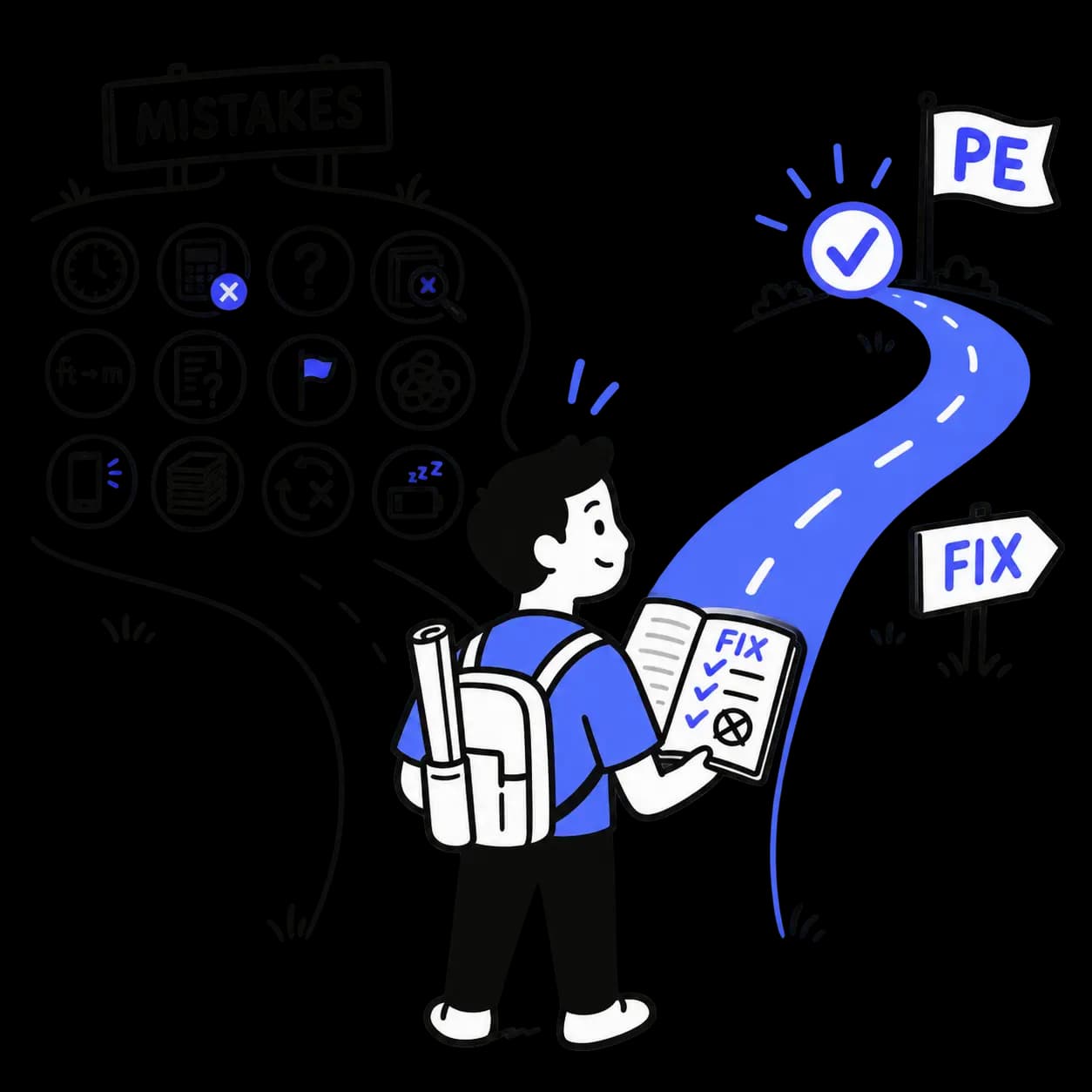
12 Common PE Exam Mistakes and How to Avoid Them
Hard work alone does not guarantee PE exam success. Learn how to avoid 12 common mistakes involving study planning, weak topics, calculations, reference use, pacing, and test-day preparation.

PE Civil Exam Format: How the CBT Exam Works
Master the computer-based PE Civil exam with expert strategies for digital navigation, electronic handbook mastery, and CBT interface optimization. Learn how to leverage technology for exam success.