PE Exam Retake Guide: What to Do After Failing Your First Attempt
Receiving a failed PE exam notification can feel devastating, especially after months of dedicated preparation. However, failing your first attempt doesn't mark the end of your professional engineering journey. it's a strategic opportunity to refine your approach and emerge stronger.
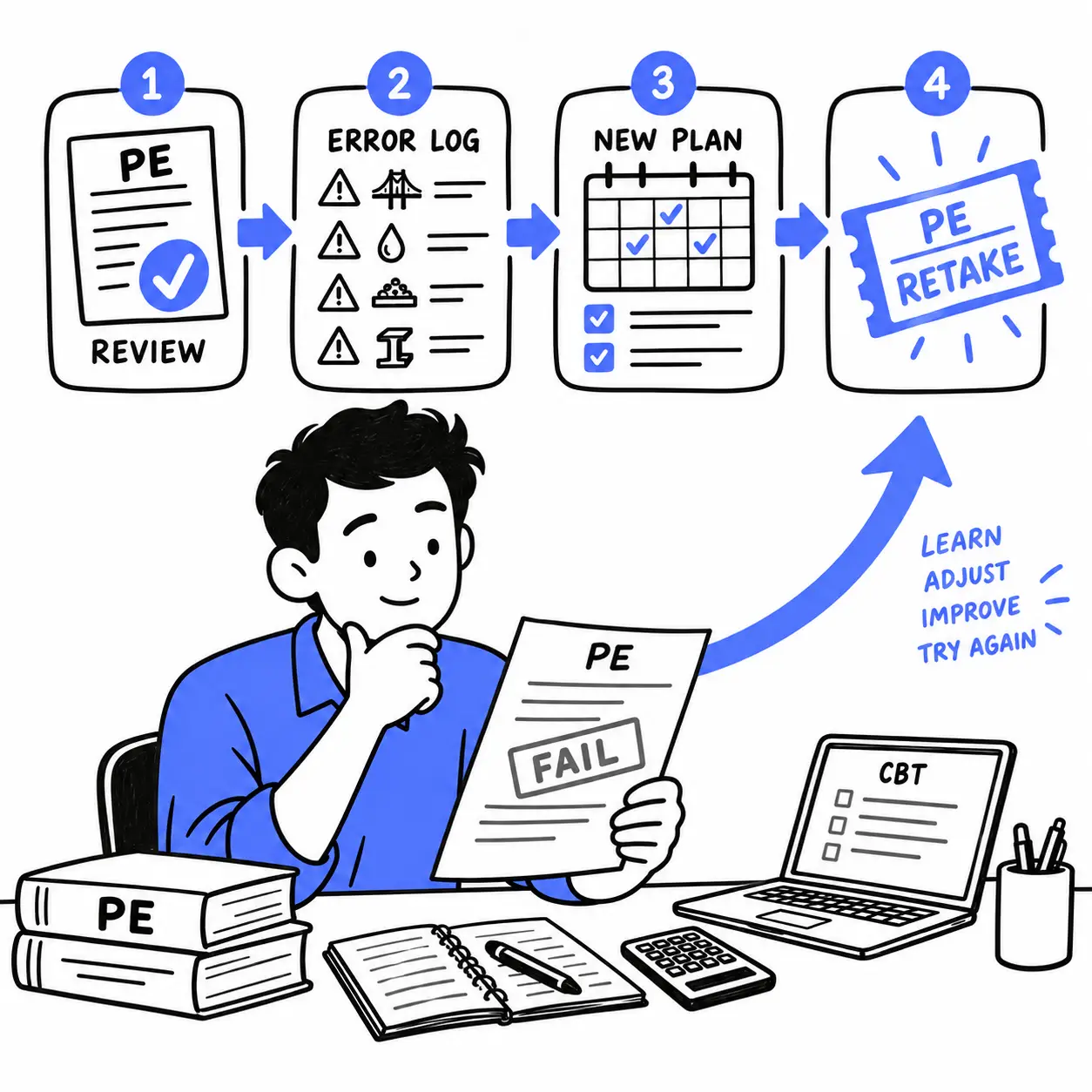
Failing the PE exam on your first attempt is discouraging, but it is not a study plan. The useful question is not simply how to study more. It is what the first attempt revealed about your preparation, exam execution, and readiness-and what must change before you sit again.
For PE Civil candidates, the most productive retake process is diagnostic first: review the official NCEES result, study the diagnostic report without trying to reverse-engineer a passing score, compare it with what you remember from exam day, and build a new plan around the specific weaknesses that affected your performance. A retake should be a changed attempt, not a repeat of the same preparation with more hours added.
What to do immediately after failing the PE exam
Give yourself enough time to process the result, then move quickly into evidence-based review. You do not need to decide on a new course or register for the next available appointment on the same day. You do need to preserve useful information before the details of the first attempt fade.
1. Record what you remember from exam day
Before looking for explanations online, write down the parts of the exam that felt difficult. Note the topics that required the most effort, the questions you left for later, the references you could not locate, the calculations that took too long, and the point at which your concentration or pacing changed.
This record is not a substitute for the NCEES diagnostic report. It is a second source of evidence. If the same weakness appears in both your memory and the official report, it deserves early attention. If your memory says that time management was the main problem but your content performance was also weak across several areas, the retake plan must address both issues.
2. Review the official result in MyNCEES
NCEES reports PE exam results as pass or fail. For an unsuccessful attempt, NCEES provides a diagnostic report showing performance across the major knowledge areas so that you can identify where improvement is needed before retaking the exam. Results are typically available 7-10 days after the exam, although candidates should rely on the notification in MyNCEES for their own result.
The report is intended to guide preparation. It is not a scorecard that tells you exactly how many questions you answered correctly, and it cannot be used to calculate an official passing score. NCEES does not publish a fixed passing percentage because the required ability level can vary slightly with exam difficulty. First-time and repeat candidates are graded to the same standard.
3. Do not treat the diagnostic report as a percentage-to-question calculator
This is one of the most important corrections for PE exam retakers. The diagnostic report is not designed to reveal the number of questions you missed in each topic. Do not multiply a diagnostic value by the number of questions in an exam specification and present the result as your actual number correct or incorrect.
Use the report directionally. Identify areas that were substantially below the performance of passing examinees, areas that were close to that comparison, and areas that were relatively stronger. Then combine that information with the official exam specification, your practice history, and your exam-day notes.
4. Pause before registering for a retake
Registration creates a useful deadline only when the selected date matches the amount of repair you need. Registering immediately can be appropriate when you were close to readiness and your main weakness was pacing or reference navigation. It can be counterproductive when several major knowledge areas require rebuilding or when your original study plan was incomplete.
Before choosing a date, confirm the current NCEES policy and your licensing board’s requirements. NCEES states that a particular exam may generally be attempted once per testing window and no more than three times during a 12-month period, but some licensing boards impose more restrictive rules. PE Civil exams are offered year-round, while appointment availability and board procedures can still affect your options.
What the NCEES diagnostic report can-and cannot-tell you
The diagnostic report is most useful when it is treated as a prioritization tool rather than a prediction of your next result.
| The report can help you identify | The report cannot tell you |
|---|---|
| Knowledge areas that require substantial study before another attempt | The exact number of questions you answered correctly in each area |
| Areas where your performance was closer to that of passing examinees | The unpublished passing score for your exam form |
| Relative strengths that should be maintained while you repair weaknesses | The exact question, calculation, or reference lookup that caused each miss |
| A starting point for comparing your preparation with the exam specification | A guarantee that improving one topic will produce a specific score increase |
The report should therefore be read together with the specification for the discipline and exam date you plan to take. NCEES publishes separate specifications for Construction, Geotechnical, Structural, Transportation, and Water Resources and Environmental. The applicable specification and supplied design standards can change by effective date, so verify the current documents through the official NCEES Civil page and do not assume that a handbook or standard edition from your first attempt will apply to the retake.
Diagnose why the first attempt did not work
The same fail result can come from very different causes. A retaker who understood the concepts but could not locate information in the electronic references needs a different intervention from a retaker who never built the underlying concepts. Start by classifying each problem instead of describing the entire attempt as “not studying enough.”
| Evidence from your first attempt or practice | Likely bottleneck | What to change before retaking |
|---|---|---|
| You could not explain the governing concept before starting a problem | Conceptual gap | Relearn the concept, solve a guided example, then solve a new problem without looking at the solution |
| You knew the topic but could not identify the required equation, assumptions, or load path | Problem setup gap | Practice translating the prompt into givens, unknowns, governing relationships, and units before calculating |
| You understood the solution after seeing it but could not find the supporting rule | Reference-navigation gap | Practice searching the assigned electronic handbook and standards with realistic wording and synonyms |
| Your setup was correct but answers were lost through units, signs, conversions, or data entry | Calculation-control gap | Add a written unit and reasonableness check to every timed problem and record repeated calculation errors |
| You performed adequately in untimed practice but ran out of time on exam day | Pacing or decision gap | Use timed sets, question triage, milestone checks, and full-length simulations rather than more untimed reading |
| You became less accurate after several hours | Stamina gap | Complete realistic long sessions, review late-session errors, and reduce last-minute cramming |
| You struggled with multiple-correct, point-and-click, drag-and-drop, or fill-in-the-blank items | Alternative-item-type gap | Practice every question format included in your discipline and review how each response must be entered |
| Anxiety disrupted recall, pacing, or decision-making | Test-performance gap | Rehearse the exam sequence, build controlled exposure through timed practice, and investigate eligible accommodations early |
Most retakers have more than one bottleneck. The purpose of the table is to identify the dominant causes that your new plan must address first.
Should you retake the PE exam right away?
There is no universal waiting period that makes a retake successful. The right date depends on the distance between your current performance and the performance required by the exam, the number of knowledge areas that need repair, and the time you can study consistently.
A relatively near miss does not automatically mean that you should repeat the same preparation for a shorter period. It means you should determine whether the result came from a narrow execution problem or from several unrecognized content gaps. A candidate who was comfortable with the material but lost time may need targeted timed practice. A candidate who guessed through many areas needs a more substantial content rebuild, even if the result felt close.
Use these questions before selecting a retake date:
- Can you identify the main cause of the unsuccessful attempt using the diagnostic report, exam-day notes, and practice evidence?
- Does your planned study period provide enough time to repair the weakest knowledge areas and still complete mixed, timed practice?
- Will you study with the specification, handbook, and design standards that apply to the new exam date?
- Can you explain what will be different in your next preparation cycle?
- Have you confirmed the retake rules and approval process with NCEES and your licensing board?
If you cannot answer the last question, do not rely on a general retake article. Licensing requirements and approval procedures vary by jurisdiction.
Build a retake plan that changes the PE exam result
Your second plan should be organized around actions and evidence. A calendar that only assigns chapters or video hours does not show whether the original weakness is improving.
Start with the current exam specification
Download the specification for your discipline and intended exam date from NCEES. Use it as the scope boundary for the retake. Mark each knowledge area as one of three conditions: needs substantial repair, needs targeted review, or currently strong but must be maintained.
Do not use an old breadth-and-depth plan for a current PE Civil discipline exam. The five PE Civil disciplines follow their own discipline-specific specifications. The specification determines the knowledge areas, approximate question ranges, units, and design standards relevant to the attempt.
Prioritize by weakness, exam weight, and repeat errors
Start with the areas where the diagnostic report shows the greatest need for improvement, then consider how much of the exam each area represents under the current specification. Within those areas, use your error log to locate repeat patterns. A topic that appears weak once but improves quickly may need less time than a smaller topic where the same setup or reference error keeps returning.
This approach prevents two common retake mistakes: spending the entire cycle rereading the topics you already enjoy and treating every topic as equally urgent. You still need broad coverage, but your study time should reflect the evidence from the first attempt.
Replace passive review with a repair loop
For each weak concept, use a repeatable sequence of active recall:
- Review the concept and the conditions under which it applies.
- Solve a guided problem while explaining why each step is valid.
- Solve a new problem without looking at the solution.
- Locate the governing equation, table, or standard in the electronic reference.
- Re-solve the problem later from a cold start.
- Add the error, correction, and prevention rule to your log.
The goal is not to recognize a solution that you have already seen. The goal is to make the correct setup, reference choice, calculation, and decision repeatable when the problem is worded differently.
Keep an error log that leads to a decision
An effective retake error log records more than the question number and the correct answer. For each missed or uncertain problem, record the knowledge area, error type, cause, correct method, reference location, and the action that will prevent the same error.
| Error-log field | Example of a useful entry |
|---|---|
| Knowledge area | Retaining structures |
| Error type | Incorrect setup |
| What happened | Used the wrong earth-pressure condition before calculating |
| Correct reasoning | Identify wall movement and drainage assumptions first |
| Reference location | Assigned handbook or standard section used for the rule |
| Prevention rule | Write the pressure condition and assumptions before selecting an equation |
| Follow-up | Re-solve two varied problems in a timed set within one week |
Review the log every week. If the same error appears again, the issue is not finished simply because you watched another lesson or read another explanation.
Practice references in the same way you will use them on exam day
The PE Civil exam provides an electronic reference handbook and the design standards listed for the applicable exam specification. Personal copies are not allowed in the testing room. The NCEES Examinee Guide explains that the supplied references are searchable PDFs and that the search function in the exam environment should be practiced directly; ordinary computer habits such as relying on Ctrl+F may not match the exam workflow.
During the retake cycle, practice finding a rule from the wording of a problem rather than from the name of a chapter. Search synonyms, identify the relevant document, verify the context of the equation or provision, and return to the problem without losing track of the assumptions. Your reference practice should be timed because a correct rule found too late is still a pacing problem.
Use timed practice before full-length simulations
Do not wait until the final week to discover that your knowledge does not yet translate into exam-speed decisions. Begin with short timed sets in the weakest areas, then combine several knowledge areas, and eventually complete full-length simulations.
Review every simulation by error type instead of looking only at the total number correct. Record which questions required excessive time, which errors appeared late in the session, which references were difficult to find, and which answers were guesses. A practice result is useful when it changes the next week of preparation; it is not a reliable promise of an NCEES result.
PEwise practice exams can be used for discipline-specific CBT-style practice with timed sessions, question flagging, searchable reference panels, and detailed solutions. The PEwise interface is a study environment, not the actual NCEES testing platform. Candidates should continue to verify exam-day rules and supplied references through NCEES.
How long should you study before retaking the PE exam?
The correct retake timeline is determined by the work required, not by a universal hour target. Use the following planning ranges as starting points, then adjust them after your first diagnostic set.
| Retake situation | Reasonable planning approach |
|---|---|
| Your content knowledge was generally sound, but pacing, reference use, or exam execution failed | A shorter focused cycle may be appropriate, provided timed practice shows rapid improvement |
| One or two major knowledge areas were clearly weak | Plan enough weeks to relearn those areas, complete varied problems, and test them in mixed sets before scheduling the final simulation |
| Several knowledge areas were weak or the first plan did not cover the full specification | Use a longer rebuild with complete scope review, structured practice, an error log, and multiple readiness checks |
The plan should contain four stages: diagnosis and scope confirmation, targeted repair, mixed and timed practice, and final simulation with tapering. The 12- or 24-week PEwise study planner can help you assign the work to a realistic calendar, but the retake version should be driven by your diagnostic priorities rather than by copying the first plan.
An eight-week retake framework for candidates who are close to readiness
An eight-week framework is suitable only when your evidence shows that the retake is mainly a focused repair. It is not a shortcut for a candidate who needs to rebuild several subjects.
Weeks 1-2: Diagnose and rebuild the plan
Review the NCEES diagnostic report, record your exam-day evidence, confirm the new specification and reference set, and complete a mixed diagnostic set. Create the error log and select the first repair areas.
Weeks 3-5: Repair weak areas and change the method
Study the weakest concepts, solve new problems, and use the electronic references while working. Add short timed sets several times each week. If the first attempt relied heavily on reading, shift the balance toward active problem solving and explanation.
Weeks 6-7: Integrate and test under pressure
Complete mixed sets that combine strong and weak knowledge areas. Use full or half-length timed sessions to test pacing, digital navigation, and stamina. Review the log after each session and return to the underlying concept when an error repeats.
Week 8: Confirm readiness and reduce overload
Complete the final realistic simulation early enough to act on its findings. Review high-value errors and reference locations, but do not attempt to learn the entire discipline from scratch in the final days. Confirm your appointment, identification, approved calculator, route, and test-center requirements from the current NCEES and Pearson instructions.
What to change when the main problem was not content knowledge
Retakers often assume that every unsuccessful result requires a new content resource. Sometimes the main change should be operational.
If you ran out of time, practice deciding when to move on, flag a question, and return later. Use milestone checks rather than giving every question the same amount of time. The PE Civil exam has two operational sections, and questions submitted in the first section cannot be reopened after submission, so your practice should include the decisions required by that workflow.
If reference searching was slow, practice the electronic handbook and listed standards as part of normal problem solving. If calculator or data-entry mistakes were common, use the same approved calculator during practice and add a final units, sign, and input check. If anxiety disrupted your performance, build familiarity through progressively longer timed sessions and investigate any accommodation request during registration rather than waiting until exam week.
If you guessed on alternative item types, practice the exact response behavior required by multiple-correct, point-and-click, drag-and-drop, and fill-in-the-blank questions. These items are scored correct or incorrect, and NCEES does not award partial credit.
When should you change PE exam study resources?
Change resources when the current resource does not solve the bottleneck-not simply because you are disappointed with the result. A new book or course cannot replace a missing diagnostic process, and a larger question bank cannot automatically repair a conceptual gap.
Self-study may be sufficient when your diagnostic shows limited, clearly defined weaknesses and you can select current references, build a schedule, review errors, and obtain realistic practice. A structured course may be useful when you need a mapped sequence, explanations for several weak areas, discipline-specific practice, or accountability while studying around work.
PEwise currently offers PE Civil preparation courses for Geotechnical, Water Resources and Environmental, Construction, and Structural candidates, along with discipline-specific practice environments and free sample questions. The relevant choice is the course or practice set that matches the discipline and the bottleneck shown by your diagnostic-not the resource with the longest feature list. Review current course pages before relying on counts, access terms, practice-exam inventory, or guarantee conditions because those details can change.
Your final PE exam retake checklist
Before the retake, you should be able to explain what caused the first result and what evidence shows that the cause has been addressed. Confirm the following:
- Your planned attempt follows the current NCEES specification and the requirements of your licensing board.
- You can identify your priority knowledge areas without guessing at a passing score or exact missed-question count.
- Your error log shows fewer repeated errors and includes prevention rules, not just corrections.
- You have practiced with the electronic references and the question types used by your discipline.
- Timed sets show that you can make decisions at the required pace.
- At least one realistic simulation has exposed and corrected your remaining execution problems.
- You know the current test-center, identification, calculator, and appointment requirements.
- The final question is simple: what will you do differently on the retake? If the answer is only “study more,” the plan is not specific enough yet.
Frequently asked questions about retaking the PE exam
How many times can I retake the PE exam?
NCEES generally allows a candidate to attempt a particular exam once per testing window and no more than three times during a 12-month period. Some licensing boards are more restrictive, so verify the policy for the board connected to your registration before choosing a retake date.
How soon can I retake the PE exam after failing?
PE Civil exams are offered year-round, but the earliest practical retake depends on the testing window, appointment availability, licensing-board procedures, and your readiness. Do not select a date only because it is available. Choose a period long enough to repair the weaknesses identified by the diagnostic report and your practice evidence.
Should I retake the PE exam if I was close to passing?
You can use a near result as evidence for a focused retake, but NCEES does not publish a personal distance-to-passing score. Decide based on the diagnostic report, your exam-day notes, and timed practice. A candidate who was close because of pacing needs a different plan from one who was close while still weak in several knowledge areas.
Can I calculate how many PE exam questions I got correct from my diagnostic report?
No. NCEES states that the diagnostic report is not intended to determine the passing score or the number of questions answered correctly. Use it to prioritize knowledge areas and compare your performance directionally with the report’s reference information.
What should I do if my diagnostic report shows weak performance in several areas?
Do not respond by studying every topic randomly. Map the weak areas to the current discipline specification, rank them by need and exam weight, and build a longer repair cycle. Relearn the concepts, solve varied problems, record repeated errors, and delay full simulations until you have enough foundational control to learn from them.
What if my content scores were acceptable but I ran out of time?
Make pacing the central retake problem. Use timed sets, practice question triage, set decision checkpoints, and complete long sessions that expose late-exam fatigue. Review questions that took too long even when you eventually answered them correctly; slow correct work can still create a failed exam-day outcome.
Should I use the same study materials for my PE exam retake?
Keep materials that match the current NCEES specification and genuinely address your weaknesses. Change or supplement a resource when it leaves a concept unclear, does not provide enough varied practice, or does not help you work with the electronic references. Changing everything at once makes it difficult to determine what improved your preparation.
How long should I study after failing the PE exam?
Study until the specific weaknesses behind the first result have been repaired and tested under timed conditions. A focused execution problem may require a shorter cycle; several weak knowledge areas require a longer rebuild. Use diagnostic performance and repeat-error trends instead of a fixed number of hours as your readiness evidence.
What should I do if I fail the PE exam more than once?
Stop repeating the same plan. Compare the diagnostic reports, identify weaknesses that persisted, and examine whether your practice results were being reviewed deeply enough. You may need to change the study method, reference practice, discipline-specific resource, schedule, or test-day strategy. If the reports do not explain the result, seek qualified guidance before scheduling another attempt.
Does failing the PE exam mean I am not ready to be an engineer?
No. The result measures performance on one secure licensing examination under specific conditions. It does show that the preparation and exam execution used for that attempt did not meet the required standard. Treat the result seriously, but use it as evidence for a better plan rather than as a judgment about your professional identity.
The goal of a PE exam retake
A successful retake begins when the failed attempt becomes specific. Instead of carrying forward a general feeling that the exam was difficult, identify whether the main problem was knowledge, setup, reference navigation, calculation control, pacing, stamina, alternative item types, or test-day performance. Then change the preparation cycle so that each problem is practiced, measured, and revisited.
The objective is not to erase the first attempt. It is to use it to make the next attempt more deliberate, more current, and better matched to the PE Civil exam you will actually take.
Prepare for your retake with PEwise
At PEwise, our goal is to help busy engineers prepare for the PE Civil exam with clear, visual, and efficient study tools. We turn complex topics into focused lessons, worked problems, and discipline-specific practice so you can identify weaknesses, build confidence, and study with purpose.
Explore the PEwise PE Civil exam prep courses, or put your readiness to the test with PEwise Civil PE practice exams.
Keep Reading

PE Exam Anxiety: How to Manage Stress Before and During the PE Civil Exam
PE exam anxiety is manageable when you reduce avoidable uncertainty and rehearse the decisions you will need under pressure. Use this PE-specific plan for study, sleep, pacing, blank-mind recovery, the scheduled break, retakes, and accommodations.
12 Common PE Exam Mistakes and How to Avoid Them
Hard work alone does not guarantee PE exam success. Learn how to avoid 12 common mistakes involving study planning, weak topics, calculations, reference use, pacing, and test-day preparation.

PE Civil Exam Format: Questions, Timing, Breaks & CBT Sections
The PE Civil exam has 80 questions, eight hours of testing, and a break between two CBT sections. Here’s what to expect from the timing, question types, electronic references, and section submission on exam day.