12 Common PE Exam Mistakes and How to Avoid Them
Hard work alone does not guarantee PE exam success. Learn how to avoid 12 common mistakes involving study planning, weak topics, calculations, reference use, pacing, and test-day preparation.
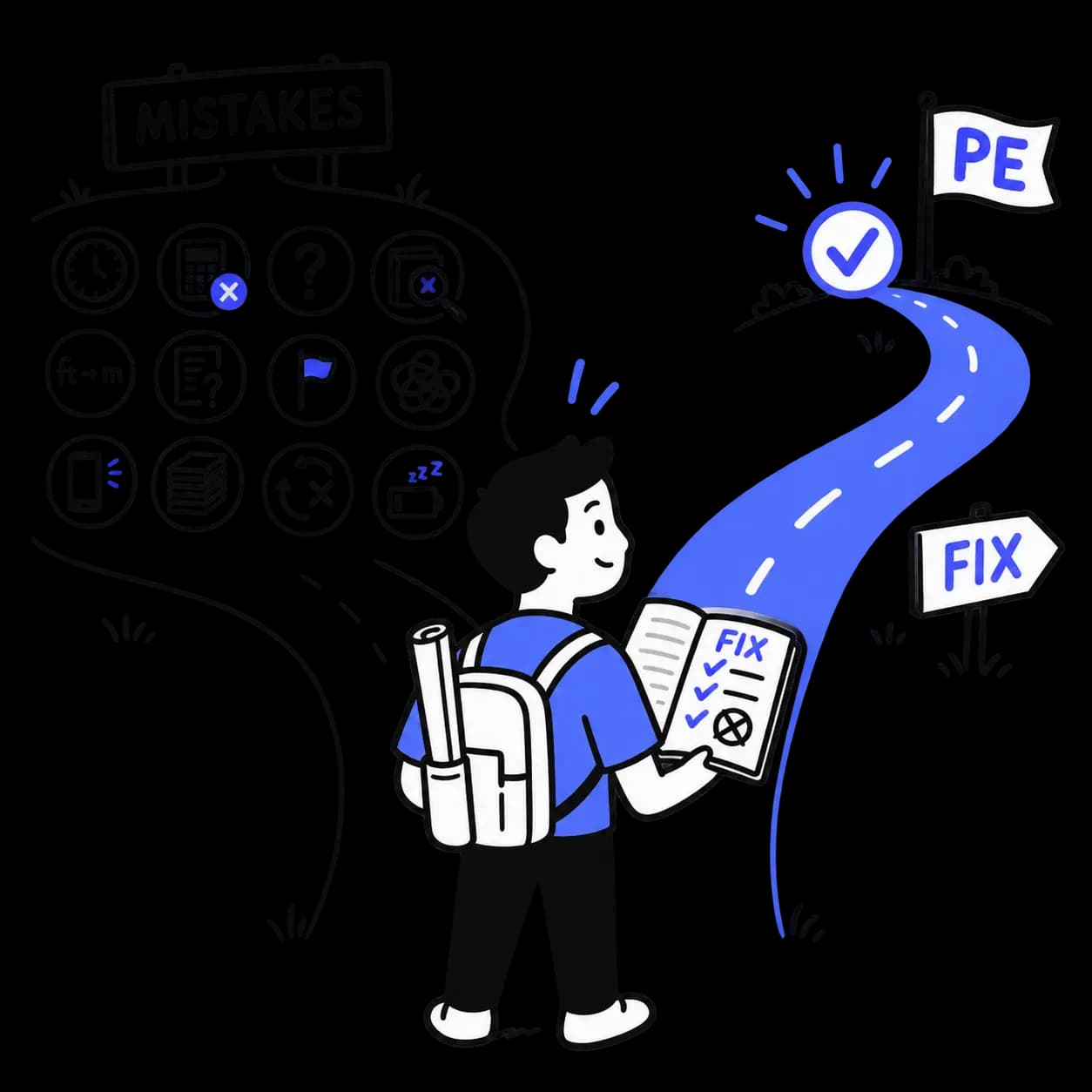
Most engineers preparing for the PE exam do not have a motivation problem. They are already balancing work, family, and a demanding study schedule.
The bigger risk is putting in serious effort without getting the right kind of practice. You can understand the engineering and still lose points because you misread a condition, search too long for a reference, mix units, or spend too much time on one difficult question.
The good news is that these mistakes are usually repeatable, which means they are also fixable. This guide shows you what to watch for, what to do differently, and how to build habits that hold up under exam-day pressure.
Important: This article focuses on PE Civil. Exact technical topics and supplied design standards vary by discipline. Always confirm the current requirements for your exam on the official NCEES PE exam page and in your MyNCEES account.
The short answer: the most common PE exam mistakes
The most frequent PE exam pitfalls are:
1. Treating the exam as a test of general engineering knowledge rather than a timed, specification-based performance.
2. Starting to study without a realistic plan or baseline diagnostic.
3. Spending most of your time on comfortable topics while avoiding weak areas.
4. Reading notes and watching lessons without solving enough problems.
5. Practicing untimed, with unlimited notes or internet access.
6. Failing to learn the computer-based testing interface and supplied references.
7. Making preventable unit, sign, rounding, calculator, or data-entry errors.
8. Misreading the question and solving the wrong quantity or condition.
9. Getting stuck on difficult problems and running out of time.
10. Skipping full-length simulations and arriving without enough mental stamina.
11. Leaving test-day logistics until the last minute.
12. Repeating the same study approach after a failed attempt instead of using the diagnostic report and an error log.
You do not need to fix everything at once. As you read, choose the two mistakes that sound most familiar and turn the recommended actions into your plan for the next week.
PE Civil exam facts that change how you prepare
The current NCEES Examinee Guide lists PE Civil (all disciplines) as an 80-question, computer-based exam with an 8-hour-50-minute exam time inside a 9-hour appointment. The appointment also includes a 2-minute nondisclosure agreement and an 8-minute tutorial. That means an equal-pace calculation is 530 minutes ÷ 80 questions = 6.625 minutes per question, or about 6 minutes 38 seconds. This is an average, not an individual question limit; some questions will take less time and others will take more.The same guide states that:
- the exam can include traditional multiple-choice and alternative item types, including multiple-correct-option, point-and-click, drag-and-drop, and fill-in-the-blank questions;
- all questions are scored correct or incorrect, with no partial credit;
- there are no deductions for wrong answers;
- NCEES supplies the current electronic reference handbook and any design standards listed in the applicable exam specification; and
- the supplied reference is a searchable PDF, but the exam software does not provide the usual Ctrl+F shortcut.
These details matter because several common PE exam mistakes come from preparing for an older paper-and-pencil experience or from treating the reference materials as a substitute for practice.For current logistics, review the NCEES PE Exam page and the May 2026 NCEES Examinee Guide. NCEES can change exam procedures, specifications, and supplied materials.
1. Treating the PE exam as a test of knowledge only
Why this mistake hurts
Professional experience and engineering knowledge are necessary, but they do not automatically produce a passing exam performance. The PE exam asks you to interpret a question, identify the governing relationship, select the correct assumptions or standard, calculate accurately, and enter the requested answer under time pressure.Candidates who study as if they are preparing for a college final often overvalue recognition. They reread formulas, highlight chapters, and feel familiar with worked examples. On the exam, familiarity is not enough. You must recognize what the problem is asking and execute the solution without someone else choosing the starting point for you.
How to avoid it
- Treat every study session as practice for a specific exam behavior: identify, set up, calculate, verify, or navigate.
- After reviewing a solution, close it and reproduce the setup from the question alone.
- Explain why the chosen equation, standard provision, or assumption applies—not just what number it produces.
- Include unfamiliar wording and mixed-topic problems in your practice so you do not depend on recognizing a memorized template.
The goal is not to memorize more solution paths. It is to become reliable at turning a new question into a defensible answer.
2. Studying without a plan tied to the current specification
Why this mistake hurts
An unstructured plan encourages random reading. You may spend weeks moving through a textbook in chapter order, then discover too late that you have not practiced the topics that consistently expose your weaknesses. A plan also prevents you from reserving enough time for timed practice, review, and correction.The current NCEES specification for your discipline should define the study map. Do not rely on a generic topic list, an old review-book outline, or a course page that uses broad labels without checking the official specification.
How to avoid it
- Download the current specification for your exact PE discipline from NCEES.
- Take a short diagnostic across the major knowledge areas before building the schedule.
- Put every specification area on the calendar, including areas you expect to be easy.
- Reserve separate blocks for learning, problem solving, error review, and timed simulation.
- Rebuild the final weeks around measured weaknesses rather than around the order in which you first studied.
Your plan should answer three questions: what will you study, how will you prove that you can solve it, and what will you do when your accuracy or speed is not improving?
3. Avoiding weak topics and overstudying comfortable ones
Why this mistake hurts
Strong topics feel productive because they produce quick correct answers. Weak topics feel slow and expose uncertainty, so candidates often postpone them. That creates a false sense of readiness: practice scores look good in familiar areas while the same weak areas continue to produce missed questions.The opposite mistake is spreading your effort so thin that you never become dependable in any problem type. The solution is not to study every subject for exactly the same number of hours. It is to use the specification and your diagnostic results to decide where additional practice is most valuable.
How to avoid it
- Keep a topic-level accuracy record instead of relying on how confident a topic feels.
- Rank weak areas by both frequency of errors and importance within your current specification.
- Work a small set of representative problems in the weak area, review every miss, and retest the same skill with new numbers.
- Maintain your strong topics with shorter mixed sets so they do not disappear while you repair the floor.
- Do not skip a topic because you have not seen it in your job; the exam specification, not your daily work assignment, determines the scope.
A weak-area plan is working when the error changes from “I do not know how to start” to a more specific and fixable problem such as “I selected the wrong load condition” or “I lost the unit conversion during entry.”
4. Reading and watching instead of solving
Why this mistake hurts
Notes and lessons can clarify concepts, but passive review does not reveal whether you can select the method, organize the given data, and finish a problem independently. It also hides the difference between recognizing a solution and generating one.One of the most common PE exam preparation mistakes is to count hours of exposure as hours of preparation. A candidate may have watched every lesson and still have little experience recovering from a wrong first step.
How to avoid it
- Start each study block with problems from the target topic.
- Use concept review to explain a missed problem, not as a replacement for solving.
- Write a short reason for every wrong answer: concept, setup, reference, arithmetic, units, interpretation, or time.
- Rework the problem without looking at the solution, then solve a new problem that tests the same skill.
- Practice explaining the setup in words before entering numbers.
Correct answers are useful, but corrected mistakes are more informative. The learning value is in identifying why the first approach failed and what detail in the question should have changed your approach.
5. Practicing untimed or with unlimited help
Why this mistake hurts
Untimed practice can make difficult problems feel manageable because you have time to search, restart, check an answer online, or read a full solution before deciding what to do. The real exam removes those supports and requires you to manage one continuous pool of time.If you never measure time, you may not notice that one problem is consuming the time needed for several easier questions. If you always practice with every book open, you may confuse access to information with the ability to retrieve it quickly.
How to avoid it
- Use untimed practice early to learn a method, then add time limits as soon as the method is understood.
- Work timed blocks with only the calculator and references you are allowed to use on exam day.
- Track both accuracy and time by topic; speed without accuracy is not readiness.
- Make practice conditions progressively closer to the actual computer-based experience.
- Schedule at least two full-length simulations before the exam if your schedule allows, and review the results after you have recovered from the session.
Use a timer to reveal process problems, not to punish yourself. If a problem takes too long, record the cause: unclear setup, slow reference search, arithmetic rework, or difficulty deciding when to move on.
6. Failing to learn the digital exam and reference materials
Why this mistake hurts
The current PE Civil exam is computer-based. NCEES supplies the electronic reference handbook and the design standards identified in the applicable specification. That is helpful only if you have practiced locating information in the same kind of searchable on-screen reference.A frequent reference mistake is searching for a formula without knowing the vocabulary used by the source. Another is assuming that a phrase, table, or standard will be available because it appeared in a preparation book. NCEES says that the exam software's usual Ctrl+F shortcut is not available, so your search and navigation habits need to match the supplied environment.
How to avoid it
- Download the current handbook from MyNCEES and use it regularly during practice.
- Practice searches using the terminology that appears in the handbook, not only the wording used by your review provider.
- Learn the handbook's section structure so you can navigate when a keyword search is too broad.
- Practice opening the supplied design standards listed in your exam specification and learning where their major provisions live.
- Use the same approved calculator throughout preparation and confirm its functions before exam day.
- Practice flagging a question, moving on, and returning later so the interface itself does not become a source of lost time.
Do not spend several minutes searching for information that is not in the supplied reference. First decide whether the question is testing a relationship you should know, a value you must locate, or a standard provision that is actually listed for your exam.
7. Making unit, sign, rounding, calculator, and data-entry errors
Why this mistake hurts
Calculation errors are especially frustrating because they can occur after the engineering method is correct. Common examples include mixing US customary and SI units, using a diameter where a radius is required, reversing a sign convention, rounding too early, entering a percentage as a whole number, or using the wrong calculator angle mode for trigonometry.The same problem can also appear as a data-entry error: the work on the screen is correct, but the final response is entered in the wrong unit, decimal place, or format.
How to avoid it
Use a repeatable calculation check:
Write what the question asks for, including the requested units.
Put units beside the important givens and convert to one consistent system before calculating.
Write the governing equation before substituting numbers.
Keep extra precision through intermediate steps and round only at the end unless the problem directs otherwise.
Check signs, order of magnitude, and calculator mode.
Compare the final result with the requested quantity and enter the answer exactly as required.
When reviewing a miss, label the error precisely. “Careless mistake” is not a diagnosis. “Used feet with pounds per square inch,” “rounded before multiplying,” or “entered the requested flow in cubic feet per second instead of gallons per minute” tells you what behavior must change.
8. Skimming the question and solving for the wrong quantity
Why this mistake hurts
Many wrong answers come from solving a nearby problem. The candidate calculates demand instead of capacity, total stress instead of effective stress, a required value instead of an available value, or a design quantity instead of the requested average. Qualifiers such as least, maximum, except, not, most nearly, and under drained conditions can change the entire solution.The danger increases when a familiar diagram or formula creates a sense of recognition before the full question has been read.
How to avoid it
- Read the final sentence first or last—whichever helps you identify the requested output—then confirm it against the full question.
- Mark the quantity, condition, and units the answer must satisfy.
- Separate given information from information that must be calculated.
- Check qualifiers and boundary conditions before selecting an equation.
- Before submitting, ask: “Does my result answer the exact question that was asked?”
Build this check into practice. The habit needs to be automatic before stress makes the question feel shorter than it is.
9. Getting stuck on one problem and running out of time
Why this mistake hurts
Time management is not simply working quickly. It is deciding when continued effort on a difficult problem is less valuable than securing other available points. Candidates often lose time by trying three different approaches, repeatedly searching the reference, or refusing to leave a problem that has not yielded a clear setup.For PE Civil, the current NCEES table gives 8 hours 50 minutes for 80 questions. The exam is divided into two sections, but you receive the full pool of exam time at the beginning. After you review and submit approximately half of the questions, you cannot return to them. You may then take the scheduled break.
The following equal-pace checkpoints are only a rough planning model. The section split and question difficulty can vary, so do not treat these as required targets.
| Questions completed | Equal-pace elapsed time |
|---|---|
| 20 | 2 hours 12 minutes 30 seconds |
| 40 | 4 hours 25 minutes |
| 60 | 6 hours 37 minutes 30 seconds |
| 80 | 8 hours 50 minutes |
How to avoid it
- Use a first pass to secure questions with a clear path.
- If you cannot identify a viable setup after a reasonable attempt, flag the item and move on.
- Use a second pass for questions that need a calculation or reference lookup.
- Reserve review time within each section for unanswered items, units, signs, and data entry.
- Before submitting the first section, confirm that you are comfortable giving up access to every question in it.
- Because NCEES reports no deductions for wrong answers, do not leave an item blank when you can make an informed or best-supported selection.
Your pacing plan should be flexible, but it should never be nonexistent. A clock check at a few question milestones can expose a slow start before the shortage becomes unrecoverable.
10. Failing to build stamina with full-length simulations
Why this mistake hurts
An isolated practice problem tests a skill. A full-length simulation shows whether you can continue applying that skill after hours of reading, calculating, searching, and making decisions. Without that experience, you may not realize how fatigue affects your attention—causing you to overlook qualifiers, misread units, or second-guess correct answers late in the appointment. If you need a realistic way to build endurance, explore these PE Civil practice exams, including online, free, and full-length options, and choose the format that best fits your discipline and stage of preparation.
How to avoid it
- Complete full-length practice in a quiet environment with the same calculator and digital references you will use for study.
- Follow the current NCEES timing and interface as closely as your practice tool allows.
- Record when accuracy, speed, or concentration begins to decline.
- Review the simulation by error category, not just by total score.
- Reduce the workload near exam day so you arrive rested instead of trying to recover from a last-minute cram session.
The purpose of a simulation is not to predict your NCEES result. It is to expose the habits that appear only when the session is long enough for them to surface.
11. Leaving test-day logistics until the last minute
Why this mistake hurts
A candidate can prepare technically and still create avoidable stress by discovering a problem with identification, appointment details, calculator eligibility, arrival time, or permitted belongings on test day. The current NCEES Guide says that the name on the appointment confirmation and government-issued ID must match, digital IDs are not accepted, and only permitted items may enter the testing room.
How to avoid it
At least several days before the appointment:
- confirm the exam discipline, date, time, and test-center address;
- check the name on the appointment confirmation against your physical government-issued ID;
- verify the current NCEES Calculator Policy and test the calculator you plan to bring;
- review the current NCEES Examinee Guide, including permitted items and check-in procedures;
- plan your route and arrival time; and
- prepare food, water, medication, and other personal items according to the test-center rules for breaks and storage.
Do not rely on an old checklist from a paper-based exam or from another candidate's testing experience. Test-center procedures and supplied materials are controlled by the current NCEES and Pearson instructions.
12. Repeating the same approach after a failed attempt
Why this mistake hurts
Adding more hours to the same process does not automatically fix the cause of a failed attempt. If the real problem was untimed practice, poor reference navigation, weak-area avoidance, or calculation errors, rereading the same notes may simply repeat the pattern for longer.NCEES provides examinees who do not pass with a diagnostic report showing performance by major knowledge area and relative performance compared with the average passing examinee. NCEES describes the report as general information to help identify areas for improvement—not as a complete reconstruction of every missed question.
How to avoid it
Save the diagnostic report and identify the lowest-performing knowledge areas.
Compare the report with your practice results and mistake log.
Separate knowledge gaps from execution errors such as time, units, reference use, or misreading.
Change the study method that produced the original weakness.
Retest the repaired skill with new questions under realistic conditions.
Rebuild the schedule around evidence, then take another full-length simulation before rebooking if possible.
A retake plan should be different in a specific way. “Study harder” is not a method change; “complete timed mixed sets, review every unit error, and use the supplied reference in every session” is.
Build a PE exam mistake log that leads to better scores
Use one row for every missed or guessed question. The purpose is to find repeatable causes, not to collect a long list of topics.
| Field | What to record |
|---|---|
| Date and practice set | Where the mistake occurred |
| Discipline and topic | The specification area involved |
| Error type | Concept, setup, reference, arithmetic, units, interpretation, time, or data entry |
| What happened | The exact step that failed |
| Correct signal | The word, value, condition, or reference clue you missed |
| New rule | One specific behavior you will use next time |
| Retest date | When you will solve a new problem of the same type |
| Retest result | Whether the new rule improved accuracy or speed |
After several practice sets, look for repeated labels. Three separate “unit” errors require a unit-control routine. Several “reference” errors require navigation drills. Repeated “time” errors require a stronger move-on rule. The retest result tells you whether the fix actually worked.
For example, replace “be more careful with units” with a rule you can observe: “Convert every given into one unit system before entering values in the calculator.” Specific rules are much easier to practice.
A final PE exam mistakes checklist
Before you sit for the exam, you should be able to answer yes to these questions:
- Have I checked the current NCEES specification for my exact discipline?
- Have I practiced solving problems rather than only reviewing explanations?
- Do I know my three most frequent error types?
- Have I worked timed sets with the same calculator and reference environment I expect to use?
- Can I find common information in the supplied handbook without relying on Ctrl+F?
- Have I completed at least one full-length simulation and reviewed what happened late in the session?
- Do I have a rule for flagging, moving on, and returning to difficult questions?
- Do I check units, signs, rounding, requested output, and final data entry before submitting?
- Have I confirmed my appointment, physical ID, calculator, arrival plan, and permitted items?
- If I previously failed, is my new study process measurably different from the old one?
If several answers are no, those gaps are more useful than another unstructured study session. Fix the process that is creating the mistakes.
A practical seven-day reset
If your preparation feels scattered, use this simple reset week:
Day 1: Check the current specification and take a short mixed diagnostic.
Day 2: Review every miss and start your mistake log.
Days 3–4: Repair the two weakest, highest-value skills with focused practice.
Day 5: Practice locating information in the current handbook and listed standards.
Day 6: Complete a timed mixed set using your move-on rule.
Day 7: Retest the repaired skills and plan the next week from the results.
This is not a complete study plan. It is a quick way to replace guesswork with evidence and regain momentum.
Frequently asked questions about common PE exam mistakes
What are the most common PE exam mistakes?
The most common mistakes are studying without a specification-based plan, avoiding weak topics, relying on passive review, practicing without realistic timing, fumbling with digital references, making unit or calculator errors, misreading qualifiers, getting stuck on one problem, skipping full-length simulations, neglecting test-day logistics, and repeating the same method after a failed attempt.
What is the most frequent PE exam preparation mistake?
The most damaging preparation mistake is usually a process with no feedback: the candidate studies topics randomly, solves too few problems, does not record error types, and cannot tell whether accuracy or speed is improving. A realistic plan, diagnostic, timed practice, and mistake log make the preparation measurable.
How can I prevent calculation errors on the PE exam?
Use one consistent unit system, write units beside important quantities, preserve precision until the final step, check signs and calculator mode, estimate the expected magnitude, and confirm that the final entry uses the requested units and format. Record the exact cause of every calculation miss so “careless” does not become a recurring blind spot.
How can I avoid running out of time on the PE exam?
Practice with a timer, use milestone checks, secure questions with a clear path first, flag problems that are consuming too much time, and return during a later pass. For PE Civil, the current NCEES guide lists 8 hours 50 minutes for 80 questions, but that is a shared pool of exam time—not a requirement that every question take exactly the same amount of time.
Is the PE exam open-book, and can references cause mistakes?
NCEES supplies an electronic reference handbook and any design standards listed in the applicable specification, but that does not make the exam a relaxed open-book exercise. The references are on-screen, the software does not provide the usual Ctrl+F shortcut, and physical books and notes are not permitted in the testing room. Practice with the supplied digital references so searching does not replace solving.
Should I answer every PE exam question?
Yes. The current NCEES Guide states that there are no deductions for wrong answers. If you cannot complete an item, make the best-supported selection before time expires rather than leaving it blank, while following the question's required response format.
What should I do after failing the PE exam?
Use the NCEES diagnostic report as a directional map, compare it with your practice results and mistake log, and determine whether each weakness is conceptual or procedural. Then change the study behavior that caused the weakness and retest it under realistic conditions. Simply adding hours to the same routine is not a retake strategy.
Do common PE exam mistakes differ by discipline?
The process mistakes are similar across PE disciplines, but the technical mistakes depend on the current specification, supplied standards, and problem types for your exam. Use this article for the shared preparation and execution pitfalls, then verify discipline-specific content in the current NCEES specification and handbook.
Can an online PE exam review course help prevent common mistakes?
A useful review program can help if it gives you specification-aligned problems, realistic timed practice, searchable-reference drills, detailed explanations, and feedback on weak areas. It cannot replace the habits that prevent mistakes: solving independently, checking units and requested outputs, practicing under time limits, and reviewing your own error patterns. Judge any program by whether it helps you do those things consistently.
Conclusion: fix the repeatable mistakes before adding more hours
Common PE exam mistakes are rarely random. They usually follow a pattern that can be observed in practice: the same weak topic is avoided, the same reference search takes too long, the same unit conversion is missed, or the same difficult question consumes the time needed elsewhere.Find the pattern, name the cause, change the behavior, and retest it. That process turns a failed practice problem—or a failed attempt—into useful information. The objective is not perfect preparation. It is a reliable system that produces careful, complete answers under the conditions you will face on exam day.
Keep Reading

PE Exam Anxiety: How to Manage Stress Before and During the PE Civil Exam
PE exam anxiety is manageable when you reduce avoidable uncertainty and rehearse the decisions you will need under pressure. Use this PE-specific plan for study, sleep, pacing, blank-mind recovery, the scheduled break, retakes, and accommodations.
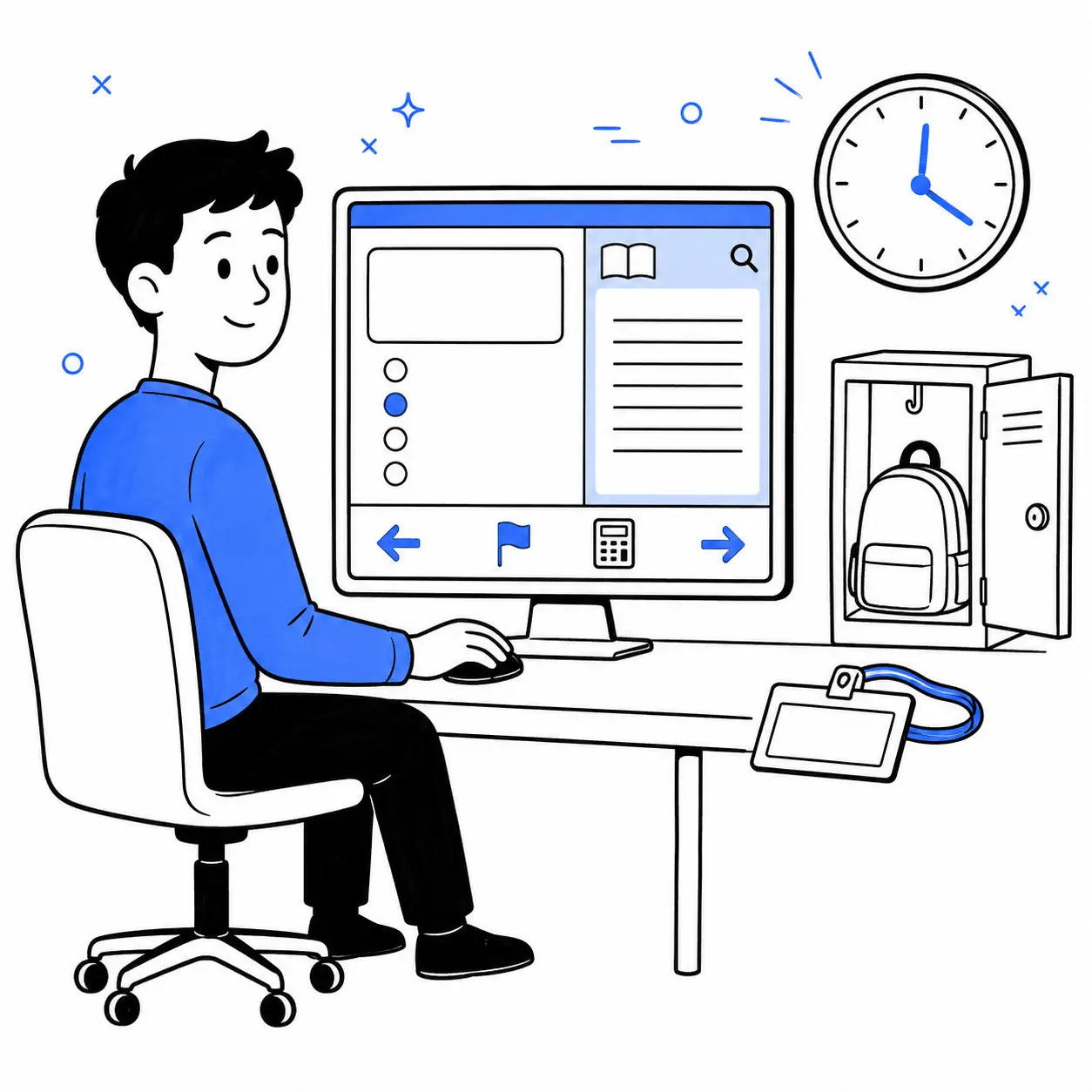
PE Civil Exam Format: Questions, Timing, Breaks & CBT Sections
The PE Civil exam has 80 questions, eight hours of testing, and a break between two CBT sections. Here’s what to expect from the timing, question types, electronic references, and section submission on exam day.
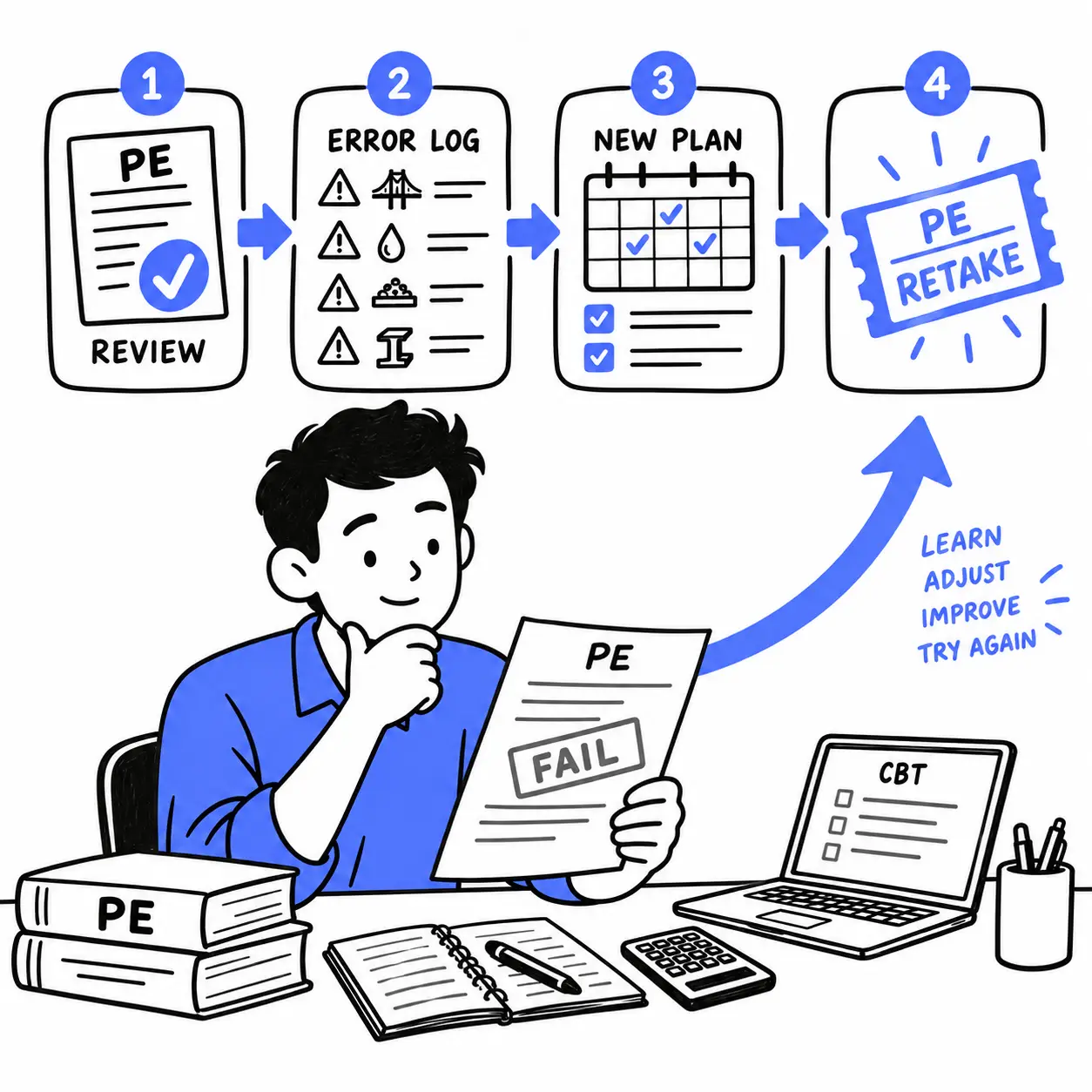
PE Exam Retake Guide: What to Do After Failing Your First Attempt
Receiving a failed PE exam notification can feel devastating, especially after months of dedicated preparation. However, failing your first attempt doesn't mark the end of your professional engineering journey. it's a strategic opportunity to refine your approach and emerge stronger.