PE Exam Study Methods: Visual Learning, Videos, and Textbooks
Research shows engineering students learn 60% better through visual methods. Discover why animation outperforms textbooks for mastering complex engineering concepts.
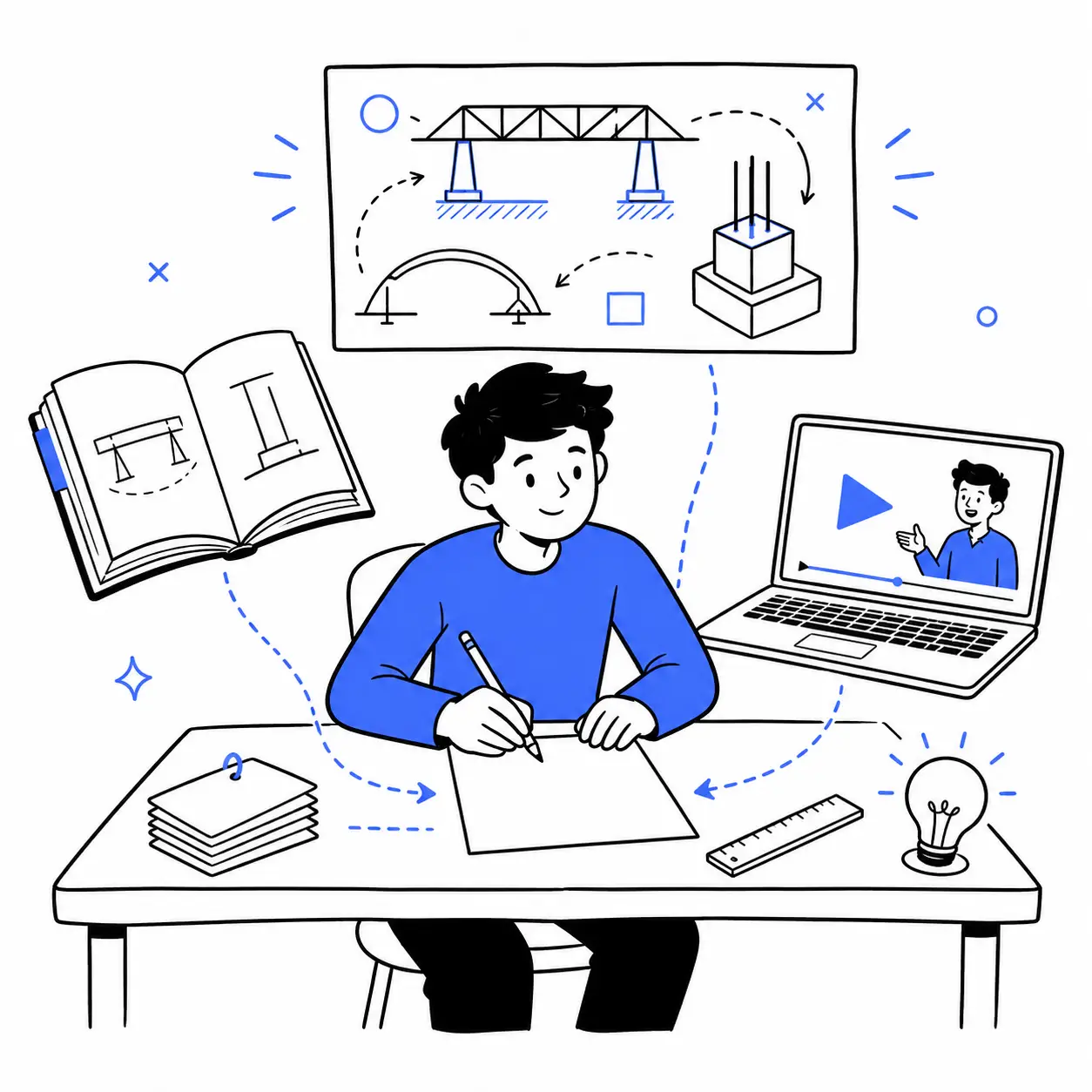
Is visual learning better than textbooks for PE exam preparation? Not by itself. The most effective PE exam study methods give each resource a specific job. Visual and animated lessons can build accurate mental models of spatial, dynamic, and multistep engineering concepts. Textbooks and written explanations can supply detail. The references available during the exam develop lookup skills, while practice problems develop independent application.
For most PE Civil candidates, the strongest approach moves from concise concept instruction to reference use, independent problem-solving, error review, and timed practice. Visual learning for PE exam preparation can make difficult material clearer, but exam readiness begins when you can apply that material without the lesson guiding you.
PEwise packages those stages together rather than offering visual lessons as a stand-alone benefit. Its PE Civil courses combine focused visual instruction with topic practice, exam-day reference connections, timed practice exams, error review, and weekly live support—the complete visual preparation system candidates need to turn understanding into PE exam performance.
What Are the Most Effective PE Exam Study Methods?
The most effective PE exam study method is a sequence, not a single format: understand the concept, locate the governing relationship, solve independently, diagnose errors, re-solve after a delay, and perform under time constraints.
Videos, books, references, problems, and live support each contribute something different. A candidate who expects one resource to perform every job is likely to develop gaps. For example, a clear video can explain why a system behaves as it does, but it cannot substitute for selecting an equation in a new problem. A reference can provide an equation or provision, but it may not teach the underlying concept.
| Study method | Best use | Main limitation | How to make it active |
|---|---|---|---|
| Animated lessons | Understanding processes and spatial relationships | Can create familiarity without retrieval | Pause, predict, sketch, then solve |
| Recorded lectures | Guided explanation and worked reasoning | Can be long and difficult to review selectively | Use chapter markers and attempt problems first |
| Textbooks and written lessons | Detail, definitions, and deliberate review | Can be dense or slow for dynamic concepts | Summarize, diagram, and retrieve from memory |
| Exam-day references | Formula and provision navigation | Do not teach every underlying concept | Use them while solving problems |
| Practice problems | Application and exposure to errors | Weak explanations may leave conceptual gaps | Classify and correct every error |
| Timed practice exams | Pacing, stamina, and decision-making | Poor as an initial teaching resource | Review performance by error type |
| Live question-and-answer sessions | Resolving persistent misunderstandings | Value depends on candidate preparation | Bring a specific attempted problem |
Is Visual Learning Better Than Textbooks for the PE Exam?
Visual instruction is often more useful for first understanding motion, sequence, spatial relationships, and interacting components. Textbooks are often more useful when a candidate needs definitions, qualifications, detailed discussion, or time to examine a static explanation carefully. Neither format is automatically superior.
This is where PEwise goes beyond simply providing videos. The visual explanation is one part of a complete PE Civil preparation package that carries candidates from concept understanding through reference use, independent practice, timed exam simulation, and instructor support.
Animation is not effective merely because it moves. Unnecessary motion can distract attention, and a fast presentation can disappear before a learner integrates its parts. Likewise, a book is not rigorous merely because it is dense. Written material that separates a diagram from the explanation it supports can force the reader to divide attention between disconnected sources.
PE Civil candidates usually benefit from treating visual and written instruction as complementary:
- Use a visual explanation to see how a process, system, or load path works.
- Use written material to confirm terminology, assumptions, and detail.
- Find the relevant equation or provision in the appropriate exam-day reference.
- Solve a new problem without following an example.
- Return to instruction only after identifying the gap.
The best format depends on the task. A candidate learning a changing hydraulic relationship may need an animation. The same candidate checking a definition may need a concise written explanation. Both learning activities must eventually lead to independent problem-solving.
PEwise brings those complementary jobs into one structured course experience: concise visuals establish the model, written and reference connections add precision, practice problems test application, and realistic timed exams measure whether the knowledge can be used under exam conditions.
How Does Visual Learning Support PE Exam Preparation?
Visual learning in the PE exam context means using relevant diagrams, animations, graphs, and demonstrations to build an accurate mental model of an engineering relationship. It does not mean assigning candidates a fixed “visual learner” identity. The useful question is whether a visual representation makes the technical relationship easier to understand and apply.
Dual coding
Dual coding proposes that related verbal and visual representations can support learning through connected forms of mental representation. For PE Civil preparation, the practical value comes from linking the picture and the engineering language. A diagram of a load path is more useful when the candidate can explain the forces verbally and connect them to the governing relationships.
The visual should not function as decoration. It should show information that the candidate needs to interpret, explain, or use.
Multimedia learning
Multimedia learning research examines how people learn from words and pictures together. Mayer’s evidence-based treatment of multimedia instruction emphasizes that design matters: relevant words and visuals should be coordinated, unnecessary material should be removed, and complex explanations should be divided into manageable segments. Cambridge University Press describes this work as an evidence-based approach to learning from well-designed multimedia instruction.
For a PE lesson, that can mean showing a system while explaining the relevant change, placing an equation beside the relationship it describes, and allowing the candidate to pause before the next step. A narrated slide crowded with unrelated text and graphics may be video, but it is not necessarily effective multimedia instruction.
Cognitive-load management
New engineering material can place heavy demands on working memory. Cognitive-load theory distinguishes the inherent complexity of the subject from avoidable demands created by poor presentation. The goal is not to remove the technical thinking. It is to remove friction that does not contribute to understanding.
Sweller, van Merriënboer, and Paas’s review of cognitive architecture and instructional design explains why limited working-memory capacity matters when learners process unfamiliar information. In practice, a focused lesson can manage this load by isolating one relationship, showing only the necessary elements, and then reconnecting that relationship to the larger system.
Shorter instruction is therefore valuable only when it removes repetition, dead time, and irrelevant detail—not when it removes necessary conditions or technical depth.
Spatial and dynamic understanding
Visual explanation is especially useful when a candidate would otherwise need to reconstruct a changing or interconnected system from static prose. Examples include movement, load transfer, changes over time, construction sequence, flow through a system, and three-dimensional relationships.
Research supports a conditional—not universal—advantage. A meta-analysis of 26 studies found a small-to-medium overall advantage for instructional animation over static pictures, with results depending on what the animation represented and the type of knowledge being learned. The study reported an overall weighted effect size of 0.37. A later review similarly cautioned that visual displays can help learners but can also impose substantial processing demands without appropriate support. Renkl and Scheiter describe both the potential and the difficulty of learning from visual displays.
PEwise applies this visual advantage within a larger exam-preparation system. Candidates do not stop at watching an animation; they connect the visual model to equations and references, solve related problems, review errors, and progress to timed practice with weekly live support available when misunderstandings remain.
The conclusion is straightforward: use animation when motion adds information, not as a decorative substitute for teaching.
When Does Animation Improve Engineering Learning?
Animation is most useful when it represents a meaningful change that would be difficult to infer from separate static images. It should direct attention toward the engineering relationship instead of competing with it.
Effective animated instruction usually has several characteristics:
- Motion represents an actual process, sequence, or interaction.
- Narration and visuals are synchronized.
- Attention cues highlight the relevant relationship.
- Complex processes are segmented into manageable parts.
- The candidate can pause, replay, and control the pace.
- Equations appear in the context of the behavior they describe.
- Decorative movement and unrelated information are removed.
- The candidate predicts, explains, sketches, or solves afterward.
Animation may fail when it moves too quickly, overloads the screen, merely repeats written text through narration, oversimplifies technical conditions, or shows solutions without requiring independent work. Its transient nature can also be a disadvantage: a static diagram remains available for inspection, while an animation requires the learner to retain earlier states as the presentation continues.
The best visual lesson gives the candidate control and a reason to think. It does not simply make passive viewing more entertaining.
Which PE Civil Concepts Benefit Most From Visual Explanation?
Visual instruction is most valuable for dynamic, spatial, sequential, or interconnected concepts. It can reduce the amount of mental reconstruction required before a candidate begins the real engineering analysis.
PEwise extends that value across its Geotechnical, Water Resources and Environmental, and Construction course paths, combining discipline-specific visual explanations with the practice and support required to convert conceptual clarity into independent PE exam problem-solving.
Geotechnical
Geotechnical candidates may benefit from visual explanations of soil–structure interaction, seepage and groundwater flow, consolidation and settlement, earth-pressure development, slope and foundation failure mechanisms, and the relationship between subsurface conditions and field-test information.
The visual is useful when it helps the candidate see the mechanism. The candidate must still identify assumptions, interpret the problem, locate the appropriate relationship, and calculate independently.
Water Resources and Environmental
Water Resources and Environmental candidates may use visual instruction to understand energy and hydraulic grade lines, pipe-network behavior, head loss, pump and system curves, open-channel transitions, hydrograph development, and water or wastewater treatment sequences.
These topics often involve changes along a path or over time. A purposeful animation can show the changing relationship more directly than a series of disconnected descriptions.
Construction
Construction candidates may benefit from visual explanations of temporary-structure load paths, formwork and reshoring sequences, earthwork balance, mass-haul relationships, construction sequencing, Critical Path Method networks and float, equipment operations, site logistics, and excavation-safety configurations.
Here again, visualization supports the first job: constructing the correct model. It does not replace the standards, equations, or decision-making required to solve a problem.
Are Animated Lessons Better Than Traditional Recorded Lectures?
Animated lessons and recorded lectures are different instructional formats. A recorded lecture usually preserves a classroom-style presentation. It may offer broad context and extended explanation, but it can take time to revisit one specific point. A focused animated lesson can isolate one technical relationship, represent motion or sequence directly, and let the candidate review only the concept that needs attention.
That does not make every animation better than every lecture. A strong lecturer can explain reasoning exceptionally well. A weak animation can conceal assumptions, move too quickly, or trade precision for appearance. Quality depends on instructional design and technical accuracy.
For working engineers, segmentation has a practical advantage. A candidate with a short study window can return to the precise relationship they misunderstood instead of replaying a long class. A short lesson can also remain technically deep when it compresses presentation rather than scope.
This is an important distinction: efficiency does not mean superficial coverage. Efficient instruction preserves the conditions, reasoning, and reference connections a candidate needs while removing repetition that does not advance learning.
PEwise turns that efficient visual format into a complete preparation package: short, technically focused lessons; connected topic practice; timed exam simulations; error review; and weekly live access to support. Candidates receive more than a library of videos—they receive a path from visual understanding to exam-ready application.
Why Is Watching PE Exam Videos Not Enough?
Watching PE exam videos is not enough because recognition is easier than retrieval and application. A solution can feel obvious while an instructor is presenting it. That feeling does not prove that the candidate can select the method, set up the problem, use the available reference, and complete the work independently.
| Learning state | Candidate experience |
|---|---|
| Familiarity | “This looks familiar when I see it.” |
| Understanding | “I can explain why the relationship works.” |
| Retrieval | “I can recall the relevant method without being shown.” |
| Application | “I can choose and use it in a new problem.” |
| Exam readiness | “I can do this accurately with the available references and time constraints.” |
Fluent narration can create an illusion of mastery. Explain the concept with the lesson closed. Sketch the system from memory. Locate the relationship in the reference. Solve a related but unfamiliar problem. Then review the outcome.
Video has done its job when it improves independent performance—not when it merely feels clear while playing.
How Should Candidates Use PE Exam Videos Actively?
Use the See → Explain → Locate → Solve → Review workflow:
- Set the objective. Identify what you should be able to explain or do after the lesson.
- Recall first. Before watching, retrieve what you already know about the topic.
- See the relationship. Watch a focused visual explanation.
- Predict. Pause before the outcome and decide what should happen next.
- Explain. Sketch the system, process, load path, or sequence and describe it in your own words.
- Locate. Connect the mental model to the governing equation, table, or provision in the appropriate reference.
- Solve. Complete a related problem without replaying the lesson.
- Review. Classify conceptual, setup, reference, and calculation errors separately.
- Re-solve. Attempt the problem again after a delay.
- Mix and time. Combine the topic with other knowledge areas and later apply it under time constraints.
This workflow converts a learning format into a preparation system. It also shows where a breakdown occurs. If you cannot explain the relationship, return to the concept. If you understand it but cannot locate the equation, practice reference navigation. If you select the method but make arithmetic errors, focus the correction there.
How Should You Combine Videos, Textbooks, and Practice Problems?
Start with the resource that addresses the current gap, then move quickly toward independent work.
- Use a concise visual lesson to build the mental model.
- Consult written material when you need definitions, qualifications, or added detail.
- Locate the governing relationship in the reference available for your exam.
- Solve focused problems without guidance.
- Diagnose why each error occurred.
- Return only to the lesson or passage that addresses the gap.
- Re-solve from memory after a delay.
- Mix the topic with other knowledge areas.
- Apply it under timed conditions.
This targeted loop is more efficient than replaying an entire lecture or rereading a full chapter after every missed problem. It also develops the navigation skills required in a computer-based testing environment. As practice becomes more realistic, candidates should deliberately practice PE Civil CBT navigation and digital reference use rather than separating technical study from exam-day execution.
How Do Active Recall and Spaced Practice Fit With Visual Learning?
Active recall turns visual instruction into something the candidate can reproduce. After a lesson, close it and explain the relationship, redraw the process, predict what changes when a variable changes, or identify the governing method from memory.
Spaced practice tests whether the learning remains available after time has passed. Re-solve a problem later rather than repeating it immediately while the solution is still fresh. Return to weak material across multiple days and use recurring errors to determine what to retrieve next.
Visual learning builds the model; retrieval strengthens access to it. Spaced, independent application reveals whether the model can support performance beyond the original lesson.
PEwise is designed around this full progression. Its visual lessons establish the model, while practice questions, delayed review, timed practice exams, and weekly live support help candidates retrieve, apply, and strengthen that knowledge throughout their preparation. You can also read about Pewise`s approach to active recall.
How Should Working Engineers Choose a PE Exam Study Method?
Working engineers need a method that is selective without being incomplete. Evening fatigue, family obligations, uneven subject knowledge, and long gaps since college make it difficult to sustain broad, unfocused review. The answer is not automatically to study less content. It is to spend less time on presentation that does not address a real need.
| Candidate situation | Recommended emphasis |
|---|---|
| Forgotten conceptual foundation | Visual explanation followed by focused practice |
| Strong concepts but weak speed | Mixed and timed problems |
| Trouble visualizing processes | Animation, diagrams, and self-generated sketches |
| Strong reader who needs detail | Written resources plus reference-based practice |
| Limited study windows | Segmented lessons and targeted review |
| Repeated setup errors | Concept review, error classification, and re-solving |
| Familiarity without independent performance | Closed-resource retrieval before referenced practice |
Self-paced access can help candidates use short study windows, but flexibility needs structure. Decide what output each session should produce: an explanation from memory, a corrected error, a completed problem set, or a timed result. Lesson completion alone is not a strong measure of progress.
How Can You Tell Whether a Study Method Is Working?
A PE exam study method is working when it produces observable independent performance. Enjoyment, confidence, and completed videos may support consistency, but they do not establish readiness.
Look for evidence that you can:
- explain the concept without replaying the lesson;
- sketch the important relationships;
- choose the correct equation or provision;
- find it efficiently in the appropriate reference;
- solve a new problem independently;
- explain why an incorrect approach fails;
- retain the method after a delay;
- apply it in a mixed set; and
- perform accurately under time constraints.
Use more than one signal. Strong untimed topic performance does not prove pacing. A good timed result may conceal repeated weakness in one knowledge area. An error log, delayed re-solving, mixed sets, and realistic simulations provide a more complete picture.
How PEwise Combines Visual Learning With Exam Practice
PEwise is designed for PE Civil candidates who want comprehensive coverage without unnecessarily long instruction. Short, purpose-built visual lessons isolate the relationship a candidate needs to understand, while topic practice, timed simulations, and weekly live support help convert that understanding into independent problem-solving.
That combination is PEwise’s whole visual package for PE Civil preparation: see difficult relationships clearly, connect them to the governing references, practice applying them, diagnose errors, test performance under realistic time pressure, and ask questions when a gap persists. The system is built to support the work required to pass without suggesting that watching videos—or purchasing any course—can guarantee an exam result.
The instruction is compressed to protect study time, not stripped of necessary depth. This efficient-but-deep model is distinct from simply recording long classroom lectures: candidates can revisit the exact concept they need and then return to active practice.
As reviewed in September 2026, PEwise publishes three active PE Civil course paths:
- Geotechnical: 26 modules, 340+ lesson topics, three active practice exams, and weekly live support.
- Water Resources and Environmental: 35 modules, 580 published lesson topics, two active 80-question practice exams, 127 quiz questions, and weekly live support.
- Construction: 39 modules, 566 published lesson topics, two active 80-question practice exams, 124 quiz questions, and weekly live support.
Course inventories can change, so candidates should confirm current details before enrolling. You can compare PEwise’s Geotechnical, WRE, and Construction courses and preview available lessons to see how the visual format fits your preparation.
The larger principle remains the same regardless of resource: see the relationship, explain it, locate the governing information, solve independently, and review the result.
Frequently Asked Questions About PE Exam Study Methods
What is the most effective study method for the PE exam?
The most effective method combines conceptual instruction, reference navigation, independent problem-solving, error review, delayed re-solving, and timed practice. Videos or textbooks can introduce a concept, but candidates need to retrieve and apply it without guidance before treating it as learned.
Is visual learning effective for the PE exam?
Visual learning can be effective when a diagram or animation accurately represents a spatial, dynamic, or multistep relationship. PEwise builds the necessary follow-through into its visual package by connecting focused lessons to reference use, problems, timed exams, error review, and weekly live support. Candidates progress from seeing the relationship to applying it independently.
Is visual learning better than textbooks for PE exam preparation?
Visual instruction is often better for initially seeing motion, sequence, load transfer, or interaction. Textbooks are often better for definitions, detailed conditions, and slow review. PEwise combines visual explanations with the reference connections, practice, simulations, and live support needed for complete PE Civil preparation rather than treating either format as sufficient alone.
Are PE exam video courses enough to pass?
No single format ensures a passing result. A video course must be paired with practice problems, reference navigation, correction of errors, delayed review, and timed simulations. Course quality also depends on technical accuracy, relevant coverage, instructional design, and the quality of its practice and support.
Are animated lessons different from recorded lectures?
Yes. A recorded lecture usually preserves a classroom presentation, while a purpose-built animation can isolate one relationship and directly represent change, sequence, or interaction. PEwise uses that focused format within a complete preparation system that adds independent practice, timed simulations, error review, and live support. The advantage is the full progression, not animation alone.
How should I combine PE exam videos and practice problems?
Watch a concise lesson to build the concept, connect it to the appropriate reference, and then solve a related problem without guidance. Classify any error, revisit only the relevant gap, and re-solve after a delay. Later, place the topic in mixed and timed sets.
Can visual learning improve retention by 60%?
Research does not support a universal 60% retention improvement for PE candidates. Studies of video and animation report varying results across different learners, subjects, designs, and assessments. The defensible conclusion is that well-designed visuals can support learning, but they do not guarantee a fixed retention gain or a higher PE pass probability.
How can I avoid watching PE exam videos passively?
Recall what you know before starting. Pause before the outcome, predict the next step, sketch the system, and explain the relationship in your own words. Then close the lesson, locate the relevant reference information, and solve a related problem independently.
Are textbooks still useful for the computer-based PE exam?
Yes. Textbooks and written resources remain useful for learning concepts, terminology, and detailed conditions. However, candidates should also practice with the references permitted or supplied for their specific exam and develop efficient digital navigation rather than relying on a study book as an exam-day tool.
Which PE Civil topics benefit most from animation?
Topics involving motion, sequence, spatial relationships, or interacting components often benefit most. Examples include seepage, consolidation, hydraulic grade lines, pump and system curves, treatment sequences, temporary-structure load paths, construction sequencing, and Critical Path Method networks.You can find visual lessons for all of the subjects mentioned in Pewise`s course modules.
What study method is best for a PE candidate working full-time?
A working candidate often benefits from segmented concept instruction combined with scheduled independent practice. Short study windows should produce a clear output, such as a solved set, a corrected error, a reference-navigation drill, or an explanation from memory. Shorter instruction is useful when it remains technically complete.
Keep Reading

PE Exam Dates and Registration: 2026–2027 Schedule and How to Book
Paid your PE exam fee? Your test date still isn’t booked. Before you build your study plan, learn how exam schedules, board approval, and seat availability affect when you can test. This 2026–2027 guide walks you from registration to a confirmed appointment.

How to Register for the PE Exam: From Board Rules to a Confirmed Test Date
A payment receipt does not mean you have a test date. Follow the path from your licensing board’s rules through PE exam registration and scheduling, so you know when your appointment is actually confirmed.
Can You Take the PE Exam Without the FE?
You’ve spent years solving engineering problems—but do you still need to pass the FE before taking the PE? In some states, your experience or education may qualify you for an FE waiver. Learn what boards look for, how requirements differ, and what to verify before planning your next move.