Geotechnical Engineer Salary and Career Paths After the PE Civil Geotechnical Exam
You passed the PE Civil Geotechnical exam—but will your paycheck reflect it? A raise isn’t automatic. Explore salary benchmarks, career paths after licensure, and how to connect your new responsibilities to a stronger case for higher pay.

You passed the PE Civil Geotechnical exam, or you’re getting close, and want to know what it could mean for your salary and career. Passing the exam is a step toward licensure, but it does not automatically bring a raise.
Once you receive your PE license, your earning potential depends on your experience, location, and the responsibilities you take on. This guide covers salary ranges for licensed geotechnical engineers, career paths after licensure, and how to make a stronger case for higher pay.
Where geotechnical work comes from
A geotechnical career can take you well beyond building sites. Roads and bridges need investigations and foundation recommendations. Dams, levees, and slopes need engineers who understand movement and groundwater. Energy projects need ground and foundation work too. That variety is useful when you plan your career: the PE may matter in different ways depending on the project and the role you want.
How much does a geotechnical engineer make
For licensed geotechnical engineers in the United States, recruiter LVI Associates lists annual salary ranges of 90,000–130,000 for mid-career roles and 125,000–150,000 or more for senior roles. Treat these as recruiting benchmarks, not a guaranteed pay scale. Actual offers depend on location, experience, project complexity, and leadership responsibilities.
How licensure can change a geotechnical salary
For geotechnical work, the pay question is tied to scope. Can you lead an investigation, review foundation or retaining recommendations, manage risk, and take responsible charge of work within your competence? An employer may pay more when your licensed role lets the team take on those responsibilities. The license alone does not make you the engineer of record on every project; that depends on your role and state rules.
If your job stays the same after licensure, the first raise may be modest or may wait for a scheduled review. Ask your employer what new responsibilities come with the license and how the salary band changes when you take them on.
What happens after you pass the PE Civil Geotechnical exam
Passing the PE Civil Geotechnical exam is a major step. It does not, by itself, issue a PE license. Your state board still needs to approve your application. The usual route includes education, the FE exam, acceptable experience, and the PE exam, but requirements vary by state. Check with your board before treating an exam result as a license or expecting a pay change.
Once the license is issued, schedule a conversation with your manager. Bring the projects you already handle, the new work you are ready to take responsibility for, and current postings for licensed geotechnical roles in your area. Ask whether your role and pay band will change now, at a scheduled review, or when you take on defined responsibilities. That gives you a concrete answer instead of hoping that the license will appear in your next paycheck.
Which geotechnical career paths can raise your earning potential
There is more than one way to grow after licensure. The best route depends on the work you enjoy and the responsibility you want to carry.
Consulting and design leadership
If you like interpreting subsurface data and turning it into recommendations, consulting can lead from project engineer to senior technical lead or principal. The work may include designing foundations, retaining systems, slopes, or ground improvement; reviewing reports; mentoring staff; and talking with clients about uncertainty and risk. The PE is particularly useful when the role involves taking responsible charge of engineering work. Strong judgment and review experience matter as much as a list of software packages.
Construction and field leadership
If you prefer seeing how the ground behaves on a live project, you can move toward construction support, instrumentation, quality oversight, or a field-heavy project engineer role. Some positions require licensure and some do not. Compare field time, travel, overtime rules, and who is responsible for design decisions before judging an offer by its base salary alone.
Public agencies and owners
Transportation agencies, public works departments, utilities, and owners need geotechnical judgment for projects and asset management. These jobs may trade some consulting sales work for procurement, technical review, standards, and long project timelines. When comparing pay, include retirement benefits, paid time off, and the actual scope of authority.
Deep technical specialization
You might become the person a team calls for deep foundations, seismic ground response, landslides, underground works, or another complex ground problem. Specialization can support senior roles when employers need that skill and you can show a record of sound decisions. If you later pursue ASCE geotechnical board certification, remember that it is a separate credential for experienced professionals, not a replacement for a PE license.
Industry sectors for geotechnical engineers
An energy or mining project may bring you into ground improvement, foundations, tailings, or slope work. Transportation can mean bridge foundations, embankments, retaining systems, or difficult construction staging. Private development may involve a quicker cycle of site investigation, recommendations, and construction support. Public infrastructure can give you longer projects and different review responsibilities.
No sector guarantees the highest pay for every geotechnical engineer. Look at the actual job: Is the work mostly field support or design? Will you supervise others, lead a client relationship, or take responsible charge? Those details tell you more about the salary opportunity than the sector name alone.
Corporate and consulting career paths
Consulting can give you a mix of clients and ground conditions. As you progress, you may spend more time reviewing work, managing budgets, and bringing in projects. An in-house role with an owner, utility, or developer may focus more on setting requirements, reviewing consultants, and carrying knowledge from one project to the next. Neither route guarantees a higher salary. Compare the work you will own, the support available, travel expectations, benefits, and how advancement works at that employer.
Geographic salary variations
A national average will not price a licensed geotechnical job in your city. Ground conditions, the mix of local projects, competition for experienced engineers, and cost of living all affect offers. A position that pays more on paper can also come with more travel or a higher cost of housing.
If you are considering a move across state lines, check the destination board’s licensure requirements before assuming your current license carries over automatically. Then compare current local openings with similar duties and experience, rather than comparing one city’s staff engineer with another city’s practice leader.
Why licensed geotechnical engineers earn different salaries
Experience is only part of it. A person who reviews work and manages risk across several projects is taking on different responsibilities from someone newly licensed who still works under a senior reviewer. Location, employer type, project complexity, client contact, and management duties all shape the offer.
Compare like with like when you look at salaries. Is the figure base pay or total compensation? Does it include a bonus, overtime, or an ownership stake? Are you comparing a geotechnical design engineer with a practice leader? National figures can orient you, but local postings for geotechnical roles and conversations with employers will tell you more about your next move.
How to make the PE license count in a salary conversation
Start with the work you can own. Pick two or three recent projects and explain the decisions you made, how you handled uncertainty in soil or groundwater conditions, and where you worked with a licensed reviewer. Then describe the next responsibility you are ready to take on, such as managing a site investigation, reviewing a recommendation, or leading a client discussion. Keep your claims within the work you are competent and authorized to perform.
Bring local salary evidence for roles with similar experience and duties. Ask about base pay, bonus criteria, overtime, training support, and the timing of the next review. If the firm says licensure alone does not change the salary band, ask what specific role or responsibility would. You can then decide whether the path fits you or whether it is time to look elsewhere.
Professional development after licensure
The PE is a foundation for the next role, not the last thing you need to learn. You might deepen your work in site characterization, foundations, slope stability, geosynthetics, or seismic ground response. You might also build the review and communication skills needed to lead a team. Choose training that helps with the work you want to be trusted with, rather than collecting software names or credentials without a clear use for them.
A graduate degree can be useful for a specialty that needs deeper analysis, but it is not a universal requirement for career advancement. Look at the positions you want and the people doing that work. Ask what experience they needed, and seek projects that let you build it. If you eventually want to run a practice, client relationships, project delivery, and mentoring will matter alongside technical depth.
Frequently asked questions
Does passing the PE Civil Geotechnical exam give me a raise
No raise is guaranteed. Passing the exam and receiving a license are separate steps, and employer pay policies differ. Your strongest case ties the issued license to responsibilities the firm needs you to take on.
What is the salary for a licensed geotechnical engineer
There is no single national salary for that role. A geotechnical recruiting guide gives broad expectations of $90,000–$130,000 for licensed mid-career roles and $125,000–$150,000 or more for licensed senior roles. The job scope, location, and employer can move an offer outside those ranges.
Can I work in geotechnical engineering without a PE
Yes. Entry-level civil engineers generally do not need a license, and geotechnical teams include unlicensed engineers doing fieldwork, analysis, and reports under appropriate supervision. Licensure is generally needed for certain independent professional services and sign-off responsibilities; rules depend on the state and role.
Does the PE Civil Geotechnical exam give me a geotechnical license
The PE Civil Geotechnical exam is an exam discipline. A state board awards the professional engineer license after its requirements are met. ASCE geotechnical board certification is another, optional credential for qualified licensed engineers.
Your next step
If you already have your license, compare geotechnical roles by responsibility and local pay. If you are working toward the exam, start with the PE Civil Geotechnical exam guide and the geotechnical exam topics breakdown. PEwise’s Geotechnical course offers visual lessons, practice exams, and weekly live support if you want a structured way to prepare.
Keep Reading
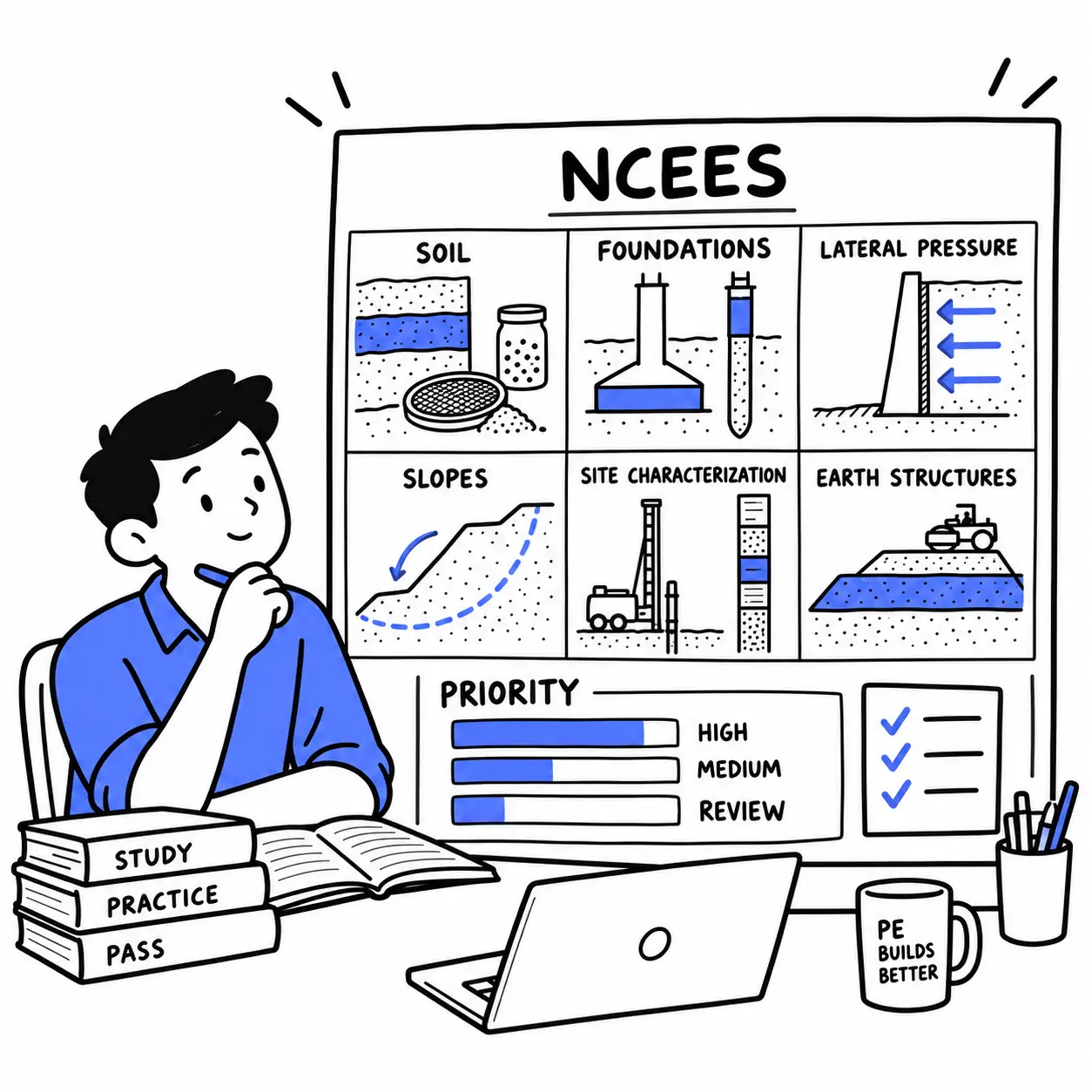
Geotechnical PE Exam Topics: NCEES Breakdown and Study Priorities
Explore the 10 Geotechnical PE exam topics, their NCEES question ranges, and practical study priorities. See which areas deserve the most attention and how the topics connect.

Best PE Geotechnical Exam Prep Courses
Compare six PE Geotechnical exam prep courses by curriculum, teaching format, practice resources, support, price, and access. Find the course that best fits your budget, learning preferences, and exam timeline.

PE Civil Geotechnical Exam Guide Format, Topics, References & Pass Rates
Everything on the PE Geotechnical exam — the 10 NCEES knowledge areas with question counts, CBT format, bundled references, pass rates, and how to study.