Geotechnical Engineering Career Paths: Maximizing Your PE License Value
PE-licensed civil engineers earn roughly $40,000 more per year than unlicensed counterparts, with an ASCE 2025 average of $148,000 across specialties. Strategic career paths, geotechnical specializations, and the latest BLS-verified salary breakdown for 2026.
Bottom Line Up Front: Per the ASCE 2025 Civil Engineering Salary Report (the most recent authoritative source as of April 2026), licensed civil engineers earn an average of $148,000/year, with a PE-license premium of roughly $40,000/year over unlicensed counterparts. BLS OES (May 2024) reports a civil-engineering median of $95,890 and a 90th percentile of $153,580. Strategic specialization in geotechnical engineering can push compensation toward the upper percentiles, making the PE license a crucial career investment.
The geotechnical engineering field offers exceptional career growth opportunities for civil engineers willing to specialize in soil mechanics, foundation design, and subsurface investigation. With the global geotechnical engineering market projected to reach $4.5 billion by 2032 and job growth rates significantly above national averages, professionals in this discipline are positioned for sustained career advancement and financial success.
Current Market Overview: Why Geotechnical Engineering is Thriving
The demand for geotechnical engineers has reached unprecedented levels in 2026. Given the demand for engineers—expected to grow by 11% over the next decade—the industry is becoming more flexible, with companies increasingly focused on practical training and accessible certifications. This growth stems from several converging factors that make geotechnical specialization particularly attractive.
Infrastructure Investment Driving Demand
Growth in infrastructure projects: Cities around the world are growing, and they need smart planning to make sure buildings are safe and stable. As more wind farms and other renewable energy projects get built as well, geotechnical engineers are needed to ensure these structures are well-supported. The renewed focus on infrastructure modernization, combined with climate resilience requirements, has created a sustained demand for geotechnical expertise across multiple sectors.
Market Value and Growth Projections
The global geotechnical engineering market was valued at USD 2.4 billion in 2022, and it's expected to double to USD 4.5 billion by 2032. This remarkable growth trajectory reflects the critical role geotechnical engineers play in ensuring safe, sustainable construction practices in an increasingly complex regulatory environment.
Employment Statistics and Job Security
Current data shows promising employment trends for geotechnical professionals. There are currently 15,062 Geotechnical Engineers in the United States. That is expected to grow 7% from 2018 to 2028. This growth rate significantly exceeds the national average for all occupations, providing excellent job security for those entering the field.
Geotechnical Engineer Salary in 2026
The most recent authoritative salary data for civil engineers comes from two sources: the ASCE 2025 Civil Engineering Salary Report (published October 2025; covers 2024 compensation; n = 2,415 ASCE members), and the BLS Occupational Employment and Wage Statistics for Civil Engineers (SOC 17-2051, May 2024 release). ASCE has not yet published a 2026 edition—new editions typically release in October. The figures below are the latest verified numbers as of April 2026; this section will refresh when ASCE 2026 publishes.
A note on geotechnical specificity: ASCE's 2025 report breaks out only one specialty median publicly (Transportation, $126,000); other specialty-level medians sit behind ASCE's paid Searchable Survey Data tool. BLS OES does not subdivide civil engineers by subspecialty. The figures below therefore use the civil-engineering aggregate as the closest verified proxy for geotechnical compensation, supplemented by ASCE's PE-licensure premium (which applies to all licensed civil engineers, geotechnical included).
Salary by experience level (ASCE 2025 + BLS OES May 2024)
| Experience | Total compensation | Source |
|---|---|---|
| Entry-level (0–3 years) | ~$77,100/year (ASCE 2025 entry-level civil-engineer figure) | ASCE 2025 Civil Engineering Salary Report |
| Mid-level (4–9 years) | $95,890/year (BLS national median for civil engineers) | BLS OES May 2024 (SOC 17-2051) |
| Senior (10–15 years) | ~$122,840/year (BLS 75th percentile) | BLS OES May 2024 |
| Principal / Senior PM (15+ years) | ~$153,580/year (BLS 90th percentile). ASCE 2025 reports a $148,000 average for licensed civil engineers across all specialties. | BLS OES May 2024 + ASCE 2025 |
Experience bands are typical industry conventions, not part of the BLS or ASCE source schemas; the dollar figures themselves are taken directly from the cited sources.
The PE license premium
ASCE's 2025 Civil Engineering Salary Report puts the PE-license premium at approximately $40,000 per year over unlicensed counterparts, averaged across specialties and experience levels. For geotechnical engineers in particular, the premium reflects three things: (1) eligibility to stamp drawings and sign reports for foundation, slope-stability, and seismic-design work; (2) ability to take on senior project-management and consulting roles that require licensure; (3) the legal liability that licensure conveys, which firms compensate for. The absolute dollar premium tends to be smaller at entry-level (typically $5,000–$10,000 for the immediate bump on licensure) and larger at the senior and principal level.
Sources cited above: ASCE Civil Engineering Salary Report (2025 edition) • BLS Occupational Employment Statistics — Civil Engineers (May 2024).
Salary Analysis: The Financial Impact of PE Licensure
Understanding the financial implications of PE licensure is crucial for making informed career decisions. Recent salary data reveals significant earning potential for geotechnical engineers, with notable premiums for licensed professionals.
Current Salary Ranges by Experience Level
Entry-Level Geotechnical Engineers (0-2 years)
- ASCE 2025 entry-level salary: $77,100/year (across all civil engineering specialties; ASCE 2025 Civil Engineering Salary Report)
- BLS OES May 2024, 25th percentile for civil engineers: ~$74,500/year — the lower-quartile band most entry-level engineers fall into
Mid-Level Professionals (3-7 years)
- BLS OES May 2024 median for civil engineers (SOC 17-2051): $95,890/year — this is the national median across all civil engineering specialties
- Typical mid-career band (BLS 25th–75th percentile): ~$74,500 to ~$122,840 annually
Senior-Level Engineers (8+ years)
- BLS OES May 2024, 75th percentile: ~$122,840/year for civil engineers — the band most senior PE-licensed engineers fall into
- BLS OES May 2024, 90th percentile: ~$153,580/year — principal engineers, practice leaders, and senior consultants
- ASCE 2025 average for licensed civil engineers (all specialties): $148,000/year
PE License Salary Premium
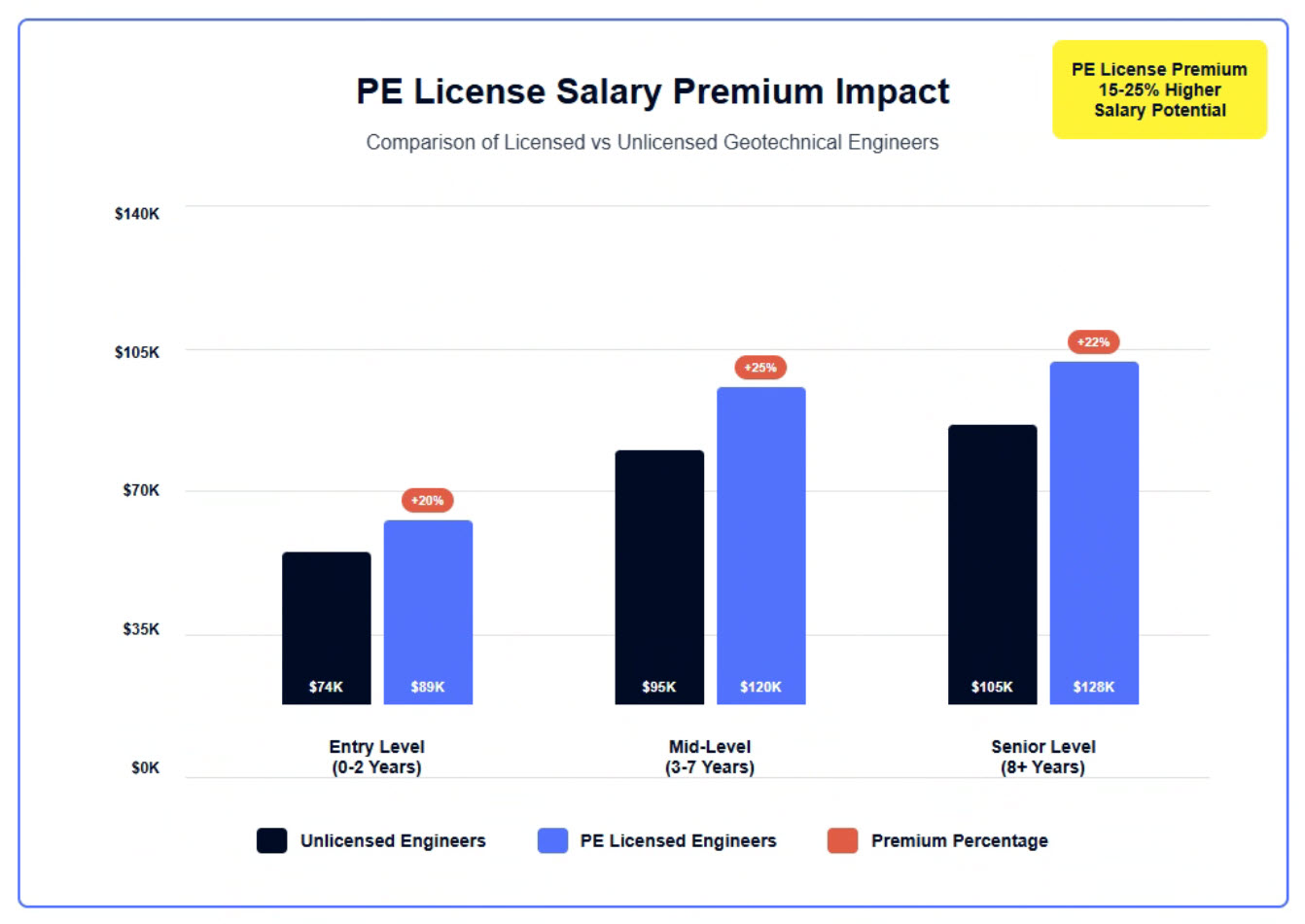
The Professional Engineer license provides substantial financial benefits. ASCE's 2025 Civil Engineering Salary Report puts the PE-license premium at approximately $40,000 per year over unlicensed counterparts, averaged across specialties and experience levels. The absolute dollar premium tends to be smaller at entry-level (typically $5,000–$10,000 for the immediate bump on licensure) and larger at the senior and principal level, where licensed engineers can take on stamping, signing, and senior consulting responsibilities.
Industry data reveals that PE-licensed geotechnical engineers typically earn 15-25% more than their unlicensed counterparts throughout their careers. This premium reflects the increased responsibility, liability, and leadership roles that licensed engineers can assume.
Geographic Salary Variations
Location significantly impacts earning potential. Berkeley, CA beats the national average by $20,843 (22.4%), and Nome, AK furthers that trend with another $22,334 (24.0%) above the $92,871 average. High-cost metropolitan areas offer substantial salary premiums:
Top-Paying Regions:
- San Francisco Bay Area: $95,000-$140,000
- New York Metropolitan Area: $88,000-$128,000
- Boston: $84,000-$123,000
- Los Angeles: $82,000-$122,000
- Seattle: $81,000-$122,000
Career Pathways: Choosing Your Specialization
Geotechnical engineering offers diverse career paths, each with distinct advantages and earning potential. Understanding these pathways helps engineers make strategic decisions about specialization and professional development.
Traditional Consulting Path
Geotechnical Consultant
Consultants give advice to building companies and government groups. They check out construction sites, assess risks, write reports, and design structures like tunnels and dams. You need to be great at solving problems and understanding how soil and rocks behave in different places.
Responsibilities:
- Site investigation and soil testing
- Foundation design and recommendations
- Risk assessment and mitigation strategies
- Client communication and project management
- Report writing and regulatory compliance
Career Progression:
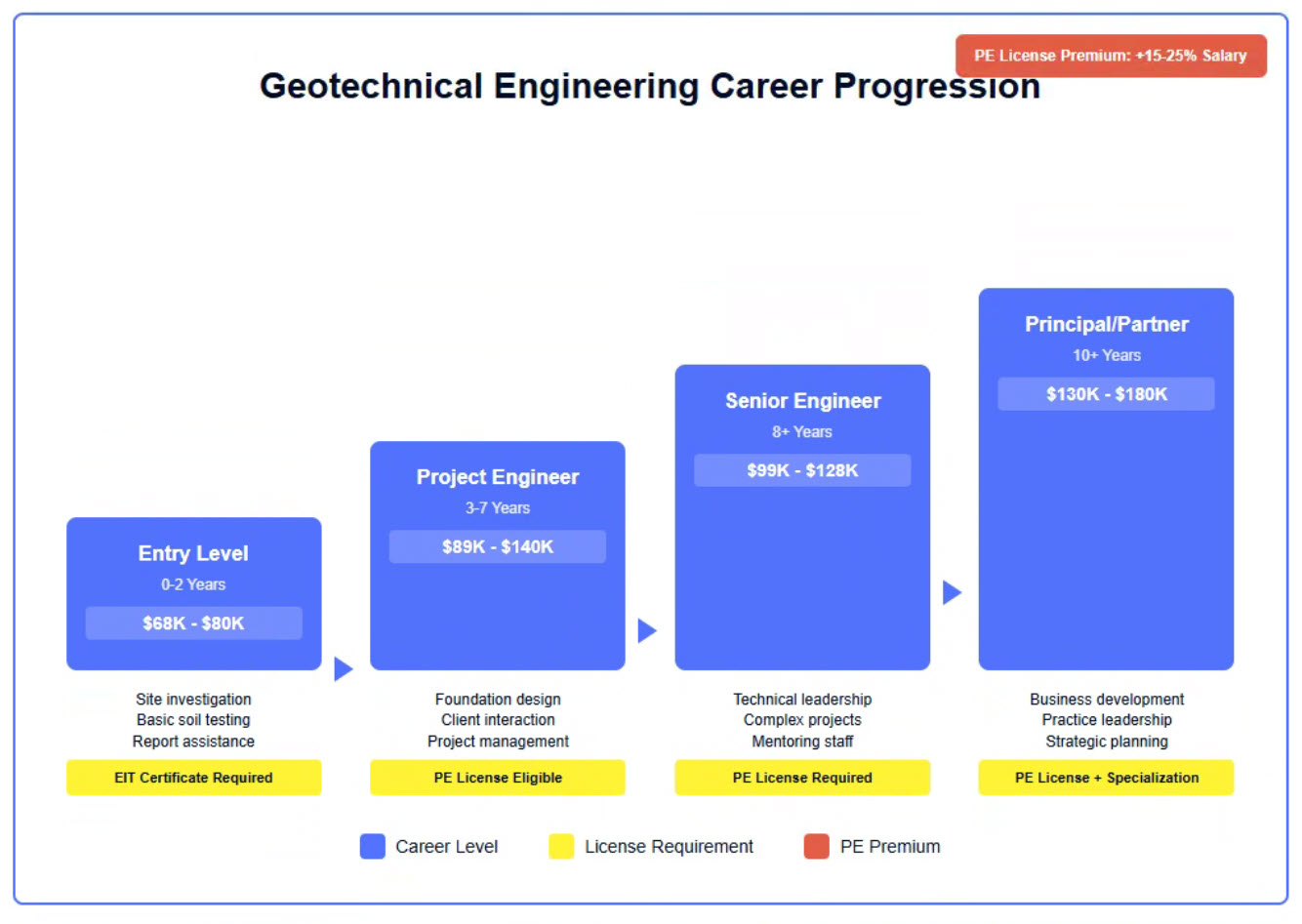
- Junior Consultant (0-3 years): $70,000-$85,000
- Project Engineer (3-6 years): $85,000-$105,000
- Senior Consultant (6-10 years): $105,000-$130,000
- Principal/Practice Leader (10+ years): $130,000-$180,000
Construction and Field Engineering
Site/Field Engineer
This job is all about being on construction sites. Site engineers test the soil, analyze foundations, and give advice based on what they find at the site. Field engineers work directly on construction projects, ensuring geotechnical designs are properly implemented.
Key Activities:
- Real-time soil testing and analysis
- Construction oversight and quality control
- Problem-solving during construction
- Coordination with contractors and project teams
- Field instrumentation and monitoring
Advancement Path:
Field Technician → Site Engineer → Project Manager → Construction Manager
Specialized Technical Disciplines
Foundation Engineering Specialist
Foundation engineers specialize in designing and analyzing foundations for structures. They assess the soil conditions, load requirements, and site characteristics to determine the most appropriate foundation type and design.
High-Value Specializations:
- Deep foundation systems (piles, drilled shafts)
- Mat foundation design for high-rise buildings
- Specialty foundation techniques (micropiles, underpinning)
- Foundation rehabilitation and retrofit
Slope Stability Engineer
Slope stability engineers focus on assessing and managing the stability of natural and man-made slopes. They evaluate the factors influencing slope stability, such as soil properties, groundwater conditions, and slope geometry.
Market Demand:
- Landslide mitigation projects
- Highway cut slope design
- Mining slope stability
- Dam embankment engineering
Earthquake/Seismic Engineer
Earthquake engineers specialize in analyzing and designing structures to withstand seismic forces. This specialization commands premium rates due to complex analysis requirements and high liability.
Emerging Specializations
Environmental Geotechnical Engineer
Focus on sustainability: There's a big push to make sure new construction projects don't harm the environment. Geotechnical engineers play a key role in making these projects as green as possible.
Responsibilities:
- Contaminated site remediation
- Landfill design and closure
- Groundwater protection systems
- Sustainable construction materials
- Carbon footprint reduction strategies
Geosynthetics Engineer
Geosynthetics engineers specialize in the design and application of geosynthetic materials, such as geotextiles, geogrids, and geomembranes. They use these materials to improve soil stability, reinforce slopes, provide drainage solutions, and control erosion.
Industry Sectors: Maximizing Career Opportunities
Understanding industry sectors helps geotechnical engineers align their skills with market demand and optimize earning potential.
High-Paying Industry Sectors
Energy, Mining & Utilities
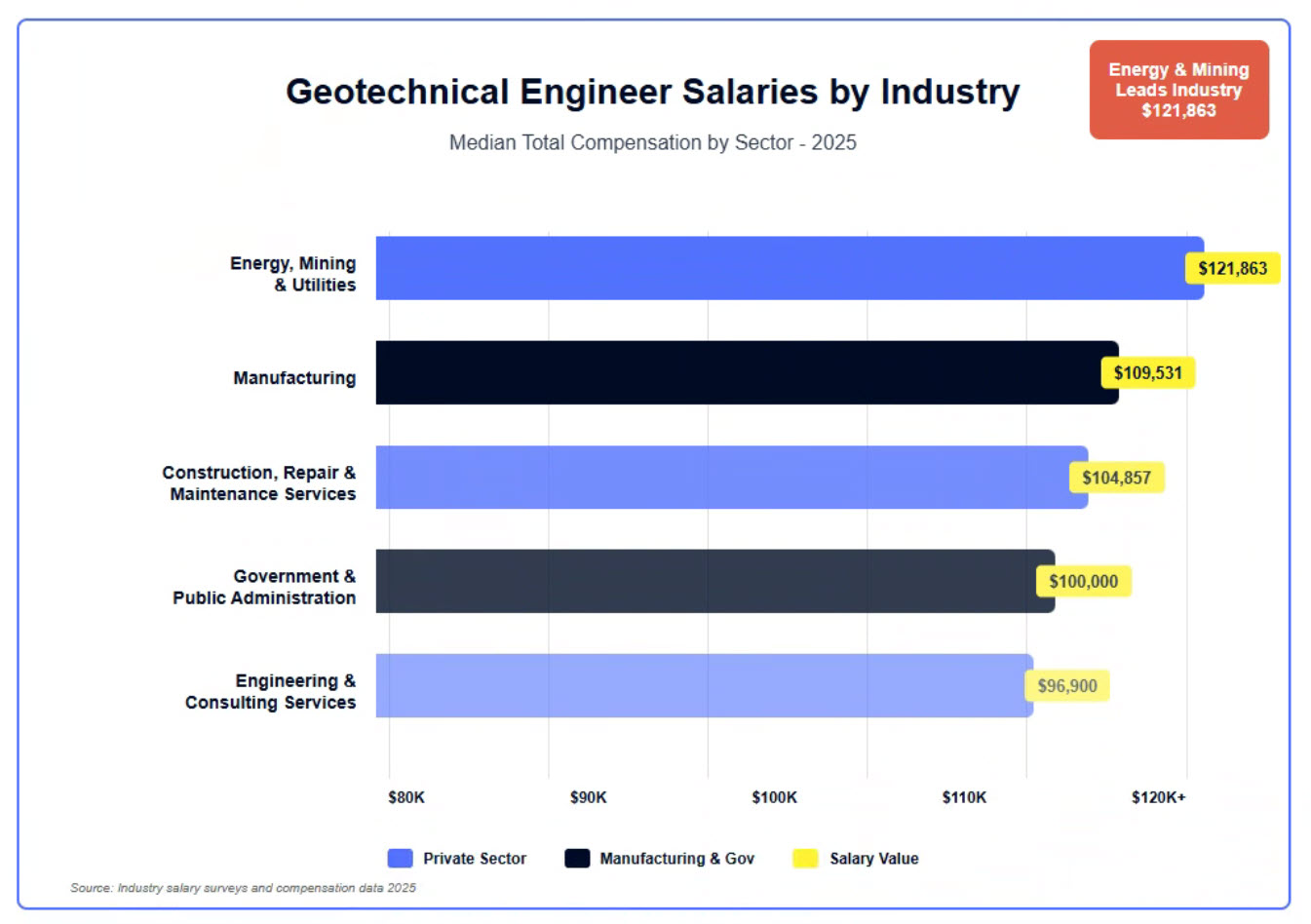
The top 5 paying industries for a Geotechnical Engineer in United States are Energy, Mining & Utilities with a median total pay of $121,863
Key Opportunities:
- Mining operations and tailings management
- Oil and gas infrastructure
- Renewable energy projects (wind farms, solar installations)
- Nuclear facility construction
- Utility infrastructure (power lines, pipelines)
Manufacturing Sector
Manufacturing with a median total pay of $109,531
Applications:
- Industrial facility construction
- Heavy equipment foundations
- Warehouse and distribution centers
- Manufacturing plant upgrades
Construction Services
Construction, Repair & Maintenance Services with a median total pay of $104,857
Government and Public Sector
Federal Opportunities
The top paying company in Government & Public Administration for Geotechnical Engineer is US Army Corps of Engineers
Advantages:
- Job security and comprehensive benefits
- Retirement planning (FERS system)
- Professional development opportunities
- Large-scale infrastructure projects
- Diverse project portfolio
Typical Federal Roles:
- Dam safety engineering
- Military installation design
- Environmental remediation
- Flood control systems
- Navigation and waterway projects
Corporate vs. Consulting Career Paths
Corporate Employment Advantages
Stability and Benefits:
- Predictable work schedules
- Comprehensive health and retirement benefits
- Professional development funding
- Clear advancement pathways
- Reduced business development requirements
Typical Corporate Roles:
- Staff Engineer
- Senior Engineer
- Principal Engineer
- Engineering Manager
- Technical Director
Consulting Career Benefits
Higher Earning Potential:
- Project-based compensation premiums
- Overtime opportunities during peak periods
- Partnership/ownership potential
- Diverse project exposure
- Client relationship development
Challenges:
- Variable workload and income
- Business development responsibilities
- Higher professional liability exposure
- Client management requirements
Geographic Career Strategies
High-Demand Regions
West Coast Markets
California leads in geotechnical opportunities due to seismic requirements and high construction activity. In California, the average yearly salary for a Geotechnical Engineer is $83,926
Northeast Corridor
Major metropolitan areas offer premium salaries. In Massachusetts, the average annual salary is $82,807
Energy Sector Regions
Texas, North Dakota, and Alaska offer opportunities in oil and gas projects, though market volatility requires careful career planning.
International Opportunities
Experienced geotechnical engineers with PE licenses can pursue international opportunities, particularly in:
- Infrastructure development projects in emerging markets
- Mining and resource extraction globally
- Consulting roles with multinational firms
- Government and military overseas positions
Professional Development Strategies
Education and Continuous Learning
Master's Degree Benefits
Advanced education offers deeper knowledge in specialized areas, such as soil mechanics, foundation engineering, and environmental geotechnics. This specialized knowledge can set you apart from your peers and open doors to more advanced roles within the field.
Professional Development Options:
- Part-time or online master's programs
- Professional certifications (ASCE, NICET)
- Technical conference attendance
- Software training (PLAXIS, GeoStudio, etc.)
Networking and Professional Organizations
Key Organizations:
- American Society of Civil Engineers (ASCE)
- Geo-Institute (G-I)
- International Society for Soil Mechanics and Geotechnical Engineering (ISSMGE)
- Deep Foundations Institute (DFI)
- Association of Environmental & Engineering Geologists (AEG)
Benefits of Active Participation:
- Industry networking opportunities
- Technical committee involvement
- Conference speaking opportunities
- Continuing education credits
- Career advancement visibility
Building Technical Expertise
Critical Skills Development:
- Advanced soil mechanics and rock mechanics
- Numerical modeling and finite element analysis
- Geotechnical instrumentation and monitoring
- Risk assessment and reliability analysis
- Construction methods and procedures
Software Proficiency:
- PLAXIS for finite element analysis
- SLIDE for slope stability analysis
- GeoStudio suite for comprehensive analysis
- AutoCAD and Bentley MicroStation
- GIS applications for site investigation
Fast-Track Your PE License Journey
Maximize your career earning potential by passing the PE Geotechnical exam on your first attempt. PEwise provides the specialized preparation you need to succeed.
Geotechnical-specific content aligned with NCEES PE exam syllabus
Visual learning approach proven to improve retention for complex soil mechanics
Practice exam simulator with 59 questions matching real exam format
Try first 2 modules free • Only $90 for complete course • Specialized for PE Geotechnical
The PE License Advantage in Geotechnical Engineering
Regulatory Requirements
The PE license is essential for independent practice in geotechnical engineering. In most cases, geotechnical engineers need a Professional Engineer (PE) license to work independently or approve engineering plans.
PE License Benefits:
- Sign and seal engineering documents
- Offer services directly to the public
- Assume greater project responsibility
- Enhanced credibility with clients
- Expanded career opportunities
Pathway to PE Licensure
Requirements:
- Bachelor's degree from ABET-accredited program
- Pass Fundamentals of Engineering (FE) exam
- Four years of progressive engineering experience
- Pass Professional Engineering (PE) exam
- Meet state-specific requirements
Continuing Education Requirements
PE license maintenance requires ongoing professional development. Most states require 15-30 professional development hours (PDHs) annually, which can be obtained through:
- Technical conferences and seminars
- Professional courses and webinars
- Technical publication authoring
- Professional society involvement
- Graduate coursework
Maximizing Long-Term Career Value
Strategic Career Planning
5-Year Career Planning:
- Years 1-2: Gain broad experience across multiple project types
- Years 3-4: Develop specialization focus and obtain PE license
- Years 5+: Establish expertise in chosen specialization and build professional network
10-Year Strategic Goals:
- Technical expertise in chosen specialization
- Professional recognition in industry
- Leadership roles in projects and organizations
- Mentoring of junior engineers
- Business development capabilities
Building a Professional Brand
Establishing Expertise:
- Author technical papers and articles
- Speak at professional conferences
- Participate in industry committees
- Develop innovative solutions
- Mentor junior professionals
Professional Visibility:
- LinkedIn professional presence
- Industry publication contributions
- Conference presentation opportunities
- Professional organization leadership
- Client testimonials and case studies
Entrepreneurial Opportunities
Independent Consulting: Experienced geotechnical engineers with strong professional networks can establish successful consulting practices. Requirements include:
- Minimum 10-15 years experience
- Strong client relationships
- Professional liability insurance
- Business development skills
- Technical expertise in specific niches
Partnership Opportunities:
- Joint ventures with established firms
- Specialty consulting services
- International project partnerships
- Technology development collaborations
Future Trends Shaping Geotechnical Careers
Technology Integration
Emerging Technologies:
- Artificial intelligence for data analysis
- Remote sensing and drone technology
- Advanced geophysical investigation methods
- Real-time monitoring systems
- Building Information Modeling (BIM) integration
Impact on Career Development: Engineers who embrace new technologies will have competitive advantages in the evolving market. Continuous learning and adaptation to technological changes will be essential for long-term career success.
Sustainability Focus
Impact on Sustainability: As construction projects increasingly aim for sustainability, the role of geotechnical engineers has never been more crucial.
Sustainable Practice Areas:
- Carbon footprint reduction in construction
- Renewable energy infrastructure
- Climate-resilient design
- Circular economy principles
- Environmental impact minimization
Global Market Expansion
International infrastructure development creates opportunities for experienced geotechnical engineers. Markets showing strong growth include:
- Asia-Pacific infrastructure projects
- Middle East construction boom
- African development initiatives
- Latin American mining and energy projects
Conclusion: Maximizing Your Geotechnical Engineering Career
The geotechnical engineering field offers exceptional opportunities for career growth and financial success, particularly for engineers who strategically develop their expertise and obtain professional licensure. With average salaries ranging from $92,000 to $140,000 and significant premiums for specialized expertise, the field provides excellent long-term earning potential.
Key Success Strategies:
- Obtain PE Licensure Early: The 15-25% salary premium and expanded opportunities make PE licensure essential for career advancement.
- Develop Technical Specializations: Focus on high-demand areas like seismic engineering, foundation design, or environmental geotechnics to command premium rates.
- Choose Industry Sectors Strategically: Energy, mining, and utilities sectors offer the highest compensation, while government provides stability and benefits.
- Invest in Continuous Learning: Master's degrees, professional certifications, and emerging technology skills maintain competitive advantages.
- Build Professional Networks: Active participation in professional organizations creates opportunities for career advancement and business development.
The geotechnical engineering profession combines technical challenge with excellent financial rewards. Engineers who approach their careers strategically, invest in professional development, and adapt to industry changes will find exceptional opportunities for growth and success.
References
- Educating Engineers Editorial Team. (2025). "Geotechnical Engineering: Career Path, Salary, and Education Requirements." Educating Engineers. https://educatingengineers.com/careers/geotechnical-engineer/
- Geo-Technology Associates, Inc. (2024). "How Geotechnical Engineering Offers a Great Path to a Lucrative Career." https://www.gtaeng.com/great-path-to-a-lucrative-career/
- 4 Corner Resources. (2025). "The Ultimate Geotechnical Engineer Career Guide." https://www.4cornerresources.com/career-guides/geotechnical-engineer/
- Zippia Research Team. (2025). "Geotechnical Engineer Job Outlook And Growth In The US." https://www.zippia.com/geotechnical-engineer-jobs/trends/
- Indeed Career Guide. (2024). "How To Become a Geotechnical Engineer." https://www.indeed.com/career-advice/finding-a-job/how-to-become-geotechnical-engineer
- Glassdoor Inc. (2025). "Geotechnical Engineer Salary in United States." https://www.glassdoor.com/Salaries/geotechnical-engineer-salary-SRCH_KO0,21.htm
- ZipRecruiter. (2025). "Geotechnical Engineer Salary." https://www.ziprecruiter.com/Salaries/Geotechnical-Engineer-Salary
- PayScale Inc. (2025). "Geotechnical Engineer Salary." https://www.payscale.com/research/US/Job=Geotechnical_Engineer/Salary
- Salary.com. (2025). "Entry Level Geotechnical Engineer Salary." https://www.salary.com/research/salary/alternate/entry-level-geotechnical-engineer-salary
- PEwise. (2025). "PE License Salary 2025: $42K+ Increase Analysis." https://pewise.com/pe-license-salary-2025-civil-engineer/
- Enginuity Advantage. (2024). "Advancing Your Geotechnical Engineering Career: Master's Degree or Experience?" https://www.enginuityadvantage.com/advancing-your-geotechnical-engineering-career-masters-degree-or-experience/
Keep Reading
SPT and CPT Correlation Problems on the PE Geotechnical Exam
SPT N-value corrections (energy, overburden, rod-length) and CPT-to-SPT correlations (Robertson) for the PE Geotechnical exam — three worked NCEES-style problems plus the SPT correction-factor reference table.
PE Geotechnical Retaining Wall Design Problems: Cantilever, Anchored, MSE
Cantilever stability checks, anchored-bulkhead free-earth-support, and MSE wall external + internal stability for the PE Geotechnical exam — with three worked NCEES-style problems and the FoS reference table.
PE Geotechnical Lateral Earth Pressure: Coulomb vs Rankine vs At-Rest
Coulomb, Rankine, and at-rest earth-pressure theories for the PE Geotechnical exam — with three worked NCEES-style problems comparing horizontal forces, OC clay below the water table, and Coulomb passive caveats.