🚀 NEWPE Civil: Water Resources & Environmental course launching March 2026!

Pe Exam PrepExam StrategyGeotechnical Engineering

Why You Keep Failing the PE Geotechnical Exam (And How to Fix It)

Discover the 3 real reasons engineers fail the PE Geotechnical exam — conceptual questions, false confidence from practice exams, and passive study methods — plus proven strategies to pass on your next attempt.

PEwise Team
February 26, 2026

If you've failed the PE Geotechnical exam, you're not alone — and you're not the problem. The exam is.

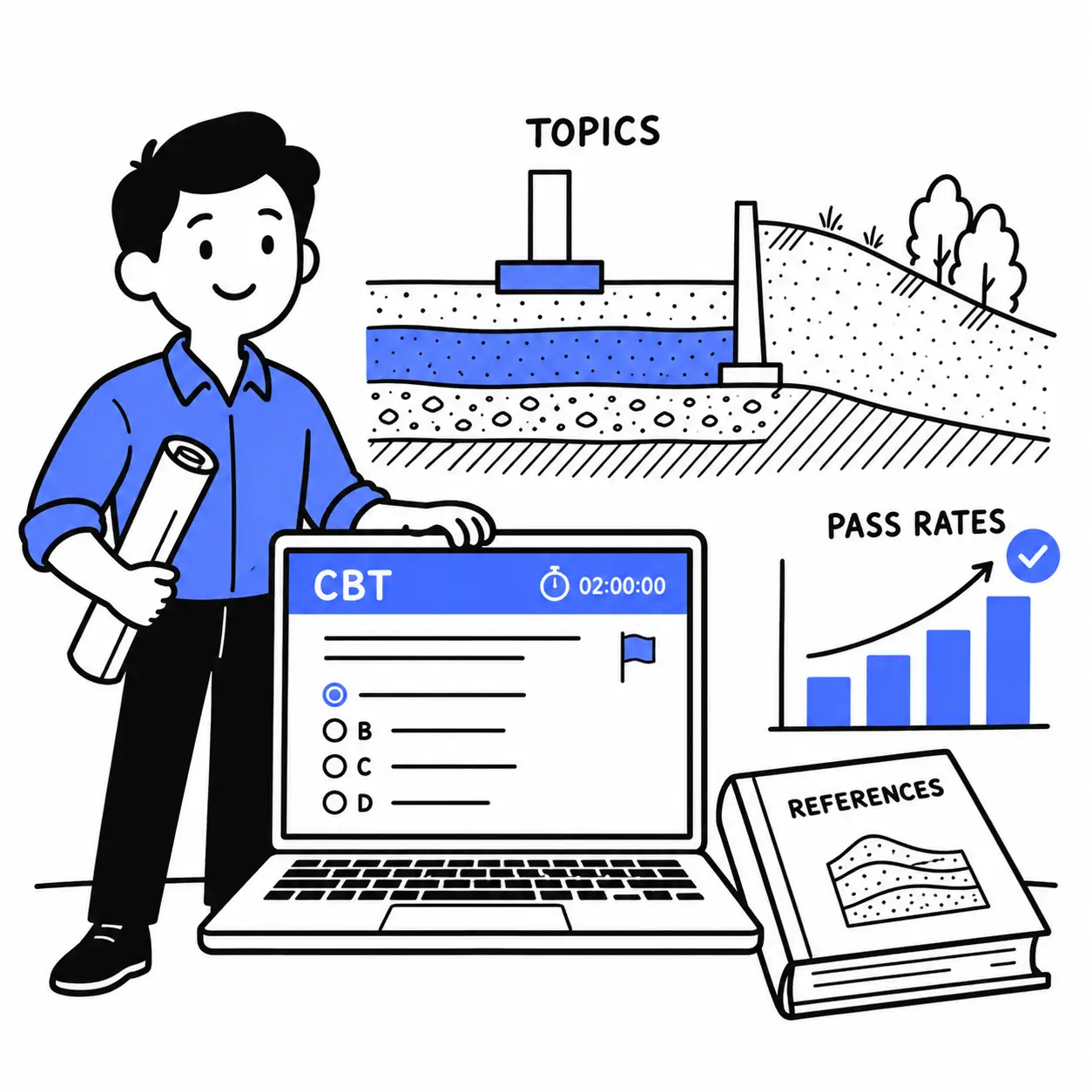
The PE Geotechnical exam has one of the lowest repeat-taker pass rates of any PE discipline. According to NCEES data, only 30-34% of repeat takers pass, compared to first-time pass rates that hover between 54-63%. That means roughly two out of every three engineers who retake this exam will fail again.

Read that again: the majority of repeat takers fail. Not because they're bad engineers. Not because they didn't study. But because they studied the wrong way for an exam that has fundamentally changed in recent years.

This article breaks down the three real reasons engineers fail the PE Geotechnical exam — reasons that practice exams, review courses, and textbooks rarely address — and gives you a concrete plan to fix each one. Whether you're preparing for your first attempt or recovering from a failed one, understanding these failure patterns is the first step toward passing.

The Real Problem: It's Not What You Think

Here's what most PE Geotechnical candidates believe: if they solve enough practice problems, memorize enough formulas, and put in enough hours, they'll pass. It sounds logical. It's also wrong.

The PE Geotechnical exam doesn't just test your ability to plug numbers into equations. It tests whether you understand geotechnical engineering at a conceptual level — why certain methods work, when to apply them, and what happens when field conditions don't match textbook assumptions.

Test-takers consistently report being blindsided by qualitative questions about which field test to use in a given soil condition, which pipe type is appropriate for a specific application, how to properly install geotextile reinforcement, or what factors control the selection of a particular foundation type. These aren't calculation problems. They're judgment calls that require real understanding of geotechnical practice.

One engineer who shared their diagnostic report on EngineerBoards described scoring approximately 90% on numerical calculation problems but only about 50% on conceptual and qualitative questions. They had the math skills. They had the formulas memorized. What they didn't have was the deep conceptual understanding that separates passing from failing.

Making matters more challenging, the exam format changed significantly as of April 2024. The old format included a breadth section covering multiple civil engineering disciplines, giving geotechnical engineers a chance to pick up points in areas like transportation or water resources. That safety net is gone. All 80 questions are now geotechnical depth — meaning every single question targets your geotechnical knowledge specifically. There's nowhere to hide weak spots anymore.

Reason #1: Conceptual Questions Are the Hidden Killer

This is the number one reason engineers fail the PE Geotechnical exam, and it's the one that catches the most people off guard.

Approximately 20-25% of the exam consists of experience-based conceptual questions that cannot be solved with formulas or reference materials. These questions test whether you understand the "why" behind geotechnical engineering, not just the "how." And for engineers who've built their entire study plan around solving numerical problems, these questions are devastating.

What Conceptual Questions Actually Look Like

Conceptual questions on the PE Geotechnical exam cover topics that many study materials barely mention:

  • Modulus of subgrade reaction: Not just the formula, but what it physically represents, when it's appropriate to use, and how it varies with footing size and soil type
  • Frost heave mechanisms: Why frost heave occurs in some soils but not others, what the three conditions for frost heave are, and how to mitigate it in design
  • Lacustrine deposits: Their engineering properties, typical behavior under loading, and how they differ from alluvial or glacial deposits
  • Field testing method selection: When to use SPT vs. CPT vs. vane shear vs. pressuremeter — not how to calculate results from each, but which one to specify given specific site conditions
  • Geotextile installation procedures: Proper overlap requirements, orientation, separation vs. filtration vs. reinforcement applications, and common installation errors
  • Pipe type selection: Rigid vs. flexible pipe behavior, appropriate bedding conditions, and how soil-structure interaction differs between pipe types
  • Compaction quality control: When to use nuclear density gauge vs. sand cone vs. rubber balloon method, and what each test actually measures

One frustrated test-taker posted: "I could not find what the problems were asking in any materials I have." This is the experience of someone who studied hard but studied the wrong material. When your entire preparation is built around solving equations, and a quarter of the exam asks you to explain concepts in plain engineering terms, no amount of calculation practice will save you.

Why This Happens

Most PE review courses and textbooks are organized around calculation methods. They teach you Terzaghi's bearing capacity equation, Rankine's earth pressure theory, and settlement calculations — all essential topics. But they spend very little time on the practical, field-oriented knowledge that comes from years of geotechnical practice experience.

The exam, however, is written by practicing geotechnical engineers who deal with these field decisions daily. They know that choosing the right field test matters as much as interpreting its results. They know that understanding soil behavior is more valuable than memorizing soil classification tables. And they write questions accordingly.

How to Fix It

Building conceptual understanding requires a different study approach than solving practice problems:

  1. Read Das's Principles of Geotechnical Engineering for understanding, not just formulas. Das explains the "why" behind every concept. Don't skip the descriptive paragraphs to get to the equations — those paragraphs are where the conceptual exam answers live.
  2. Study the Geotechnical Engineer's Portable Handbook by Robert Day. This reference is organized around practical field decisions and covers exactly the type of applied knowledge the exam tests.
  3. Use visual learning to build intuition. Animated explanations of how soil particles interact during consolidation, how pore water pressure dissipates over time, or how lateral earth pressure develops against a retaining wall create lasting understanding that text alone cannot match.
  4. Create concept maps connecting related topics. For example, link soil classification to expected behavior to appropriate field tests to design methods. The exam tests these connections, not isolated facts.
  5. Study FHWA manuals and AASHTO guidance documents. Many conceptual questions draw from federally published design guidance that practicing engineers use daily.

The goal isn't to memorize more facts. It's to develop the engineering judgment that lets you answer "which method is appropriate here?" without needing to look it up.

Build Conceptual Understanding, Not Just Calculation Skills

PEwise's 270+ animated video lessons teach the "why" behind every geotechnical concept — exactly what conceptual questions test. Visual learning builds the intuition that formula memorization can't.

Explore PEwise Geotechnical Course

Try the first 2 modules free — no credit card required

Reason #2: Your Practice Exam Gave You False Confidence

This is possibly the most dangerous trap in PE Geotechnical exam preparation, and thousands of engineers fall into it every exam cycle.

The NCEES practice exam — the "official" preparation resource that most candidates rely on — is significantly easier than the actual exam. Test-takers who have taken both consistently rate the NCEES practice exam difficulty at roughly 5 out of 10, while rating the actual exam at 7 out of 10 or higher.

One engineer shared a story that has become all too common: "I scored 75 out of 80 on the NCEES practice exam but quickly panicked on exam day when I saw the actual questions." They had built their entire confidence on a practice resource that dramatically understated the real exam difficulty. When exam day arrived, the gap between what they'd practiced and what they faced was overwhelming.

The Practice Exam Problem in Detail

The disconnect between practice and reality has several dimensions:

  • The NCEES practice exam has fewer conceptual questions than the real exam. Most practice questions are straightforward calculations, which doesn't prepare you for the qualitative reasoning the actual exam demands.
  • The calculation difficulty is lower. Practice exam problems tend to be single-step or two-step calculations. The real exam often requires multi-step analysis where you need to determine intermediate values before reaching the answer.
  • Problem setups are more straightforward. The NCEES practice exam presents information cleanly. The real exam may give you more data than you need, require you to determine what's relevant, or present information in an unfamiliar format.
  • Time pressure is underestimated. Because the practice problems are simpler, candidates finish early and assume they'll have plenty of time on exam day. The harder real problems take significantly longer, and many candidates run out of time.

Third-Party Materials Have Their Own Problems

If the NCEES practice exam is too easy, you might think third-party study materials would fill the gap. Unfortunately, the picture there is mixed at best.

Some third-party resources are too difficult. Engineers studying with Lindeburg's Civil Engineering Reference Manual (CERM) have described the problems as "WAY too hard and too complex" compared to what the actual exam tests. Spending weeks mastering problems that are harder than anything you'll see on exam day isn't just inefficient — it can destroy your confidence and waste precious study time on edge cases that won't appear on the test.

Other third-party practice exams are too easy, essentially restating the NCEES practice problems with different numbers. These give you volume without increasing difficulty, which means you're practicing at a level below what the exam requires.

The result is that candidates have no reliable benchmark for their readiness. They either think they're more prepared than they are (NCEES practice exam) or feel overwhelmed by unnecessarily difficult problems (some third-party resources).

How to Fix It

  1. Use multiple practice sources. Don't rely on any single practice exam. The NCEES practice exam should be your baseline, not your ceiling. Supplement with materials from School of PE, EET, PPI, and other providers to see problems from different angles and difficulty levels.
  2. Aim for 85% or higher on practice exams before sitting for the real thing. If you're scoring 70% on practice materials that are easier than the real exam, you're not ready. Build in a confidence margin — aim for 85%+ on practice to give yourself a buffer for the harder real exam.
  3. Simulate real exam conditions. Take full-length practice exams in one sitting, timed, with only the NCEES PE Reference Handbook available. No phone, no breaks beyond what the real exam allows, no extra references. The goal is to remove all surprises on exam day.
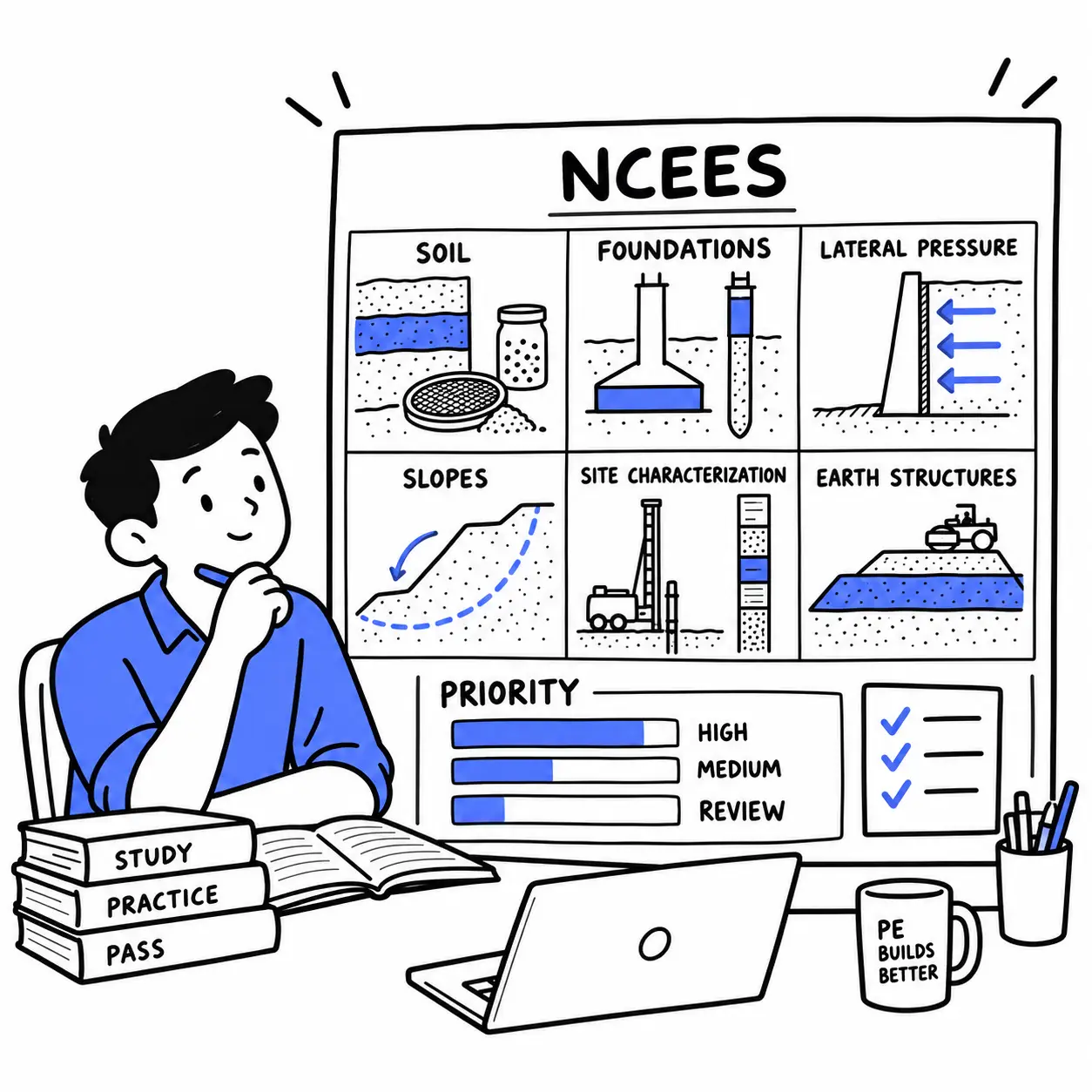
  4. Track your performance by topic area. Don't just record your overall score. Break down your performance by NCEES exam specification categories: soil mechanics, foundations, earth retaining structures, earthworks, groundwater, and specialty topics. Identify where you're weak and focus your remaining study time there.
  5. Practice with the CBT interface. Since the exam moved to computer-based testing, familiarity with the digital interface matters. Practice navigating the on-screen reference handbook, using the built-in calculator, and flagging questions for review. Small efficiencies in navigation add up over 80 questions.

Reason #3: You're Studying Theory, Not Application

This is the study method trap, and it's insidious because it feels productive even while it's wasting your time.

One engineer described their failed preparation approach honestly: "By the time I watched the review videos, I did not have much left in the tank for doing problems." They had spent the majority of their study hours in passive learning mode — watching lectures, reading textbooks, highlighting notes — and left almost no time for active problem-solving practice.

This is backwards. Research on active recall vs. passive reading consistently shows that retrieval practice — forcing yourself to recall and apply information — is dramatically more effective than passive review for exam preparation. Yet most PE candidates spend 70-80% of their study time in passive mode and wonder why they can't perform on exam day.

The 60/40 Rule

The most successful PE Geotechnical exam candidates follow what experienced PE review instructors call the 60/40 rule:

  • 60% of study time on active practice: Solving problems, taking practice exams, working through scenarios, and testing yourself without looking at notes
  • 40% of study time on theory review: Watching lectures, reading textbooks, reviewing notes, and building conceptual understanding

Most failing candidates have this ratio inverted. They spend 70-80% of their time in passive learning and only 20-30% doing problems. The result is that they recognize concepts when they see them but can't apply them under time pressure — which is exactly what the exam requires.

The Passive Learning Trap

Passive learning is seductive because it's comfortable. Watching a well-produced lecture on consolidation theory feels productive. Highlighting key equations in your textbook feels like progress. Reading through solved examples feels like studying. But none of these activities force your brain to do what it needs to do on exam day: retrieve information from memory, select the right approach, and execute under time pressure.

The difference between recognizing an answer and producing an answer is enormous. When you read a solved example, you think "yes, that makes sense" — but that recognition is not the same as being able to reproduce the solution from scratch. On exam day, you won't have solved examples to follow. You'll have a problem, a reference handbook, and a clock.

How to Fix It

  1. Flip the ratio immediately. Starting today, spend the majority of your study time solving problems. If you have a 3-hour study session, spend no more than 1 hour reviewing theory and at least 2 hours working problems.
  2. Solve problems before studying the theory. Try to solve problems on a topic before you watch the lecture or read the chapter. You'll get most of them wrong, but the struggle of attempting them first makes the subsequent theory review dramatically more effective. This is called the "generation effect" in learning science.
  3. Practice without your reference materials first. After your initial learning phase, try solving problems with the book closed. Check your reference handbook only when you're truly stuck. This trains your brain to recall methods and formulas, building the retrieval pathways you'll need on exam day.
  4. Review wrong answers intensively. When you miss a practice problem, don't just read the solution and move on. Understand why your approach was wrong, identify the concept you were missing, and then solve 2-3 similar problems to reinforce the correct method.
  5. Use timed practice sessions to build exam stamina. Solving 10 problems over 3 relaxed hours is very different from solving 10 problems in 60 minutes. Build up to exam-pace problem solving gradually.

The Pass Rate Reality Check

Let's look at the data honestly. Understanding PE exam pass rates isn't about discouragement — it's about making informed decisions about your preparation strategy.

Category PE Geotechnical PE Water Resources
First-Time Pass Rate 54-63% ~70%
Repeat Taker Pass Rate 30-34% ~45%
Total Questions 80 80
Exam Duration 8 hours 8 hours
Format (2024+) All Depth (CBT) All Depth (CBT)

What These Numbers Actually Mean for You

The PE Geotechnical exam is objectively one of the harder PE disciplines. The first-time pass rate of 54-63% means that nearly half of all first-time takers — many of whom are fresh from graduate school with strong academic foundations — fail on their first attempt. This isn't a reflection of these engineers' abilities. It's a reflection of how different this exam is from what most engineers expect.

The repeat-taker rate of 30-34% is even more telling. It suggests that most engineers who fail don't fundamentally change their approach before retaking. They study more hours, solve more problems, and use the same methods that didn't work the first time. The definition of insanity applies here: doing the same thing and expecting different results.

Compare this to Water Resources, where about 70% of first-time takers pass. The difference isn't that geotechnical engineers are less capable — it's that the geotechnical exam tests a different kind of knowledge. Water Resources has more calculation-heavy problems that reward traditional study methods. Geotechnical has more conceptual and judgment-based questions that require a different preparation approach.

The Afternoon Session Factor

Test-takers consistently report that the second half of the exam (the afternoon session equivalent in the CBT format) is harder and more conceptual than the first half. This aligns with NCEES exam design principles — later questions tend to test higher-order thinking and applied judgment rather than straightforward calculations.

This has important implications for your time management strategy. If you burn through your mental energy and time budget on the first 40 questions, you'll face the harder conceptual questions with depleted cognitive resources. Plan accordingly: maintain a steady pace, take your scheduled breaks, and save some mental energy for the second half.

How to Actually Pass on Your Next Attempt

If you've failed the PE Geotechnical exam — or if you're preparing for your first attempt and want to avoid the common mistakes that trip up most candidates — here's a concrete action plan based on what the data shows actually works.

Step 1: Change Your Study Method, Not Just Your Study Hours

The single biggest predictor of repeat-taker failure is using the same study method that didn't work the first time. If you failed, your study method needs to change — not just your study volume. Adding 100 more hours of the same approach that led to failure won't produce a different result.

Specifically:

  • If you focused primarily on solving practice problems, add dedicated conceptual review time
  • If you focused primarily on watching lectures and reading, flip to majority practice problem solving
  • If you used only one study resource, diversify to at least 3-4 different sources
  • If you studied alone, find a study group or online community for discussion

Step 2: Master the Concepts, Not the Formulas

You can look up any formula in the NCEES PE Reference Handbook during the exam. You cannot look up conceptual understanding. This means your study time should prioritize understanding why methods work over memorizing how to use them.

For every equation you study, ask yourself:

  • What physical phenomenon does this equation model?
  • What are the assumptions behind it, and when do those assumptions break down?
  • When would you choose this method over alternatives?
  • What does each variable physically represent (not just its symbol)?
  • What happens to the result if key parameters increase or decrease?

If you can answer these questions without looking at your notes, you have conceptual understanding. If you can only plug in numbers and turn the crank, you're vulnerable to the conceptual questions that account for 20-25% of the exam.

Step 3: Learn the CBT Interface Cold

The PE exam has been computer-based since 2024, and candidates who aren't comfortable with the Pearson VUE testing interface waste precious time and mental energy on exam day. The NCEES website offers a practice exam in the CBT format — use it until navigating the interface is second nature.

Key CBT skills to practice:

  • Searching the on-screen NCEES PE Reference Handbook by keyword and section
  • Flagging questions for review and navigating between flagged items
  • Using the built-in calculator efficiently
  • Managing your whiteboard/scratch paper within the digital environment
  • Understanding the question navigation panel and progress indicators

Step 4: Know the Reference Handbook Inside and Out

The NCEES PE Reference Handbook is the only reference you're allowed during the exam. Unlike the old paper-based format where you could bring your own references, you're now limited to what NCEES provides. This means you need to know exactly where every relevant formula, table, and chart is located.

Spend dedicated study time simply browsing the reference handbook. Build a mental map of its organization. Know which sections cover each topic area. Practice finding specific information quickly — on exam day, the 30 seconds you save finding each formula adds up to 40+ minutes over 80 questions.

Step 5: Build Visual Intuition for Geotechnical Concepts

Geotechnical engineering is inherently visual. Soil doesn't behave in abstract equations — it flows, consolidates, fails along surfaces, and interacts with structures in physical ways. Engineers who develop visual intuition for these processes perform dramatically better on conceptual questions.

Visual learning means using animations, diagrams, and physical models to understand:

  • How stress distributes through soil beneath a footing (Boussinesq distribution)
  • What actually happens during consolidation at the particle level
  • How Mohr's circle represents stress states and failure conditions
  • Why certain slope failure modes occur in specific soil and groundwater conditions
  • How earth pressure develops against retaining walls during active, passive, and at-rest conditions
  • What flow nets look like and how they relate to seepage quantity and uplift pressure

Once you can visualize these processes, the conceptual questions become dramatically easier because you're reasoning from understanding rather than trying to recall a memorized fact.

Step 6: Build a Realistic Study Schedule

Most PE Geotechnical candidates need 300-400 hours of total study time spread over 3-6 months. But the distribution of those hours matters more than the total. Here's a framework that addresses all three failure reasons:

  • Months 1-2 (Foundation Phase): 40% theory, 40% problems, 20% conceptual review. Focus on building understanding of each topic area before trying to master it.
  • Months 3-4 (Application Phase): 20% theory, 60% problems, 20% conceptual review. Shift heavily toward problem solving. Work through progressively harder problems and start taking timed practice sections.
  • Final 4-6 Weeks (Exam Phase): 10% theory, 50% full practice exams, 40% targeted review of weak areas. Take at least 3-4 full-length practice exams under real conditions. Use your results to identify and shore up remaining weak spots.

The Bottom Line

Failing the PE Geotechnical exam doesn't mean you're a bad engineer. It means you were caught off guard by an exam that tests differently than most engineers expect. The conceptual questions, the difficulty gap between practice and real exams, and the passive-learning trap are systematic issues that affect thousands of qualified engineers every year.

The engineers who pass on their next attempt are the ones who recognize these patterns and actively change their approach. They don't just study harder — they study differently. They build conceptual understanding alongside calculation skills. They practice with realistic difficulty levels. And they spend most of their study time actively solving problems rather than passively reviewing material.

The 30-34% repeat pass rate isn't a ceiling. It's the result of most repeat takers using the same failed approach. Change your method, and you change your odds dramatically.

Don't Repeat the Same Mistakes — Change Your Approach

PEwise was built specifically to address the three failure patterns above. Here's how:

  • 270+ animated video lessons that teach the "why" behind every concept — not just the formulas
  • 59-question practice exam calibrated to real exam difficulty with detailed explanations
  • Weekly live Q&A sessions where you can ask questions and learn from other candidates' struggles
  • Pass guarantee — if you complete the course and don't pass, get your money back
  • Only $60 — a fraction of the cost of retaking the exam ($375 per attempt)
Start Your PE Geotechnical Prep Today

Try the first 2 modules free — no credit card required

Related Topics

PE geotechnical exam failfailed PE geotechnical examPE geotechnical pass ratePE geotech exam tipsPE geotechnical exam study guideconceptual questions PE exam