PE Civil Disciplines Compared Which Exam Should You Take
Compare the five PE Civil disciplines, including their topics, professional focus, pass rates, and ideal backgrounds. Learn how to choose the exam that best matches your experience, reference knowledge, and career goals.
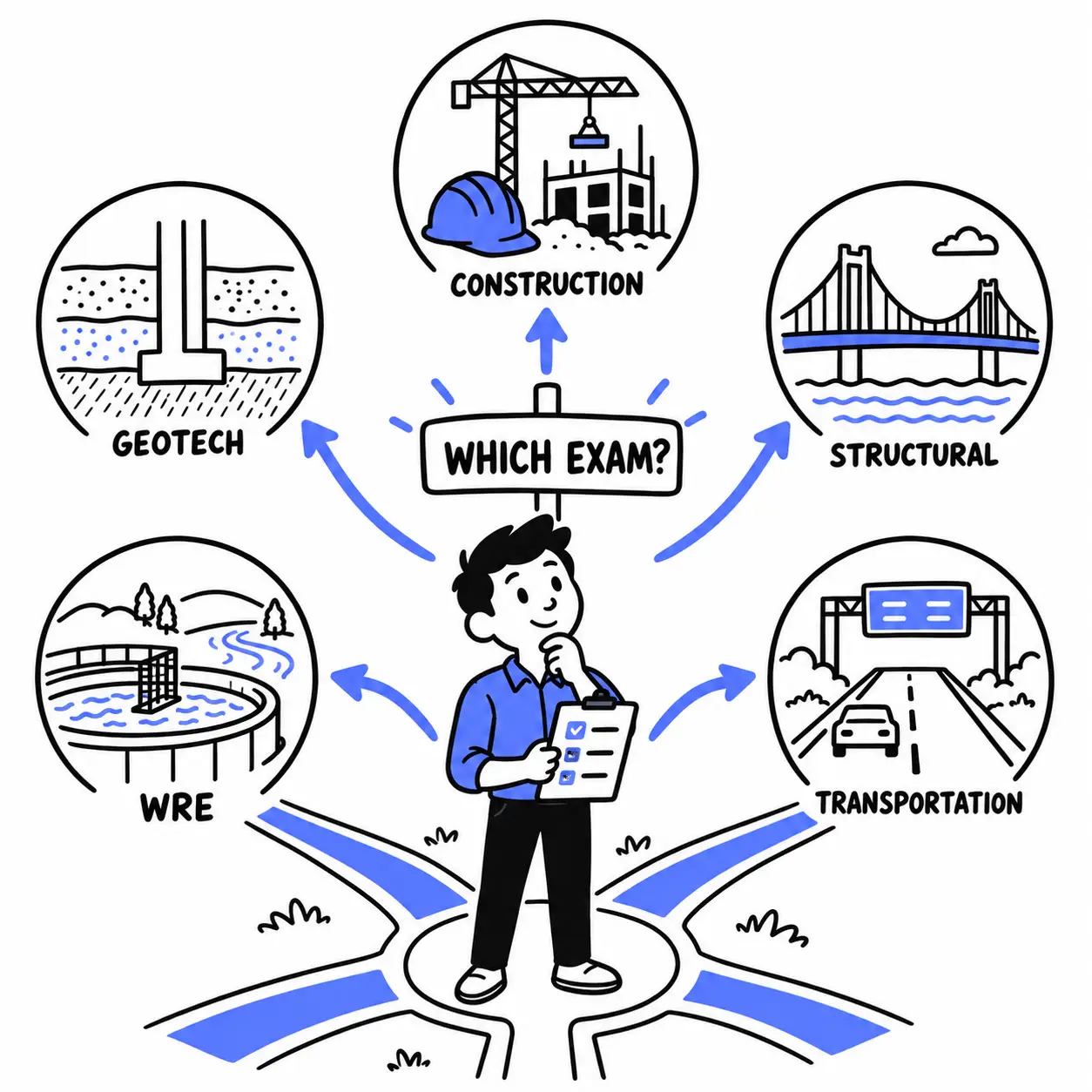
Which PE Civil discipline should you take? Choose the discipline that matches your professional experience, the work you want to perform, and the official NCEES exam specification you will use. The five options are Structural, Geotechnical, Transportation, Water Resources and Environmental, and Construction. They share the same computer-based testing format, but their blueprints, reference standards, and technical decisions differ substantially.
The latest NCEES pass-rate table is useful context, but it should not decide your discipline by itself. A higher reported rate can reflect the candidate population and testing period rather than an easier exam. The strongest choice is usually the exam whose blueprint looks most like the work you already understand and the work you want your license to support.
Quick answer for choosing a PE Civil discipline
Start with the civil engineering work you can describe in specific terms. Structural is centered on loads, forces, materials, component design, detailing, and temporary structures. Geotechnical is centered on site characterization, soil and rock behavior, groundwater, retaining structures, and foundations. Transportation is centered on traffic, roadway geometry, pavement, drainage, and traffic control. Water Resources and Environmental is centered on hydrology, hydraulics, water quality, drinking water, wastewater, and sitework. Construction is centered on estimating, planning, scheduling, quality control, means and methods, construction loads, and safety.
If your experience crosses disciplines, compare the official topic areas and select the specification that best matches your dominant responsibilities. Before registering, confirm that the discipline and experience path meet the requirements of your licensing board. NCEES administers the exam, but state and territorial boards control licensure rules.
PE Civil disciplines at a glance
| Discipline | Official exam focus | Work that commonly aligns | NCEES topic areas in the April 2024 specification |
|---|---|---|---|
| Structural | Loads, load effects, structural materials, component design, detailing, and temporary structures | Building, bridge, industrial, and other structural design | 5 |
| Geotechnical | Site characterization, soil and rock, groundwater, earth structures, retaining structures, and foundations | Site investigation, foundations, retaining walls, earthwork, and geotechnical design | 10 |
| Transportation | Traffic engineering, roadway geometry, intersections, signals, traffic control, pavement, and drainage | Highway, roadway, traffic, safety, and transportation planning | 10 |
| Water Resources and Environmental | Hydrology, hydraulics, water quality, drinking water, wastewater, groundwater, and project sitework | Stormwater, flood and watershed work, water treatment, wastewater, and hydraulic design | 12 |
| Construction | Estimating, scheduling, quality control, operations, construction-load support, structural mechanics, and safety | Contractor, construction management, field engineering, estimating, and project delivery | 11 |
The topic-area count is a count of named categories in the April 2024 NCEES specifications. It is not a ranking of scope or difficulty. NCEES supplies a range of questions for each category, so a discipline with more named categories does not automatically require more questions or more study time.
What all five PE Civil exams have in common
All five PE Civil disciplines use the same high-level exam appointment. The NCEES Civil exam page describes a computer-based, year-round exam at an NCEES-approved Pearson test center with 80 questions. The appointment is nine hours, including a two-minute nondisclosure agreement, an eight-minute tutorial, eight hours of exam time, and a 50-minute scheduled break. The exam is divided into two four-hour sections, with the scheduled break between them.
The computer-based exam can include traditional multiple-choice questions and alternative item types. NCEES identifies multiple-correct, point-and-click, drag-and-drop, and fill-in-the-blank items. Each item is scored as correct or incorrect; there is no partial credit. The format is shared across the disciplines, while the technical content and supplied references change by discipline.
The reference handbook and the design standards listed for the applicable specification are provided electronically during the exam. Candidates may not bring personal copies of those references. NCEES also states that the electronic reference search is limited to one chapter at a time, which makes reference familiarity part of preparation for every discipline.
Read the NCEES Civil exam page for the current appointment details, registration information, and the specification links that apply to your exam date. Read the NCEES computer-based testing page for the current item types and scoring treatment.
PE Civil pass rates compared
The table below reproduces the latest pass-rate figures displayed by NCEES when this article was reviewed on September 8, 2026. NCEES reports year-round computer-based testing rates for January through June and July through December populations, and it updates the table twice each year. The volume is included because a percentage without its population can be misleading.
| Discipline | First-time volume | First-time pass rate | Repeat volume | Repeat pass rate |
|---|---|---|---|---|
| Construction | 1,000 | 60% | 417 | 38% |
| Geotechnical | 434 | 63% | 201 | 44% |
| Structural | 1,624 | 62% | 847 | 43% |
| Transportation | 1,929 | 61% | 1,097 | 43% |
| Water Resources and Environmental | 2,620 | 71% | 876 | 49% |
These figures describe performance for the reported testing populations. They do not measure the inherent difficulty of a discipline, and they do not predict an individual result. A candidate with strong recent experience in a lower-rate discipline may be better prepared than a candidate choosing a higher-rate discipline with little relevant experience.
Exam date matters in 2026 and 2027
NCEES now separates the Civil exam information into specifications effective before April 2027 and specifications effective beginning April 2027. The discipline names remain the same, but the applicable reference standards and editions can change. A course, practice problem, or article that uses the wrong exam-date specification can mislead a candidate even when the technical topic sounds familiar.
Use the specification and standard list linked from the NCEES Civil exam page for the date you plan to test. The April 2024 specifications below are the basis for the topic-area comparisons in this article. Candidates testing beginning in April 2027 should use the 2027 NCEES specification and its listed references instead of assuming that an older edition applies.
Structural PE Civil exam compared
The Structural exam is the best match for engineers whose work centers on how structures carry loads and how structural components are analyzed, designed, and detailed. The blueprint includes both analysis and design. It also includes temporary structures and other topics, so a comparison that reduces Structural to building calculations misses part of the exam.
Structural exam scope
The April 2024 Structural specification divides the exam into five areas:
| Structural topic area | NCEES question range |
|---|---|
| Analysis of Structures Loads and Load Applications | 12 to 18 |
| Analysis of Structures Forces and Load Effects | 17 to 26 |
| Temporary Structures and Other Topics | 5 to 8 |
| Design and Details of Structures Materials and Material Properties | 10 to 15 |
| Design and Details of Structures Component Design and Detailing | 26 to 39 |
Together, these areas cover load applications and load paths, analysis of forces and effects, structural materials, component design, connections, detailing, and temporary structures. The specification includes the design context for materials such as steel, reinforced concrete, timber, and masonry, along with foundation and retaining-wall applications where they fall within the structural design task.
Who should consider Structural
Structural is a natural starting point for engineers who design or review building frames, bridge elements, industrial structures, structural systems, or structural components. The exam also fits engineers who regularly use structural design standards and move between analysis, member design, and detailing.
If your daily work is primarily subsurface investigation, soil parameters, settlement, slope stability, or foundation capacity, Geotechnical may match your experience more closely. The two disciplines overlap around foundations and retaining systems, but they ask different primary questions: Structural emphasizes how the designed structural system resists actions, while Geotechnical emphasizes how soil and rock respond and how the ground supports or retains the system.
For the April 2024 exam, the NCEES Structural specification lists the design standards and references used for that exam version. Candidates testing under the 2027 specification should use the newer standard list linked by NCEES.
Geotechnical PE Civil exam compared
The Geotechnical exam follows the ground model from investigation through design and construction. It covers soil and rock characterization, laboratory testing, groundwater, earth structures, problematic ground, retaining structures, and shallow and deep foundations. It is broader than a foundation-only comparison suggests.
Geotechnical exam scope
The April 2024 Geotechnical specification divides the exam into ten areas:
| Geotechnical topic area | NCEES question range |
|---|---|
| Site Characterization | 8 to 12 |
| Soil Mechanics Laboratory Testing and Analysis | 8 to 12 |
| Construction Observation Monitoring and Quality Control and Safety | 6 to 9 |
| Earthquake Engineering and Dynamic Loads | 5 to 8 |
| Earth Structures Ground Improvement and Pavement | 9 to 14 |
| Groundwater and Seepage | 4 to 6 |
| Problematic Soil and Rock Conditions | 4 to 6 |
| Retaining Structures ASD or LRFD | 10 to 15 |
| Shallow Foundations ASD or LRFD | 6 to 9 |
| Deep Foundations ASD or LRFD | 10 to 15 |
The ranges are NCEES planning ranges, not a guaranteed question count for a particular appointment. The scope connects field observations and laboratory results to design decisions, so candidates should understand the assumptions behind soil parameters rather than memorizing isolated formulas.
Who should consider Geotechnical
Geotechnical is a strong fit for engineers who work with site investigations, borings, soil and rock reports, earthwork, embankments, ground improvement, groundwater, retaining systems, or foundation recommendations. It also fits engineers whose design decisions depend on settlement, bearing resistance, lateral earth pressure, seepage, or pile behavior.
The Geotechnical and Structural exams share foundation and retaining-wall vocabulary, but their center of gravity differs. Structural asks how a structural component is proportioned and detailed for its actions. Geotechnical asks how the ground responds, how the soil-structure interaction affects performance, and how the foundation or retaining system transfers load to the ground.
Transportation PE Civil exam compared
The Transportation exam is organized around the movement of people and vehicles through a transportation system. It combines traffic engineering with roadway geometry, intersections, signals, traffic control, pavement, geotechnical considerations, and drainage. That combination is why a candidate should compare the full specification instead of preparing from a roadway-design-only outline.
Transportation exam scope
The April 2024 Transportation specification divides the exam into ten areas:
| Transportation topic area | NCEES question range |
|---|---|
| Project Management | 6 to 9 |
| Traffic Engineering Capacity Analysis Transportation Planning and Safety Analysis | 10 to 15 |
| Roadside and Cross Section Design | 7 to 11 |
| Horizontal Design | 8 to 12 |
| Vertical Design | 8 to 12 |
| Intersection Geometry | 7 to 11 |
| Traffic Signals | 5 to 8 |
| Traffic Control Design | 5 to 8 |
| Geotechnical and Pavement | 6 to 9 |
| Drainage | 8 to 12 |
The scope moves from transportation planning and traffic analysis into design decisions for the roadway itself. The reference burden can include transportation standards and manuals such as the Highway Capacity Manual, the Manual on Uniform Traffic Control Devices, and applicable AASHTO and FHWA references. The exact editions depend on the NCEES specification for the exam date.
Who should consider Transportation
Transportation is a natural fit for engineers who work on traffic operations, transportation planning, roadway design, highway safety, intersections, signal timing, pavement, roadway drainage, or construction plans for transportation facilities. It can also fit a multidisciplinary civil engineer whose current projects repeatedly use traffic, roadway, and drainage standards.
If your work is mainly hydrologic modeling, open-channel flow, water treatment, or wastewater, compare WRE first. If it is mainly earth retention, soil behavior, or foundations, compare Geotechnical first. Drainage and pavement create overlap across disciplines, so the decision should follow the dominant design responsibility and the complete blueprint.
Use the NCEES Transportation specification for the April 2024 scope. Candidates testing in 2027 should confirm the applicable 2027 references on the NCEES Civil page.
Water Resources and Environmental PE Civil exam compared
The Water Resources and Environmental exam, commonly called WRE, covers the water cycle and the engineered systems that manage, treat, convey, and protect water. It includes hydrology, closed-conduit and open-channel hydraulics, groundwater, water quality, drinking water, wastewater, materials, soil mechanics, and project sitework.
WRE has the largest number of named topic areas in the April 2024 Civil specifications, with 12. That count describes how NCEES organizes the blueprint; it does not establish that WRE is the hardest or easiest discipline.
WRE exam scope
The April 2024 WRE specification divides the exam into twelve areas:
| WRE topic area | NCEES question range |
|---|---|
| Project Planning | 4 to 6 |
| Soil Mechanics | 3 to 5 |
| Materials | 4 to 6 |
| Analysis and Design | 6 to 9 |
| Hydraulics Closed Conduit | 7 to 11 |
| Hydraulics Open Channel | 7 to 11 |
| Hydrology | 8 to 12 |
| Groundwater and Wells | 4 to 6 |
| Surface Water and Groundwater Quality | 5 to 8 |
| Drinking Water Distribution and Treatment | 6 to 9 |
| Wastewater Collection and Treatment | 7 to 11 |
| Project Sitework | 9 to 14 |
WRE therefore reaches into soil mechanics and sitework, but it is not a substitute for the Geotechnical exam. Its primary application is water and environmental systems: rainfall-runoff relationships, open-channel and pipe flow, groundwater, treatment processes, water quality, collection systems, and site drainage.
Who should consider WRE
WRE is a strong fit for engineers who work on stormwater, flood studies, watersheds, hydrology, hydraulic structures, water distribution, drinking-water treatment, wastewater collection, wastewater treatment, groundwater, or water quality. It can also fit civil engineers whose projects combine hydraulic analysis with site development and drainage.
Candidates who are comparing WRE with Transportation should look closely at the drainage and hydrology boundary. Transportation includes roadway drainage within a transportation system. WRE gives more of the blueprint to hydrology, hydraulics, water quality, and water and wastewater treatment. The right choice depends on which system you design and which standards you use in practice.
Construction PE Civil exam compared
The Construction exam is built around delivering civil work in the field. It includes estimating, planning and scheduling, production and execution quality control, construction operations and methods, support of construction loads, structural mechanics, soil mechanics, hydraulics and hydrology, site layout, material properties, and health and safety.
Construction especially emphasizes how work is planned, priced, sequenced, executed, inspected, and kept safe. That emphasis distinguishes it from the design-centered framing of Structural, Geotechnical, Transportation, and WRE, although the Construction blueprint still includes technical design and analysis topics.
Construction exam scope
The April 2024 Construction specification divides the exam into eleven areas:
| Construction topic area | NCEES question range |
|---|---|
| Soil Mechanics | 6 to 9 |
| Site Layout and Development | 5 to 8 |
| Material Properties | 5 to 8 |
| Estimating Quantities and Costs | 6 to 9 |
| Project Planning and Scheduling | 7 to 11 |
| Material Production and Execution Quality Control | 7 to 11 |
| Structural Mechanics | 7 to 11 |
| Hydraulics and Hydrology | 4 to 6 |
| Construction Operations and Methods | 9 to 14 |
| Design for Support of Construction Loads | 10 to 15 |
| Health and Safety | 4 to 6 |
Construction Operations and Methods plus Design for Support of Construction Loads account for a combined NCEES range of 19 to 29 questions, or approximately 24% to 36% of an 80-question exam. That is a substantial emphasis, but it is not a fixed one-third of every appointment. Temporary-structure and construction-safety content also appears in other Civil specifications, so the distinction is the depth and combination of construction topics, not exclusive ownership of those subjects.
Who should consider Construction
Construction is a strong fit for engineers who work for contractors, construction managers, design-build teams, owners, or field organizations. Relevant work can include quantity takeoffs, cost estimating, schedules, submittals, quality control, means and methods, equipment and production decisions, temporary support, site layout, and jobsite safety.
If your responsibilities are primarily permanent structural design, compare Structural. If they are primarily soil and foundation analysis, compare Geotechnical. If they are primarily roadway and traffic design, compare Transportation. If they are primarily hydraulic, water, or wastewater design, compare WRE. Construction is the better match when project delivery and field execution are central to your role.
Use the NCEES Construction specification for the April 2024 scope and the current NCEES 2027 link for a later exam date.
Structural versus Geotechnical PE Civil exams
Structural and Geotechnical are the most common close comparison because both can touch foundations, retaining systems, and structural support. The distinction is the engineering system being modeled and the primary design question.
| Comparison point | Structural | Geotechnical |
|---|---|---|
| Primary system | Structural members and systems | Soil, rock, groundwater, and soil-structure interaction |
| Typical design questions | What forces act on the structure, and how should the components and connections be designed and detailed | What ground conditions exist, how will the ground respond, and how should the foundation or retaining system be designed |
| Blueprint center | Loads, load effects, materials, component design, detailing, and temporary structures | Site characterization, soil mechanics, groundwater, earth structures, retaining structures, and foundations |
| Work fit | Building, bridge, industrial, and structural-system design | Site investigation, earthwork, retaining, foundation, and ground-improvement work |
| Main comparison risk | Choosing Structural because a project contains foundations even though the candidate does not perform structural design | Choosing Geotechnical because a project contains a structure even though the candidate does not evaluate ground behavior |
Choose based on the work you perform, not the object being built. A building project can require both disciplines, while an engineer on that project may work in only one of them.
How to choose among all five disciplines
Use the following decision sequence when two or more disciplines appear plausible.
Confirm board eligibility first
Check the requirements of the board where you plan to seek licensure. NCEES describes a common path that includes education, engineering experience, the FE exam, and the PE exam, but individual boards set their own rules and may vary in timing, approvals, and experience documentation. The FE discipline may be relevant to your preparation, but it does not universally determine which PE Civil discipline you must take.
Match the exam to your recent work
List the tasks you have performed, the calculations or decisions you have owned, and the standards you have used. Then compare that list with the complete NCEES specification. Job titles are less useful than actual responsibilities. For example, a project engineer may work in Construction, Transportation, Structural, or WRE depending on the work package.
Use this background comparison for PE Civil Disciplines
| Your strongest recent experience | Discipline to compare first | What to verify before choosing |
|---|---|---|
| Structural analysis and design for buildings, bridges, or industrial systems | Structural | Whether your experience includes the materials, detailing, and temporary-structure topics in the blueprint |
| Site investigation, soil and rock, foundations, retaining, or ground improvement | Geotechnical | Whether your preparation covers construction observation, groundwater, dynamic loads, and both shallow and deep foundations |
| Traffic, roadway geometry, intersections, signals, pavement, or transportation safety | Transportation | Whether you are ready for the full combination of traffic, roadway, drainage, and reference manuals |
| Hydrology, hydraulics, stormwater, water quality, drinking water, or wastewater | WRE | Whether your preparation covers treatment, groundwater, open-channel flow, closed-conduit flow, and sitework |
| Estimating, scheduling, quality control, means and methods, field engineering, or construction safety | Construction | Whether your preparation covers technical topics as well as project delivery, construction loads, and safety |
The "compare first" column is a starting point, not a licensure determination. If your experience is evenly divided, compare the question ranges, reference standards, and your ability to solve representative problems under the exam format.
Compare blueprint fit before pass rate
Pass rates can help you understand the current testing population, but they do not tell you which discipline matches your background. Start with the official topic ranges. Then review a representative set of problems from each plausible discipline and note whether you can identify the governing concept, locate the applicable reference, and set up the solution without relying on guesswork.
Compare standards and reference navigation
Each discipline has its own design standards and reference manuals. Compare the references for your exam date and practice navigating the electronic versions that NCEES provides. A candidate who knows the subject but cannot locate the governing provision efficiently may lose time, while a candidate who studies only a familiar older edition may prepare for the wrong requirements.
Compare the work you want after licensure
The PE discipline should support the engineering work you expect to perform and take responsibility for. Consider the type of calculations, plans, specifications, reviews, and decisions you want your license to support. When the choice remains close, use the discipline that keeps your near-term work, official blueprint, and preparation materials aligned.
Is one PE Civil discipline easier
There is no universal easiest PE Civil discipline. A discipline may feel more manageable when its subject matter is familiar, its reference standards are current in your daily work, and its problem types resemble work you have already performed. The same discipline can feel unfamiliar to a candidate from another specialty.
The NCEES pass-rate table cannot establish a permanent difficulty ranking. It reports outcomes for defined testing populations, and the populations and rates change. Use pass rates as context after you compare the blueprint and your experience. Do not switch disciplines solely to chase the highest percentage.
How to compare online PE Civil prep courses
When you compare online courses for different PE Civil disciplines, check whether each course is tied to the correct NCEES specification for your exam date. A useful comparison asks whether the course covers every official topic area, identifies the applicable standards and editions, includes questions across the current computer-based item types, gives practice with electronic reference navigation, and explains how access, support, live sessions, and refunds work.
PEwise currently lists published prep paths for Geotechnical, Water Resources and Environmental, Construction, and Structural. Transportation is listed as planned. The published course catalog states that the courses are $149 for 90 days and that the first two modules are free; availability and terms can change, so confirm the current details on the PEwise course catalog.
The PEwise refund policy describes a policy-qualified Pass Guarantee as one additional three-month access period after the student completes the full core lessons, takes the official PE exam, and provides NCEES results. It is an access extension, not a guaranteed pass and not the same as a refund. PEwise course practice is a preparation environment and is not the NCEES testing platform.
PE Civil disciplines compared FAQs
What are the five PE Civil disciplines
The five PE Civil disciplines are Structural, Geotechnical, Transportation, Water Resources and Environmental, and Construction. NCEES publishes a separate specification and reference set for each discipline.
What are the main differences between the PE Civil disciplines
Structural focuses on structural loads, forces, materials, component design, detailing, and temporary structures. Geotechnical focuses on soil, rock, groundwater, retaining structures, and foundations. Transportation focuses on traffic, roadway geometry, intersections, signals, traffic control, pavement, and drainage. WRE focuses on hydrology, hydraulics, water quality, drinking water, wastewater, groundwater, and sitework. Construction focuses on estimating, scheduling, quality control, construction operations, construction loads, and safety.
Which PE Civil discipline should I take
Take the discipline whose official blueprint most closely matches your recent engineering responsibilities and the work you want to perform after licensure. Confirm your board's eligibility rules, compare the specification and standards for your exam date, and use representative problems to test your readiness.
Which PE Civil discipline is easiest
No discipline is objectively easiest for every candidate. Familiarity with the subject, experience with the applicable standards, and preparation for the full blueprint usually matter more than a simple pass-rate ranking.
Does the FE discipline determine the PE Civil discipline
Not universally. The FE discipline and PE discipline can be related, but state boards control licensure requirements and experience evaluation. Ask the board where you will apply before treating the FE discipline as a restriction.
Which exam should I compare if my work is structural and geotechnical
Compare Structural when you own structural analysis, member design, connections, and detailing. Compare Geotechnical when you own site characterization, soil and rock interpretation, groundwater, settlement, earth pressure, or foundation recommendations. If a project contains both kinds of work, choose the discipline tied to your actual engineering responsibility.
Are all PE Civil disciplines the same length and format
Yes at the high level. Each Civil discipline uses an 80-question, eight-hour computer-based exam inside a nine-hour appointment, with a scheduled 50-minute break. The technical blueprint, reference standards, and question distribution differ by discipline.
Where can I find the official NCEES exam specifications
Start on the NCEES Civil exam page. It separates specifications effective before April 2027 from specifications effective beginning April 2027. Use the specification and standards list for your actual exam date.
What changes if I test beginning in April 2027
Use the NCEES 2027 specification and its reference standards rather than assuming that the April 2024 editions apply. NCEES publishes separate before-April-2027 and beginning-April-2027 links on the Civil exam page. Confirm the applicable version when you register and again when you select preparation materials.
How should I compare PE Civil prep courses across disciplines
Compare specification coverage, standards and editions, realistic computer-based question types, electronic-reference practice, instructor support, access terms, and refund terms. Check the provider's current course page because availability and product details can change. A course should help you prepare for the discipline you selected; it should not be used to decide your discipline without first comparing the NCEES blueprints.
Final recommendation
For PE Civil disciplines compared, the most defensible choice is the discipline that best matches your work and the NCEES blueprint for your exam date. Use Structural for structural systems and components, Geotechnical for ground and foundations, Transportation for traffic and roadway systems, WRE for water and environmental systems, and Construction for project delivery and field execution. Use current NCEES specifications and pass-rate data as decision inputs, then confirm eligibility with your board and select preparation that covers the complete discipline-specific scope.
Keep Reading

How Much Does the PE Civil Exam Cost in 2026?
The PE Civil exam costs $400 through NCEES, but your total budget may be higher after state fees, preparation, travel, and licensing requirements. Learn the real 2026 costs—including California’s $1,150 minimum subtotal—and how to avoid unnecessary expenses.

PE Civil Exam Study Guide: How to Prepare Step by Step
Build your PE Civil study plan step by step. Learn how to schedule, diagnose weak areas, navigate references, use timed practice, and prepare for exam day with Pewise.

PE Exam and License for International Engineers: U.S. Requirements and Pathways
Comprehensive guide for international engineers seeking PE licensure in the United States. Learn about NCEES credential evaluation, state-specific requirements, and proven strategies for success.