Active Recall vs. Passive Reading: Why Highlighting Fails PE Exam Prep
Research shows highlighting and re-reading are among the least effective study methods. Learn why active recall dramatically improves PE exam performance and how to implement it in your preparation.
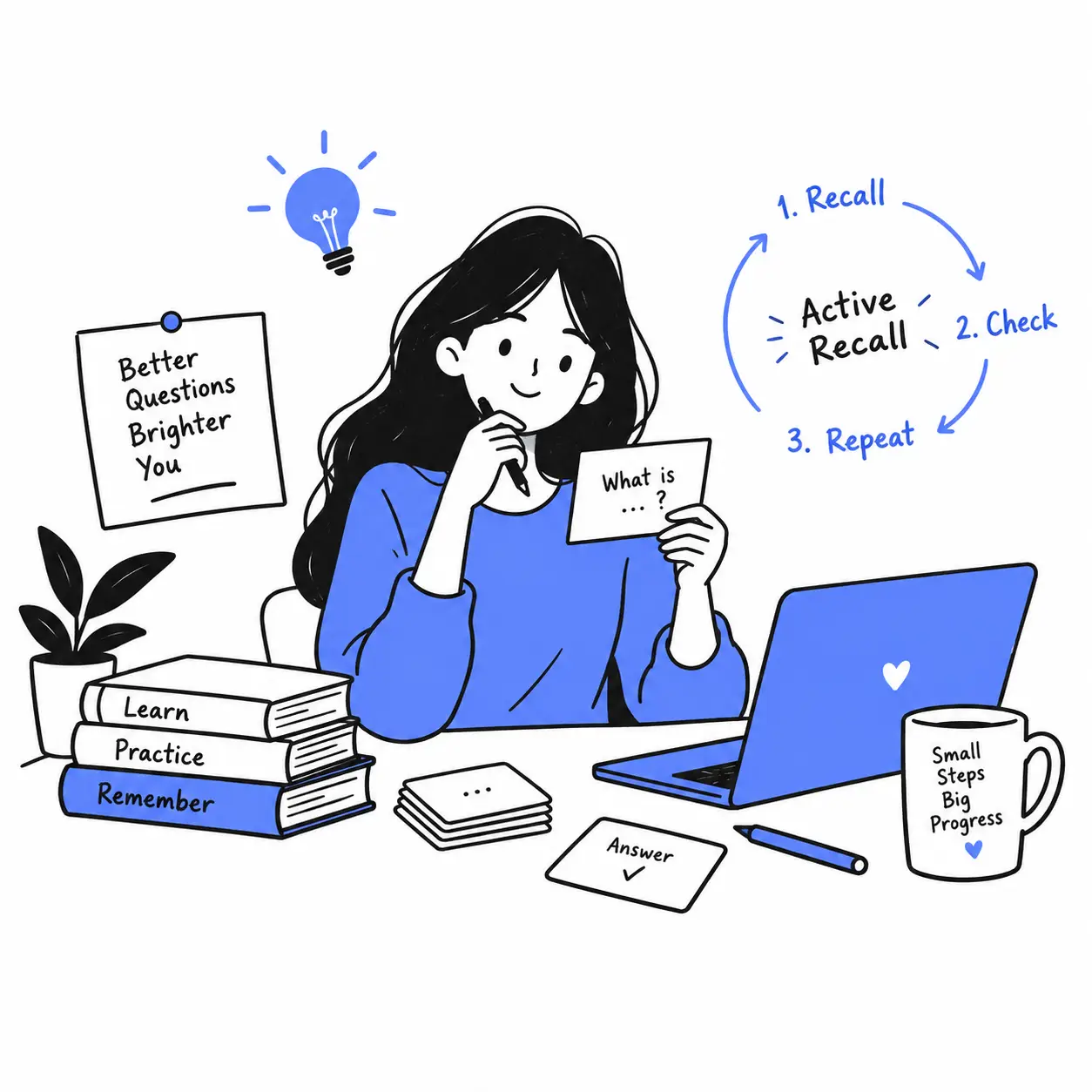
Highlighting can help you identify important material. Rereading can help you regain context. But neither activity tells you whether you can retrieve and apply what you studied when a PE exam problem is on the screen.
That is the purpose of active recall: attempting to retrieve knowledge before checking the answer. For PE exam preparation, active recall is most useful when it goes beyond memorizing facts. It should train you to recognize the problem type, choose a method, locate the governing equation or provision, build a solution, and check the result.
The short answer
Active recall is more effective than passive review when it requires you to produce an answer from memory and then correct it with feedback. For a PE Civil candidate, the highest-value forms of active recall are:
- Solving a problem before reading its solution
- Writing the solution path before searching the references
- Practicing where and how to find equations in the exam-day PDFs
- Converting mistakes into questions and retesting them later
- Mixing related problem types so you must identify the correct method
- Repeating retrieval over several study sessions instead of cramming
Highlighting and rereading are not automatically useless. They become weak study strategies when they replace retrieval, problem solving, and feedback.
What is active recall?
Active recall—also called retrieval practice—means trying to bring information to mind without first looking at the answer. Examples include answering a question, outlining a procedure on a blank page, explaining a concept aloud, or solving a practice problem from scratch.
The important feature is not the tool. A flashcard, quiz, or practice exam supports active recall only when you genuinely attempt the answer before revealing it.
Passive review moves in the opposite direction. You look at information that is already available: rereading a chapter, rewatching a lesson, copying a solution, or scanning highlighted passages. Those activities can support initial learning, but they provide weak evidence that you can retrieve or apply the material later.
Active recall vs. passive reading
| Study behavior | What you do | What it measures | PE exam value |
|---|---|---|---|
| Rereading | Review text or notes again | Familiarity with the material | Useful for orientation; weak as the main study method |
| Highlighting | Mark important words, rules, or equations | Ability to recognize importance while reading | Useful only if highlights become later questions or retrieval prompts |
| Watching a solution | Follow an instructor's completed reasoning | Ability to understand a presented method | Useful for initial instruction; can create false confidence if not followed by independent work |
| Flashcards | Retrieve a fact, definition, trigger, or short procedure | Recall of targeted knowledge | Useful for concepts and decision rules; limited for full calculations |
| Closed-solution problem solving | Solve before viewing the worked solution | Method selection, setup, execution, and checking | High value when the problems match your exam specification |
| Timed mixed practice | Identify and solve different problem types under time constraints | Retrieval, discrimination, reference use, and pacing | High value later in preparation |
The practical conclusion is not “never read.” It is read to learn, then retrieve to test and strengthen learning.
Why passive review feels more effective than it is
Rereading becomes easier with repetition. The terms look familiar, the derivation seems obvious, and the completed solution flows from one step to the next. That fluency can be mistaken for mastery.
The illusion becomes obvious when the notes are closed. Can you identify the governing concept? Can you write the first equation? Can you explain why the method applies? Can you find the required provision in the reference? If not, familiarity has not yet become usable knowledge.
Highlighting has a similar limitation. A highlighted equation shows that you recognized it while reading. It does not show that you can recognize the conditions that call for that equation in an unfamiliar problem.
What the learning research actually shows
A major review by Dunlosky and colleagues rated practice testing and distributed practice as high-utility learning techniques. Highlighting and rereading received low-utility ratings because their benefits were less consistent and less generalizable. That does not mean a single highlight is harmful; it means highlighting alone should not carry your study plan.
In a frequently cited experiment, Roediger and Karpicke found that repeated study supported stronger immediate performance, while retrieval practice produced better retention after a delay. Rowland's later meta-analysis likewise found an overall benefit for testing compared with restudying and reported larger benefits when the initial test required recall rather than simple recognition.
Feedback matters. Research reviewed by Roediger and Butler indicates that retrieval can help without feedback, but checking and correcting the response generally improves learning. For PE preparation, this means a practice problem is not finished when you choose an answer. You should identify why your reasoning was correct or incorrect and what cue should trigger the right method next time.
Spacing also matters. Cepeda and colleagues found broad support for distributing learning over time rather than concentrating it in one session. There is no universal 1-3-7-day schedule that is optimal for every learner or exam date; review intervals should expand when recall is successful and shorten when it is not.
An important limitation
The learning-science literature supports retrieval practice, but much of it studies verbal materials, classroom learning, or laboratory tasks—not PE Civil candidates completing code-based engineering calculations. It does not prove a specific pass-rate increase, a fixed retention multiplier, or a guaranteed score improvement. The most defensible approach is to apply the research principles to PE-relevant tasks and measure whether your own accuracy, method selection, reference speed, and pacing improve.
Why active recall must be adapted for the PE Civil exam
The PE Civil exam is computer-based and currently includes 80 questions. NCEES provides an electronic reference handbook and the design standards listed for the selected discipline. Personal reference materials are not permitted. NCEES also publishes separate Civil specifications for exams taken before April 2027 and beginning in April 2027, so candidates should use the specification that matches their exam date.
Those conditions change what “recall” should mean.
You do not need to treat every supplied equation as a flashcard. Your study system should instead build four kinds of retrieval:
Concept retrieval: What physical behavior or engineering principle controls the problem?
Method retrieval: Which analysis or design procedure applies, and what assumptions limit it?
Reference retrieval: Which handbook section or design standard contains the needed equation, table, or criterion?
Execution retrieval: In what order should you extract the givens, convert units, calculate, and check the answer?
Memorizing a formula without its conditions can be worse than not memorizing it. The goal is to recognize the situation, retrieve the correct approach, and use the supplied reference efficiently.
Seven active recall methods for PE exam preparation
1. Use a closed-solution first attempt
When studying a worked example, cover the solution before reading it. On a blank page, write:
- What is given, with symbols and units?
- What is being asked?
- What principle or failure mode controls?
- Which reference should contain the governing equation or criterion?
- What is the solution sequence?
- What checks would make the result reasonable?
Then solve as far as you can. Compare your work with the solution only after making a real attempt.
If the problem is too difficult to solve independently, do not abandon retrieval. Reveal one step, hide the rest, and continue. This is sometimes called worked-example fading: support is reduced as competence grows.
2. Practice problem setup without completing every calculation
Full calculations are essential, but they are time-consuming. Add short setup drills to increase the number of decisions you practice.
For each prompt, give yourself two or three minutes to identify the topic, list the governing equations or code checks, note the reference location, and outline the sequence. Then check the solution path.
This method is especially useful when two problems look similar but require different methods. It trains method selection rather than calculator endurance.
3. Turn your error log into a retrieval deck
An error log should not be a list you reread. Convert every important mistake into a future question.
Instead of writing:
Forgot the groundwater correction.
Write:
What clues indicate that groundwater affects this calculation, and where does the correction enter the solution?
Classify each error so you know what to retrain:
- Concept gap
- Wrong method or equation
- Missed condition or exception
- Reference-location problem
- Unit conversion
- Calculator entry
- Algebra or arithmetic
- Misread prompt
- Time-management decision
Retest the question later without looking at the original solution. A corrected mistake becomes durable learning only when you can retrieve the correction in a new session.
4. Run reference-location drills
Because the PE Civil exam supplies searchable electronic references, navigation is part of performance. Pick a topic and answer three questions:
Which document controls?
Which search terms lead to the relevant section?
What nearby definitions, limitations, or table notes could change the answer?
Do the drill with the handbook and the exact editions of the design standards listed in the specification for your exam date. Avoid building a workflow around personal notes that will not be available in the testing environment.
For more on the computer-based format, read PE Civil Exam Format: How the CBT Exam Works.
5. Explain the method aloud
After solving a problem, close the solution and explain:
- Why this method applies
- Why a plausible alternative does not apply
- What each variable represents
- Which assumptions are being made
- What change in the givens would require a different method
If the explanation becomes vague, you have found a gap. Reopen the source, correct the gap, and explain it again in precise language.
6. Mix related problem types
Blocked practice—solving ten nearly identical problems in a row—can help you learn a procedure. But it also tells you which procedure to use before you read the question.
Once the basics are stable, mix related topics. A geotechnical session might alternate among effective stress, consolidation, bearing capacity, earth pressure, and seepage. A mixed set forces you to diagnose the problem before solving it.
Begin with blocked practice when a method is new. Progress to mixed practice when you can complete the basic procedure accurately.
7. Use timed practice exams as retrieval plus diagnosis
A timed PE Civil practice exam should do more than produce a score. It should reveal:
- Which topics you identify slowly
- Which reference searches fail
- Which errors repeat
- Whether you spend too long on low-probability attempts
- Whether accuracy changes under time pressure
After the exam, redo missed and uncertain questions without the solution. Then study the governing concept, write a retrieval prompt, and solve a related problem later. The review process is where much of the learning occurs.
A 45-minute active recall study session
Use this structure when you have limited time after work:
Minutes 0-5: Retrieve the plan
Without notes, write the concepts, equations, and reference sections you expect to use.
Minutes 5-25: Solve
Complete one substantial problem or a small set of related questions. Keep the solution hidden. Use only the references you intend to practice with.
Minutes 25-35: Check and diagnose
Compare your method and answer with the solution. Label each error by type. Do not record only “careless mistake”; identify the decision that allowed the error.
Minutes 35-42: Correct from a blank page
Close the solution and reconstruct the correct approach. If you still cannot produce it, reduce the problem to a smaller retrieval prompt.
Minutes 42-45: Schedule the next retrieval
Add the missed concept or problem type to your next review session. Increase the interval after successful recall; shorten it after an unsuccessful attempt.
How to combine active recall with spaced practice
Spacing does not require a complicated app. Use a simple review queue:
- New or failed: Review in the next study session
- Correct with difficulty: Review after a short interval
- Correct and well explained: Review after a longer interval
- Correct in mixed, timed practice: Keep it in periodic cumulative review
The interval matters less than the behavior: retrieve first, check second, and revisit the material after some forgetting has begun.
Flashcard software can automate scheduling for definitions, conceptual triggers, units, and short procedures. Do not force multi-page calculations onto flashcards. Use practice problems for multi-step application.
How to measure whether your study method is working
Hours studied and pages highlighted are input measures. Track performance measures instead:
- First-attempt accuracy by NCEES specification topic
- Percentage of problems for which you select the correct method before checking notes
- Time to locate the governing reference
- Frequency of repeated error types
- Accuracy on previously missed problems after a delay
- Accuracy and pacing on mixed, timed sets
- Confidence calibration: how often “confident” answers are actually correct
Review the trend every one or two weeks. If total accuracy rises but the same conceptual error repeats, the score is hiding a weakness. If untimed accuracy is strong but timed accuracy collapses, shift some practice toward reference navigation and decision speed.
Common active recall mistakes in PE Civil exam prepration
Using flashcards for everything
Flashcards are efficient for compact knowledge. They are not a substitute for analyzing and solving full engineering problems.
Revealing the answer too quickly
Retrieval requires an honest attempt. If you reveal the solution immediately, you return to passive review. When completely stuck, reveal the smallest useful hint and continue.
Practicing errors without feedback
Repeatedly retrieving a wrong rule is not productive. Check the answer against the governing source, correct it, and retrieve the corrected version again.
Memorizing equations without applicability conditions
For every equation, ask what the variables mean, which assumptions apply, and when the equation should not be used.
Repeating only familiar problems
Success on a recognizable problem can reflect memory of the example rather than mastery of the concept. Change the givens, mix topics, and include unfamiliar wording.
Treating difficulty as proof of effectiveness
Effort can support learning, but difficulty alone is not the goal. Retrieval that repeatedly fails without guidance or correction can waste time. Adjust the prompt, use a worked example, and rebuild toward independent performance.
Frequently asked questions
Is active recall useful for the PE exam?
Yes, when it is adapted to engineering application. Solving unseen problems, outlining solution methods, retrieving reference locations, and correcting mistakes are more relevant than memorizing isolated facts.
Should I memorize formulas for the PE Civil exam?
Do not make blanket formula memorization your goal. NCEES supplies an electronic handbook and the specified design standards. Learn to recognize which relationship applies, understand its limitations, and locate it efficiently. Some frequently used relationships may become memorized naturally through practice.
Is highlighting a waste of time?
Not necessarily. Highlighting can identify material that deserves attention, but it is a weak endpoint. Turn a highlight into a question, close the source, retrieve the idea, and apply it to a problem.
How often should I use active recall?
Use it in most study sessions after the initial explanation. Review missed or difficult material sooner and well-retrieved material later. Your exam date, baseline knowledge, and performance should determine the schedule.
Are practice problems active recall?
They are when you attempt the method and answer before seeing the solution. Copying or following a worked solution is guided study, not retrieval practice.
What is the best active recall method for engineering problems?
Closed-solution problem solving is usually the most direct method. Combine it with short setup drills, reference-location practice, error-log questions, mixed sets, and timed exams.
Build a study system that produces evidence
A good study session should leave you with more than completed pages. It should tell you what you can retrieve, what you can apply, where your reasoning breaks, and what to practice next.
Use passive review to encounter and clarify a concept. Then close the material, retrieve the method, solve the problem, check the governing source, and schedule another attempt. That cycle turns familiarity into exam-ready performance.
If you are preparing for PE Civil: Geotechnical, explore the PEwise Geotechnical course for current curriculum details, practice options, free-preview access, and pricing.
Keep Reading

PE Exam Anxiety: How to Manage Stress Before and During the PE Civil Exam
PE exam anxiety is manageable when you reduce avoidable uncertainty and rehearse the decisions you will need under pressure. Use this PE-specific plan for study, sleep, pacing, blank-mind recovery, the scheduled break, retakes, and accommodations.
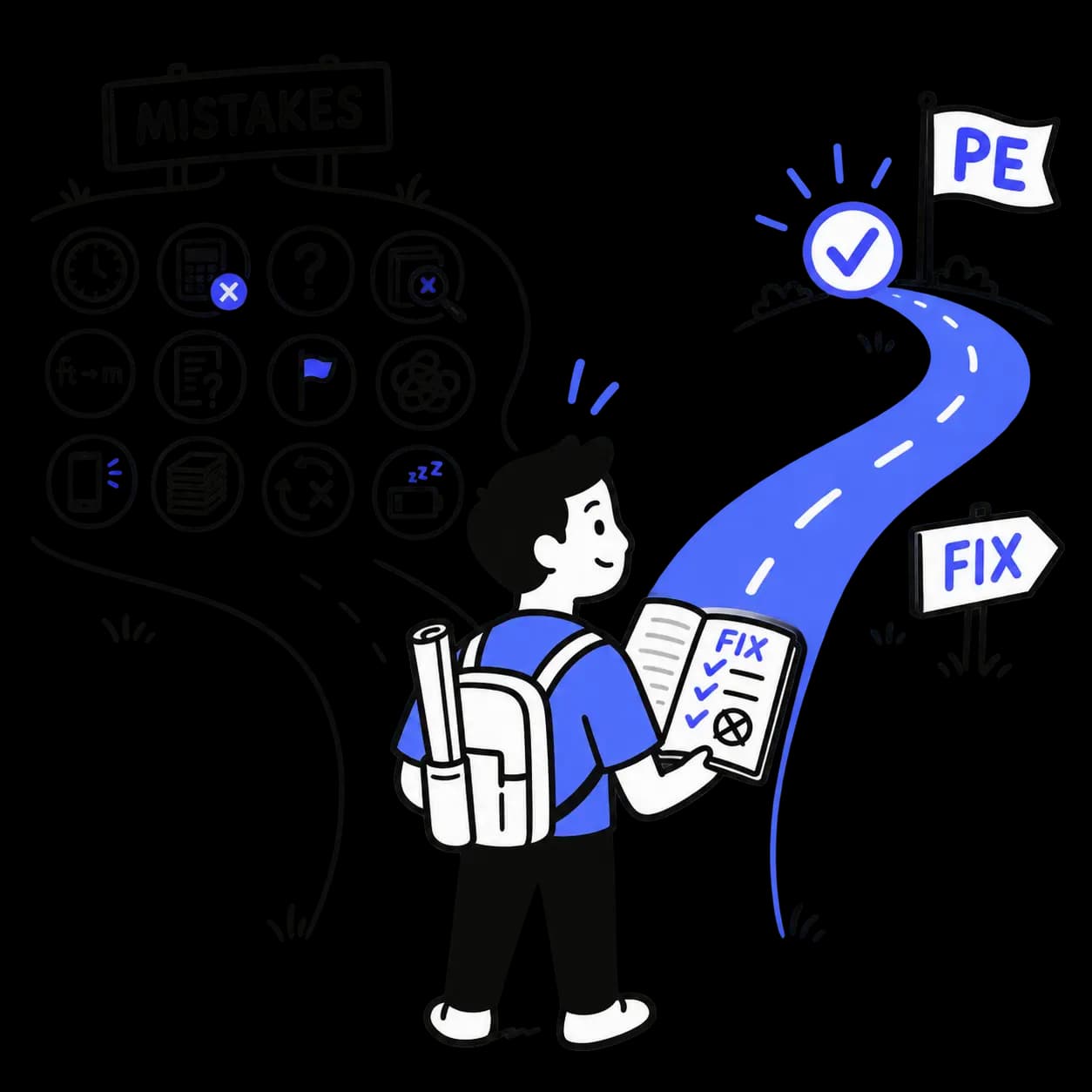
12 Common PE Exam Mistakes and How to Avoid Them
Hard work alone does not guarantee PE exam success. Learn how to avoid 12 common mistakes involving study planning, weak topics, calculations, reference use, pacing, and test-day preparation.

PE Civil Exam Format: How the CBT Exam Works
Master the computer-based PE Civil exam with expert strategies for digital navigation, electronic handbook mastery, and CBT interface optimization. Learn how to leverage technology for exam success.