Best PE WRE Study Materials: Courses, Books, Apps, and Flashcards
Compare PE WRE courses, books, apps, flashcards, practice exams, and free resources. Learn which materials best support concept review, problem-solving practice, reference navigation, and exam readiness.

The best PE WRE study materials are a coordinated stack, not a pile of competing resources. Start with the NCEES specification for your exam date and the reference handbook assigned through MyNCEES. Then choose one primary teaching resource, add varied problem practice and full-length simulations, and use apps or flashcards for recall and error review—not as substitutes for solving engineering problems.
For most candidates, that stack looks like this:
The applicable NCEES PE Civil: Water Resources and Environmental exam specification.
The PE Civil Reference Handbook available in the candidate’s MyNCEES account.
One complete WRE teaching resource, such as a self-paced or live review course.
The official NCEES PE Civil WRE Practice Exam.
One additional source of varied practice problems.
An error log and a small set of self-made flashcards.
At least one additional exam-length timed simulation if the primary course does not provide one.
The right combination depends on your exam date, baseline knowledge, learning style, schedule, and budget. A candidate who needs instruction should not build a plan entirely from practice exams. A candidate who understands the material but struggles with pacing may need simulations, not another lecture series.
Taking the exam in April 2027 or later? NCEES provides separate Civil WRE specification links for exams before April 2027 and beginning April 2027. Use the document listed for your exam date and verify every course, book, and practice exam against it before buying.
| Study need | Best material type | Strong starting options | Why it belongs | Watch-out |
|---|---|---|---|---|
| Define the exam scope | Official NCEES specification | The Civil WRE specification for your exam date | Identifies knowledge areas, approximate question ranges, and supplied design standards | Do not use the wrong effective-date document |
| Learn the supplied references | Official electronic reference | The PE Civil Reference Handbook in MyNCEES | Builds equation-location and PDF-search fluency | The handbook is a reference, not a teaching textbook |
| Learn or relearn concepts | Complete WRE course | PEwise, EET, School of PE, PPI; ASCE or Civil Engineering Academy as alternatives | Provides sequence, explanations, and guided practice | Formats and support differ; one course is usually enough |
| See official publisher practice | Official practice exam | NCEES PE Civil WRE Practice Exam | Introduces the published format, scope, and solution style | One exam is not a full learning system |
| Add problem variety | Current WRE problem book or question bank | PPI WRE materials, School of PE workbooks or question bank, course-based practice | Builds repetition and exposes weak topics | Check the edition and specification date |
| Retain concepts and mistakes | Self-made flashcards | Anki, Quizlet, Brainscape, or paper cards | Useful for concepts, triggers, units, and error prevention | Public decks may be inaccurate or outdated |
| Test readiness | Timed, mixed, full-length simulation | NCEES plus a course or independent WRE simulation | Tests pacing, endurance, reference use, and topic switching | Do not treat a familiar retake as a fresh readiness measure |
If you are still deciding whether you need a course, a useful first step is to try a free PE Civil WRE practice sample or preview the PEwise PE Civil WRE course. A diagnostic is more informative than buying resources based only on popularity.
How we evaluated PE WRE study materials
PEwise publishes this guide and also offers a PE Civil WRE course. That relationship should be clear when you weigh our recommendations.
We compared resources by the job they perform, using seven criteria:
- Specification fit: Does the material identify the NCEES document it follows, and is that document applicable to your exam date?
- Teaching depth: Does it explain why and when to use a method rather than only show an answer?
- Practice quality: Are problems varied, clearly solved, and useful for diagnosing mistakes?
- CBT and reference practice: Does the resource help with electronic-reference navigation, pacing, mixed-topic work, and applicable item formats?
- Feedback and support: Does it provide useful explanations, diagnostics, instructor access, or progress signals?
- Study friction: Can a working engineer use it consistently within the available schedule?
- Value: Does it solve a real weakness without duplicating tools the candidate already owns?
Our competitor descriptions are based on features published by the providers, not a claim that PEwise completed every competing course. We do not use vendor-advertised pass rates to rank resources. Prices, access periods, course inventories, and app features can change; verify them before purchasing.
Start with the materials NCEES actually supplies
Before comparing courses or books, establish which official documents control your preparation.
The NCEES PE Civil exam page describes the exam as computer-based and states that the electronic PE Civil Reference Handbook and the design standards listed in the applicable exam specification are supplied during the exam. Personal books, notes, and flashcards may help you study, but you cannot bring them into the testing room.
That makes three official resources especially important.
1. The NCEES specification for your exam date
The specification is your scope map. It lists knowledge areas and approximate question ranges; it also identifies separately supplied design standards.
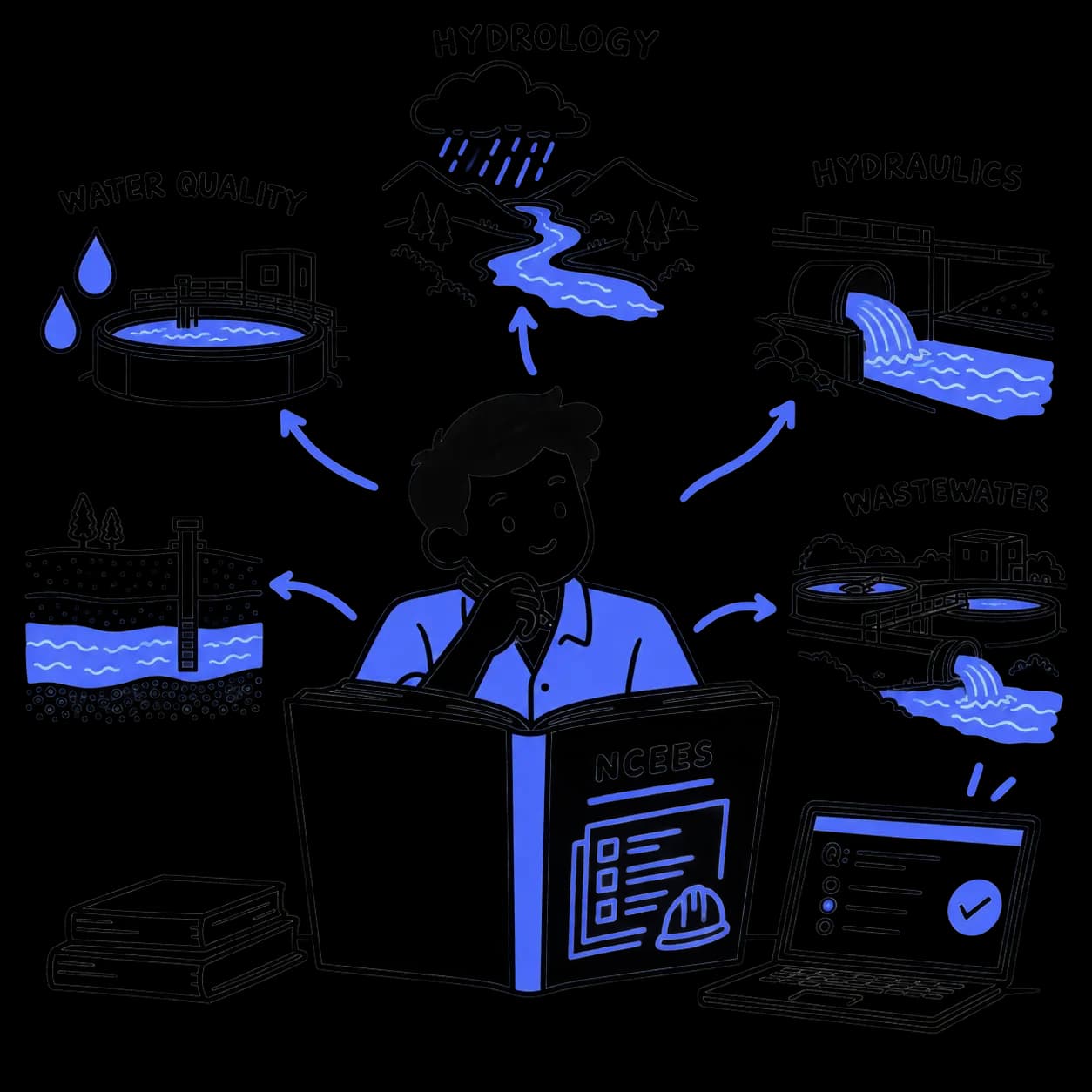
For exams before April 2027, use the Civil WRE CBT specification effective beginning April 2024. It describes an 80-question exam appointment with both SI and U.S. Customary units. Its knowledge areas include project planning, soil mechanics, materials, analysis and design, closed-conduit hydraulics, open-channel hydraulics, hydrology, groundwater and wells, water quality, drinking-water systems and treatment, wastewater collection and treatment, and project sitework.
For exams beginning in April 2027, use the separate Civil WRE document linked by NCEES for April 2027. Do not assume that a course or book labeled “current” automatically applies to that administration. Compare its stated scope and standards to the NCEES document yourself.
The specification tells you what may be assessed. It does not teach the material, provide a complete equation set, or tell you how many hours to spend on each topic.
2. Your assigned PE Civil Reference Handbook
Download the handbook from your own MyNCEES account. That copy is the authority for the version assigned to you.
Do not build your plan around a handbook version number quoted in an old blog post, online forum, or file name. Instead, practice searching the actual PDF available in your account. Learn the vocabulary that leads to the relevant section, how tables and equations are organized, and what information is not included.
The handbook is not a review manual. It gives you reference information, but it does not replace conceptual instruction or repeated problem solving.
3. The official NCEES practice exam
NCEES currently describes its PE Civil: Water Resources and Environmental Practice Exam as an 80-question PDF with solutions, including alternative item types, produced for the specification that took effect in April 2024.
That makes it a sensible baseline resource for most candidates taking the corresponding exam. Use it to become familiar with official publisher terminology, scope, and solution presentation. Preserve it for a meaningful checkpoint rather than casually reading every answer at the beginning of your study period.
If your exam is in April 2027 or later, check the NCEES product page for an updated edition before purchasing or relying on an older copy.
What a complete PE WRE study stack must do
A useful study plan has five functions. One resource rarely performs all five equally well.
Teach unfamiliar concepts
WRE candidates often have uneven backgrounds. A water-resources engineer may be comfortable with hydrology and pipe flow but need more work in drinking-water treatment, wastewater, soil mechanics, or sitework. An environmental engineer may have the opposite pattern.
A course or review manual should close those knowledge gaps with explanations and worked examples—not just present formulas.
Build method-selection and reference-navigation skill
Knowing an equation exists is different from recognizing when it applies. Practice should make you identify the method, assumptions, required inputs, expected units, and relevant reference location before calculating.
Because the exam uses electronic references, your study sessions should also include PDF search and navigation. A personal summary sheet may help you learn, but it cannot replace working with the supplied-reference environment.
Create varied practice
Repeating the same worked example until it feels familiar can create false confidence. You need problems that vary the givens, required output, units, context, and method choice.
Topic-focused sets are useful early. Later, mix topics so you must decide which approach applies without a chapter heading giving away the method.
Expose weaknesses
A good question bank, quiz system, or error log should show more than a percentage score. Classify misses by cause:
- Concept gap
- Wrong method selection
- Reference-navigation delay
- Unit or conversion error
- Calculator entry
- Misread wording
- Time pressure
That diagnosis tells you what to add to the stack. More lectures will not fix a pacing problem, and more flashcards will not fix weak multi-step calculation skill.
Confirm pacing and endurance
Full-length, timed practice is where the separate parts of preparation come together. It tests sustained concentration, topic switching, reference use, question triage, and recovery after a difficult item.
Do not wait until the final weekend to discover that you can solve individual problems but cannot maintain your process across an exam-length session.
Best PE WRE courses by learning need
The best course is the one that solves your largest preparation problem in a format you will use consistently. The options below are categorized by learning need, not by a claim that one provider is ideal for everyone.
For a detailed vendor-to-vendor analysis, see our complete PE WRE course comparison.
Best for focused self-paced visual preparation: PEwise
The PEwise PE Civil WRE course is a strong fit for candidates who want focused self-paced lessons, integrated quizzes and exams, and recurring access to the course creator without the time commitment of long scheduled lectures.
As verified on August 27, 2026, the published course page lists:
- 35 modules and 580 published lesson topics
- 40 published quizzes with 127 questions
- Two active 80-question practice exams in a timed CBT-style interface
- Weekly PE Power Hour on Wednesdays at 6 p.m. Pacific Time
- Two preview modules
- 90 days of access
- A current enrollment price of $149
PEwise’s published Pass Guarantee is conditional. For an eligible student who completes the stated requirements, takes the official exam, and submits qualifying NCEES results, the remedy is one additional three-month access period—not a refund. Review the current refund and Pass Guarantee policy before enrolling.
Best fit: Busy professionals who prefer short visual lessons, self-paced study, and weekly live support.Tradeoff: A self-paced format still requires the candidate to create and protect a weekly schedule.May still need: The assigned NCEES references and, depending on individual performance, an additional source of varied problems.
Best for extensive scheduled live instruction: EET
EET’s Water Resources and Environmental course offers live-webinar and on-demand paths. Its live format is a natural fit for candidates who want substantial instructor-led class time, a defined calendar, and real-time interaction.
Best fit: Candidates who learn well in longer lectures and want external schedule pressure.Tradeoff: The larger time and financial commitment may be unnecessary for someone who needs targeted practice rather than comprehensive reteaching.May still need: Independent full-length readiness checks and deliberate practice using the candidate’s assigned electronic references.
Best for package flexibility and integrated study tools: School of PE
School of PE’s WRE collection includes live and on-demand preparation, workbooks, a question bank, and mobile access. Its course pages emphasize progress tracking and Instructor Connect for eligible formats.
Best fit: Candidates who want several package formats and an integrated platform.Tradeoff: The number of products and access options makes it important to identify what is included in the exact package being considered.May still need: A clear plan for avoiding overlap among the course, workbooks, question bank, and outside practice exams.
Best for a large traditional prep ecosystem and diagnostics: PPI
PPI’s PE Civil WRE materials connect courses, review materials, practice books, diagnostics, and a question bank. This ecosystem can suit a candidate who wants a conventional, resource-heavy program with substantial practice infrastructure.
Best fit: Candidates who value a large bank of traditional review and practice resources.Tradeoff: More material is not automatically more efficient; candidates need a plan for deciding what to complete and what to skip.May still need: A realistic weekly sequence that prioritizes weak areas rather than treating every page as equally valuable.
Alternative: ASCE’s session-based on-demand review
ASCE describes its PE Civil WRE on-demand review as more than 22 hours across nine sessions, with handouts, practice problems, instructor contact by email, study-plan guidance, and six months of access.
Best fit: Candidates who want a relatively compact professional-society review.Tradeoff: Confirm how much independent question practice and full-length simulation you will need beyond the sessions.
Alternative: Civil Engineering Academy
Civil Engineering Academy offers a civil-focused WRE review course and an 80-question practice exam. Its approach may appeal to candidates who prefer a civil-only provider and want a planned path through review and homework.
Best fit: Candidates who want another civil-specific guided option.Tradeoff: Check the current course scope and any recommended third-party books against the specification for your exam date, especially when older breadth or depth resources are referenced.
Before choosing a course, preview the teaching style when possible. The instructor whose explanation helps you solve the next problem independently is more useful than the platform with the longest feature list.
Best PE WRE books and practice exams
Books work best when each one has a specific role. A compact, current library usually beats a shelf of overlapping editions.
Best first practice exam: the official NCEES WRE Practice Exam
For candidates testing under the specification effective beginning April 2024 and before the April 2027 transition, the official NCEES practice exam is the clearest starting point. It contains 80 questions with solutions and includes alternative item types.
Use it in stages:
Review a small sample early to understand presentation and terminology.
Preserve most of the questions for a timed checkpoint.
Classify every miss by cause, not only by topic.
Rework missed questions without the solution visible.
Use the results to decide whether you need instruction, more problem variety, or faster reference navigation.
Because it is one finite set, it cannot measure improvement indefinitely. Once you remember the questions, your score no longer represents a fresh readiness test.
Best role for a review manual: teaching and consolidation
A current WRE-specific review manual can provide a coherent explanation when the NCEES handbook is too terse and scattered online resources are too inconsistent.
One candidate is PPI’s PE Civil Water Resources and Environmental Review Manual, marketed for the 2024 NCEES PE Civil WRE exam. Before buying, confirm the exact edition, table of contents, errata, and specification claim on the publisher’s current product page.
Use a review manual to:
- Relearn weak concepts
- See worked applications
- Connect related subtopics
- Build vocabulary for searching the supplied references
- Identify assumptions and method-selection cues
Do not spend weeks passively reading from the first page to the last. After each short review block, solve problems without copying the example’s steps.
Best role for a problem book or question bank: variation
Your additional practice source should make you retrieve and apply concepts in unfamiliar forms. PPI offers WRE practice materials, while School of PE lists WRE workbooks and a question bank. Course platforms may also include topic quizzes and mixed exams.
Compare any practice source using these questions:
- Which NCEES specification does it claim to follow?
- Does the topic distribution match your applicable blueprint?
- Does it use both SI and U.S. Customary units where appropriate?
- Are solutions detailed enough to diagnose a wrong method, not just a wrong number?
- Are corrections or errata published?
- Are questions sufficiently varied, or are they slight rewrites of one template?
- Can you practice selecting and searching the electronic references rather than relying on a chapter summary beside the problem?
Problem count alone is a weak quality measure. One hundred varied problems with instructive solutions can be more valuable than hundreds of repetitive questions.
Are older PE WRE depth and breadth books still useful?
Sometimes—but only as supplemental problem sources.
The PE Civil exam changed in April 2024 from the former breadth-plus-depth organization to discipline-specific specifications. An older WRE depth book may contain useful hydraulics, hydrology, groundwater, drinking-water, or wastewater problems that overlap with the current scope. An old breadth book may contain relevant project-planning, materials, soil, or sitework problems.
The risk is scope drift. Old books may emphasize topics, methods, references, or an exam structure that no longer applies. They may also omit knowledge areas now present in the WRE specification.
Before using an old problem, map it to a line in your applicable NCEES specification. Then solve it with the references and methods assigned for your exam. If you cannot make that mapping, skip it. Never use a pre-April-2024 table of contents as your current study blueprint.
Best apps for PE WRE study
There is no single app that replaces a complete PE WRE preparation system. Apps are most useful when you assign them a narrow job.
Course and question-bank apps
Some prep providers offer mobile access to videos, quizzes, or question banks. This can turn lunch breaks and commutes on public transportation into useful review time.
Before relying on mobile access, check:
- Whether full course content or only selected features are available
- Whether equations, subscripts, tables, and diagrams render clearly
- Whether progress syncs across devices
- Whether content can be used offline
- Whether explanations are practical on a small screen
- Whether the app supports flagging and reviewing mistakes
Use mobile course access for short lessons and conceptual review. Use a computer and calculator for multi-step problems, electronic-reference practice, and timed simulations.
Flashcard apps
Anki, Quizlet, and Brainscape can all hold PE WRE recall prompts. The important choice is not the logo; it is whether the tool makes it easy for you to create, correct, tag, and repeatedly review accurate cards.
Public PE WRE decks can provide ideas, but they are user-generated unless a qualified author and technical review process are documented. A deck may follow an old specification, omit conditions, use inconsistent units, or contain a confident-looking error. Treat every imported card as unverified until you check it against your assigned references or another controlling source.
Planning and error-log tools
A simple spreadsheet, notes app, or task manager can be more valuable than a specialized exam app. Track:
- Date and source of each problem set
- Topic and subtopic
- Timed or untimed status
- Correct, incorrect, or guessed
- Time spent
- Error category
- Reference location used
- Corrective action
- Date to retry
The best app is the one that makes this loop easy: attempt, diagnose, correct, revisit.
Are flashcards worth using for PE WRE?
Yes—selectively.
Flashcards are good for retrieving compact information. They are not good at reproducing the decision-making and calculation sequence of a full engineering problem.
Good PE WRE flashcard targets
- The difference between similar concepts or methods
- Clues that point toward one analysis approach instead of another
- Treatment-process purpose and sequence
- Common units and dimensional checks
- Definitions of variables and terms
- Assumptions and limitations
- Reference locations and productive PDF search terms
- Mistakes from your own error log
Poor PE WRE flashcard targets
- A formula copied without defining every symbol and condition
- An entire worked problem compressed into one card
- Unverified statements from a public deck
- Memorized constants or tables that you do not understand how to use
- Long cards that test recognition rather than retrieval
Five card formats that build useful recall
Method cue: “What information would make the Rational Method an appropriate option for this problem?”
Distinction: “What clues distinguish a closed-conduit energy problem from a network-analysis problem?”
Unit check: “What dimensions should the requested result have, and which input units must be converted first?”
Reference navigation: “Which search terms lead to this relationship in my assigned reference?”
Error prevention: “What mistake did I make last time, and what check would catch it before I submit an answer?”
Notice that these prompts test judgment, not just formula recitation.
A strong personal deck is usually small and dynamic. Add cards when a missed problem reveals a reusable lesson. Delete or rewrite cards that are ambiguous. If a card cannot be answered without saying “it depends,” add the missing condition to the prompt.
| Study stack | Core components | Best for | Main tradeoff |
|---|---|---|---|
| Lean self-study | Applicable NCEES specification, assigned handbook, official practice exam, one current problem source, error log, and personal flashcards | Candidates with a strong technical baseline and consistent study habits | You own scope control, sequencing, and diagnosis |
| Guided self-paced | Self-paced WRE course, official sources, additional mixed practice, and scheduled simulations | Busy professionals who need structure without fixed lectures | You must enforce your own calendar |
| Live and accountable | Live course, official sources, independent practice, and full-length simulations | Candidates who learn through interaction and external deadlines | Higher cost and less schedule flexibility |
| Retaker diagnostic | Prior performance evidence, targeted instruction, fresh mixed practice, error log, and a new full simulation | Candidates who can identify specific failure modes | Buying more content will not help without a diagnosis |
Lean self-study stack
Choose this path if your diagnostic performance shows that you can learn effectively from written explanations and manage your own schedule. Spend money first on current, high-quality practice—not multiple overlapping review manuals.
Your risk is hidden incompleteness. Audit your study log against every line of the applicable NCEES specification, including topics outside your daily work.
Guided self-paced stack
Choose this path if you need a sequence, explanations, and integrated progress checks but cannot attend long scheduled sessions. Set weekly deadlines and reserve separate blocks for mixed practice and full simulations.
The PEwise WRE course can fill the primary teaching role in this stack. Its two 80-question practice exams also provide exam-length simulation, but you should still use the official references assigned through MyNCEES.
Live and accountable stack
Choose this path if you learn better by asking questions in real time or need an external calendar to keep moving. Before enrolling, compare the live schedule to your work and family obligations. A live course you routinely miss becomes an expensive recording library.
Retaker diagnostic stack
Do not automatically repeat the same plan with more hours. Start with evidence from your prior preparation and any performance information available to you. Identify whether the main issue was incomplete scope, weak fundamentals, method selection, reference speed, pacing, endurance, or inconsistent execution.
Then purchase only the resource that addresses that failure mode. A targeted module and fresh mixed practice may be more valuable than a second full course.
Do not buy both until you know why: Two review manuals may explain the same topics. Two full courses may duplicate hundreds of lessons. Several question banks may repeat familiar templates. Add a second resource only when you can name the gap it will fill.
How to choose your PE WRE materials in 10 minutes
Step 1: Confirm your exam date
Open the NCEES Civil exam page and select the WRE specification applicable before or beginning April 2027. Save that document as the controlling scope for your plan.
Step 2: Diagnose your current position
Complete a mixed set without notes beyond the references you intend to practice with. If you are a retaker, include evidence from your previous preparation.
Step 3: Name the largest gap
Choose one:
- I do not understand several major topics.
- I understand topics but cannot select methods independently.
- I need more varied problems.
- I am too slow with electronic references.
- I struggle with pacing and endurance.
- I know what to do but study inconsistently.
Step 4: Choose one primary resource
- Large knowledge gaps: a complete course or current review manual.
- Method-selection gaps: worked instruction followed by closed-solution practice.
- Practice gaps: a varied question bank or problem book.
- Reference gaps: deliberate PDF-search drills using assigned materials.
- Pacing gaps: mixed timed sets and full simulations.
- Consistency gaps: a live schedule, study partner, or firm weekly plan.
Step 5: Add only what is missing
Check whether your primary resource already includes quizzes, a question bank, full-length exams, instructor access, and mobile review. Do not pay twice for the same function without a reason.
Step 6: Set a re-evaluation date
After your first substantial timed mixed set, review the error categories. Keep, change, or add resources based on evidence—not frustration after one difficult evening.
Our recommended PE WRE study-material stack for most candidates
For most candidates, the strongest stack is:
- The NCEES specification applicable to the exam date
- The assigned PE Civil Reference Handbook from MyNCEES
- One complete teaching resource
- The official NCEES PE Civil WRE Practice Exam
- One additional source of varied problems
- A personal error log and small recall deck
- At least one additional exam-length timed simulation if the primary resource does not include one
PEwise can serve as the teaching and simulation core for candidates who prefer focused self-paced visual lessons plus weekly live access. Its current WRE course includes quizzes and two active 80-question practice exams in a CBT-style study environment. It is a PEwise platform, not the actual NCEES testing interface.
The smartest next step is not necessarily enrollment. First, inspect the curriculum and try the teaching style. Preview the PEwise WRE course or take a free WRE practice sample, then decide whether the course solves the gap your diagnostic exposed.
Frequently asked questions
What study materials do I need for the PE WRE exam?
At minimum, use the NCEES specification for your exam date, the assigned PE Civil Reference Handbook from MyNCEES, a reliable way to learn weak topics, varied practice problems, and an exam-length readiness check. Many candidates also benefit from the official NCEES WRE Practice Exam, an error log, and a small set of self-made flashcards.
Is the NCEES practice exam enough by itself?
Usually not. It is a valuable official practice source, but one 80-question set cannot teach every weak concept, provide unlimited variation, or remain a fresh readiness measure after you remember the questions. Pair it with instruction as needed and additional mixed practice.
Can I pass PE WRE without a review course?
A paid course is not an NCEES requirement. Self-study can work when you can control the scope, learn weak topics accurately, maintain a schedule, practice with electronic references, and evaluate readiness objectively. A course is valuable when it reduces planning friction, closes knowledge gaps, supplies feedback, or provides structure you would otherwise lack.
Are older PE WRE depth books still useful?
They can be useful for extra problems that overlap with the applicable specification, but they should be supplemental. The exam organization changed in April 2024. Map each old problem to the current specification and solve it with the references assigned for your exam. Do not use an old breadth/depth table of contents as your blueprint.
Are Quizlet, Anki, or Brainscape good for PE WRE?
They can be effective containers for your own recall prompts, especially method-selection cues, concepts, units, treatment-process sequences, reference locations, and recurring mistakes. They do not replace calculation practice or full simulations. Treat public PE WRE decks as unverified until every card has been checked against a controlling source.
What PE WRE materials can I use during the exam?
NCEES states that it supplies the electronic PE Civil Reference Handbook and the design standards listed in the applicable exam specification. Personal books, notes, and flashcards cannot be brought into the testing room. Review the current NCEES exam page and Examinee Guide before your appointment because procedures can change.
How do I know whether a PE WRE book is current?
Check the exact edition and publication information, the NCEES specification it claims to follow, its table of contents, listed references, and published errata. Then compare its scope with the NCEES document for your exam date. A new sale listing does not necessarily mean the underlying book is current.
Should I buy multiple PE WRE courses?
Usually not. Begin with one course that matches your learning needs. Add another resource only when performance evidence identifies a gap the first course does not solve. For example, you may need fresh mixed problems or more live support—not another complete set of introductory lectures.
What changes for candidates testing in April 2027 or later?
NCEES provides a separate Civil WRE specification link for exams beginning April 2027. Candidates should use that document to verify the applicable scope and supplied design-standard editions, then confirm that every course, book, and practice exam matches their administration. Do not assume a resource created for the April 2024 specification is automatically current for an April 2027 exam.
Sources and verification
Product facts and external course features in this article were last checked August 2026. Recheck volatile details before purchase.
Keep Reading
PE Water Resources & Environmental Exam Topics: NCEES Specifications Decoded
The NCEES PE WRE specification tells you what the exam covers—but not how to study it. This guide breaks down all 12 topic areas, official question ranges, essential skills and study priorities.

Best PE Civil Structural Study Materials
More study materials don’t always mean better preparation. Discover which books, references, courses, and practice exams you actually need for the PE Civil: Structural exam—and build a focused study system that fits your schedule.

PE Exam Dates and Registration: 2026–2027 Schedule and How to Book
Paid your PE exam fee? Your test date still isn’t booked. Before you build your study plan, learn how exam schedules, board approval, and seat availability affect when you can test. This 2026–2027 guide walks you from registration to a confirmed appointment.