Free PE Civil Exam Study Plan: 12- and 24-Week Schedules
Build a realistic PE Civil study schedule without guessing what to study each week. Download the free planner, choose a focused 12-week plan or a lower-intensity 24-week plan, prioritize topics by published exam ranges and your weaknesses, and track every study session and repeat error in one place.
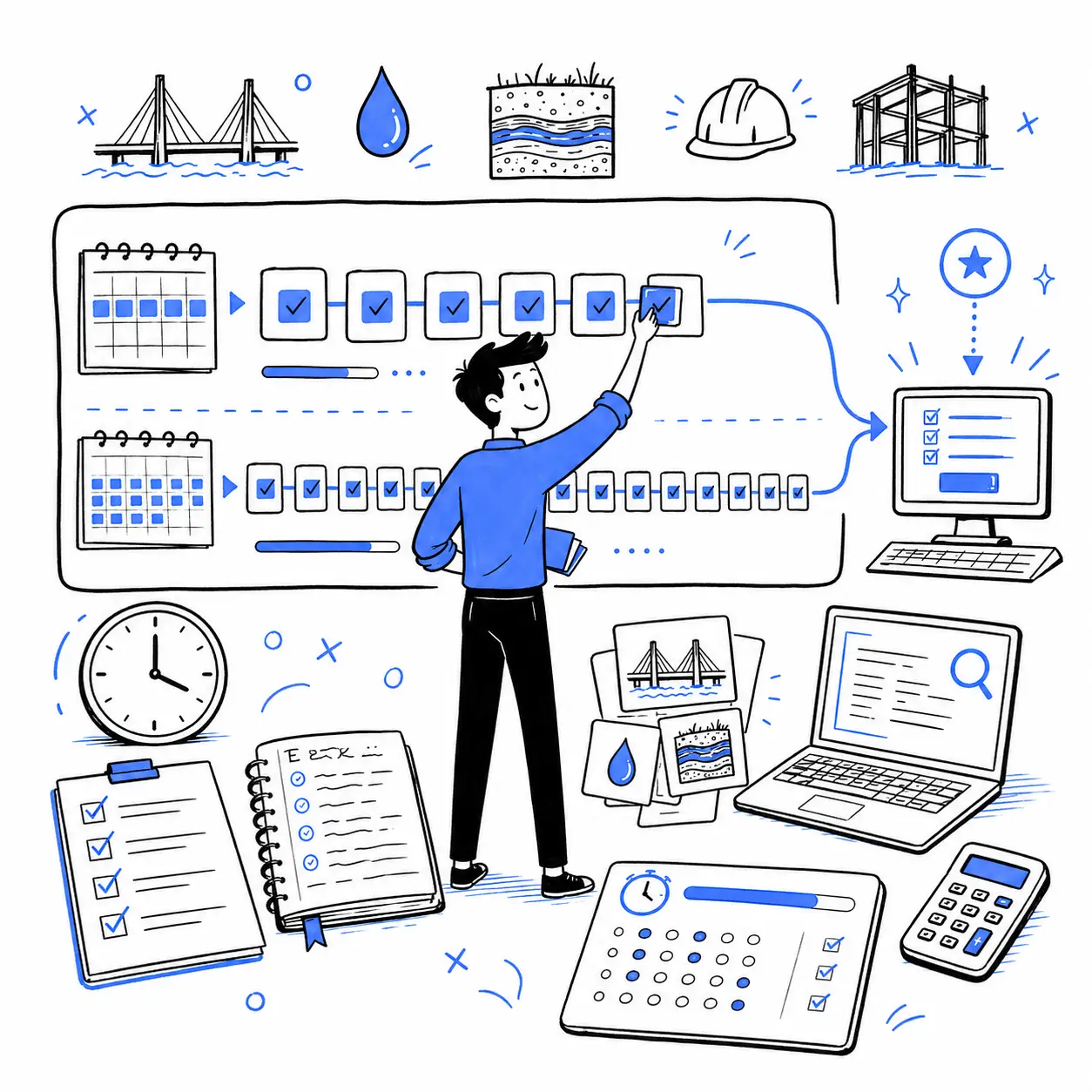
A PE Civil exam study schedule should do more than divide a long list of topics into calendar boxes. It should tell you what to study first, how much work fits into your actual week, when to begin timed practice, and what to change when your results expose a weak area. That is especially important when you are preparing around a full-time engineering job, project deadlines, travel, or family responsibilities.
This guide gives you two complete frameworks: a focused 12-week plan and a lower-intensity 24-week plan. It also ranks the official knowledge areas for Construction, Geotechnical, Structural, Transportation, and Water Resources and Environmental by their published NCEES question ranges. You will still study every listed area, but you will give more time to high-weight topics where your diagnostic work shows weakness.
You can use the free PEwise planner to put the system into practice. The PDF contains a 12-week scheduling log, a 24-week scheduling log, a study-session log, and an error log. Choose the timeline that fits your preparation window, record what you actually complete, and adjust the next week from evidence instead of guilt or guesswork.
Download the free PE Civil Study Planner: Get the 12-week log, 24-week log, session log, and error log in one click. Direct PDF URL: https://pewise.com/pewise-pe-study-planner.pdf · Direct Excel URL: https://pewise.com/pewise-pe-study-planner.xlsx
Choose 12 or 24 Weeks Before You Fill the PE Exam Calendar
There is no official NCEES requirement for a specific number of study hours, and a candidate's years of experience do not convert neatly into a reliable hour target. Someone with ten years in transportation may still need substantial review in drainage or geotechnical topics. A recent graduate may remember core theory but need more speed, reference navigation, and discipline-specific practice. Start with evidence rather than an experience-based formula.
Begin with a mixed diagnostic set drawn from your selected discipline. Use enough questions to touch several knowledge areas and reveal more than content recall. Record whether each miss came from the concept, the setup, arithmetic, units, reference navigation, misreading, or time pressure. Also mark correct guesses and solutions that took too long. Those results show both what you know and what could fail under exam conditions.
| Decision factor | 12-week plan | 24-week plan |
|---|---|---|
| Best fit | About 12 weeks remain; diagnostic foundation is workable; roughly 12-18 sustainable hours per week are genuinely available. | Five to six months remain; knowledge is uneven or rusty; roughly 6-10 sustainable hours per week fit work and family. |
| Main advantage | Creates urgency and a tight feedback loop between learning, practice, and retesting. | Allows more spaced repetition, smaller weekly blocks, and planned recovery weeks. |
| Main risk | Leaves less room for overtime, illness, travel, or unexpectedly slow topics. | Can drift into passive study unless timed work and checkpoints begin early. |
| Practice progression | Diagnostic in Week 1; timed sets by Weeks 4-5; full simulations around Weeks 9 and 11 when suitable exams are available. | Diagnostic in Week 1; timed sets by Weeks 8-10; substantial checkpoints before full simulations around Weeks 21 and 23. |
| Choose it when | You can protect the weekly commitment without sacrificing sleep and can move the appointment if readiness remains weak. | Consistency matters more than intensity, or major gaps need time to rebuild. |
A practical decision rule
Choose the shortest plan that lets you cover every official knowledge area, spend extra time on high-weight weak areas, complete mixed timed practice, review your error log, and arrive rested. If the 12-week plan requires unsustainable hours, removes every recovery buffer, or forces you to trade sleep for study, use the 24-week plan or move the exam date. A longer realistic plan is stronger than an aggressive plan you cannot maintain.
Download the free PE Civil Study Planner: Get the 12-week log, 24-week log, session log, and error log in one click. Direct PDF URL: https://pewise.com/pewise-pe-study-planner.pdf · Direct Excel URL: https://pewise.com/pewise-pe-study-planner.xlsx
Start With the Correct NCEES Specification and References
Before assigning a single topic to a week, open the official NCEES PE Civil exam page and select your discipline. Use the specification and design-standard list that matches your scheduled exam date. NCEES currently provides separate sets for exams effective before April 2027 and exams beginning in April 2027, so a candidate planning across that boundary must not rely on an older saved list.
- Exam-date check: Confirm whether your appointment falls before April 2027 or begins in April 2027 or later. Download the matching discipline specification and design-standard list from NCEES before building your weekly plan.
The PE Civil exam is computer based and offered year round at Pearson VUE testing centers identified by NCEES. The appointment is nine hours: a two-minute nondisclosure agreement, an eight-minute tutorial, eight hours of exam time, and a 50-minute scheduled break. The exam contains 80 questions, so eight testing hours divided by 80 questions equals an average of six minutes per question. Treat that as an overall pacing reference, not a command to spend exactly six minutes on every item.
The exam is closed book. Candidates use the electronic NCEES PE Civil Reference Handbook and the design standards listed for their discipline and exam date. Personal notes, books, and tabbed references are not allowed in the exam room. The handbook copy available through your MyNCEES account controls; do not assume a version number from an old file name or search result.
Build reference navigation into every phase of the schedule. Learn where the governing equations and tables are located, practice searching with the terms you are likely to remember under pressure, and use the same on-screen workflow during timed sets. For more detail, review PEwise's PE Civil computer-based and CBT format testing guide.
Practice electronic references as a problem-solving skill
Reference familiarity is not the same as memorizing page numbers. The search result that works in the PE Civil Reference Handbook may differ from the term used in a problem statement, and a design standard may require you to move from an index or contents page to a table, equation, or exception. During ordinary practice, write down the search term, document, and location that produced the answer. During timed practice, repeat the lookup without using your note. This separates genuine navigation skill from familiarity with one bookmarked solution.
Create short navigation drills that do not require solving a complete problem. Pick five equations, tables, definitions, or design provisions used in the week's knowledge area and locate each one from a blank start. Record searches that fail or produce too many results. Then add the successful term and location to the session log. This keeps reference work active throughout the plan instead of leaving it for a final practice exam, when there may be too little time to change the habit.
Prioritize Topics by Blueprint Weight and Your Weaknesses
NCEES publishes an approximate question range for each knowledge area. Those ranges are the best stable starting point for deciding how much attention an area deserves, but they do not predict the exact number or order of questions on your individual exam. Every listed knowledge area remains in scope. A lower published range means proportionally less time, not permission to skip the topic.
Use the three study tiers below as a first-pass sequence. Tier 1 contains the largest published ranges. Tier 2 contains substantial areas that still deserve planned coverage and repeated practice. Tier 3 contains lower-range areas that must remain on the schedule, especially when diagnostic results show weakness. Within each tier, personalize the order from your results and work experience.
Use an adaptive priority score each week
A simple planning score can combine blueprint weight with recent performance. For each knowledge area, take the midpoint of its NCEES question range and multiply it by one plus your recent error rate. A 10-15-question area has a midpoint of 12.5. If you missed 40% of recent problems in that area, the planning score is 12.5 x 1.40 = 17.5. A 4-6-question area with a 20% error rate scores 5 x 1.20 = 6. The first area receives more of the next week's flexible practice time, but both stay in the plan.
This score is a PEwise scheduling heuristic, not an NCEES formula and not a pass predictor. Recalculate it weekly from recent work. Use it only to divide flexible practice hours after fixed commitments such as diagnostics, simulations, cumulative review, and final taper have already been protected.
Turn the diagnostic into a coverage map
Create one row for every knowledge area in your discipline specification. Add the published question range, diagnostic attempts, misses, correct guesses, average or completion time, and primary error cause. Mark an area as comfortable only when you can choose the method, complete representative problems, and find the required references without heavy prompting. Mark it rusty when the method returns after review, and unknown when you cannot yet identify a workable starting point. This prevents a familiar topic name from being mistaken for exam-ready performance.
Next, reserve nonnegotiable calendar blocks: the initial diagnostic, cumulative checkpoints, full simulations when available, review days, buffer time, and the final taper. Divide only the remaining flexible topic hours with the priority score. Give each Tier 1 and Tier 2 area an initial learning block and a later retrieval block. Place Tier 3 coverage early enough that a weak result can still trigger a repair session. The result is a complete coverage map with deliberate emphasis, not a list in which lower-weight topics silently disappear.
PE Civil Topic Priorities by Discipline
Source control: The tables below use the official NCEES discipline specifications available September 1, 2026, for exams effective before April 2027. Candidates and editors should compare them with the official PDF that matches the scheduled exam date before relying on the ranges.
PE Civil: Construction exam subject priorities and question range
| Study tier | Official NCEES knowledge area | Question range |
|---|---|---|
| Tier 1 | Design for Support of Construction Loads | 10-15 |
| Tier 1 | Construction Operations and Methods | 9-14 |
| Tier 2 | Project Planning and Scheduling | 7-11 |
| Tier 2 | Material, Production, and Execution Quality Control | 7-11 |
| Tier 2 | Structural Mechanics | 7-11 |
| Tier 2 | Soil Mechanics | 6-9 |
| Tier 2 | Estimating Quantities and Costs | 6-9 |
| Tier 3 | Site Layout and Development | 5-8 |
| Tier 3 | Material Properties | 5-8 |
| Tier 3 | Hydraulics and Hydrology | 4-6 |
| Tier 3 | Health and Safety | 4-6 |
Study every listed area. Use tier and recent error data to decide the proportion of flexible practice time.
Construction candidates should begin with support of construction loads and construction operations when those areas are weak, then connect them to planning, quality control, structural mechanics, soil mechanics, and estimating. Avoid studying scheduling, safety, materials, hydraulics, and site work as isolated vocabulary. Use calculation, sequencing, interpretation, and decision problems so the weekly plan reflects the range of tasks in the specification. During review, distinguish a technical-method miss from a failure to locate a requirement in the assigned electronic references.
PE Civil: Geotechnical exam subject priorities and question range
| Study tier | Official NCEES knowledge area | Question range |
|---|---|---|
| Tier 1 | Retaining Structures (ASD or LRFD) | 10-15 |
| Tier 1 | Deep Foundations (ASD or LRFD) | 10-15 |
| Tier 1 | Earth Structures, Ground Improvement, and Pavement | 9-14 |
| Tier 2 | Site Characterization | 8-12 |
| Tier 2 | Soil Mechanics, Laboratory Testing, and Analysis | 8-12 |
| Tier 2 | Construction Observation, Monitoring, QA/QC, and Safety | 6-9 |
| Tier 2 | Shallow Foundations (ASD or LRFD) | 6-9 |
| Tier 3 | Earthquake Engineering and Dynamic Loads | 5-8 |
| Tier 3 | Groundwater and Seepage | 4-6 |
| Tier 3 | Problematic Soil and Rock Conditions | 4-6 |
Study every listed area. Use tier and recent error data to decide the proportion of flexible practice time.
Geotechnical preparation should connect subsurface information to design decisions. Retaining structures, deep foundations, and earth structures carry the largest ranges, but site characterization and soil mechanics supply inputs used throughout those areas. Practice moving from field or laboratory data to parameters, assumptions, analysis, and design checks. Keep groundwater, seepage, earthquake effects, and problematic soil or rock conditions in cumulative sets even when their published ranges are smaller, because weakness in an input can affect several design contexts.
PE Civil: Structural exam subject priorities and question range
| Study tier | Official NCEES knowledge area | Question range |
|---|---|---|
| Tier 1 | Design and Details - Component Design and Detailing | 26-39 |
| Tier 1 | Analysis - Forces and Load Effects | 17-26 |
| Tier 2 | Analysis - Loads and Load Applications | 12-18 |
| Tier 2 | Design and Details - Materials and Material Properties | 10-15 |
| Tier 3 | Temporary Structures and Other Topics | 5-8 |
Study every listed area. Use tier and recent error data to decide the proportion of flexible practice time.
Structural has a concentrated blueprint: component design and detailing plus forces and load effects dominate the published ranges. That concentration supports large recurring blocks, but it does not justify postponing loads, materials, or temporary structures until the end. Mix analysis and design so you practice the full chain from load identification and load path to demand, capacity, and detailing. Track whether errors come from mechanics, the selected design provision, load application, units, or the interpretation of a limit state.
PE Civil: Transportation exam subject priorities and question range
| Study tier | Official NCEES knowledge area | Question range |
|---|---|---|
| Tier 1 | Traffic Engineering: Capacity, Planning, and Safety | 10-15 |
| Tier 2 | Horizontal Design | 8-12 |
| Tier 2 | Vertical Design | 8-12 |
| Tier 2 | Drainage | 8-12 |
| Tier 2 | Roadside and Cross-Section Design | 7-11 |
| Tier 2 | Intersection Geometry | 7-11 |
| Tier 3 | Project Management | 6-9 |
| Tier 3 | Geotechnical and Pavement | 6-9 |
| Tier 3 | Traffic Signals | 5-8 |
| Tier 3 | Traffic Control Design | 5-8 |
Study every listed area. Use tier and recent error data to decide the proportion of flexible practice time.
Transportation candidates should pair traffic engineering with geometric design and drainage instead of completing each area once in isolation. Horizontal design, vertical design, roadside and cross-section design, and intersection geometry share data and judgment patterns that benefit from mixed sets. Project management, pavement and geotechnical work, signals, and traffic control have smaller ranges but remain scheduled. Include reference lookups, diagrams, units, and reasonableness checks so speed does not come at the expense of reading the requested condition correctly.
PE Civil: Water Resources and Environmental exam subject priorities and question range
| Study tier | Official NCEES knowledge area | Question range |
|---|---|---|
| Tier 1 | Project Sitework | 9-14 |
| Tier 1 | Hydrology | 8-12 |
| Tier 2 | Hydraulics - Closed Conduit | 7-11 |
| Tier 2 | Hydraulics - Open Channel | 7-11 |
| Tier 2 | Wastewater Collection and Treatment | 7-11 |
| Tier 2 | Analysis and Design | 6-9 |
| Tier 2 | Drinking Water Distribution and Treatment | 6-9 |
| Tier 3 | Surface Water and Groundwater Quality | 5-8 |
| Tier 3 | Project Planning | 4-6 |
| Tier 3 | Materials | 4-6 |
| Tier 3 | Groundwater and Wells | 4-6 |
| Tier 3 | Soil Mechanics | 3-5 |
Study every listed area. Use tier and recent error data to decide the proportion of flexible practice time.
Water Resources and Environmental candidates should build connections among sitework, hydrology, closed- and open-channel hydraulics, wastewater, drinking water, and analysis and design. Many misses that appear to be calculation errors begin with the wrong flow condition, boundary assumption, unit system, or treatment-process relationship. Use mixed practice to identify which model applies before calculating. Keep water quality, planning, materials, groundwater, wells, and soil mechanics visible through short retrieval blocks after their first coverage.
These tables replace a week-by-week inventory tied to changing course module counts. They remain useful even when PEwise adds, reorganizes, or renames lessons because the organizing framework is the official exam specification. If you use a course, book, or problem bank, map each resource back to these knowledge areas rather than assuming its chapter order is your ideal study order.
The 12-Week PE Civil Study Schedule
The 12-week plan is a focused build. It moves quickly from diagnosis to high-weight topic work, introduces timed sets early, and reserves two late checkpoints for full simulations when suitable practice exams are available. The plan assumes you have already selected the correct discipline and exam-date specification.
| Week | Focus | Candidate actions | Planner output |
|---|---|---|---|
| 1 | Set the baseline | Confirm the exam-date specification and listed standards. Block sustainable study time. Complete a mixed diagnostic and rate each area as comfortable, rusty, or unknown. | Baseline and calendar |
| 2 | Tier 1 topic A | Learn only what is needed to solve problems. Complete targeted untimed work. Start the session and error logs. | Accuracy and error types |
| 3 | Tier 1 topic B | Continue targeted practice. Rework Week 2 errors without notes. Add a short reference-navigation drill. | Repeat-error rate |
| 4 | Tier 1 / Tier 2 | Add timed problem sets and cumulative retrieval from Weeks 2-3. Protect one recovery block. | Timed accuracy |
| 5 | Tier 2 topic cycle | Study the next weighted weak area. Mix new and previously missed problems. Review the error log midweek. | Priority update |
| 6 | Cumulative checkpoint | Take a half-length or substantial mixed timed set. Review every response, including correct guesses and slow solves. | Timing and weak areas |
| 7 | Remaining Tier 2 | Close major specification gaps. Allocate flexible hours using the adaptive priority score. | Coverage check |
| 8 | Tier 3 and integration | Touch every remaining official area. Emphasize common units, reference locations, and cross-topic setup skills. | No skipped areas |
| 9 | Full simulation 1 | Complete an 80-question, eight-hour simulation when an appropriate exam is available. Reproduce the break and electronic-reference workflow. | Full review log |
| 10 | Targeted repair | Rework the largest concept, setup, calculation, unit, reference, and timing weaknesses. Avoid adding low-value passive content. | Error reduction |
| 11 | Full simulation 2 | Take a second simulation or the strongest available mixed timed set early in the week. Review thoroughly and verify logistics. | Readiness evidence |
| 12 | Taper and arrive ready | Add no large new content blocks. Use short retrieval, reference navigation, easy-to-medium problems, sleep, and exam-day preparation. | Final checklist |
Keep the sequence, then replace generic Tier labels with the highest-priority weak areas from your selected discipline.
How to assign topics inside the 12-week plan
After the diagnostic, choose the two highest-scoring Tier 1 areas for Weeks 2 and 3. Use Weeks 4 through 7 for the next highest scores, mixing Tier 1 reinforcement with Tier 2 coverage. Week 8 closes remaining specification gaps, including Tier 3. This prevents the common mistake of spending the first two months on one comfortable major topic and discovering untouched areas near the exam.
A 12-week plan needs cumulative practice. Once an area has been introduced, include at least a few prior-topic problems in later sessions. Relearning the same method after a gap is more valuable than finishing a chapter once and never retrieving it again. By Week 6, your timed sets should contain mixed topics so the first task is identifying the correct approach, not merely performing a method named by the chapter heading.
The 24-Week PE Civil Study Schedule
The 24-week plan uses the same logic at a more sustainable weekly intensity. Its advantage is not twice as much passive content. The extra runway supports smaller topic blocks, spaced rework, deliberate buffer weeks, and a gradual transition from untimed accuracy to mixed timed performance. Keep a visible checkpoint every four to six weeks so the schedule cannot drift.
| Weeks | Phase | Candidate actions |
|---|---|---|
| 1 | Setup and diagnostic | Match the specification to the exam date, reserve study blocks, complete a mixed diagnostic, and create the first priority ranking. |
| 2-4 | Foundations | Build handbook and standards familiarity. Cover the first high-weight weak area and begin short cumulative reviews. |
| 5-8 | Tier 1 cycle | Complete targeted learning and problem practice for the highest-weight areas. Use the session log after every block. |
| 9 | Checkpoint and buffer | Take a substantial mixed timed set, review it, and use remaining time to recover a missed week rather than doubling the next one. |
| 10-13 | Tier 2 cycle A | Cover the next weighted areas. Revisit earlier misses through spaced retrieval and increase timed work gradually. |
| 14 | Cumulative review | Use a half-length or mixed timed exam. Audit specification coverage and reference-navigation speed. |
| 15-17 | Tier 2 cycle B | Close remaining medium-weight gaps and reallocate flexible hours from the current priority score. |
| 18 | Tier 3 coverage | Give every remaining area deliberate coverage. Lower published ranges must not become skipped topics. |
| 19-20 | Mixed timed practice | Shift from isolated topics to mixed sets. Train flag-and-return decisions and complete full-solution review. |
| 21 | Full simulation 1 | Complete a full 80-question, eight-hour simulation when available and create a detailed error-repair plan. |
| 22 | Repair week | Fix the largest error clusters, then retest them without notes. Keep sleep and workload sustainable. |
| 23 | Full simulation 2 | Complete a second simulation or the strongest available mixed timed set early in the week. Confirm logistics and references. |
| 24 | Taper | Use short retrieval, easy-to-medium confidence problems, an error-log scan, logistics, and rest. |
Use Weeks 9 and 14 as decision points: update the priorities, confirm the remaining calendar, and protect the final simulation and taper windows.
Build a Weekly Rhythm That Survives a Full-Time Job
A rigid Monday-to-Sunday calendar can make one missed evening feel like a failed week. Use movable study blocks instead. Decide which outputs must be completed by the end of the week, then place the blocks around your workload. If Tuesday disappears into a deadline, move the block; do not declare the entire week lost.
| Weekly block | Purpose | What to do |
|---|---|---|
| Block 1 | Learn and set up | Open one narrow concept cluster, locate the governing equations or tables, and solve three to five setup problems before checking solutions. |
| Block 2 | Targeted practice | Work problems on the same area, record time and result, and classify each miss. |
| Block 3 | Error rework | Redo missed or guessed problems without the solution. Write a brief prevention rule for repeat errors. |
| Block 4 | Mixed retrieval | Interleave the new area with prior topics so recognition and method selection are trained. |
| Long block | Timed work | Use a weekend or another protected window for a timed set, reference-navigation drill, or full simulation. |
| Weekly review | Plan the next week | Total focused hours, calculate error rates, update priority scores, and place the next blocks. |
Count focused work, not time when a video played in the background or a book remained open beside another task. A useful session ends with an observable output: problems attempted, errors classified, a reference location found, or a timed result reviewed. Protect at least one longer block for cumulative or timed work and one short block for error rework.
Match the study mode to the problem
Use learning resources to close a defined gap, then move quickly into retrieval and application. If the diagnostic shows that you cannot explain a governing principle, review the narrow lesson or reference section and solve a few setup problems. If you understand the concept but choose the wrong method, compare similar problems and write the cue that separates them. If accuracy is acceptable but time is weak, use short timed sets and practice stop decisions. Watching more content is rarely the best repair for a unit-conversion or reference-navigation error.
A balanced block often follows four steps: identify the goal, attempt problems without help, review the full solution and reference path, then retest a fresh problem after a delay. Do not copy a worked solution and count it as an independent success. When a solution introduces a shortcut, verify that you understand the governing method and when the shortcut is valid. The session log should record the level of assistance used so later results are comparable.
Protect your PE Civil study plan from predictable disruptions
- Schedule the hardest block during the time of day when you are most alert, not automatically after the longest workday.
- Tell family or housemates which blocks are protected and which can move. A flexible block still needs a clear boundary.
- Keep one buffer window each week or every few weeks. Do not fill every available hour with new content.
- When work travel or a major deadline is known in advance, reduce new topics and preserve short retrieval plus error-log review.
- Plan sleep and recovery as part of preparation. A schedule that depends on chronic sleep loss is not sustainable.
Use the Session Log to Measure What You Actually Did
The session log turns a planned schedule into usable evidence. Complete it at the end of each study block while the details are fresh. Record the date, planned duration, actual focused duration, topic, study mode, and resource. Then record problems attempted, correct, incorrect, guessed, and unfinished. For timed work, add the completion status or average time.
Finish with one sentence on what improved and one next action. Examples include: 'I can now identify when to use the energy equation, but I still lose time finding minor-loss coefficients' or 'My setup was correct on retaining-wall problems, but unit conversion caused two misses.' This is more useful than writing 'study went well' because it tells you exactly what belongs in a later block.
At the end of the week, compare planned and focused hours. If the gap is large, determine whether the plan was unrealistic or the study blocks were not protected. Do not respond by automatically doubling the next week's hours. Reduce low-value work, use a buffer, or extend the timeline while preserving the important checkpoints.
Use the Error Log to Stop Repeating the Same Miss
A wrong answer is not a complete diagnosis. Two candidates can miss the same problem for entirely different reasons, so the repair should be different. Record the topic and problem source, why the answer failed, the correct method, a short prevention rule, and a retest date. Include correct guesses and answers that required excessive time; they are hidden weaknesses, not clean successes.
| Error type | What it means | Next action |
|---|---|---|
| Concept | The governing principle was not understood. | Relearn the narrow concept, then solve a fresh problem. |
| Setup or method | The topic was recognized, but the wrong equation, model, or sequence was selected. | Write a method-selection cue and compare two similar problems. |
| Calculation | Arithmetic, calculator entry, algebra, sign, or rounding failed. | Redo cleanly and add a calculator or estimation check. |
| Units | SI and USCS units were mixed, a conversion was missed, or the final units were wrong. | Carry units through each line and add a final-unit check. |
| Reference navigation | The formula, table, chapter, or listed standard could not be found quickly. | Record the exact location and repeat a timed lookup. |
| Misread | A qualifier, requested quantity, sign convention, or exception was missed. | Underline the ask and write the requested units before solving. |
| Timing or decision | Too much time was spent, a difficult item was not flagged, or guessing began too early. | Practice a stop rule and flag-and-return sequence. |
| Correct guess | The selected answer hid weak understanding. | Treat it as an error and solve it independently. |
The five-step weekly review
- Total actual focused hours and compare them with the sustainable plan. Exclude passive background time.
- Calculate recent error rate by topic and by cause, including correct guesses.
- Identify repeat errors that survived rework. These take priority over optional new content.
- Update the adaptive priority score and allocate only the next week's flexible practice hours.
- Carry no more than one missed major block forward. Use a buffer or reduce passive work instead of doubling the next week.
Practice Exams, Timing, and the Final Two Weeks
Practice exams are most useful when they change the schedule. A score without a full review tells you little about why performance rose or fell. After every substantial timed set, review correct and incorrect responses, guesses, skipped items, slow solutions, reference searches, and decisions to flag or continue. PEwise's PE Civil practice exam hub can be used to locate discipline-specific practice options.
Do not treat one practice percentage as a guaranteed passing threshold. Providers vary in difficulty and coverage, and NCEES does not publish a universal practice-exam score that predicts a pass. Readiness is a pattern: improving results across mixed sets, fewer repeat errors, more reliable reference navigation, appropriate pacing, and the ability to explain the method without leaning on a solution.
During a full simulation, reproduce the eight hours of exam time and the scheduled-break workflow as closely as practical. Practice choosing when to flag and return. The six-minute average is a planning reference across 80 questions, but some items should take less time and others more. The goal is to prevent a few difficult problems from consuming the time needed for approachable ones.
Use a readiness dashboard, not a magic score
Review five signals together: specification coverage, mixed-set performance, repeat-error rate, timing decisions, and reference navigation. Coverage asks whether every official knowledge area has received deliberate work. Mixed-set performance shows whether you can identify a method without a chapter label. Repeat-error rate reveals whether review is changing behavior. Timing decisions show whether you move on from a difficult item before it damages the rest of the session. Reference navigation shows whether needed equations, tables, and provisions can be located through the assigned electronic materials.
Look for stability across more than one session. One strong result may reflect familiar questions, while one weak result may reflect fatigue or an unusually difficult set. Readiness is more credible when several mixed and timed results improve, the same error causes occur less often, and retested problems can be solved without notes. If a high-weight area remains unknown, simulations repeatedly run out of time, or the schedule has not touched every listed area, the dashboard is identifying a planning problem that deserves action before the appointment.
The final two weeks
Use the first of the final two weeks for the last major simulation or strongest available mixed timed set, followed by targeted repair. Use the final week to taper. Avoid launching large new content areas. Review the highest-value error rules, perform short reference lookups, solve easy-to-medium confidence problems, and confirm identification, travel, arrival time, calculator policy, and other current exam-day requirements in the official NCEES guidance.
If anxiety begins to disrupt sleep, concentration, or timed performance, reduce uncertainty through a written logistics plan and a familiar simulation routine. PEwise also has a guide to managing PE exam anxiety.
What to Do If You Miss a Week of Study
A missed week is a scheduling event, not a verdict on your preparation. First, identify what was missed: new content, cumulative practice, timed work, error rework, or all four. Protect the activities that produce the strongest readiness evidence. Move one high-value block into a buffer, cut low-value passive review, and recalculate the topic priorities. Do not simply paste the entire missed workload onto the next week.
If the missed week removes a full simulation, leaves several official areas untouched, or makes the remaining weekly hours unsustainable, reconsider the exam date. The purpose of a schedule is to make tradeoffs visible early enough to act. Hiding the shortfall behind an overloaded calendar does not recover the preparation.
Repeat candidates should give extra weight to the previous diagnostic report and the causes behind earlier errors. The article on common PE exam mistakes can help identify planning patterns worth correcting, but your current logs should control the next week's decisions.
PE Civil Study Schedule FAQs
How long should I study for the PE Civil exam?
There is no official NCEES hour requirement. Start with a mixed diagnostic, count the weekly hours you can sustain, and choose the shortest plan that covers every official area, cumulative practice, full simulations when available, thorough review, and final rest.
Is 12 weeks enough for the PE Civil exam?
It can be if your diagnostic base is workable and roughly 12-18 focused hours per week are genuinely available. If that pace sacrifices sleep, leaves no buffer, or cannot cover all official areas, use 24 weeks or move the appointment.
How many hours per week should I study?
Use capacity scenarios, not a universal rule. A 12-week plan usually requires a larger weekly commitment than a 24-week plan. Focused problem solving, error rework, and timed practice matter more than nominal hours with a book or video open.
Which PE Civil topics should I study first?
Begin with high-weight knowledge areas where the diagnostic shows weakness. Use the official discipline table and the adaptive priority score, but keep every listed knowledge area in the plan.
Should I take a diagnostic before studying?
Yes. A mixed diagnostic exposes knowledge, setup, units, timing, and reference-navigation gaps. It also prevents equal time from being assigned to topics with unequal weight and unequal need.
When should I take full-length practice exams?
In the 12-week plan, use full simulations around Weeks 9 and 11 when appropriate exams are available. In the 24-week plan, place them around Weeks 21 and 23, with earlier substantial timed checkpoints.
What belongs in a PE exam error log?
Record the knowledge area, problem source, failure cause, correct method, prevention rule, and retest date. Include correct guesses, slow solves, and reference-navigation problems.
Can I bring notes or reference books to the PE Civil exam?
No personal reference materials are allowed. NCEES supplies the electronic PE Civil Reference Handbook and the design standards listed for your selected discipline and exam date.
What if I miss part of the plan?
Use a buffer or move one high-value block. Do not double the next week's workload. Recalculate priorities and preserve timed practice, sleep, and the final taper.
Does a practice score predict passing?
Not reliably across providers. Use score trends together with topic-level errors, timing, reference navigation, and repeat performance. Do not treat one percentage as a guarantee.
Download the Free PE Civil Study Planner
A good schedule is not the one that looks most ambitious on the first day. It is the one that survives real weeks, reveals what needs repair, and changes as your performance changes. Choose the 12- or 24-week log, protect the major checkpoints, and use the session and error logs to decide what the next week should contain.
Download the free PE Civil Study Planner: Get the 12-week log, 24-week log, session log, and error log in one click. Direct PDF URL: https://pewise.com/pewise-pe-study-planner.pdf · Direct Excel URL: https://pewise.com/pewise-pe-study-planner.xlsx
If you want additional structure after building the plan, use the PEwise practice exam hub and the current course page for your discipline. Course inventory, pricing, access, and support details can change, so confirm them on the dedicated page rather than relying on an older article claim.
Keep Reading

PE Exam Study Materials: What You Actually Need
Build the right PE exam study stack with expert guidance on NCEES references, review courses, PE exam books, practice problems, simulations, flashcards, and free resources

PE Exam Anxiety: How to Manage Stress Before and During the PE Civil Exam
PE exam anxiety is manageable when you reduce avoidable uncertainty and rehearse the decisions you will need under pressure. Use this PE-specific plan for study, sleep, pacing, blank-mind recovery, the scheduled break, retakes, and accommodations.
12 Common PE Exam Mistakes and How to Avoid Them
Hard work alone does not guarantee PE exam success. Learn how to avoid 12 common mistakes involving study planning, weak topics, calculations, reference use, pacing, and test-day preparation.