How to Use PE Practice Exams: Timing, Review, and Readiness
Learn how to use PE practice exams as a complete study system. This guide explains when to test, how to manage time, review answers, analyze topic performance, use CBT features, correct recurring mistakes, and judge your readiness before exam day.
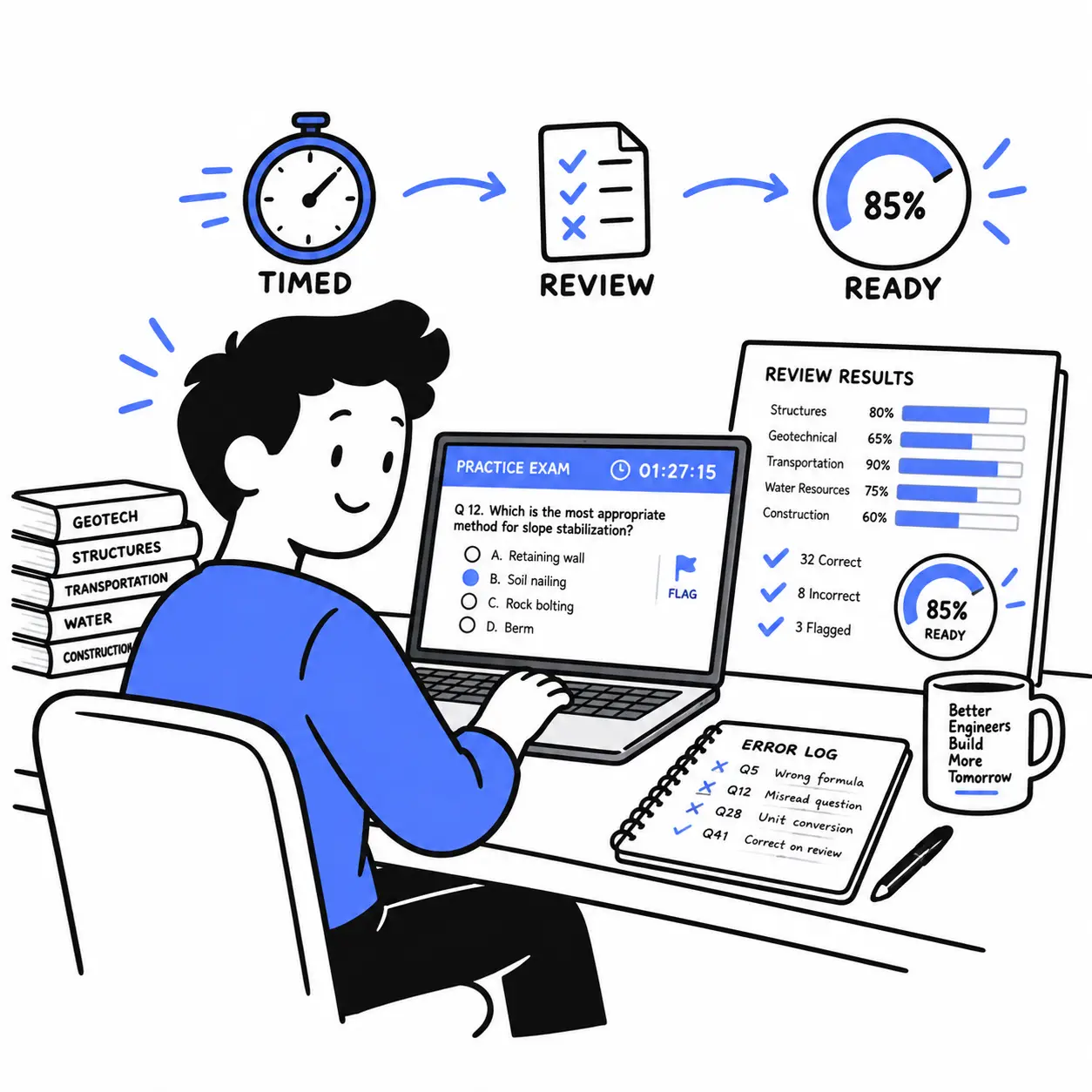
A practical guide to using CBT-style practice exams to improve accuracy, pacing, and exam readiness.
A PE practice exam is more than a collection of questions and more than a number at the end of a session. Used correctly, it shows whether you understand the material, how efficiently you navigate your references, where you lose time, and which topics require more study.
The computer-based PE Civil exam adds another layer to preparation. Candidates must work with digital references, alternative item types, question flagging, an electronic calculator, and a long testing session. The official PE Civil exam contains 80 questions. The appointment lasts nine hours and includes a nondisclosure agreement, tutorial, eight-hour exam period, and scheduled break. NCEES Civil exam information
The most effective practice-exam cycle is:
Take the exam -> Review the evidence -> Diagnose weaknesses -> Correct the problem -> Retest.
This cycle turns a practice attempt into a study system rather than an isolated score.
The purpose of a PE practice exam
A practice exam performs three related jobs: diagnosis, skill development, and readiness evaluation. Understanding which job you are asking it to perform helps you choose the right timing, review method, and level of pressure.
Diagnosis
An early exam can reveal which topics you already understand, which subjects require substantial review, which questions you answer correctly only by guessing, and where reference navigation slows you down. It can also expose careless errors, pacing problems, and difficulty maintaining concentration during a long session.
Skill development
Practice exams help you improve the process of solving PE problems. You learn to recognize the governing concept, search references efficiently, use the digital calculator, manage flagged questions, and decide when to move on. These skills matter because the real CBT exam tests decision-making under time pressure, not just whether you have seen a formula before.
Readiness evaluation
A final simulation should test whether you can perform consistently under realistic conditions. It should not be the first time you experience a long, timed CBT-style session or work with your electronic references for several hours.
When should you take your first PE practice exam?
There is no single correct date for every candidate. Your first exam can be used as an early baseline, a structured diagnostic, or a midpoint progress check. Take an early diagnostic if you want to understand your starting point before investing substantial study time. If you are unfamiliar with the exam format, first learn how the PE specification, Reference Handbook, and digital question types work. Then take the diagnostic once you can attempt the questions meaningfully.
Your first attempt does not need to produce a high score. Its value comes from the information it gives you. Record the results in a way that lets you decide what to do next.
| Record | Why it matters |
|---|---|
| Correct and incorrect answers | Shows overall accuracy and identifies questions requiring review. |
| Guessed answers | Separates reliable knowledge from answers that happened to be correct. |
| Unanswered questions | Shows whether pacing or question difficulty prevented completion. |
| Time used | Reveals whether the problem is knowledge, process, or speed. |
| Difficult topics and references | Creates a targeted study and navigation plan. |
The four stages of effective PE practice-exam use
A strong practice session includes preparation before the exam, disciplined execution during the exam, structured analysis after submission, and targeted correction before the next attempt.
Stage 1: Learn the CBT workflow
Before your final simulation, become comfortable moving between questions, selecting and changing answers, flagging questions, returning to flagged questions, using the calculator, opening and searching references, reviewing unanswered questions, and submitting the exam.
PEwise provides a CBT-style study environment with timed sessions, question flagging, a built-in calculator, searchable references, and detailed solutions. Its simulator is a preparation tool, not the actual NCEES or Pearson VUE testing platform. You can explore the platform through the PEwise Civil practice-exam page.
Develop habits that transfer to computer-based testing: read carefully, identify the task, search efficiently, and move on when a question is consuming too much time.
Stage 2: Practice the solving process
Use the same solving sequence on practice questions so that your process becomes repeatable:
- Identify exactly what the question asks.
- List the known information and units.
- Identify the governing concept or equation.
- Locate the relevant reference.
- Set up the solution.
- Check assumptions and units.
- Select the answer.
- Flag the question if you need to verify it later.
A consistent process reduces avoidable mistakes and makes review easier. It also helps you identify where a solution failed: interpretation, concept selection, reference navigation, calculation, or time management.
Stage 3: Analyze the evidence
After submission, examine your overall accuracy, topic-level accuracy, incorrect answers, correct answers reached through guessing, questions that took too long, unanswered questions, reference-navigation problems, and repeated error types.
Stage 4: Correct and retest
Study the underlying weakness before taking another full simulation. A useful retest should determine whether you can explain the concept, locate the reference independently, solve a similar problem without copying the solution, complete it more efficiently, and apply the method under time pressure.
How to use PEwise timing options
PEwise practice exams provide timing choices that can support different stages of preparation: standard exam timing, 25% additional time, and 50% additional time. Use the settings to progress from learning to realistic simulation rather than treating every attempt as a final exam.
| Timing setting | Best use | What to learn from it |
|---|---|---|
| Standard timing | Final simulations and realistic pacing practice. | Whether you can complete, review, and make decisions at the expected exam pace. |
| 25% additional time | Transitioning from learning to timed practice. | Whether you can improve accuracy while gradually reducing the time available. |
| 50% additional time | Learning unfamiliar topics, building platform fluency, or practicing with an accessibility-related need. | Whether you understand the question and can complete the method before focusing on speed. |
Important: Additional time in a practice platform is not the same as an official NCEES accommodation. Candidates who require an accommodation must follow the applicable NCEES and licensing-board process.
A practical progression is to begin with flexible timing when learning, reduce the additional time as your speed improves, and complete at least one final simulation under standard timing. Confirm that all three timing settings are visibly available in the live PEwise exam interface before publication.
How to manage time during a PE practice exam
A three-pass approach can prevent one difficult question from damaging the rest of your exam.
First pass: Answer clear questions
Start with questions where you understand the concept and can reach an answer efficiently. Do not spend several minutes forcing a solution when the governing method is unclear.
Second pass: Work through moderate questions
Return to questions requiring calculations, reference searches, or several steps. Use your flagged-question list to organize this pass rather than restarting the exam randomly.
Third pass: Resolve difficult questions
Use the remaining time to address the hardest questions, review unanswered items, check units, and verify flagged answers. The exact pacing will vary by discipline and candidate; the important habit is to make progress through the exam before investing too much time in one problem.
Common timing problems include searching references too broadly, re-solving without changing the approach, spending too long on an unfamiliar concept, failing to flag difficult questions, practicing only without time limits, and leaving no time to review unanswered questions.
How to Use CBT Features Effectively in a PE Practice Exam
A CBT practice platform should train both technical and digital skills. The official PE Civil exam provides the electronic Reference Handbook and specified design standards. NCEES states that these materials are searchable PDF files with linked chapters. Candidates should therefore practice searching electronically instead of relying only on printed notes. NCEES exam resources
Use the searchable reference panel
Practice searching by topic, keyword, equation name, table title, section heading, and technical term. PEwise allows candidates to upload their own NCEES PE Civil Reference Handbook and opens it beside the questions. Discipline-specific reference documents may also be built into the practice environment. Check each product page to see which documents are included and which must be supplied by the user.
Practice reference navigation before the final week. During the actual exam, knowing that a formula exists is not enough; you must be able to locate the relevant information without losing several minutes.
Use the calculator deliberately
PEwise includes a built-in TI-36X Pro calculator and also allows candidates to practice with an approved physical calculator. Use the calculator to practice entering expressions, checking units, and avoiding entry errors rather than treating it as a passive convenience.
Use question flagging strategically
Flag a question when you understand the method but need more time, need to verify a reference, face a lengthy calculation, or are uncertain between two answers. Flagging should help you manage the exam, not become a substitute for deciding when to move on.
Practice all relevant question formats
The PE Civil exam includes multiple-choice questions and alternative item types. PEwise’s current practice-exam page describes five CBT-style formats: multiple choice, select all that apply, fill in the blank, drag and drop, and point and click. Practicing these formats can prevent an avoidable disadvantage on exam day.
How to review a completed practice exam
Do not review only the questions you answered incorrectly. Review four categories: incorrect answers, correct answers reached through guessing, correct answers that took too long, and questions solved through an inefficient method.
For each reviewed question, ask whether you understood what the question asked, identified the correct concept, located the correct reference, selected the right equation, used consistent units, made an arithmetic or calculator error, misread a condition, or allowed timing to affect the answer. Then solve a similar problem independently without copying the explanation.
A correct answer reached through guessing is not the same as demonstrated mastery. Keep it in your review set until you can explain and reproduce the method.
Use PEwise topic results to direct your study
After you finish any PEwise practice exam, the results screen provides a detailed performance summary. You can view your overall score, review your performance by NCEES exam topic, and revisit each answer with detailed solution explanations and citations to the relevant reference materials.
| Results feature | What you can see |
|---|---|
| Overall score | Total questions answered correctly and your overall percentage |
| Performance by NCEES exam topic | Correct answers, total questions, and accuracy for each exam topic |
| Complete topic breakdown | Results for every topic covered on that practice exam |
| Answer review | Your selected answer, the correct answer, and the detailed solution |
| Question flagging | Questions you flagged during the exam for later review |
This results analysis is available across PEwise’s practice exams for Geotechnical, Water Resources & Environmental, Construction, and Structural.
Build an error log
An error log turns review into a long-term improvement system. For each problem, record the discipline and topic, error category, correct method, reference location, time spent, reason for the mistake, corrective action, and retest result.
Useful error categories include knowledge gap, concept confusion, incorrect equation, reference-navigation problem, unit conversion, arithmetic, misreading, incorrect assumption, timing, careless error, and guessing.
After several practice sessions, look for repeated patterns. If the same unit error appears repeatedly, solving more unrelated questions may not fix it; you may need a specific unit-checking routine. If you repeatedly lose time searching for equations, reference-navigation drills may be more valuable than another full exam. You can download Pewise`s free PE planner and use the error log we especially created for you. You can access this planner through this article: Free PE Civil Exam Study Plan: 12- and 24-Week Schedules
How to use PEwise’s free and paid practice exams
PEwise currently offers a free 10-question sample for each available PE Civil discipline: Geotechnical, Water Resources and Environmental, Construction, and Structural. Each sample uses the CBT interface and exposes candidates to the available question formats. The samples are useful for learning the platform, practicing digital navigation, testing reference upload, and establishing an initial baseline. See PEwise’s free practice samples
PEwise currently lists nine active practice exams across four disciplines:
| Discipline | Practice exams currently listed | Format |
|---|---|---|
| Geotechnical | 3 active exams | One 59-question focused review and two 80-question simulations. |
| Water Resources and Environmental | 2 active exams | Two 80-question simulations. |
| Construction | 2 active exams | Two 80-question simulations. |
| Structural | 2 active exams | Two 80-question simulations. |
| Total | 9 active exams | Four discipline-specific sets; Transportation is listed as coming soon. |
The Geotechnical focused review is shorter than a full simulation and is designed for targeted review. The 80-question simulations are better suited to mixed-topic practice, endurance development, and final readiness testing. The PEwise Civil practice-exam provides the current discipline-specific details and access paths.
A useful sequence is to begin with the free discipline sample, use targeted questions while learning, take a diagnostic exam, review topic-level results, correct weak areas, retest selected topics, and complete a full simulation under standard timing before exam day.
How many PE practice exams should you take?
There is no universal number that applies to every candidate. The right number depends on your starting knowledge, discipline, available study time, previous exam experience, ability to review thoroughly, and performance stability.
A practical structure is to use full-length exams at three decision points: baseline, midpoint, and final readiness stage. Candidates with more preparation time may add another simulation. Candidates with limited time should prioritize thorough review over taking many exams without correcting recurring errors.
What score should you get before the PE exam?
Short answer: No practice-exam score guarantees a passing PE result.
Practice exams differ in difficulty, topic distribution, wording, and scoring. Your result may also be affected by whether you used standard timing, how many answers you guessed, and how familiar you were with the platform.
Readiness is better evaluated through several signals: stable performance across multiple attempts, completion under standard timing, improved performance in previously weak topics, fewer repeated errors, faster reference navigation, less dependence on guessing, sustained concentration, and familiarity with the CBT workflow.
A high score achieved with unlimited time and frequent answer checking is less meaningful than a stable score achieved under realistic conditions.
How retakers should use PE practice exams
Retakers should use practice exams to investigate why the previous preparation did not produce the desired result. Possible causes include insufficient technical knowledge, incomplete topic coverage, poor reference navigation, slow pacing, careless errors, lack of endurance, and weak review habits.
Instead of deciding to study everything again, use your practice results to identify the most likely cause. If your topic accuracy is strong but you cannot finish, focus on pacing and mixed-topic practice. If you finish on time but miss questions across several subjects, return to structured concept review. If you answer correctly but rely heavily on guessing, strengthen your underlying understanding before increasing speed.
What students say about PEwise practice exams
Student feedback can help candidates understand how other engineers experienced the platform, although testimonials are not independent proof of future results.
PEwise publishes a verified student review describing its exam simulator as “a gem.” Another review says the simulation exams felt similar to the computer-based testing experience. Additional feedback mentions concise lessons, handbook navigation, and the usefulness of practice exams for engineers preparing while working full-time. You can read the published reviews on the PEwise reviews page.
These comments support the platform’s intended use: combining focused study, reference practice, and computer-based exam simulation in one environment. They should not be interpreted as a guarantee that every candidate will achieve the same outcome.
A repeatable PE practice-exam cycle
- Use the following cycle throughout your preparation:
- Choose the timing setting that matches your preparation stage.
- Complete the practice exam without checking answers.
- Review the overall and topic-level results.
- Revisit incorrect and guessed questions.
- Classify each error.
- Study the underlying weakness.
- Re-solve the problem independently.
- Complete targeted retesting.
- Repeat under increasingly realistic timing.
The goal is not to collect practice-exam scores. The goal is to make your performance more accurate, efficient, and reliable.
Frequently asked questions about using PE practice exams
When should I take my first PE practice exam?
Take an initial diagnostic early enough to influence your study plan, but after you understand the exam format and can attempt the questions meaningfully. Use additional exams at the midpoint and final readiness stage.
Should I take my PE practice exam under standard timing?
Use standard timing when evaluating readiness. During the learning phase, additional time may help you understand concepts and develop CBT skills. Gradually move toward standard timing as your preparation improves.
How should I review a PE practice exam?
Review incorrect answers, guessed answers, slow answers, and inefficient solutions. Identify whether each problem involved a knowledge, concept, reference, unit, calculation, or timing error.
Should I review questions I answered correctly?
Yes, if you guessed, felt uncertain, or took too long. A correct answer does not always demonstrate reliable understanding.
How do I identify weak PE exam topics?
Use topic-level results, your error log, and your time records. A topic with low accuracy needs content review; a topic with good accuracy but slow performance may need timed practice or better reference navigation.
Can a practice-exam score predict whether I will pass?
No. A practice score can provide evidence about your preparation, but it is not an official NCEES score and cannot guarantee a passing result.
Does PEwise simulate the actual NCEES platform?
PEwise provides a CBT-style preparation environment with timed sessions, references, calculator tools, flagging, and practice question formats. It is not the actual NCEES or Pearson VUE testing platform.
Does PEwise provide free PE practice exams?
Yes. PEwise currently provides a free 10-question sample for each available discipline: Geotechnical, Water Resources and Environmental, Construction, and Structural.
What practice exams does PEwise offer?
PEwise currently lists nine active exams: three for Geotechnical, two for Water Resources and Environmental, two for Construction, and two for Structural.
Choose your PEwise practice exam
When you are ready to test your progress, choose the PEwise practice exam for your discipline. Use the CBT-style environment to practice digital navigation, searchable references, question flagging, calculator use, detailed solution review, and topic-level performance analysis.
Explore PEwise Civil practice exams
Explore PEwise Geotechnical practice exams
Explore PEwise Water Resources and Environmental preparation
Keep Reading
PE Civil Practice Exams: Online, Free, and Full-Length Options
Compare PE Civil practice exams by discipline, format, solutions, timing, and reporting. Learn how to use free samples and full-length CBT simulations.

PE Exam Study Materials: What You Actually Need
Build the right PE exam study stack with expert guidance on NCEES references, review courses, PE exam books, practice problems, simulations, flashcards, and free resources

CBT PE Exam Results: Release Timing, Scoring, and What Your Result Means
Most CBT PE exam results arrive within 7–10 days. Learn how NCEES releases, scores, and reports your result—and what to do next.