FE Civil Course Formats: Self-Paced, Live Online or In Person
Choosing an FE Civil course means finding a format you can use consistently. Compare self-paced, live online and in-person preparation by study schedule, instructor support, missed-class options and total cost through exam day—then decide which approach fits your working week.
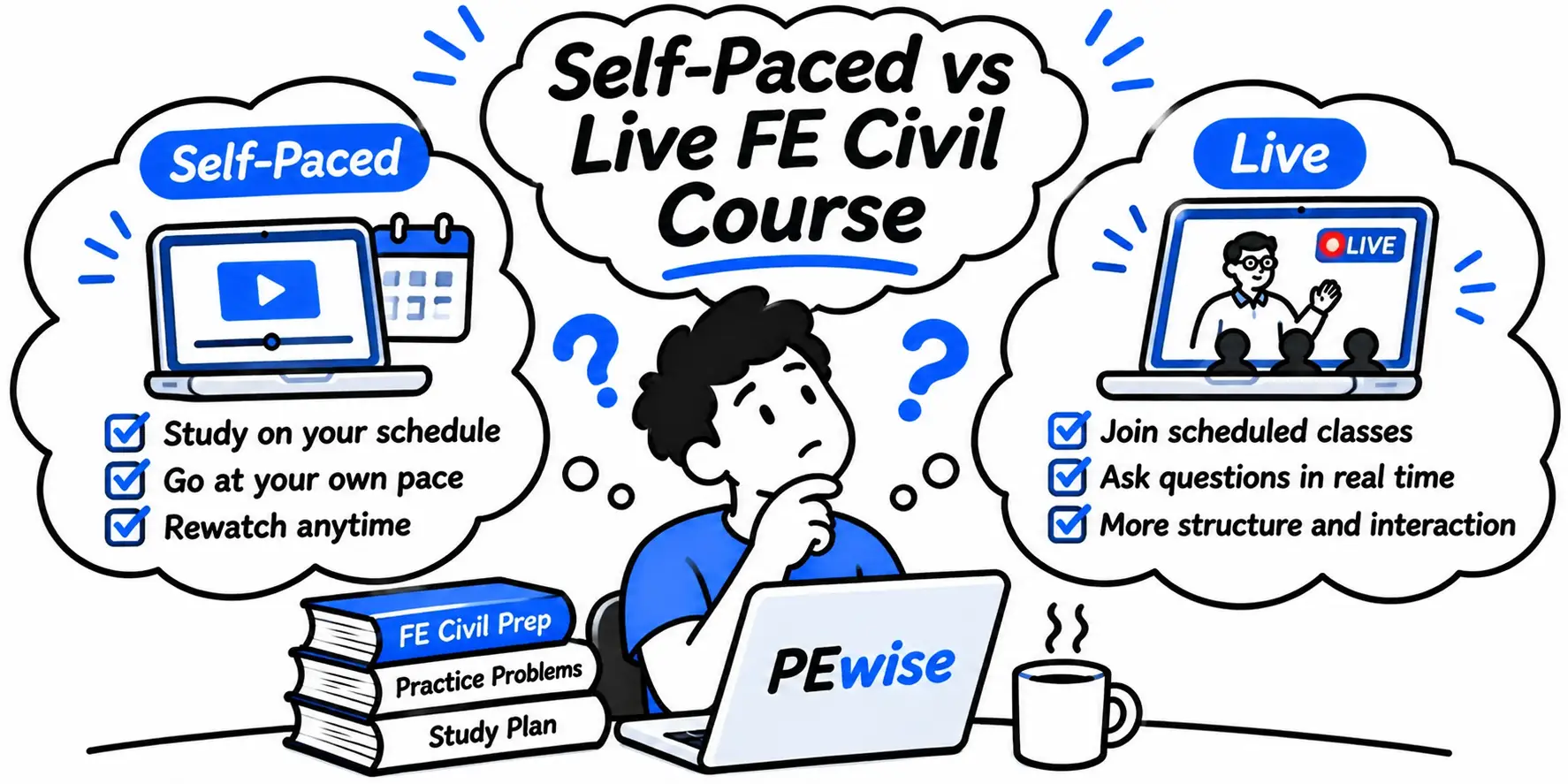
A self-paced FE Civil course lets you choose when to study recorded lessons. A live online course gives you scheduled classes and opportunities for real-time interaction. In-person preparation adds a classroom location and commute.
When comparing a self-paced vs live FE Civil course, start with the time you can reliably protect, the help you need and the cost of keeping access until your exam. A recorded course with periodic live support can also be worth considering if you need flexibility and occasional instructor guidance.
Self-paced vs live FE Civil courses at a glance
The most useful comparison is what each format asks you to commit to and what happens when your plans change.
| Decision factor | Self-paced online | Live online | In person |
|---|---|---|---|
| Attendance | Choose study times within your access period | Attend scheduled online sessions | Attend scheduled sessions at a venue |
| Pacing | Usually control lesson speed and sequence; check release rules | Follow the live teaching schedule | Follow the classroom schedule |
| Replay | Revisit recorded content within access limits | Check recording availability, release time and expiry | Check whether recordings or makeups exist |
| Instructor interaction | May include email, forums or live support | Ask questions during designated sessions | Ask questions during designated class periods |
| Accountability | Set your own study deadlines | Regular classes create external appointments | External appointments plus physical attendance |
| Missed study time | Move the study block before access expires | Use a recording or makeup if provided | Confirm how missed material can be recovered |
| Practical burden | Device, internet and a suitable study space | Same requirements plus fixed availability | Travel, possible parking and location access |
| Likely fit | Candidates who need movable study blocks | Candidates who want structure and can attend | Candidates with a convenient, suitable local cohort |
Choose the format you can use consistently. A live course loses much of its interaction advantage if you repeatedly watch it afterward. A self-paced course needs protected study appointments, even though the provider does not set them.
What each FE Civil course format actually includes
Self-paced online courses
Self-paced courses provide recorded instruction you work through within an access period. They can suit a rotating work schedule, targeted review of weak subjects or short study windows between other commitments.
The advantage is control. You can pause an explanation, attempt the problem yourself and return to a difficult step. The tradeoff is responsibility for keeping your review moving.
Check the lesson format as well as the delivery label. A searchable sequence of short lessons creates a different experience from a collection of long lecture recordings. Also check whether the syllabus is available immediately or released over time.
Self-paced does not automatically mean unsupported. Some plans include instructor contact; others provide only recorded material and solutions. Verify the actual plan you intend to buy.
Live online courses
Live online courses meet at scheduled times through an online classroom. Their main benefits are recurring appointments, instructor interaction and the opportunity to work through problems alongside other candidates.
They can be a practical choice when you can protect the class times and benefit from external deadlines. However, the live syllabus moves at the cohort's pace. You may still need separate time to rebuild a weak prerequisite or practice a topic you found difficult.
Check the time zone, start date, finish date and recording policy. “Online” removes the commute; it does not remove the attendance commitment.
In-person courses
An in-person course can provide a dedicated classroom environment and direct contact with an instructor and other candidates. It may suit someone who wants to leave home distractions behind and has a convenient local option.
Travel changes the time commitment. In an illustrative example, eight two-hour classes with one hour of round-trip travel per class require 24 hours in your calendar: 16 classroom hours and eight travel hours. Independent practice comes on top of that.
Before enrolling, verify that the listing is specifically for FE Civil, with current dates and an actual venue. Some providers list FE and PE preparation together, even when the available formats differ by exam.
Recorded lessons with live support
Some courses combine recorded instruction with periodic live problem solving or question sessions. Others combine a full live curriculum with a separate on-demand library.
Ask what the live component does. Is it the primary teaching sequence, a review workshop or optional help? That distinction determines how much of your week must follow the provider's calendar.
Which FE Civil course format is better for working professionals?
For working professionals with unpredictable hours, self-paced instruction is often the more practical starting point. For someone with dependable free evenings who struggles to maintain independent study, live online classes may offer a more useful structure.
Your job title alone does not decide the format. Use these four checks against your actual calendar.
1. Match course dates to your exam date
Put the cohort's teaching dates and the access expiry beside your intended exam date. Will you see the necessary material in time? Will you still have access during your final review?
For a recorded course, check when access starts. Buying early can use up part of a fixed access period before you are ready to begin. For a live course, check whether recorded material is available before the relevant live lesson.
2. Test a missed-class week
Consider this illustrative schedule: two two-hour live classes and three hours of independent problem solving each week. One class conflicts with a work shift.
If a recording is available in time, the week still requires seven study hours: two attended live, two spent catching up and three solving problems. If only five hours remain available, you have a two-hour scheduling gap.
The recording restores access to the lesson. You still need time to watch it, and you may need a separate way to ask questions. Do not count the missed class and its replacement recording as two separate study commitments.
3. Identify the help you will actually use
Name the problem you want instruction to solve. You may need clearer explanations, help diagnosing errors, recurring accountability or individual attention on a few weak topics.
A group question session can help with a specific problem, but it may not provide the extended individual attention of tutoring. Similarly, a forum is useful only if the response arrives when you can apply it.
4. Choose the smallest commitment that meets your needs
Use the scenarios below as decision examples, not predictions of exam performance.
| Your situation | Format worth considering | Check before choosing |
|---|---|---|
| Your shifts change and free time comes in short blocks | Self-paced instruction | Question support and access duration |
| You have reliable free evenings but keep postponing solo study | Live online classes | Actual attendance fit and homework time |
| You want a classroom and have a convenient local cohort | In-person instruction | Travel burden, FE Civil coverage and missed-class arrangements |
| You need flexible lessons and occasional help | Recorded instruction with live support | Session purpose, timing and follow-up options |
How much do self-paced and live FE Civil courses cost
Course format alone does not determine price. Access duration, included resources, instructor support and billing terms also matter. Compare the cost through your intended exam date rather than the smallest price displayed on a sales page.
These selected examples show different pricing structures. They are not a market average or a ranking of equivalent products. Published November 20, 2026. Prices are in USD and were last checked November 21, 2026; verify current prices and terms before buying; verify current terms before buying.
| Selected option | Published price | Access or scheduling detail |
|---|---|---|
| PEwise FE Civil | $149 standard price; $99 launch offer through December 3, 2026. | Three months from enrollment; one-time purchase, no auto-renewal |
| PPI FE Civil OnDemand, monthly | $395 per month | Renewing subscription |
| PPI FE Civil OnDemand, four months | $1,195 | Fixed term, non-renewing |
| PPI FE Civil Live Online, January–April 2027 cohort | $1,795 | Scheduled live cohort; check selected access dates |
| NC State ITRE FE Civil | $905 including materials | Lists self-paced and synchronous online options; self-paced materials available for one year |
Compare the cost through your exam date
Add the plan fee, any required renewals or extensions, essential resources not included, and travel or parking. Subtract only discounts you qualify for. Check taxes and other checkout charges separately.
For example, three PPI monthly billing periods at $395 total $1,185; four total $1,580. The listed four-month fixed plan costs $1,195. That makes the monthly option $10 lower for three billing periods and $385 higher for four, before other charges.
This calculation compares base fees. Confirm that the plans provide the features and dates you need before treating them as interchangeable.
Avoid paying twice for the same function
Start with the official FE Civil specification and the resources you already own. NCEES provides access to the FE Reference Handbook through MyNCEES. Use the specification to check topic coverage and the handbook to inspect how a course teaches reference use. Official NCEES resources
Before adding another book or subscription, identify what your existing setup lacks. If you understand the concepts but need practice, a practice resource may fill the gap. If solutions leave you confused, more questions alone may not provide enough instruction.
Choose one core preparation resource, inspect what it includes and add another only for a clear missing function. A course, a separate question bank and several books can overlap without addressing your actual difficulty.
How to check instructor support, recordings and access
Compare support as a set of specific services. “Instructor access” might mean questions during class, an email channel, a discussion forum or scheduled office hours. It does not automatically mean private tutoring or an immediate reply.
Before paying, get answers to these questions:
- Who answers academic questions, and through which channel?
- Can you ask follow-up questions after watching a recording?
- Are support services included in your selected plan?
- When are live recordings posted, and when do they expire?
- Can you revisit earlier topics throughout the access period?
- What does an extension cost if your exam date moves?
- What completion, attendance or exam requirements apply to guarantees?
Try a lesson on a subject you find difficult. Can you follow the explanation, attempt the example and understand why your answer differs? Then inspect the practice format and solutions. This reveals more about fit than comparing video-hour totals alone.
For live classes, ask whether missed-session questions can be submitted later. PPI, for example, states that live lecture recordings are posted the following day. That helps you evaluate recovery time, but you still need to check the selected plan's access and support terms. Why PEwise is our recommended choice for flexible FE Civil preparation
PEwise publishes this guide and sells FE Civil preparation. Our recommendation is based on schedule fit, support, access and cost.
For candidates who want maximum retention in minimum study time, we recommend starting with PEwise. Its complete FE Civil course delivers about 15.5 hours of focused video instruction—a compact alternative to a multi-month lecture schedule. Short, recorded lessons let you revisit what needs reinforcement, while the weekly FE Power Hour adds instructor-led problem solving on Wednesdays at 6:30 PM PT. The standard price is $149.
The course includes 1,026 short videos, 220 worked examples, and 125 quizzes. and two 110-question practice exams. Its 15 hours 34 minutes of video represent viewing time; allow additional time for solving problems, reviewing mistakes and taking practice exams.
You can preview the introduction and Engineering Probability and Statistics with a free account and no credit card. An optional $70 extension adds another three months. View FE Civil Exam Prep.
This format suits candidates who want control of lesson timing and can use the scheduled support. If you require a full live teaching timetable, individual tutoring or a physical classroom, evaluate a course that explicitly provides it.
Read refund and pass-guarantee terms separately
PEwise's refund eligibility includes requesting within 14 days, completing less than 25% of the course, not starting a full-length practice exam and keeping the account in good standing. Other exclusions apply, including previous refunds for the same course.
Its pass guarantee provides one additional three-month access period after you complete all core lessons, take the official exam unsuccessfully and provide your NCEES results. It provides extended access, not a refund. Read the Refund and Pass Guarantee Policy before purchase.
Questions about FE Civil course formats
What are the main benefits of a live FE Civil review program?
Live programs offer scheduled teaching, opportunities to ask questions during sessions and a recurring study commitment. These benefits are most useful when you can attend and have time for independent practice afterward. Check class size, question procedures and support outside class before assuming the attention will be personalized.
Do self-paced FE Civil courses include practice exams?
Some do, but delivery format does not establish what practice is included. Check the number and length of exams, timing options, explanations and whether questions can be reviewed afterward. Also distinguish a taught course from a question bank or practice-only subscription.
Can I switch from self-paced to live instruction later?
That depends on the provider, plan and available cohort. Ask whether an upgrade exists, whether your original payment is credited, what deadlines apply and whether access restarts or keeps its original expiry. Do not assume you can switch without paying for another course.
Where can I find useful reviews of on-demand FE Civil courses?
Look for reviews that identify the FE Civil product, purchase period, access plan and features actually used. Give more weight to explanations of lesson quality, feedback and access problems than an unexplained star rating. Check whether a review is sponsored or earns referral fees, and verify current terms on the provider's own page.
Does choosing an online FE prep course mean I can take the exam from home?
No. Online preparation lets you study remotely, but the official FE exam is computer-based and taken at an NCEES-approved Pearson test center. See the NCEES FE exam page for details.
Choose the format you can attend, practice with and afford
Start with your dependable study windows. Check how the course handles missed time, whether its support matches your needs and what access will cost through your exam date. Then test the teaching with a preview.
If flexible preparation fits those requirements, explore PEwise FE Civil Exam Prep before adding more resources to your study setup.
Keep Reading
FE Civil Preparation Cost: Build a Realistic Budget
Compare FE Civil prep course costs, access periods, and included resources to build a study budget that fits your needs. Explore teaching and practice options, account for optional books and extensions, and avoid paying for resources you already have.
FE Civil Course or Self Study: Which Is Right for You?
Should you take an FE Civil prep course or study independently? Learn how to assess your knowledge gaps, compare costs and choose an approach that fits your schedule—with practical checks before buying another resource.
Best FE Civil Exam Prep Courses: An Evidence-Based Comparison
Find the FE Civil preparation that fits your needs. This guide compares PEwise, School of PE, PPI, CEA, Genie Prep, and PrepFE across teaching formats, practice tools, pricing, and support, with recommendations for different budgets and study goals.