CPM Scheduling for the PE Construction Exam: Critical Path, Float, and Crashing
CPM for the PE Construction exam — forward/backward pass, total vs free float, the critical path, and least-cost crashing, drilled to exam speed.
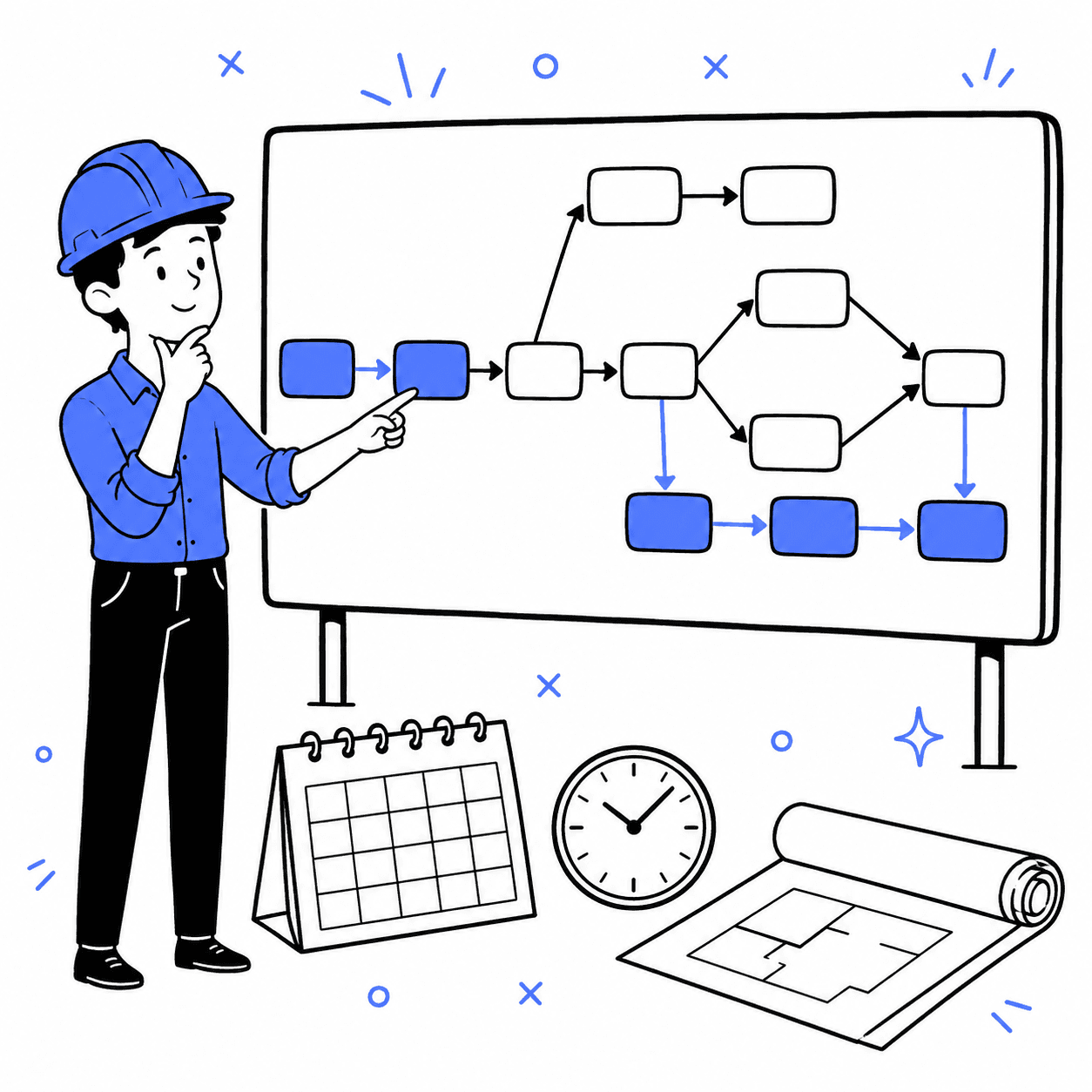
CPM questions can go wrong before the arithmetic begins. A reversed dependency, the wrong rule at a merge, or a switch between elapsed-time and inclusive-day conventions can affect every value that follows. For PE Civil: Construction candidates, the goal is therefore not to collect isolated formulas. It is to understand the logic that connects the network, the forward and backward passes, float, the critical path, and schedule compression.
For exams taken before April 2027, the NCEES PE Civil: Construction specification places critical path method (CPM) within Project Planning and Scheduling, a broader knowledge area that also includes construction sequencing, activity time analysis, project schedule analysis (network analysis, critical path method, and linear schedules), resource scheduling and leveling, and time–cost trade-off. The specification assigns 7–11 questions to that whole knowledge area—not to CPM alone. For exams beginning April 2027, use the separate NCEES Construction specification and design-standards file for that exam period. The posted knowledge-area outline retains Project Planning and Scheduling at 7–11 questions, while the supplied design standards change. For the complete discipline context, see the PE Civil Construction exam topics and format.
This guide gives you a repeatable, exam-focused way to interpret CPM information, select the correct rule at each stage, distinguish total float from free float, verify every controlling path, and reassess the schedule after a change.
What is CPM in PE Civil Construction?
The critical path method is a network-based scheduling process used to determine project duration, calculate scheduling flexibility, and identify the sequence or sequences of activities that control completion. In PE Civil Construction problems, CPM connects activity durations and dependencies to early dates, late dates, float, critical paths, and time–cost decisions.
CPM starts with logic. The network shows which work can proceed in parallel, where branches converge, and where delay can reach the project finish. A forward pass determines earliest timing, a backward pass determines latest allowable timing, and their difference reveals float and the controlling path.
This is an exam-focused hand-analysis framework, not a tutorial for Primavera P6, Microsoft Project, or field schedule administration. Software may automate calculations, but the PE candidate still needs to recognize the governing relationship and interpret the result.
How should you approach a CPM question on the PE Construction exam?
- Use the same sequence every time: identify the requested output, confirm the network and time convention, perform the passes in the correct direction, calculate the required float, identify all controlling paths, and verify the result against project duration and any changed condition. A consistent process reduces both logic errors and unnecessary calculation.
- Read the requested output first. Determine whether the question asks for an early or late date, a type of float, a critical path, project duration, or a schedule-compression decision.
- Identify the activity and time convention. Decide whether activity times are elapsed-time values, calendar dates, or another stated convention. Do not mix conventions.
- Validate predecessor and successor logic. Confirm that each dependency points in the correct direction and that every required predecessor appears in the network.
- Build or inspect the network. Locate the start, finish, parallel branches, merges, bursts, and any relationship types or lags.
- Complete the forward pass. Move from start to finish and apply the controlling maximum at each merge.
- Complete the backward pass. Move from finish to start and apply the controlling minimum at each burst.
- Determine total and free float. Match corresponding fields and use the float measure requested.
- Identify every critical path. Check zero-total-float activities under the stated assumptions and verify the duration of each continuous path.
- Cross-check the result. Confirm the project duration, units, path continuity, and the effect of any constraint or duration change.
- Recalculate after schedule changes. A changed duration or relationship can shift the controlling path, so an earlier critical-path result cannot be assumed to remain valid.
Read predecessor data before doing arithmetic
Predecessor data defines the network, and the network defines every CPM calculation that follows. Before calculating dates, translate each listed relationship into a clear direction: the predecessor must satisfy its stated relationship before the successor can reach the affected event.
An activity is a portion of work with a duration. An immediate predecessor connects directly into an activity; an immediate successor connects directly out. A parallel branch can progress independently, subject to its own dependencies. A merge has multiple immediate predecessors; a burst has multiple immediate successors. The supplied handbook and the published NCEES practice exam both present these as activity-on-node networks, so use that convention unless a question states otherwise. Note that “merge” and “burst” are standard scheduling vocabulary rather than handbook terms: the handbook states the same two rules in words, as “latest EF of predecessors” and “earliest LS of successors.”
Audit the network in both directions. Compare each activity’s incoming arrows with its predecessor list, then confirm every outgoing arrow at the receiving activity. Identify possible starting and ending activities, and make sure every valid branch connects to any explicit start and finish milestones.
This logic audit matters because CPM arithmetic can be internally consistent on the wrong network. A clean set of dates does not correct a missing dependency, a reversed arrow, or a disconnected branch.
Finish-to-start logic and when other relationships matter
In a finish-to-start relationship, the successor cannot start until the predecessor finishes, subject to any stated lag or lead. Finish-to-start with zero lag is common in hand-analysis networks, but candidates must use the relationship actually given.
Other relationships change which events are connected:
- Start-to-start: the successor’s start depends on the predecessor’s start.
- Finish-to-finish: the successor’s finish depends on the predecessor’s finish.
- Lag: a required waiting period is added to the stated relationship.
- Lead: an allowed overlap reduces the waiting period implied by the stated relationship.
For any other relationship, identify the linked events first, then apply the stated lead or lag consistently.
What is the merge rule in CPM?
In a zero-lag finish-to-start network, a successor’s early start at a forward-pass merge is controlled by the latest predecessor finish. All required incoming work must finish before the successor may begin, so an earlier branch cannot release the successor while another required branch remains incomplete. For other relationship types or stated leads and lags, use the controlling linked event and apply the offset.
The rule is a maximum, not a sum. Parallel finish times are competing readiness conditions; summing them would incorrectly treat parallel work as sequential.
What is the burst rule in CPM?
In a zero-lag finish-to-start network, a predecessor’s late finish at a backward-pass burst is controlled by the earliest late start among its immediate successors. The predecessor must remain early enough to protect every outgoing branch, so the most restrictive successor controls. For other relationship types or stated leads and lags, use the controlling linked event and apply the offset.
The controlling rule is therefore a minimum. Choosing a later successor date would protect only the less restrictive branch and could delay another branch beyond its allowable timing.
How does the CPM forward pass work?
The forward pass moves from project start to project finish to determine each activity’s earliest possible start and finish under the stated logic. At a merge, use the maximum applicable predecessor early finish; at the terminal point, the controlling early finish establishes the calculated project duration when no different completion condition governs.
Use a consistent elapsed-time convention unless the question specifies another convention. Under the time-zero elapsed-time convention:
| Symbol or relationship | Meaning |
|---|---|
| Di | Duration of activity i, in the stated time unit |
| ESi | Earliest time activity i can start |
| EFi | Earliest time activity i can finish |
| EFi=ESi+Di | Early-finish relationship for activity i |
| ESi=max(EFp) | Early start for activity i when p represents its applicable immediate predecessors in a zero-lag finish-to-start network. The handbook states the same rule in words: early start = latest EF of predecessors |
Begin at the network start and move only in the direction of the arrows. An activity is ready for calculation only after all applicable predecessor early values are known. At a merge, select the latest controlling predecessor finish. Continue until every ending branch reaches the finish condition.
Calendar-day or inclusive-counting problems may require a stated day adjustment. Do not rely on a remembered “plus one” or “minus one.” Write the specified relationship once and use it consistently throughout both passes, float calculations, and interpretation.
How does the CPM backward pass work?
The backward pass moves from project completion toward the start to determine how late each activity may finish and start without violating the stated completion condition. At a burst, use the minimum applicable successor late start.
Under the same time-zero elapsed-time convention:
| Symbol or relationship | Meaning |
|---|---|
| LFi | Latest allowable finish of activity i |
| LSi | Latest allowable start of activity i |
| LSi=LFi−Di | Late-start relationship for activity i |
| LFi=min(LSs) | Late finish for activity i when s represents its applicable immediate successors in a zero-lag finish-to-start network. The handbook states the same rule in words: late finish = earliest LS of successors |
| Initialize the backward pass at the required or calculated project completion, as directed by the problem. Move against the arrows. An activity is ready for calculation only after the applicable successor late values are known. At a burst, select the earliest successor late start because it imposes the tightest limit on the predecessor. |
An imposed completion date changes the baseline for late dates. If that required finish is earlier than the schedule can achieve under current logic and durations, negative float can result. Negative float indicates a conflict with the imposed requirement; it is not an additional category of “more critical” flexibility.
What is the difference between total float and free float?
Total float measures how much an activity can be delayed before the stated project completion is affected; free float measures how much it can be delayed before the early start of an immediate successor is affected. They protect different schedule conditions and should not be used interchangeably.
For a zero-lag finish-to-start network using the same elapsed-time convention throughout:
| Measure | What it protects | Conceptual calculation | Key interpretation |
|---|---|---|---|
| Total float (TF) | Project completion under the stated logic and completion condition | Difference between corresponding late and early dates: TFi=LSi−ESi=LFi−EFi | Zero total float normally identifies a critical activity when the network is unconstrained except by its calculated finish |
| Free float (FF) | Immediate successors’ early starts | Gap between the activity’s early finish and the earliest applicable successor early start: FFi=min(ESs)−EFi | Zero free float means there is no delay available before an immediate successor’s early start moves; it does not by itself prove the activity is critical |
The formulas depend on the network relationship. If a problem uses leads, lags, or relationship types other than finish-to-start, the linked event and the stated offset must be reflected in the float calculation. For a terminal activity with no ordinary successor, connect it to an explicit finish milestone or use the finish condition stated in the problem before determining free float.
Total float belongs to a path-level completion condition; free float is local to immediate successor timing. An activity can therefore have no free float while retaining positive total float.
Why does zero free float not always mean an activity is critical?
Zero free float means that delaying the activity would immediately delay at least one successor’s early start; it does not necessarily mean the project finish would be delayed. The affected successor path may still contain positive total float that absorbs the shift before project completion.
Criticality is tied to the controlling path and total float under the stated scheduling assumptions. Free float answers a narrower question about immediate successor timing. Treating zero free float as proof of criticality confuses a local dependency effect with the project’s completion constraint.
How do you identify and verify the critical path?
Identify a continuous start-to-finish path of activities that controls calculated project duration, then verify it with total float and path timing. In a standard unconstrained CPM network, activities on a critical path normally have zero total float. For a zero-lag finish-to-start network, the sum of activity durations along each critical path equals the calculated project duration. If leads or lags exist, include their effects in the path calculation.
A critical activity lies on a controlling path. A critical path is a continuous, valid start-to-finish sequence that controls completion. The supplied handbook defines the critical path as the longest continuous chain of activities through the network schedule that establishes the minimum overall project duration, and a critical activity as an activity on the critical path with zero total float; “longest” there means longest in total duration, not longest as drawn or greatest in activity count.
Use both checks:
- Trace zero-total-float activities and confirm that they form a continuous path from start to finish.
- Confirm that the duration of that valid path equals the calculated project duration under the chosen convention.
- If zero-float activities do not connect continuously, revisit the network, merge and burst choices, and float calculations. If two or more continuous paths satisfy the checks, the schedule has multiple critical paths.
What is a near-critical path?
A near-critical path is a valid start-to-finish path with little positive float, meaning a relatively small change could make it control project completion. It does not control the current calculated finish, but it indicates schedule sensitivity.
After a duration, logic, constraint, or compression change, a near-critical path may become critical as its remaining float is consumed or the current critical path is shortened.
What do multiple critical paths mean?
Multiple critical paths mean that more than one continuous sequence currently controls project completion. Shortening only one path may leave the project duration unchanged because another critical path still reaches the same finish.
Multiple paths increase sensitivity: a delay on any controlling path can affect completion. Compression may target a shared activity or require coordinated changes on separate branches.
How do crashing decisions work?
Crashing reduces activity duration by adding cost or resources, but it can shorten the project only when the reduction affects every path that currently controls completion. After each feasible reduction, recalculate the network because the critical path can change. The published NCEES Construction practice exam frames schedule compression through straight-time versus overtime labor cost, labor-hours, subcontract durations, and daily general conditions. Read that type of question as a project-level time–cost comparison: determine whether the changed work affects the controlling path, then compare the stated incremental labor cost with the time-dependent project savings.
Key terms are:
- Normal time, TN: planned activity duration before crashing.
- Crash time, TC: shortest feasible activity duration under the stated crash conditions.
- Maximum reducible duration: TN−TC.
- Normal cost, CN: direct activity cost at normal time.
- Crash cost, CC: direct activity cost at crash time.
- Crash cost slope: incremental direct cost per unit of duration reduction.
- The standard linear slope relationship is:
Crash cost slope = (Cᴄ − Cɴ) / (Tɴ − Tᴄ)
The slope has units of cost per unit time. It supports comparison within the stated economic and feasibility conditions; it does not prove that an activity will reduce project duration. When the question asks for minimum total project cost rather than minimum direct crashing cost, also account for any stated time-dependent indirect costs such as daily general conditions, plus liquidated damages, bonuses, incentives, or other project-level costs or savings. Treat this crash notation as standard scheduling vocabulary rather than supplied reference content: the PE Civil Reference Handbook contains no crashing section, no crash-cost-slope relationship, and none of the symbols above, and the published NCEES Construction practice exam poses its time–cost question in terms of straight-time versus overtime labor cost, labor-hours, and daily general conditions cost. Expect to build the comparison from the data stated in the problem rather than from a handbook lookup.
Use this decision sequence:
- Identify all current critical paths.
- Find activities with feasible remaining reduction on each controlling path.
- Check whether a shared activity can shorten multiple critical paths or whether separate activities must be reduced together.
- Compare the incremental costs of the feasible path-controlling options.
- Apply only a permitted reduction, never exceeding an activity’s remaining reducible duration.
- Recalculate early dates, late dates, float, and every critical path.
- Stop when the target duration is reached, no feasible reduction remains, or the next reduction fails the problem’s economic criterion.
The cheapest activity in the entire network is not necessarily the correct activity to crash. If it is noncritical and has unused total float, reducing its duration may change only that float. Likewise, the initially cheapest critical activity may cease to control after another path becomes critical.
A conceptual crashing decision table
| Schedule condition | Decision focus | Why |
|---|---|---|
| One critical path | Feasible reducible activity on that path with the best stated incremental cost | Only a reduction on the controlling path can reduce the current project duration |
| Multiple critical paths with a shared reducible activity | Evaluate the shared activity first, subject to cost and feasibility | One reduction may shorten all controlling paths together |
| Multiple critical paths with no shared reducible activity | Evaluate coordinated reductions, one on each controlling path | Shortening only one path leaves another path controlling completion |
| A near-critical path is about to become critical | Recalculate before selecting the next reduction | The least-cost option can change when control shifts |
| No critical activity has remaining reducible duration | Stop or use another permitted strategy | The stated crash limits prevent further reduction by crashing |
How do crashing, fast-tracking, leveling, and smoothing differ?
Crashing changes activity duration through added cost or resources; fast-tracking changes logic by overlapping work; leveling changes timing to resolve resource limits; and smoothing adjusts resource use within available float while aiming to preserve completion. Of the four, only resource leveling is defined in the supplied handbook; crashing, fast-tracking, and smoothing are standard industry terms worth knowing conceptually but are not part of the supplied reference set. These methods solve different problems and do not have the same effect on duration or risk.
| Method | Primary purpose | Mechanism | Major concern | Does project duration necessarily decrease? |
|---|---|---|---|---|
| Crashing | Compress the schedule | Add cost or resources to reduce feasible activity durations | Higher direct cost, practical crash limits, and shifting critical paths | No; only if every controlling path is shortened |
| Fast-tracking | Compress the schedule | Overlap work that was previously sequential by revising logic | Rework, coordination, and added execution risk | No; the overlap must affect controlling logic |
| Resource leveling | Resolve resource over-allocation or fixed resource limits | Adjust activity start times to reduce peak resource demand, sometimes within float, or extend activity durations within a constrained resource limit | May consume float, change the critical path, or extend completion | No; it may increase project duration |
| Resource smoothing | Reduce resource peaks while maintaining the completion target where possible | Shift noncritical work within available float | Available float limits the adjustment | No; its goal is generally to preserve rather than reduce duration |
For resource-leveling questions, be prepared to compare resource histograms rather than only calculate dates. The published NCEES Construction practice exam uses a figure-selection format and shifts activities from early-start toward late-start positions; its solution evaluates improvement by first moment. This is reference-navigation context, not a worked example, and the problem statement remains controlling.
Earned value is adjacent but distinct: it measures cost and schedule performance against a baseline rather than building the CPM logic used to establish activity timing. In the handbook, though, earned-value analysis sits inside the same CPM network-analysis subsection as the float nomenclature, so both are found in one place. For the cost side of schedule decisions, see construction cost estimating and time–cost decisions.
What are the most common CPM mistakes?
Most CPM errors come from incorrect network logic, inconsistent conventions, a wrong maximum or minimum choice, mismatched float fields, or failure to recalculate after a change. Diagnose the earliest incorrect decision instead of repairing downstream numbers one at a time.
| Error | Why it changes the answer | How to detect or correct it |
|---|---|---|
| Network arrows conflict with predecessor data | Every pass is performed on the wrong logic | Compare every incoming arrow with the immediate-predecessor list before calculating |
| Finishes are added at a merge | Parallel branches are incorrectly treated as sequential | Use the latest applicable predecessor finish, not the sum of finish times |
| The wrong backward-pass value is selected at a burst | A less restrictive successor is protected while another branch is allowed to run late | Use the earliest applicable immediate-successor late start |
| Time-zero and inclusive-day conventions are mixed | Systematic off-by-one differences appear across dates and duration | Write the chosen start/finish relationship once and use it everywhere |
| Extra-day adjustments are applied inconsistently | Early dates, late dates, and float no longer share the same basis | Audit every addition and subtraction against the stated convention |
| Noncorresponding fields are used for total float | The result no longer measures late-versus-early flexibility | Use LS−ES or LF−EF under the consistent convention |
| Zero free float is treated as proof of criticality | A local successor constraint is confused with project completion | Check total float and trace a continuous controlling path |
| The path with the most activities is selected | Activity count is substituted for path duration | Sum durations along each valid path or verify the zero-total-float path |
| A second critical path is missed | A proposed change appears to shorten the project when another path still controls | Trace every continuous zero-total-float route from start to finish |
| Near-critical paths are ignored after a change | A new controlling path is missed | Recalculate path float and duration after each logic or duration change |
| A noncritical activity with unused float is crashed | Cost is added without reducing completion | Confirm the activity lies on every path that must be shortened |
| Only one of several critical paths is shortened | Another controlling path preserves the original finish | Crash a shared activity or coordinate reductions across all critical paths |
| Maximum reducible duration is ignored | The proposed duration becomes infeasible | Track normal time, crash time, and remaining reducible duration |
| Crash slope is used without recalculating paths | A cost ranking from the old network is applied after control shifts | Re-run the network and re-rank feasible options after each reduction |
What is a fast CPM check for PE exam day?
A fast check should confirm the network, convention, governing merge and burst rules, float identities, critical-path continuity, project duration, units, and any required recalculation. Use it before committing to the final answer.
- Does every arrow agree with the immediate-predecessor information?
- Did I use one time convention from start to finish?
- At every forward-pass merge, did I select the maximum applicable predecessor finish?
- At every backward-pass burst, did I select the minimum applicable successor late start?
- Does EF−ES equal the activity duration under the chosen elapsed-time convention?
- Does LF−LS equal the activity duration under the same convention?
- Do LS−ES and LF−EF produce the same total float?
- Does each critical path form a continuous start-to-finish sequence and match project duration?
- Did I check for a second critical path and a near-critical path?
- Are all durations, costs, and crash slopes expressed in consistent units?
- After any duration, logic, or constraint change, did I recalculate the controlling paths?
Where should you find CPM information during the exam?
Before exam day, use the specification corresponding to your exam date to identify the tested knowledge areas. During the exam, use the supplied PE Civil Reference Handbook and listed design standards. Prepare with the handbook version available through your MyNCEES account, and do not rely on a page number or formula location taken from a different version.
The NCEES PE Civil: Construction specification identifies construction sequencing, activity time analysis, project schedule analysis (network analysis, critical path method, and linear schedules), resource scheduling and leveling, and time–cost trade-off within Project Planning and Scheduling. NCEES separately lists the handbook and designated design standards as the references supplied during the exam. Use the specification and design-standards file that matches your exam date, and confirm the exact handbook version and formula location in MyNCEES because the public specification does not identify the assigned handbook version number.
Learn the terminology used in your assigned handbook, practice precise searches, and understand the formula before relying on a lookup. Productive search terms include “Critical Path Method (CPM) Network Analysis,” “CPM precedence relationships,” “activity-on-node,” “total float,” “free float,” and “resource scheduling and leveling.” Expect the handbook to supply the nomenclature, the float identities, the critical-path and critical-activity definitions, and resource-scheduling and earned-value content. Expect it not to supply crashing, fast-tracking, near-critical-path, negative-float, or linear-schedule material, even though the specification names both linear schedules and time–cost trade-off, so plan to reason those from the problem statement. PEwise’s guide to PE Civil Construction Exam: Complete Guide to Topics Format & Scoring can help you organize the supplied-reference set, while NCEES remains the controlling source for your exam date.
From CPM understanding to broader PE Construction preparation
Ready to turn focused learning into exam readiness? PEwise delivers comprehensive PE Civil preparation with the depth you need, compressed into clearly sequenced courses that eliminate filler, repetition, and wasted study time. Hundreds of focused video lessons, realistic practice exams, and weekly live Q&A help you understand essential concepts, apply them confidently, and prepare efficiently. Choose your PE Civil discipline and discover preparation that is comprehensive in depth, focused in delivery, and efficient by design.
For PE Construction candidates, PEwise delivers 39 logically sequenced modules, 566+ focused video lessons, two realistic practice exams, and weekly live Q&A designed for the PE Civil Construction Course. Prepare deeply without studying inefficiently, and build the knowledge, speed, and confidence needed for exam day.
Key takeaways
- CPM begins with dependency logic; correct arithmetic cannot repair an incorrect network.
- The forward pass uses the latest applicable predecessor finish at a merge.
- The backward pass uses the earliest applicable successor late start at a burst.
- Total float protects project completion, while free float protects immediate successor early starts.
- Zero free float does not by itself prove that an activity is critical.
- A critical path must be continuous, control project duration, and be verified under the stated assumptions.
- Near-critical and multiple critical paths make a schedule more sensitive to change.
- Crashing must address every controlling path and must be reassessed after each feasible reduction.
To Continue your studies for the PE Construction exam subjects, you can read Formwork, Shoring & Falsework: Temporary Structures on the PE Construction Exam
Sources
NCEES PE Civil: Construction CBT Exam Specifications, effective beginning April 2024
NCEES PE Civil: Construction Exam Specifications and Design Standards, applicable beginning April 2027
NCEES PE Civil exam page
Keep Reading

Best PE Civil Construction Exam Prep Courses
An honest 2026 comparison of PE Civil Construction prep courses — price, format, depth coverage, and pass guarantees — to help you pick the right fit.
Is the PE Construction Exam Hard? Difficulty, Pass Rates & How to Prepare
How hard the PE Construction exam really is — what makes it tricky, how it compares to other civil depths, the pass-rate reality, and an efficient prep plan.

PE Exam Construction Material Quality Control: Tests, QA/QC, and Exam Decisions
Learn how to solve PE Civil Construction quality-control questions involving material tests, QA/QC, concrete, welds, bolts, maturity, and compaction.