How Many Hours Do You Really Need to Study for the PE Exam?
How many hours should you study for the PE exam? See why 300 hours is only a prep-industry guideline and how to estimate your own realistic study time.
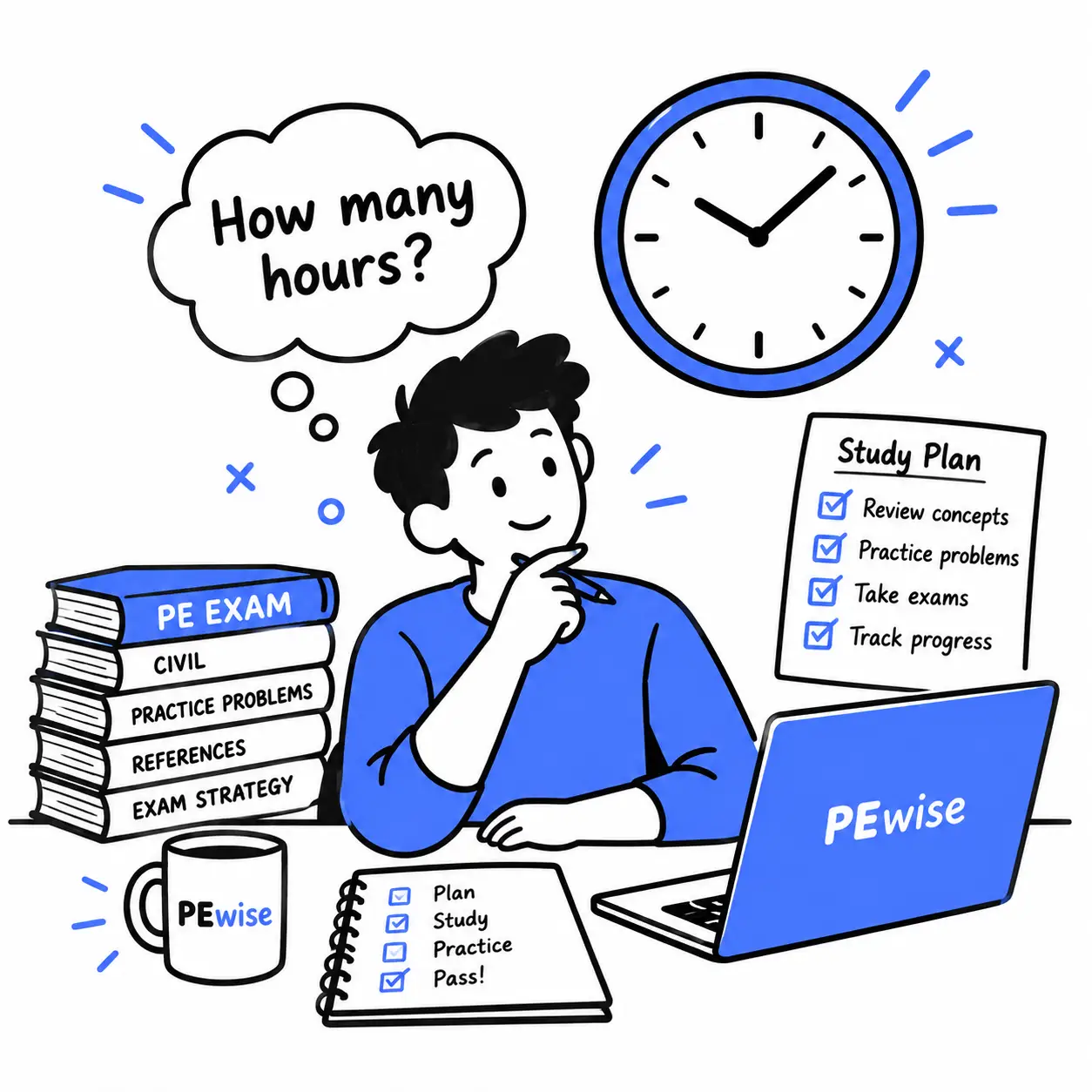
NCEES does not require or recommend a specific number of study hours for the PE exam. Prep providers commonly use approximately 200–300 focused hours as a broad planning range. That range may be appropriate for candidates who need extensive review, but it cannot account for individual topic familiarity, discipline alignment, practice efficiency, reference-navigation skill, or weekly availability.
The better question is not simply, “Have I reached 300 hours?” It is, “Can I solve representative problems accurately, at a sustainable pace, using the supplied references and reliable calculator habits?”
Key takeaways
- Use 200–300 hours only as a broad starting range; your diagnostic and timed performance should control the final estimate.
- A focused hour includes active learning, problem solving, error review, or reference practice—not distracted video playback.
- At 10–15 hours per week, each additional 50 focused hours adds roughly three to five weeks to the calendar.
- Your weakest specification areas, not an industry slogan, should determine where the next study hour goes.
- A structured course can reduce planning and resource-selection friction, but it cannot establish one universal preparation time.
How many hours should you study for the PE exam?
Most candidates can begin with 200 to 300 focused study hours as a broad planning range, then move the estimate up or down based on evidence. Some engineers may need less because their daily work closely matches the exam discipline and their diagnostic results are strong. Others may need more because they have been away from relevant coursework, work outside the chosen discipline, or need to rebuild foundational topics.
Treat the number as a starting hypothesis:
| Candidate profile | Starting approach | Reassessment signal |
|---|---|---|
| Strong alignment and diagnostic | Begin with targeted review and practice | Reassess after two weeks of timed work |
| Partial alignment and rusty areas | Follow a complete structured pathway | Reallocate time using mixed-set results |
| Broad gaps or weak pacing | Complete the full pathway and expect targeted extensions | Continue until performance becomes stable |
These are planning approaches, not NCEES statistics or predictions of passing. The applicable NCEES specification should control what you study; representative timed performance should determine how long you continue.
What counts as a focused study hour?
A focused study hour is uninterrupted time spent producing a measurable learning outcome. Examples include completing a concept lesson and retrieving its main ideas without notes, solving and reviewing problems, reworking missed questions, practicing reference searches, or completing a timed set.
Watching an hour of video while checking email is not equivalent to an hour of deliberate practice. Neither is highlighting solutions that feel familiar. Count the work that changes what you can retrieve, solve, or locate under time pressure.
Where did the 300-hour PE exam rule come from?
The “300-hour rule” is best understood as a prep-industry planning convention. It is memorable, it fits several common weekly schedules, and it gives candidates a concrete place to begin. It is not an NCEES requirement, a scientifically established average, or a universal passing threshold.
Prep providers commonly recommend approximately 200–300 hours because a broad range is useful for initial scheduling. It may suit a candidate who needs extensive review, but it cannot reflect every candidate’s existing knowledge, study quality, or rate of improvement. Treat it as a calendar input rather than a readiness standard.
That distinction matters because different evidence answers different questions:
| Evidence type | What it can tell you | What it cannot prove |
|---|---|---|
| Official NCEES material | Current specifications, policies, references, and exam procedures | How many hours you personally need |
| Prep-provider guidance | A practical planning range and study structure | A representative national average |
| Candidate reports | What worked for particular people | What will work for every candidate |
| Your timed practice data | Your current accuracy, pacing, and weak areas | The exact score needed to pass the real exam |
NCEES explains that exam results are converted to a scaled score and compared with a minimum ability level established for the exam. It does not publish the passing score. That is another reason not to turn a study-hour total or a single practice score into a promise.
Estimate your personal PE exam study hours
You do not need false precision. You need a transparent estimate that improves as you collect better information.
1. Start with the current exam specification
Download the specification for your discipline that will be effective on your scheduled exam date. As of August 2026, NCEES lists one set of PE Civil specifications for exams taken before April 2027 and another set effective beginning in April 2027. Confirm the correct effective period on the NCEES PE Civil page before building your topic list.
List each knowledge area and mark it:
- Current: You use it regularly and can solve representative problems.
- Rusty: You recognize the material but need review and practice.
- Unfamiliar: You need to learn or substantially rebuild it.
This prevents a common pain point: spending weeks reviewing comfortable topics while quietly avoiding the areas most likely to slow you down. Current PE Civil exams are organized by discipline-specific specifications; an outdated “breadth first, depth later” plan should not be used as the default framework.
2. Take a timed diagnostic
Use unseen questions that reasonably represent your discipline. Record more than the final score:
- accuracy by topic;
- average time per question;
- questions answered by guessing;
- reference lookups that took too long;
- calculator-entry errors; and
- concepts you recognized but could not apply.
One diagnostic is noisy. Its purpose is to expose the shape of the work ahead, not declare you ready or unready.
3. Adjust the starting range
Begin with your broad estimate, then move it toward the lower or upper end based on the following factors.
Move the estimate lower when: your work strongly overlaps the chosen discipline; few specification areas are unfamiliar; you maintain good pace on unseen questions; and you can navigate the supplied references efficiently.
Move it higher when: several topics are new; relevant coursework is distant; your daily work covers only a narrow part of the specification; you repeatedly depend on solution prompts; or reference and calculator use interrupts your pacing.
If you are preparing after an unsuccessful attempt, use the NCEES diagnostic report alongside your own error log. Repeating the same lectures and the same problems for the same number of hours is not a new strategy.
Planning rule: Recheck the estimate after two weeks of consistent study and again after several unseen, timed mixed sets. Add or remove time only when performance provides a reason.
4. Convert hours into weeks
Use this simple formula:
Weeks needed = estimated focused study hours ÷ sustainable focused hours per week
| Total focused hours | 8 hr/week | 10 hr/week | 12 hr/week | 15 hr/week |
|---|---|---|---|---|
| 150 | 19 weeks | 15 weeks | 13 weeks | 10 weeks |
| 200 | 25 weeks | 20 weeks | 17 weeks | 14 weeks |
| 250 | 32 weeks | 25 weeks | 21 weeks | 17 weeks |
| 300 | 38 weeks | 30 weeks | 25 weeks | 20 weeks |
Round up, then add roughly 10–15% calendar buffer for deadlines, travel, illness, and family demands. The buffer is planning advice, not an NCEES requirement.
For example, a candidate planning 200 hours at 12 hours per week needs about 17 study weeks. Adding two or three buffer weeks creates a more realistic calendar than a brittle plan that fails after one busy project deadline.
How many hours per week should you study for the PE exam?
For many full-time professionals, 10–15 focused hours per week is a workable baseline. Eight hours can succeed with a longer runway. Twenty hours may shorten the calendar, but only if the schedule does not damage sleep, attention, or consistency.
Choose a cadence you can repeat:
Steady schedule: about 10 hoursStudy for 90 minutes on four weekdays and complete one four-hour weekend block.
Weekend-weighted schedule: about 12 hoursUse two short weekday sessions for retrieval and error-log review, then complete two longer weekend sessions for lessons and problem sets.
Accelerated schedule: 15–20 hoursUse several weekday sessions plus longer weekend blocks, with at least one recovery period. Review performance after two weeks; more scheduled hours are not useful if fatigue causes repeated mistakes.
Working engineers often struggle less with motivation than with plan fragility. A late meeting, child-care problem, or field assignment can erase a perfect-looking weekly calendar. Build around a minimum viable week—perhaps two short sessions and one major block—then treat any extra time as capacity for weak areas.
For a complete calendar, use the PE exam study schedule templates.
How should you divide your PE exam study time?
The right allocation changes as your performance changes. Early weeks may require more concept development; later weeks should increasingly combine practice, correction, and simulation.
A useful starting model is:
Diagnose and map the specification. Identify current, rusty, and unfamiliar areas.
Rebuild concepts selectively. Learn enough theory to recognize conditions, assumptions, and solution paths.
Solve topic-based problems. Move quickly from explanation to application.
Review and rework errors. Classify mistakes as concept, setup, reference, units, calculator, or pacing errors.
Practice mixed timed sets. Learn to switch topics without cues from a chapter title.
Complete full-length simulations. Test endurance, break strategy, pacing, and interface habits.
Taper into targeted review. Protect sleep and correct recurring errors rather than opening large new content areas at the last minute.
Do video lecture hours equal total study hours?
No. Lecture runtime is only one part of preparation. Total workload also includes pausing to work through an example, taking useful notes, solving questions, reviewing errors, revisiting weak concepts, and completing practice exams.
Short, visual, concept-first instruction can reduce interpretation time and move candidates into problem solving sooner. Regardless of provider, compare the published lecture runtime with the expected time for problems, solution review, reference work, and simulations; lecture hours alone do not describe the full workload.
How much time should go to practice problems?
Practice should occupy a large and growing share of the plan. Count problem review and later re-solving as part of practice; simply reading the provided solution is not the same as producing it yourself.
Avoid chasing a universal question count. One hundred carefully reviewed questions across weak specification areas can teach more than several hundred repeated questions answered from memory. Track whether you can solve unseen questions, explain why wrong choices are wrong, and avoid repeating the same error category.
Are flashcards useful for the PE exam?
Flashcards can help with definitions, units, assumptions, conceptual distinctions, and retrieval cues. They are supplementary. They cannot replace multi-step engineering problems, reference navigation, or timed decision-making.
How much calculator and reference practice do you need?
Practice with the physical calculator model you intend to bring and confirm that it appears in the current NCEES calculator policy. Build speed only on functions relevant to your discipline, and record entry mistakes in your error log.
Also practice locating information in the NCEES-supplied Reference Handbook and, where applicable, the separately supplied design standards. Do not confuse owning a reference with being able to find the correct provision under time pressure.
Does your PE Civil discipline change how long you need to study?
Yes—but not because each discipline has a universal hour requirement. Your time depends on the overlap between the specification effective on your exam date, your education, and the work you perform.
- Construction: Time often grows when a candidate’s experience is concentrated in only one part of the construction process or when temporary works, planning, estimating, equipment, safety, or materials are unfamiliar.
- Geotechnical: Candidates may need extra time to connect soil behavior, investigation data, seepage, settlement, retaining systems, foundations, and site characterization rather than memorizing isolated equations.
- Structural: Reference navigation, load paths, analysis, and material-specific design provisions can increase the practice burden for candidates whose daily work is limited to one system or material.
- Transportation: Time depends on familiarity across geometric design, traffic operations, safety, planning, drainage, and the supplied references—not only the specialty used at work.
- Water Resources and Environmental: Candidates with a water-resources background may need more environmental review, and vice versa. Hydrology, hydraulics, groundwater, water quality, drinking-water treatment, and wastewater processes must become one workable exam plan.
Use the specification effective on your exam date to expose gaps, then choose discipline-specific instruction that closes them. PEwise currently offers complete Civil courses for Construction, Geotechnical, and Water Resources & Environmental. Its Structural and Transportation courses are publicly listed as planned and should not be described as currently available.
Can a PE exam prep course reduce your study time?
A well-aligned course can reduce time lost to deciding what to study, searching for explanations, organizing resources, and building practice from unrelated sources. It cannot prove that every candidate will need fewer total hours or be ready after the same amount of study.
That distinction reflects the real pain points of PE preparation. Many candidates do not fail to work hard; they lose time because the plan is fragmented. They jump between videos, textbooks, old notes, and question banks without knowing whether the applicable specification is covered. They postpone full-length practice, discover reference-navigation problems late, and receive no help when a conceptual gap blocks several topics.
PEwise is designed to bring those pieces into one learning path:
- short visual lessons that explain the engineering “why,” not only formula substitution;
- discipline-specific modules organized around current PE Civil preparation;
- practice problems and detailed solutions that connect concepts to exam decisions;
- weekly PE Power Hour sessions for questions and weak-area clarification;
- full-length practice exams inside a CBT-style interface; and
- a built-in TI-36X Pro calculator, searchable reference workflow, timed sessions, question flagging, and detailed solutions.
Together, these features address both sides of preparation. The visual course develops conceptual understanding, while the practice system helps candidates work on accuracy, reference fluency, pacing, and endurance. Learning and performance are evaluated throughout the same pathway rather than treated as unrelated phases.
The PEwise 150-hour planning framework
PEwise provides a structured 150-hour planning framework designed to reduce time lost to resource selection, duplicated review, and disconnected practice. This is a transparent workload model—not an estimate of how many hours every candidate needs and not a prediction of passing. Some candidates will need additional preparation based on their diagnostic results and timed performance.
The framework allocates up to 150 focused hours as follows:
| Activity | Suggested focused hours | Purpose |
|---|---|---|
| Visual concept lessons and worked examples | 40–45 | Build deep understanding without excessive lecture time |
| Topic practice and detailed solution review | 40–45 | Convert concepts into reliable problem-solving skill |
| Error-log rework, references, and calculator practice | 15–20 | Remove recurring mistakes and improve navigation speed |
| Timed mixed sets and full-length CBT-style exams | 30–40 | Build pacing, endurance, interface fluency, and decision-making |
| Total | Up to 150 | Initial structured PEwise planning framework |
These ranges are editorial planning assumptions. Before presenting the framework as learner-outcome evidence, PEwise should publish course-specific lesson runtime, expected problem and solution-review time, full-length exam time, learner sample size where available, completion definitions, outcome definitions, and limitations. A candidate who already understands a topic can move hours into weak-area practice; a candidate whose simulation exposes a material gap should continue beyond the framework as needed.
The PEwise course catalog currently lists 90 days of access, weekly live Q&A, and discipline-specific lesson and exam inventories. Because prices, counts, schedules, access periods, and guarantee conditions can change, candidates should review the current PEwise Civil course catalog before enrolling.
Why CBT-style practice matters
Knowing the material is not the same as performing in a computer-based exam environment. Candidates can lose time switching between questions and references, searching PDFs, entering calculations, deciding when to flag a problem, and maintaining pace over a long session.
PEwise practice exams provide a CBT-style environment that rehearses timed navigation, question flagging, TI-36X Pro calculator use, searchable reference workflows, and solution review. The simulator is a preparation tool and is not the Pearson VUE testing interface. A free sample provides 10 practice questions without requiring a credit card, making it possible to test the workflow before committing to a course. Explore the PEwise PE Civil practice exams.
How do you know when you have studied enough?
Hours are an input. Readiness is demonstrated performance. You are approaching readiness when:
- every area in the specification effective on your exam date has been reviewed and practiced;
- results are stable across multiple unseen, timed sets;
- your pace leaves deliberate time for review;
- recurring error categories are declining;
- you can locate relevant material efficiently in the supplied references;
- calculator-entry and unit errors are rare;
- you have completed and reviewed at least one full-length CBT-style simulation; and
- your sleep, concentration, and endurance are stable enough for exam day.
Do not treat one unusually high practice score as proof. Look for repeatability across topics and question sets.
Add more weeks when
- unfamiliar specification areas remain untouched;
- scores or pace swing widely between sets;
- corrected errors return on later problems;
- most study time is still passive viewing or reading; or
- a full-length simulation exposes endurance, reference, or interface problems.
Stop adding broad study hours when
- performance has stabilized across representative practice;
- additional review repeats comfortable material without improving results;
- studying more is displacing sleep and recovery; or
- the remaining work is narrow enough for targeted error correction.
Three example PE exam study plans
These illustrations show how the same planning method produces different timelines. They do not predict exam outcomes.
Recent graduate with strong discipline alignment
The candidate remembers most core material, works in the selected discipline, and performs well on an initial diagnostic but is slow with references. The plan begins with targeted topic review and reference navigation, followed by mixed sets and simulation. The candidate reassesses the calendar after two weeks instead of committing to an invented profile-based hour total.
Mid-career engineer with partial alignment
The candidate uses several exam topics at work but has rusty areas outside a narrow specialty. The plan follows a complete structured pathway, with early work aimed at unfamiliar areas. The error log determines whether later time goes to concepts, calculations, references, or pacing. The candidate reassesses after the first two mixed timed sets.
Career switcher or candidate returning after a long gap
The candidate has many unfamiliar areas and weak diagnostic pacing. The plan includes the full structured pathway, with a larger share assigned to concept development and topic practice. The candidate expects targeted study beyond the initial framework if timed results remain unstable. Any extension addresses a demonstrated weakness rather than repeating the entire course.
Frequently asked questions about PE exam study time
Is three months enough to study for the PE exam?
It can be. Three months at 15 hours per week provides about 180 focused hours; at 10 hours per week, it provides about 120. A highly aligned candidate may be ready within that window, while a candidate with broad gaps may need longer. Use a diagnostic and timed performance rather than the calendar alone.
Is six months too long to study for the PE exam?
No. Six months can be practical for a working professional studying 8–12 hours per week. Prevent forgetting by revisiting earlier topics through spaced mixed practice. A long schedule becomes inefficient only when it delays practice, lacks review loops, or repeatedly covers familiar material without measurable improvement.
Can I pass the PE exam with self-study?
Yes, some candidates prepare successfully on their own. Self-study works best when you can map the applicable specification, select reliable resources, diagnose gaps, and maintain accountability. A structured course is more valuable when you want an organized sequence, concise explanations, integrated practice, instructor access, or a full-length CBT-style simulation.
How many hours a day should I study?
For a 10–15-hour week, many candidates use 60–90-minute weekday sessions plus one or two longer weekend blocks. Choose the smallest schedule you can sustain. Long daily sessions are not automatically better if attention declines or work and family obligations make the plan inconsistent.
How many practice problems do I need?
There is no universal number. Cover the specification effective on your exam date, use unseen questions, review every error, and verify that performance is repeatable under time pressure. The quality and distribution of your practice matter more than a large total inflated by familiar or repeated questions.
Should I study differently after a failed attempt?
Yes. Combine the NCEES diagnostic report with your own evidence about pacing, references, calculator use, and repeated error types. Change the allocation of time and the practice method. Simply repeating the same lectures and questions may reproduce the same weaknesses.
Does NCEES recommend 300 study hours?
No. NCEES publishes specifications, policies, exam-preparation resources, and scoring information, but it does not prescribe a 300-hour study requirement. The number is a broad provider planning convention, not an official rule or guaranteed threshold.
Can an online PE course reduce the number of hours I need?
It may reduce planning, resource-selection, and duplication time by organizing instruction, practice, feedback, references, and simulation in one place. No provider can infer your personal preparation time from course structure alone. Evaluate efficiency using disclosed lecture runtime, expected practice workload, specification alignment, support, and the quality of timed simulations.
What study times do major PE prep providers recommend?
Provider recommendations vary and change. Compare each current source individually rather than calculating a false industry average. Also distinguish advertised video runtime from total learner workload, which includes problem solving, solution review, references, calculator practice, and full-length exams. A maintained best PE Civil courses comparison is the better place to compare live classes, problem banks, workload, pricing, and pass-rate evidence.
How should you evaluate PE course pass-rate claims?
Look for the sample size, eligible student definition, completion requirement, first-time versus repeat-candidate mix, reporting period, and treatment of students whose outcomes are unknown. A percentage without methodology is not enough to compare providers or estimate how many hours you personally need.
What calculator operations should you practice?
Practice only with a calculater model allowed under the current NCEES calculator policy. Depending on your discipline, useful practice may include equation solving, statistics, regression, vectors, matrices, trigonometric modes, scientific notation, and careful use of stored variables. Focus on the functions you actually need and on error-free entry under time pressure.
Build your plan from evidence, not an arbitrary total
Do not treat 150, 200, or 300 hours as a universal threshold. Start with a transparent planning framework, convert it into a sustainable weekly calendar, then use specification coverage, timed practice, error trends, reference speed, calculator fluency, and full-length simulation to decide whether the plan is sufficient.
Meet PEwise: PE Exam Prep Built for Busy Engineers
At PEwise, we help civil engineers prepare through focused video lessons, worked examples, timed practice exams, and weekly live support. We connect concept review with practical problem solving so you can build a study routine around your career. If you’re looking for the best PE exam prep course for your learning style and schedule, explore our courses and try the free preview modules to see how we teach.
Keep Reading

PE Civil Structural Exam Topics and NCEES Study Guide
Build a focused study plan for the PE Civil: Structural exam. This guide breaks down the NCEES exam topics, question ranges, and design references, then shows how to prioritize weak areas, practice reference navigation, and organize your preparation with an adaptable twelve-week schedule.

Best PE Civil Structural Study Materials
More study materials don’t always mean better preparation. Discover which books, references, courses, and practice exams you actually need for the PE Civil: Structural exam—and build a focused study system that fits your schedule.
PE Civil Exam Specification Changes for 2027: What Actually Changes
Preparing for the PE Civil exam in 2027? You may need to update your references—not rebuild your study plan. Explore the April design standard changes for all five disciplines and learn what to check so your practice materials match your exam date.