How to Use the NCEES PE Civil Reference Handbook: Search Tips, Study Method, and Traps
The NCEES PE reference handbook is only 75 pages of bare formulas. Learn what's missing, what you need to know cold, and how to navigate it under time pressure.
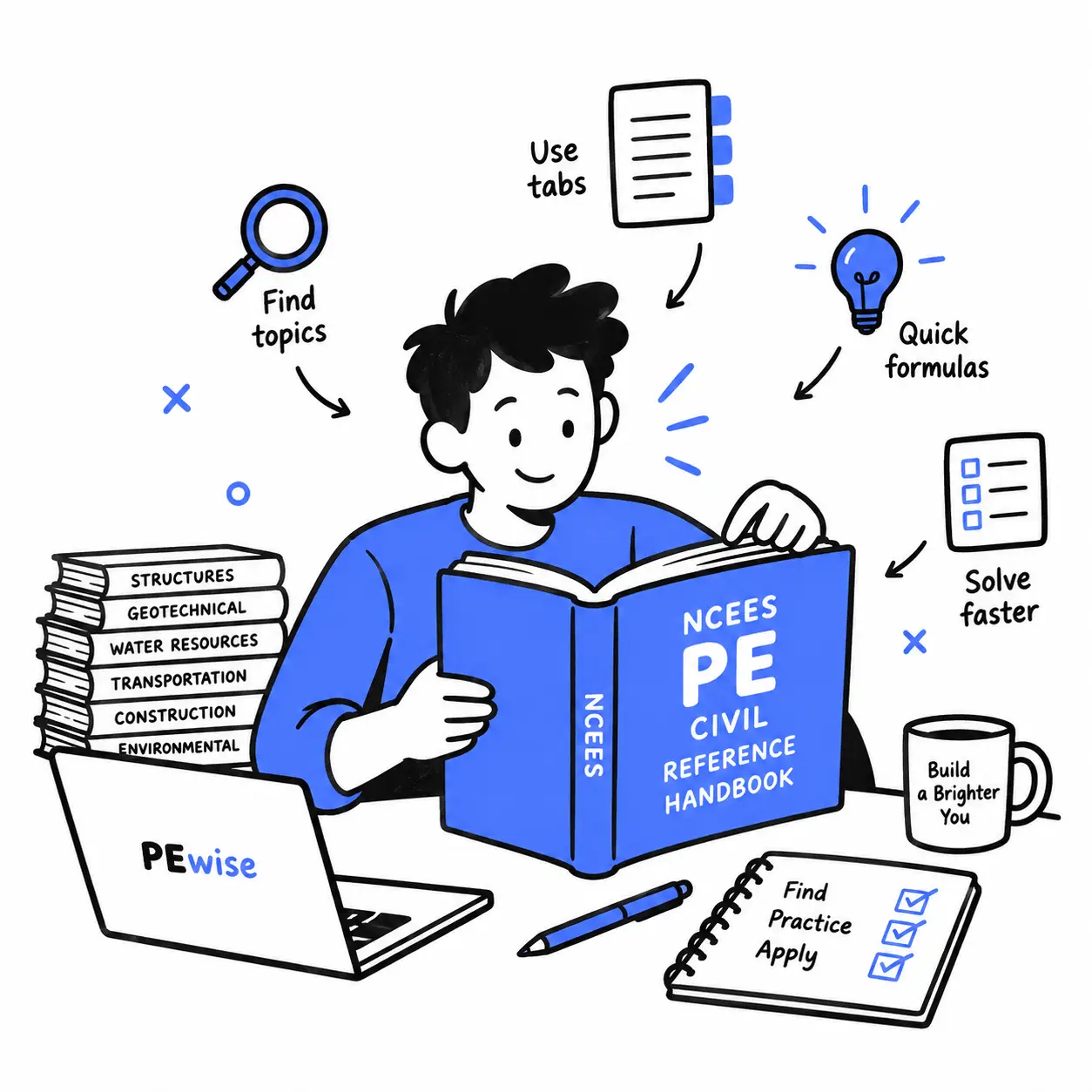
Find formulas and provisions faster, practice with the correct electronic references, and build a handbook workflow that holds up under PE Civil exam pressure.
The PE Civil Reference Handbook can save time only if you already know two things: what you are looking for and which supplied document should contain it. Treating the handbook as a searchable textbook is slow. Treating it as one part of a practiced reference system is much more effective.
This guide starts with the practical handbook tips most candidates are looking for. Then it explains the current exam interface, a repeatable search method, discipline-specific reference mapping, study drills, common traps, and the PEwise method for turning reference lookups into reliable problem solving.
The Best PE Civil Reference Handbook Tips
If you remember only one section of this guide, make it this one.
Download the handbook from MyNCEES, not from an old study folder. Open MyNCEES and use the dashboard copy as the controlling version for preparation. Confirm its title-page version rather than trusting a filename, search result, or third-party article.
Match the exam specification to your test date. The official NCEES PE Civil page currently posts one set of specifications for exams before April 2027 and another set effective beginning April 2027. The last page or pages of the correct discipline specification list the design standards supplied with your exam.
Practice in electronic form from the beginning. Printing may help with learning, but exam-day references are electronic. Complete most problem practice on a computer using searchable files so that reference navigation becomes part of solving the problem.
Do not train yourself to depend on Ctrl+F. The current NCEES Examinee Guide states that Ctrl+F is not available in the exam software. The supplied reference viewer has its own search box on the left side. Desktop PDF search is still useful during study, but your real skill is choosing effective search terms and navigating results, not memorizing a keyboard shortcut.
Choose the document before choosing the keyword. First decide whether the needed information belongs in the PE Civil Reference Handbook or in a separately supplied design standard. Searching the wrong document efficiently is still wasted time.
Search a distinctive technical term, not the broad topic. A specific equation name, test name, failure mode, material term, or uncommon noun will usually produce a shorter result list than words such as “flow,” “load,” “soil,” “steel,” or “stress.”
Build two or three search terms for every recurring concept. Record the term used in the problem, the term used in the handbook or standard, and a useful synonym or abbreviation. This protects you when the wording in a question differs from the reference.
Use the table of contents and linked chapters before scrolling. NCEES supplies searchable PDFs with linked chapters. Large design standards are presented by individual chapter, and only one chapter at a time can be opened and searched. A mental map of the document prevents blind, full-document hunting.
Verify the equation before substituting numbers. Read the nearby definitions, assumptions, diagram, units, sign convention, limits, and notes. A search hit is not proof that the displayed relationship applies to the question.
Track lookup time separately from solve time. After every timed set, label delays as document-selection errors, keyword errors, navigation errors, concept gaps, or calculation errors. Each category needs a different fix.
Set a search stop rule. If a lookup is not producing a useful result after a short, preselected interval, flag the question and continue. Choose the interval during timed practice based on your pace; do not invent it for the first time during the exam.
Rehearse the entire workflow. Practice identifying the topic, selecting the document, searching, validating the provision or formula, calculating with consistent units, answering, and deciding whether to flag. Reference skill is a sequence, not a search-box trick.
A 15-Minute Setup You Can Do Today
Use this short setup before your next practice session:
- Log in to MyNCEES and download the current PE Civil Reference Handbook.
- Open the official NCEES PE Civil page and download the specification for your discipline and exam date.
- Read the design-standard list on the last page or pages of that specification.
- Create a reference log with five columns: topic, likely document, likely chapter, successful search term, and lookup time.
- Solve five representative problems with only the references that will be supplied on exam day.
- After each problem, update the log even if your answer was correct.
- That small routine immediately reveals whether your real problem is technical knowledge, reference selection, search vocabulary, or speed.
What References Do You Actually Get on the PE Civil Exam?
The PE Civil exam is closed book with electronic references. Personal books, printed handbooks, notes, and personal copies of standards are not allowed in the testing room.
NCEES supplies:
- the current electronic NCEES PE Civil Reference Handbook; and
- the electronic design standards listed in the specification for your discipline and exam date.
- The handbook and the design standards are different resources. The handbook collects equations, tables, definitions, diagrams, and general engineering reference material. The separately supplied standards contain discipline-specific requirements, criteria, coefficients, procedures, and provisions from the organizations identified in the exam specification.
Do not memorize a third-party list of standards. NCEES says design standards change more frequently than exam specifications. The date-specific specification is the control document.
Use the Correct Specification for Your PE Exam Appointment
| Your scheduled PE Civil test date | Specification to open on the NCEES PE Civil page |
|---|---|
| Before April 2027 | The link under “Effective before April 2027” for your discipline |
| Beginning April 2027 | The link under “Effective beginning April 2027” for your discipline |
The five PE Civil disciplines are Construction, Geotechnical, Structural, Transportation, and Water Resources and Environmental. Each has its own knowledge areas and supplied-standard list. PE Civil: Structural is also different from the separate NCEES PE Structural exam.
What Is the Current Civil Handbook Version?
Use the version shown on the title page of the handbook in your MyNCEES account. Public NCEES pages refer candidates to the “current version” but may not display its version number. A page count or version number in a blog can become stale, so this article intentionally does not hard-code either one.
How the Electronic References Work During the Exam
According to the May 2026 NCEES Examinee Guide:
- the current handbook appears onscreen as a searchable PDF;
- examinees use a 24-inch monitor with enough space to display the question and reference material;
- the search box is on the left side of the supplied reference viewer;
- Ctrl+F is not available;
- references are typically best viewed at 100 percent, although zooming may help; and
the tutorial explains how to access the handbook and use the exam functions.
The PE Civil exam has 80 questions and eight hours of exam time within a nine-hour appointment. After approximately half of the questions, the system prompts you to review and submit the first section. You cannot reopen that section after submitting it. Reference searches therefore belong inside your section-time plan, not in a separate pool of time.
Current discipline specifications also explain that design standards are supplied as individual chapters. Only one chapter at a time can be opened and searched. This is why knowing the likely standard and chapter is more valuable than knowing a long list of keywords.
You may bring a calculator that complies with the current NCEES Calculator Policy, without its cover. The May 2026 Examinee Guide also states that a TI-30XS is available for onscreen use. Practice with the current calculator policy rather than relying on a blog’s model list, which can change.
The Five-Step PE Civil Handbook Search Method for PE Civil Exam
Use the same process for every lookup until it becomes automatic.
Step 1: Classify the Question
Before opening a reference, identify:
- the discipline topic;
- whether the task is analysis, design, interpretation, or a code/standard lookup;
- the requested output and units; and
- the likely governing relationship or provision.
If you cannot describe the concept in plain language, searching is unlikely to fix the problem. That is a concept gap, not a navigation gap.
Step 2: Select the Source
Ask: “Is this likely a general relationship from the PE Civil Reference Handbook, or a requirement from a listed design standard?”
Use the handbook for general equations, definitions, tables, and engineering relationships that it contains. Use the listed standard when the question turns on a prescribed design rule, coefficient, limitation, material provision, safety requirement, or standard-of-practice criterion.
The boundary is not always obvious. Resolve that uncertainty while studying by recording the successful source for each problem.
Step 3: Search Narrowly
Start with the most distinctive technical term available. A practical search ladder is:
- named equation, method, test, failure mode, or provision;
- distinctive noun from the question;
- formal technical synonym;
- recognized abbreviation; and likely chapter or section title.
Avoid starting with single-letter variables or very broad words. PDF text extraction may also handle symbols, Greek letters, hyphens, and subscripts inconsistently, so a descriptive term is usually a better first search.
Step 4: Validate the Result
Before calculating, check:
- what every symbol means;
- the required unit system;
- whether the equation is dimensional or unit-specific;
- sign conventions and coordinate directions;
- stated assumptions and applicability limits;
- whether the rule contains multiple conditions joined by “and” or “or”; and
- whether a nearby note, table heading, or figure changes the interpretation.
This step prevents a common failure: finding the right-looking equation in the wrong context.
Step 5: Decide and Move
If the reference path is clear, solve and answer. If the search is becoming circular, use the stop rule you developed in practice, flag the question, and protect the rest of the section. A controlled second pass is better than an open-ended search on the first pass.
Build a Reference Map for Your PE Civil Discipline
A reference map is a compact decision system: “For this topic, I start in this document and this chapter family.” It is not a homemade reference you can take into the exam. It is a study tool used to build memory before exam day.
Start with the knowledge areas in the specification for your discipline. For each area, identify:
- handbook topics you use repeatedly;
- listed design standards that govern the area;
- likely chapters or sections;
- effective search terms;
- unit-system issues; and
- mistakes you have already made.
Discipline-Specific Priorities
| Discipline | What the reference map should emphasize |
|---|---|
| Construction | Separate general calculations and project controls from listed formwork, structural, materials, traffic-control, and safety standards. Know which listed document governs the question before searching. |
| Geotechnical | Map site characterization, soil behavior, seepage, earth structures, retaining systems, and foundations to the handbook and the specific government or other standards listed for your date. Large manuals make chapter selection especially important. |
| Structural | Separate analysis relationships from material design, loads, building, bridge, wood, masonry, and safety provisions in the date-specific standards list. Verify both the governing standard and its assigned edition. |
| Transportation | Map geometric design, traffic analysis, controls, pavement, roadside, work-zone, and other specification topics to the exact AASHTO, FHWA, MUTCD, HCM, or other references listed for your date. Do not assume the newest industry edition is the exam edition. |
| Water Resources and Environmental | Distinguish handbook equations and process relationships from any listed regulatory, water, wastewater, hydraulic, or hydrologic design references. Track unit conversions and the source of tabulated criteria carefully. |
These are mapping priorities, not a substitute for the official list. Copy the exact titles and editions from your own date-specific NCEES specification.
A Useful Reference-Log Format
| Topic | Start in | Chapter/section family | Search terms that worked | Lookup time | What went wrong |
|---|---|---|---|---|---|
| Practice topic | Handbook or listed standard | Your verified location | Two or three tested terms | Measured time | Concept, source, search, units, or arithmetic |
Keep the log short enough to maintain. Its purpose is to change your next study session, not to become another textbook.
A Four-Stage Plan to Master the Handbook
Stage 1: Orientation
Spend one focused session reviewing the table of contents, linked chapters, major tables, figures, and the overall organization of the current handbook. Then review the standards list for your discipline and exam date.
The goal is not memorizing page numbers. Pages and editions can change. Learn document structure and topic families.
Stage 2: Integrated Practice
Use the handbook and applicable standards for every practice problem, even when you remember the equation. Repetition teaches the full path: recognize, select, locate, validate, and apply.
After each problem, record the source and successful search term. If a solution uses material that is not in the supplied references, decide whether it is a concept you must understand, a relation you should be able to derive, or evidence that the practice material does not match your specification.
Stage 3: Timed Lookup Drills
- Build short drills that test navigation without hiding technical weakness:
- choose a topic from the exam specification;
- state the likely document before opening it;
- start the timer;
- locate and validate the relevant equation, table, figure, or provision;
- stop the timer only after confirming context and units; and
- record why any slow search was slow.
Measure improvement against your own baseline. An arbitrary universal lookup target is less useful than a reliable trend across your actual references.
Stage 4: Full Workflow Simulation
Complete timed mixed sets and full-length practice in electronic form. Rehearse:
- question triage;
- reference selection;
- search and chapter navigation;
- calculator use;
- unit checks;
- flagging and review;
- the two-section submission decision; and
- sustained performance after the scheduled break.
Use only legal study copies of the editions assigned for your date. NCEES supplies copyrighted standards in the exam but directs candidates to the publishers for preparation copies.
The Most Common Reference-Handbook Traps
Trap 1: Treating the Handbook as a Textbook
What happens: You try to learn a topic from an equation and a few labels while the timer runs.
Fix: Learn concepts during preparation. Use the exam references to retrieve and verify information, not to teach yourself the topic for the first time.
Trap 2: Searching the Wrong Document
What happens: You search the handbook for a value or rule that belongs in a separately supplied standard.
Fix: Build the document-selection step into every practice problem and maintain a discipline reference map.
Trap 3: Depending on Ctrl+F
What happens: Your study habit begins with a shortcut that the exam software does not provide.
Fix: Practice the cognitive part of searching: document, chapter, term, result, context. Watch the official NCEES reference-search video and pay attention to the tutorial on exam day.
Trap 4: Using an Old Handbook or the Wrong Standard Edition
What happens: Familiar page locations, coefficients, provisions, or terminology do not match the files assigned to your appointment.
Fix: Use the current MyNCEES handbook and the NCEES specification effective for your exact exam date. Check editions on the standards list.
Trap 5: Believing “No Search Result” Means “Not Supplied”
What happens: The reference uses a synonym, formal term, abbreviation, hyphenation, or chapter title you did not try.
Fix: Use your search ladder, then navigate by chapter. If the search still fails, classify the gap instead of repeating the same broad query.
Trap 6: Substituting Numbers Too Soon
What happens: You use a nearby equation but miss a condition, unit basis, sign convention, or definition.
Fix: Make validation a required step. Read around the hit before calculating.
Trap 7: Letting One Lookup Consume the Section
What happens: The desire to recover the time already spent keeps you searching.
Fix: Use a practiced stop rule and the exam’s flag-and-review workflow. A sunk search cost is not a reason to add more time.
Trap 8: Practicing Only Familiar Topics
What happens: Your lookup speed looks strong because you already know where everything is in your best subjects.
Fix: Weight drills by the current NCEES specification and your error log. Include unfamiliar standards and weak topics.
Trap 9: Memorizing Page Numbers
What happens: A version change or different rendering breaks your mental map.
Fix: Remember document, chapter family, technical language, and visual context. Treat page numbers as temporary study clues only.
Trap 10: Trusting a Third-Party Interface as an Exact Replica
What happens: You assume controls, layout, search behavior, or reference packaging will be identical on exam day.
Fix: Use simulators to rehearse decisions and pacing, but use the NCEES Examinee Guide, official video, and tutorial as the authorities for the real interface. Also, another reliable source to practice the CBT format of the PE exam is on Pewise platform. You can try a free PE practice exam on Pewise right now!
The PEwise Method: Understand, Map, Retrieve, Apply, Review
The handbook problem is not solved by more memorization. It is solved by connecting concept knowledge to reference fluency and deliberate practice.
1. Understand
Learn what the relationship, procedure, or provision means before trying to remember where it appears. You should be able to identify the governing concept, expected behavior, and likely answer range before opening a reference.
2. Map
Connect each specification topic to the likely handbook section or listed standard. This creates the discipline reference map that prevents blind searching.
3. Retrieve
Practice finding the information with a narrow search term and chapter navigation. Record the vocabulary used by the assigned reference.
4. Apply
Solve with explicit units, definitions, assumptions, and boundary conditions. When a standard contains more than one requirement, check every applicable condition.
5. Review
After each set, separate concept errors from reference-selection, search, unit, calculator, and pacing errors. Then choose a targeted correction for the next set.
PEwise supports this cycle with short visual lessons, worked examples, quizzes, electronic-reference practice, timed practice exams, and live support in its published PE Civil offerings. The practice environment is not the official NCEES interface; its purpose is to rehearse the decisions that matter. Candidates should compare the current course blueprint with the NCEES specification effective for their registered discipline and date.
Exam-Day NCEES Handbook Checklist
Before the exam:
- Confirm the current handbook in MyNCEES.
- Confirm the specification and design-standard editions for your discipline and date.
- Review the current NCEES Examinee Guide and calculator policy.
- Watch the official NCEES video on searching onscreen references.
- Practice with electronic references and your approved calculator.
During the tutorial:
- Locate the reference button and left-side search box.
- Confirm how linked chapters, results, zoom, flagging, and review work.
- Notice how to return to the question without losing your place.
For each lookup:
- Classify the topic.
- Choose the document and chapter family.
- Search a distinctive term.
- Read the surrounding context.
- Check symbols, units, assumptions, and limits.
- Solve or flag according to your practiced stop rule.
- Before submitting the first section:
- Review flagged and unanswered questions.
- Recheck unit-sensitive answers and reference-dependent conditions.
Confirm that you are ready to lose access to the section permanently.
Frequently Asked Questions
Is the PE Civil exam open book?
No. It is a closed-book computer-based exam with electronic references supplied by NCEES. Personal books, notes, printed handbooks, and personal standards are not permitted in the testing room.
Can I use Ctrl+F on the PE Civil exam?
No. The May 2026 NCEES Examinee Guide states that Ctrl+F is not available. Use the search box on the left side of the supplied reference viewer.
Can I bring a printed PE Civil Reference Handbook?
No. NCEES supplies the handbook onscreen. NCEES permits candidates to print a handbook from its site for personal study, but personal reference materials cannot enter the testing room.
Which PE Civil Reference Handbook version should I study?
Use the current version in your MyNCEES dashboard and verify its title-page version. Do not rely on a version number or page count from a third-party article.
Does NCEES provide the design standards during the exam?
Yes. NCEES supplies the design standards listed in the official specification for your discipline and exam date. For preparation copies, NCEES directs candidates to the publishers.
Are all supplied references searchable?
NCEES states that the handbook and supplied standards are searchable electronic PDFs with linked chapters. Current PE Civil specifications explain that standards are presented as individual chapters and only one chapter at a time can be opened and searched.
Should I memorize formulas that are not in the handbook?
Do not build a memorization list from a third-party claim about what the handbook omits. Start with the current exam specification and assigned references. Learn the governing concepts, practice the required applications, and note during legitimate problem practice what must be understood or derived without a direct lookup.
How long should I spend searching for a formula?
There is no official universal limit. Establish a stop rule through timed practice that protects your overall section pace. When a lookup becomes circular, flag the question and return later.
Can I use my own calculator?
You may bring a calculator that complies with the current NCEES Calculator Policy, without its cover. The May 2026 Examinee Guide also identifies a TI-30XS for onscreen use. Verify the current policy before your appointment.
Is PE Civil: Structural the same as the PE Structural exam?
No. PE Civil: Structural is one of the five PE Civil disciplines. The separate PE Structural exam has different specifications and testing structures.
Turn Reference Practice Into Exam Skill
The handbook is not the enemy, and it is not a rescue plan. It is one part of a controlled process: understand the problem, choose the right supplied source, retrieve the relevant information, validate it, and apply it with engineering judgment.
If your study method practices that entire process, the electronic references become faster and more useful with every set. If your preparation stops at watching solutions or highlighting formulas, the search box will not save you under time pressure.
Compare PEwise’s current discipline offerings, preview the published lessons, and match any course blueprint to the NCEES specification for your registered exam date.
Keep Reading
PE Civil Geotechnical Exam Guide Format, Topics, References & Pass Rates
Everything on the PE Geotechnical exam — the 10 NCEES knowledge areas with question counts, CBT format, bundled references, pass rates, and how to study.

PE Exam Anxiety: How to Manage Stress Before and During the PE Civil Exam
PE exam anxiety is manageable when you reduce avoidable uncertainty and rehearse the decisions you will need under pressure. Use this PE-specific plan for study, sleep, pacing, blank-mind recovery, the scheduled break, retakes, and accommodations.
Why You Keep Failing the PE Geotechnical Exam (And How to Fix It)
Discover the 3 real reasons engineers fail the PE Geotechnical exam — conceptual questions, false confidence from practice exams, and passive study methods — plus proven strategies to pass on your next attempt.