PE Exam Anxiety: How to Manage Stress Before and During the PE Civil Exam
PE exam anxiety is manageable when you reduce avoidable uncertainty and rehearse the decisions you will need under pressure. Use this PE-specific plan for study, sleep, pacing, blank-mind recovery, the scheduled break, retakes, and accommodations.
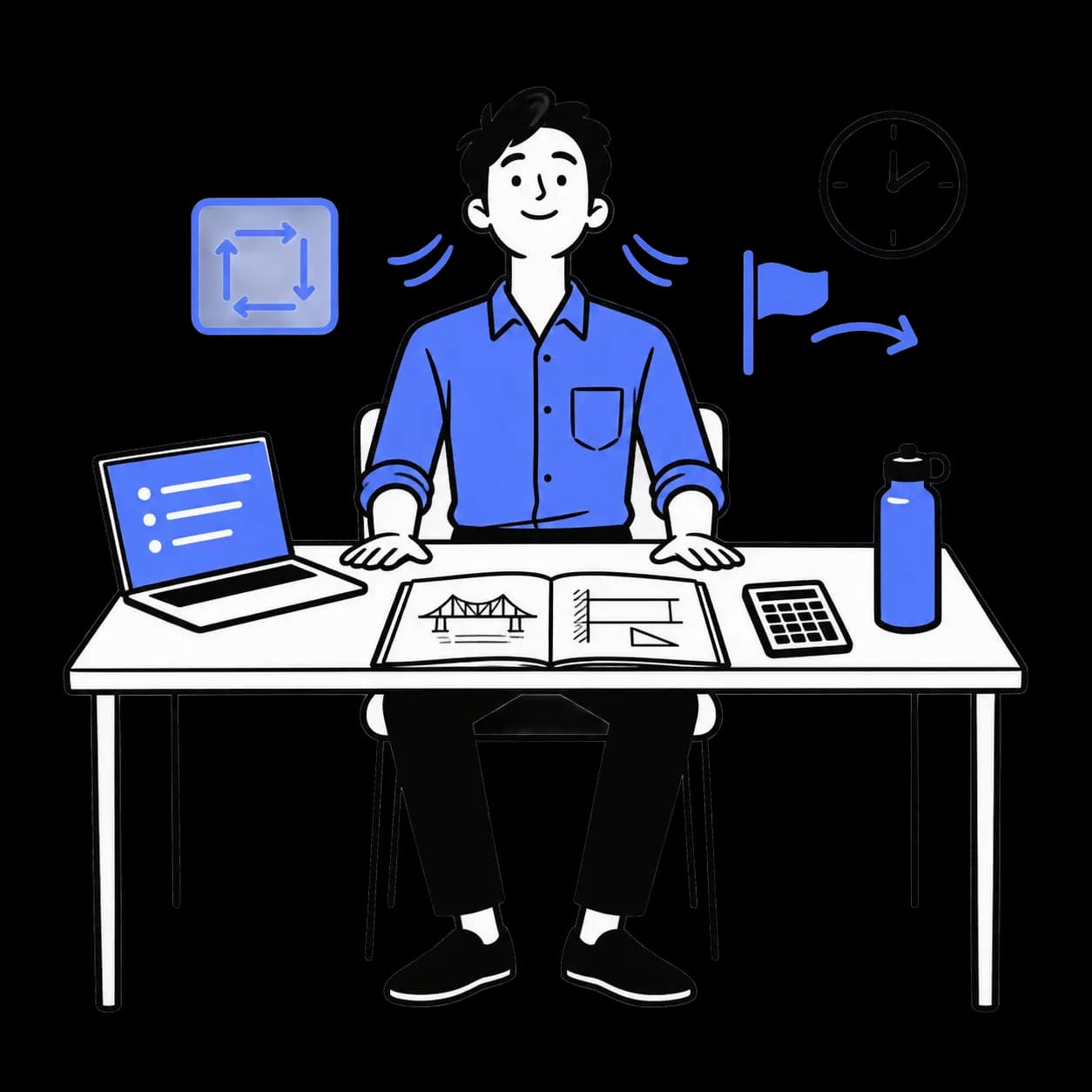
The short answer: what actually helps with PE exam anxiety
You do not need to eliminate every nervous feeling before the PE Civil exam. The practical goal is to keep anxiety from deciding what you do next.
The most useful approach combines two types of preparation:
Reduce avoidable uncertainty. Know your discipline specification, current references, test-center rules, route, identification, calculator, break plan, and pacing method.
Practice the behaviors you need under pressure. Work increasingly realistic timed sets, search the same handbook and standards you will rely on, flag a stalled question, review before submitting a section, and recover after an error.
Protect the basics. Keep a steady sleep schedule, move regularly, eat and use caffeine in a familiar way, and make the final days lighter rather than frantic.
Use one brief reset you have rehearsed. Slow, comfortable breathing and focused attention can be useful relaxation tools. They are skills to practice, not switches that guarantee instant calm.
Get help when anxiety is persistent or disabling. A licensed clinician can evaluate symptoms and discuss evidence-based care. If a disability affects testing, request reasonable accommodations through NCEES during registration.
This guide turns those principles into a plan you can use now, during the final week, and at the computer on exam day.
If your mind feels blank right now: use this five-step reset
When anxiety rises, do not try to solve your entire exam, study plan, or career at once. Complete one observable action.
Pause the calculation. Put the calculator down for a moment and let your shoulders and jaw loosen.
Breathe slowly and comfortably. Make the exhale unhurried for two or three breaths. Do not force an unusually deep breath or hold your breath if that makes you light-headed or more anxious.
Orient to the present task. Notice your feet on the floor, the chair, and the screen or page in front of you.
Rewrite the target. State the quantity requested, its units, and the one topic or reference most likely to govern it.
choose the next move. Take one concrete step. If you still cannot name a plausible method after a brief scan, flag the question and continue within the current exam section.
The reset is not meant to make you feel perfect. Its job is to interrupt the spiral and return control to a useful action.
The best PE exam anxiety strategies at a glance
| Anxiety trigger | Best response | What to practice |
|---|---|---|
| “I do not know enough.” | Replace a vague fear with a specification-based gap list. | Mixed problems, an error log, and targeted repair by knowledge area. |
| “I will run out of time.” | Use a flag-and-return rule instead of rescuing every hard question immediately. | Timed sets with a planned review reserve. |
| “The computer interface will throw me off.” | Rehearse searchable electronic references, question flagging, and section review. | Computer-based sets using the current MyNCEES handbook and applicable standards. |
| “I will panic when one question looks unfamiliar.” | Separate one difficult item from the whole exam. | A brief reset followed by the next answerable item. |
| “I failed before, so it will happen again.” | Treat the prior result as data, not a prediction. | Rebuild from the NCEES diagnostic report and a changed study method. |
| “Everyone expects me to pass.” | Limit the audience and define what support looks like. | A simple script for family, coworkers, and study partners. |
| “I cannot sleep because I am worried.” | Protect a consistent routine and address persistent sleep problems early. | Regular sleep and wake times; professional help if problems continue. |
| “My symptoms are too intense to manage alone.” | Seek a licensed clinician and review accommodation options early. | Treatment or accommodations based on individual evaluation, not internet self-diagnosis. |
Is PE exam anxiety normal, or is it time to get help?
Feeling anxious before an important test can be a normal part of life. The National Institute of Mental Health distinguishes occasional anxiety from anxiety disorders that persist, occur across situations, worsen over time, or interfere with daily life.
Only a qualified health professional can diagnose a condition. The comparison below is a decision aid, not a diagnostic test.
| Often manageable with self-care and exam preparation | A good reason to contact a licensed professional |
|---|---|
| Worry rises near study sessions or the appointment but you can still work, sleep, and function. | Anxiety repeatedly stops you from studying, working, sleeping, driving, or completing normal responsibilities. |
| Physical tension or a faster heartbeat settles when the stressor passes. | Panic-like episodes, intense physical symptoms, or fear of another episode are recurring or worsening. |
| You can recover after a difficult practice set and use the result to adjust. | You avoid registration, practice, or the testing center despite wanting to continue. |
| The worry is mainly tied to this exam. | Worry is persistent across many parts of life or continues well beyond the exam. |
| Familiar coping steps are enough to keep moving. | Coping increasingly depends on alcohol, non-prescribed drugs, or other behavior that concerns you. |
If you are unsure, a primary care clinician or licensed mental health professional can help assess what is happening. Psychotherapy may include cognitive behavioral, problem-solving, relaxation, or other evidence-based approaches tailored to the person. Do not start, stop, borrow, or change medication for exam day without guidance from the clinician who prescribes or manages it.
If you are in the United States and need immediate emotional support, call or text 988 or use the 988 chat service. In a life-threatening emergency, call 911. Readers outside the United States should use their local crisis or emergency service.
Why the PE Civil exam can feel unusually stressful
The PE Civil exam combines technical uncertainty, time pressure, career meaning, and an unfamiliar operating environment. It is not simply another set of homework problems.
It is a long appointment with a strict workflow
The current PE Civil appointment is nine hours: a two-minute nondisclosure agreement, an eight-minute tutorial, eight hours of exam time, and a 50-minute scheduled break. NCEES presents approximately half the questions, then prompts you to review and submit that section. Once submitted, it cannot be reopened.
That creates a real decision: how much of the shared eight-hour exam clock to use before the first submission. The two sections are not individually timed.
The references are electronic and controlled
NCEES supplies the current reference handbook on screen as a searchable PDF and supplies the design standards listed for the candidate's discipline. Personal references are not permitted. The exam viewer uses its own search box; Ctrl+F is not available.
Uncertainty about where an equation lives, which standard controls, or how a search term behaves can feel like lack of knowledge even when the underlying concept is familiar. Reference fluency is therefore both a technical skill and an uncertainty-reduction tool.
The result has professional meaning
Licensure can affect responsibility, opportunity, and identity. Add an exam fee, months of preparation, family tradeoffs, and coworkers who know the date, and the event can begin to feel like a verdict on the person.
It is not. The PE exam is a defined assessment of minimum competency in a discipline. A pass or fail result does not measure your worth, the quality of every project you have completed, or whether you can improve your test performance.
A previous attempt can become a trigger
After a result you did not want, a timer, practice score, or testing-center image may bring back the prior disappointment. That reaction does not prove the next attempt will be the same. It does mean the new plan should address both technical gaps and the conditions under which performance deteriorated.
First, identify the type of anxiety you are dealing with
“I am anxious” is too broad to produce a useful study decision. Write the trigger, the prediction it creates, and the evidence you need.
- Knowledge anxiety
Typical thought: “There are entire topics I cannot solve.”
Useful response: Compare performance with the official specification for your discipline and exam date. Separate unstudied content, misunderstood concepts, reference-lookup delays, and ordinary errors. Build the next week around the largest verified gaps.
- Time anxiety
Typical thought: “One slow question will ruin the day.”
Useful response: Practice a stopping rule. A question can be technically solvable and still be the wrong question to work on at that moment. Flag it, protect time for reachable points, and return before the current section is submitted.
- Interface and logistics anxiety
Typical thought: “Something unexpected at the center will throw me off.”
Useful response: Read the current NCEES Examinee Guide, verify the appointment confirmation and identification match, confirm the calculator policy, drive the route, and rehearse the electronic-reference workflow. Use the official tutorial on exam day.
- Outcome and social-pressure anxiety
Typical thought: “I will disappoint my boss or family.”
Useful response: Decide who needs to know the date and what you want from them. A useful message is specific: “Please do not ask for score predictions. I will share the result when I am ready. This week I need two uninterrupted study blocks.”
- Retake anxiety
Typical thought: “The last result proves I cannot pass.”
Useful response: Use the NCEES diagnostic report to identify relative strengths and weaknesses, then document what will be different this cycle. Repeating the same hours in the same way is not a recovery plan.
- Broader or persistent anxiety
Typical pattern: Symptoms extend beyond the exam or interfere substantially with daily function.
Useful response: Contact a licensed professional. Better technical preparation can reduce uncertainty, but an exam-prep article or course is not treatment for an anxiety disorder.
Build calm through progressive, realistic practice
Do not make an eight-hour simulation your first timed experience. Increase difficulty in stages so that every stage teaches a behavior you can repeat.
Stage 1: establish a clean baseline
- Complete a small mixed set without time pressure. Record more than right and wrong answers. For every miss or slow solution, classify the cause:
- Concept or governing relationship not understood
- Correct concept, wrong reference or search term
- Setup, units, sign, or calculator error
- Time-management decision
- Attention or anxiety disruption
This classification prevents the common mistake of treating every miss as “study more.” Each error type needs a different repair.
Stage 2: add short time pressure
Move to a small timed set. Use the current reference handbook from MyNCEES and legally obtained copies of the standards listed for your exam date. Practice the same calculator you plan to bring.
The goal is not a heroic score. It is to observe what changes when the timer appears: Do you reread compulsively? Search too broadly? Abandon units? Refuse to flag? Change answers without a reason? Those behaviors become the next practice targets.
Stage 3: practice sections and recovery
- Work a longer mixed section and deliberately include unfamiliar-looking questions. Rehearse three actions:
- Identify the requested quantity and likely governing source.
- Flag when progress stops being productive.
- Return in a planned review pass before ending the section.
Also rehearse recovery after an error. In the real exam, you will not know whether the previous answer was correct. The useful skill is to close the prior item mentally and give the current item a clean start.
Stage 4: complete a realistic simulation
Before exam day, complete at least one long simulation that resembles the current PE Civil workflow as closely as practical. Use a computer, controlled references, the same calculator, a planned 50-minute break, and minimal interruptions. Practice at the time of day your appointment begins when feasible.
Use the result as a diagnostic. A simulation that reveals fatigue, pacing trouble, or a weak knowledge area has done useful work. It is not a forecast carved in stone.
Stage 5: repair, then verify
After reviewing the simulation, choose a small number of high-value repairs. Relearn the concept, re-solve missed items without the solution visible, practice the reference search, and then verify the repair with a fresh problem. Merely reading a worked solution can create familiarity without independent performance.
Use an error log that reduces uncertainty instead of collecting shame
An effective error log is short enough to use and specific enough to change behavior.
| Field | What to record |
|---|---|
| Topic and source | Specification area; handbook or listed standard used. |
| Failure mode | Concept, reference search, setup, units, calculator, pacing, or attention. |
| Earliest detectable clue | The first moment the error could have been caught. |
| Repair | One action: relearn, re-solve, create a search-term pair, drill units, or change the stop rule. |
| Verification | Date and result of a new problem completed without the prior solution. |
Review patterns weekly. Five isolated misses may be less important than one repeated behavior, such as searching every document broadly or continuing calculations after the units stop making sense. You use pewise`s error log in our free study planner PDF. you can access this feature through
Create a pacing rule before the timer creates one for you
The PE Civil exam has 80 questions and eight hours of exam time, which is an average of about six minutes per question. That average is a planning reference, not a command to spend exactly six minutes on every item.
Use a simple three-pass approach within each available section:
First pass: reachable work. Answer questions for which you can identify a sound path. Flag items that require a long lookup, multi-step calculation, or a method you cannot yet name.
Second pass: deliberate work. Return to flagged items with the best combination of confidence and point potential. Use a defined time check so one item does not consume the review reserve.
Final review: completion and verification. Address unanswered items, check requested units and selections, and change an answer only when you can name a concrete reason: a misread word, wrong equation, unit error, arithmetic error, or better-supported interpretation.
Do not rely on the claim that the first answer is always best. Do not change an answer merely because it feels uncomfortable either. Use evidence.
Protect sleep, movement, food, and caffeine without inventing a new body
Stress can make concentration and decision-making harder. Sleep supports attention and memory, and the CDC recommends at least seven hours per night for most adults ages 18 to 60. The useful exam strategy is consistency across the preparation period, not an emergency attempt to manufacture perfect sleep the night before.
Keep sleep and wake times reasonably steady, especially in the final week.
Put demanding study earlier if late-night work repeatedly delays sleep.
Use brief movement or outdoor breaks during long study days. Every amount of physical activity can have health benefits.
Rehearse the breakfast, lunch, snacks, water, and caffeine pattern you plan to use.
Avoid an unfamiliar energy drink, supplement, or major caffeine change on exam day.
If sleep problems are persistent, talk with a healthcare professional rather than waiting for the final night.
If a clinician has given you individualized guidance about food, caffeine, exercise, sleep, or medication, that guidance takes priority over general exam tips.
Practice a relaxation technique before you need it
The National Center for Complementary and Integrative Health describes breathing exercises, progressive muscle relaxation, guided imagery, and related practices as relaxation techniques. They are generally considered safe for healthy people, but some people report increased anxiety or other negative reactions.
Choose one simple technique and practice it during ordinary study sessions. For example:
- Let the breath slow without forcing a maximum inhale.
- Make the exhale comfortable and unhurried.
- Release tension in the jaw, shoulders, hands, and feet.
- Focus attention on one physical sensation and one next action.
- If breath-focused practice makes you dizzy, panicky, or more distressed, stop forcing it and return to normal breathing. A clinician can help you choose a more appropriate strategy when needed.
The final week: reduce decisions, not just study hours
Seven days before
- Confirm the discipline specification and references that apply to your exam date.
- Read the current NCEES Examinee Guide and appointment confirmation.
- Check the physical ID, name match, calculator policy, route, parking or transportation, and test-center timing.
- Finish the last demanding simulation early enough to review it without stealing sleep from the final nights.
Three days before
- Shift from discovering large new topics to targeted repair and retrieval.
- Pack the permitted essentials and plan what will stay in the locker for the scheduled break.
- Decide when study stops each evening.
- Keep meals, movement, caffeine, and bedtime familiar.
The day before
- Use light, selective review: error-log patterns, key reference locations, and calculator checks.
- Do not use a low practice score as an excuse for an unplanned all-night cram session.
- Confirm the route and departure time, set alarms, and place the physical ID and approved calculator where they cannot be forgotten.
- Decide what you will do after study ends so the evening is not an open space for endless checking.
The morning of the exam
- Follow the breakfast and caffeine routine you already rehearsed.
- Leave enough margin to arrive at the Pearson test center 30 minutes before the scheduled appointment, as NCEES directs.
- Avoid last-minute score predictions, message threads, and technical debates.
- Use the admissions process and tutorial as a sequence of small tasks, not as evidence that the entire day is at stake at once.
Exam day: the current PE Civil workflow you should expect
| Component | Current NCEES information |
|---|---|
| Appointment | Nine hours total. |
| Opening | Two-minute nondisclosure agreement and eight-minute tutorial. |
| Exam | Eight hours and 80 questions; the two sections are not individually timed. |
| Midpoint | After approximately half the questions, review and submit the first section. It cannot be reopened. |
| Scheduled break | Optional 50-minute break after first-section submission. Returning late can reduce second-section time. |
| Unscheduled break | Available by raising your hand, but the exam timer continues and access to personal items is restricted. |
| References | Current electronic NCEES handbook plus the design standards listed for the discipline; personal references are prohibited. |
| Search | Use the exam viewer's search box; Ctrl+F is not available. |
Policies can change. Recheck the official NCEES PE Civil page, the current Examinee Guide, and your MyNCEES appointment information shortly before testing.
What to do when anxiety rises during the PE exam
At the first screen
Use the tutorial. It is provided for current interface behavior, including advancing, flagging, reviewing, and accessing the references. Do not rush through it to prove that you are calm.
Before the first question, write a minimal scratch-page plan using the provided booklet: a time check for the first section, a review reserve, and the steps “target - units - source - solve - check.” Keep it short enough to follow.
When the first hard question appears
Say what is true: “This item is hard for me right now.” Do not convert it into “The entire exam is impossible.” Identify the target and likely source. If a method is not emerging, flag it and continue. The exam does not require you to solve questions in emotional order.
When your mind goes blank
Use the five-step reset from the beginning of this guide. Then ask:
What quantity is requested?
What units should the answer have?
What topic family is this?
Is the governing information in the handbook or a separate listed standard?
Can I take one valid step now?
If not, move. Returning later is a strategy, not a surrender.
When the timer starts to dominate your attention
Check time only at planned points rather than after every click. Compare time used with work completed in the current section, then make one adjustment: shorten a lookup, flag a calculation, or protect the final review reserve. Do not recalculate the entire eight-hour forecast after each difficult item.
Before submitting the first section
Submission is final. Review unanswered and flagged items, verify selections, and check requested units. Make answer changes only for a specific technical reason. Then submit and let that section end; the break cannot be used to reopen it.
During the scheduled break
Use the break to support the second section:
- Leave enough time for check-in and readmission.
- Eat, drink, move, and use the restroom according to the current test-center rules and your rehearsed routine.
- Do not search for remembered questions or compare answers. Exam content is protected by the nondisclosure agreement, and debriefing feeds doubt without improving the submitted section.
Begin the second section with a fresh pacing decision based on the exam time that remains.
If symptoms feel unmanageable or you feel physically unsafe
Raise your hand and tell the proctor you need assistance. An unscheduled break uses exam time, but safety matters more than preserving a timer. Test-center staff cannot answer exam-content questions, but they can respond to testing or medical concerns under their procedures.
Should you reschedule because of anxiety?
Do not wait for zero anxiety; that is not a useful readiness standard. Decide from evidence and from your health needs.
Keeping the appointment may be reasonable when you have covered the applicable specification, can complete realistic timed work, know the exam workflow, and remain able to function even though you feel nervous.
Rescheduling may deserve serious consideration when major knowledge areas remain untouched, repeated simulations show an execution problem you have not had time to repair, a major life or health event prevents safe participation, or a clinician recommends a change.
Review current cancellation and rescheduling terms before acting. NCEES currently requires computer-based appointments to be rescheduled at least 48 hours in advance, with separate emergency documentation rules. Fees, board requirements, and authorization periods may apply. Use MyNCEES and the current Examinee Guide rather than an older blog post.
How NCEES accommodations work for anxiety or another disability
NCEES encourages examinees with disabilities to request reasonable accommodations. Accommodations may include changes to the testing environment, additional testing or break time, auxiliary aids or services, or other approved changes.
The timing matters:
- Indicate the need for accommodations during the initial exam registration process.
- NCEES then sends next-step instructions for the request managed through Pearson.
- A request cannot be added to an existing registration. If the need was not indicated initially, NCEES says the current registration must be canceled and a new one completed.
- You cannot reserve a test-center seat until the accommodation decision is made.
- Documentation and eligibility requirements apply; an accommodation is not automatic.
NCEES states that medical and mental health information submitted for the request is treated as confidential, subject to stated legal exceptions.
Start early. Read the current NCEES reasonable accommodations page and Pearson documentation guidance before choosing an appointment date.
After the exam: manage the wait without retaking the test in your head
Once a section is submitted, rumination cannot change it. Create a result-waiting rule before leaving the center:
- Do not reconstruct or share protected exam content.
- Choose one time to check MyNCEES rather than refreshing continuously.
- Resume a normal activity that the study cycle displaced.
- Write down any process observation without trying to determine whether a specific answer was right.
- Allow for a possible emotional drop after a long, high-stakes event; rest before making conclusions about your performance.
NCEES reports PE exam results as pass or fail. For many computer-based PE exams, results are typically available within 7 to 10 business days, but candidates should use MyNCEES for the actual release.
If you did not pass: a retake plan that addresses anxiety and performance
A result you did not want deserves recovery time, but it also provides new information. NCEES gives unsuccessful examinees a diagnostic report showing relative performance by major topic area.
Use this sequence:
Separate the result from identity. “I did not pass this administration” is accurate. “I am not capable of becoming licensed” is a prediction.
Read the diagnostic report as a pattern. Identify the weakest areas, but do not invent a percentage score or universal passing cutoff that NCEES does not publish.
Reconstruct the process, not protected questions. Note pacing, reference use, fatigue, attention, and whether anxiety changed your decisions. Do not disclose exam content.
Name what will change. Different materials, more independent solving, shorter feedback loops, better reference practice, a new pacing rule, professional support, or an accommodation request.
Set a new evidence standard. Rebook when fresh timed work shows the changed process, subject to NCEES and licensing-board rules.
For a deeper recovery workflow, use the PEwise PE exam retake guide together with the official NCEES diagnostic report.
The PEwise method: reduce uncertainty one loop at a time
An exam-prep course cannot diagnose or treat anxiety. What structured preparation can do is reduce technical and process uncertainty. PEwise uses a repeatable learning loop:
- Understand one concept. Short, single-concept lessons keep the learning target visible.
- See a worked method. Examples show how givens, references, equations, units, and checks connect.
- Solve independently. Quizzes and practice problems reveal whether recognition has become performance.
- Simulate the workflow. Timed CBT-style practice uses searchable references, question flagging, and review tools.
- Diagnose and repair. Detailed solutions and performance review turn misses into specific next actions.
- Ask for help. Weekly PE Power Hour sessions provide live problem-solving support on the schedule published for each available discipline.
PEwise currently offers self-paced PE Civil preparation for Geotechnical, Water Resources and Environmental, Construction, and Structural. Features vary by course, so candidates should review the current dedicated page for their discipline.
PEwise practice is a study environment, not the NCEES or Pearson testing platform. It should be paired with the official NCEES specification, the current handbook from MyNCEES, the listed design standards, and the official tutorial and test-center rules.
Compare current PEwise PE Civil courses or begin with the PE Civil Reference Handbook guide to improve reference fluency before the next timed set.
Frequently asked questions about PE exam anxiety
Is it normal to feel anxious before the PE exam?
Yes. Occasional anxiety before a high-stakes exam can be normal. The important questions are whether it persists, worsens, spreads across situations, or interferes with sleep, work, study, relationships, or daily functioning. Those patterns are reasons to contact a licensed professional.
Can PE exam anxiety make my mind go blank?
Stress can interfere with concentration and decision-making. When blanking happens, pause, use comfortable slow breathing if helpful, identify the requested quantity and units, name the likely source, and take one valid step. If no path emerges, flag the item and return within the current section.
What is the fastest way to calm down during the exam?
There is no technique that guarantees instant calm. A brief, rehearsed sequence is more reliable than experimenting under pressure: loosen muscle tension, slow the exhale without forcing it, orient to the present screen, state the next task, and either act or flag the item.
Should I study the night before the PE exam?
Use only light, selective review if it helps you feel organized. Avoid a large new topic or an all-night cram session. Protect the routine that supports sleep, and pack the physical ID, approved calculator, and appointment information.
Should I change an answer if I am second-guessing myself?
Change it when you have a specific reason, such as a misread condition, wrong governing equation, calculation mistake, unit mismatch, or better-supported interpretation. Do not change it only to relieve discomfort, and do not keep it only because of a slogan about first instincts.
What should I do if I feel a panic attack starting at the test center?
Use the brief reset if you can do so safely. If symptoms feel unmanageable or you feel physically unsafe, raise your hand and tell the proctor you need assistance. For recurring panic-like episodes, contact a licensed clinician before the exam rather than relying only on an exam-day technique.
Can I get NCEES accommodations for an anxiety disorder?
Potentially, if you meet the applicable disability and documentation requirements and the request is approved. Indicate the need during initial registration and follow the Pearson process. A request cannot be added to an existing registration, so start early and use the current NCEES accommodations page.
Should I take medication to calm down for the PE exam?
This article cannot determine whether medication is appropriate. Discuss symptoms and options with a qualified prescriber. Do not borrow medication or start, stop, or change a prescribed medication solely for the exam without the clinician's guidance.
How do I deal with anxiety after failing the PE exam?
Allow time for the immediate disappointment, then use the NCEES diagnostic report and your process notes to build a changed plan. If the experience triggers persistent avoidance, panic, sleep disruption, or broader impairment, include professional support in the retake plan.
A final reminder
You can be anxious and still execute a good plan. Readiness is not the absence of sensation; it is the presence of practiced decisions.
Reduce the unknowns you can control. Practice the exact behaviors the exam requires. Protect your health. Use professional help and accommodations when appropriate. Then, one screen at a time, do the next sound engineering step.
Keep Reading
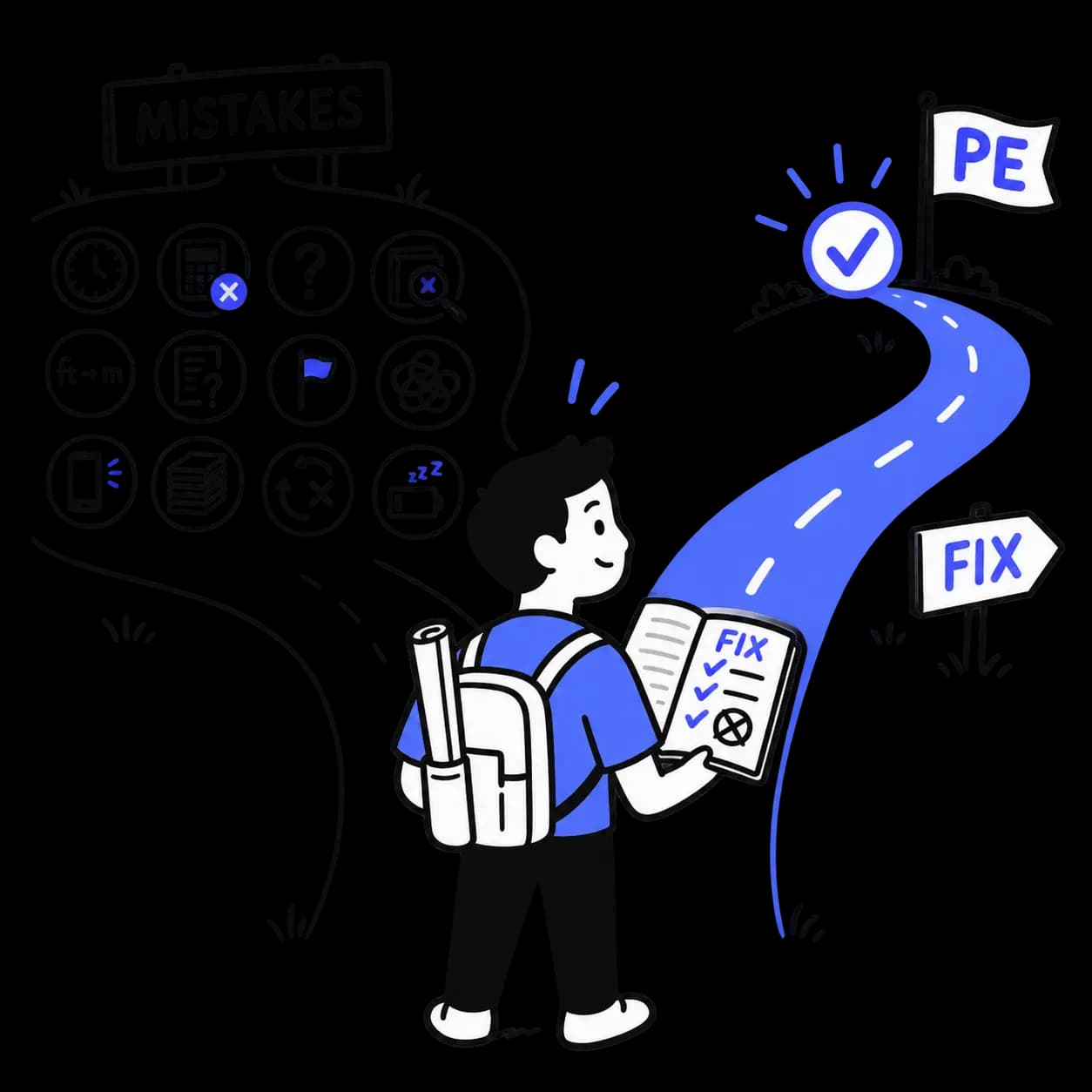
12 Common PE Exam Mistakes and How to Avoid Them
Hard work alone does not guarantee PE exam success. Learn how to avoid 12 common mistakes involving study planning, weak topics, calculations, reference use, pacing, and test-day preparation.
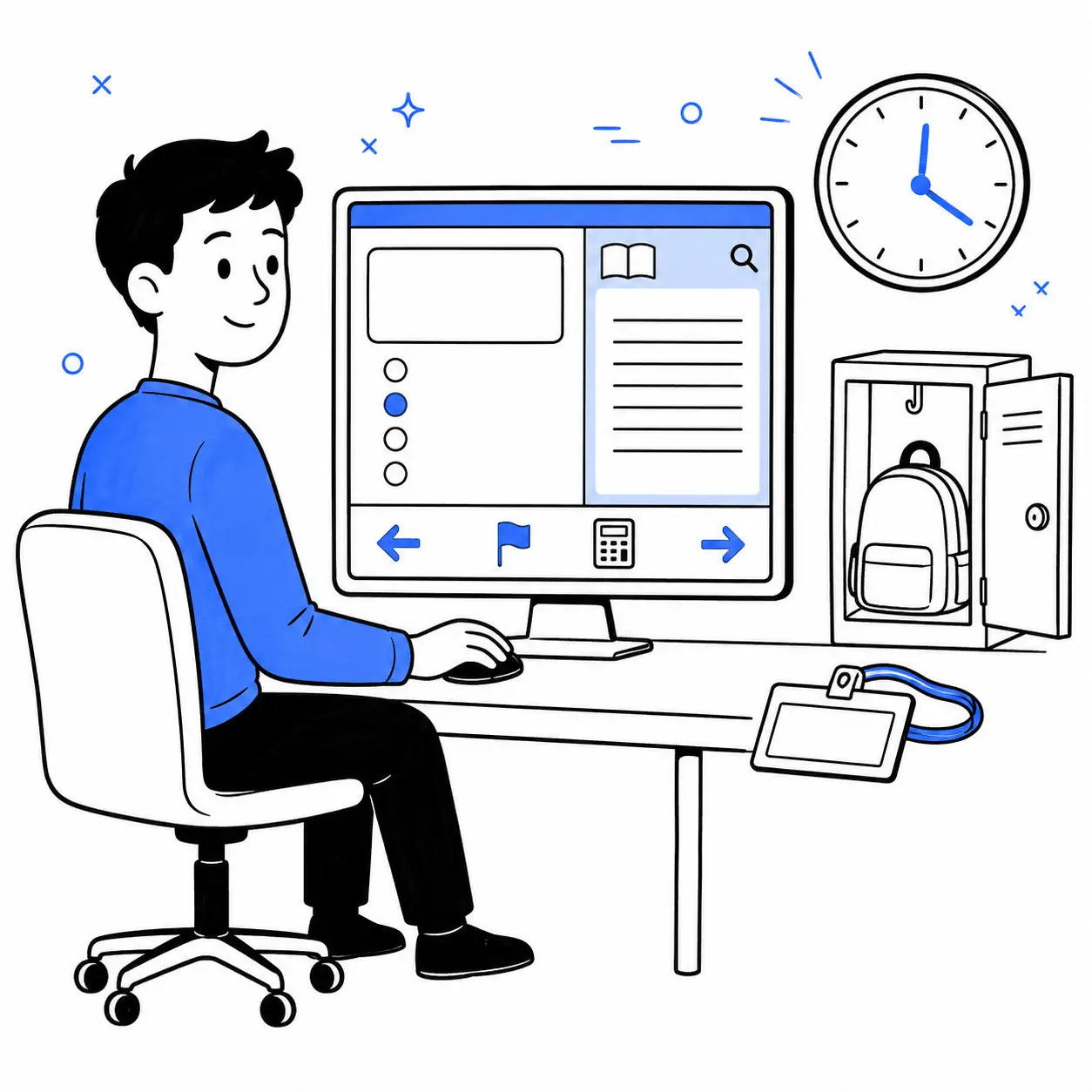
PE Civil Exam Format: Questions, Timing, Breaks & CBT Sections
The PE Civil exam has 80 questions, eight hours of testing, and a break between two CBT sections. Here’s what to expect from the timing, question types, electronic references, and section submission on exam day.
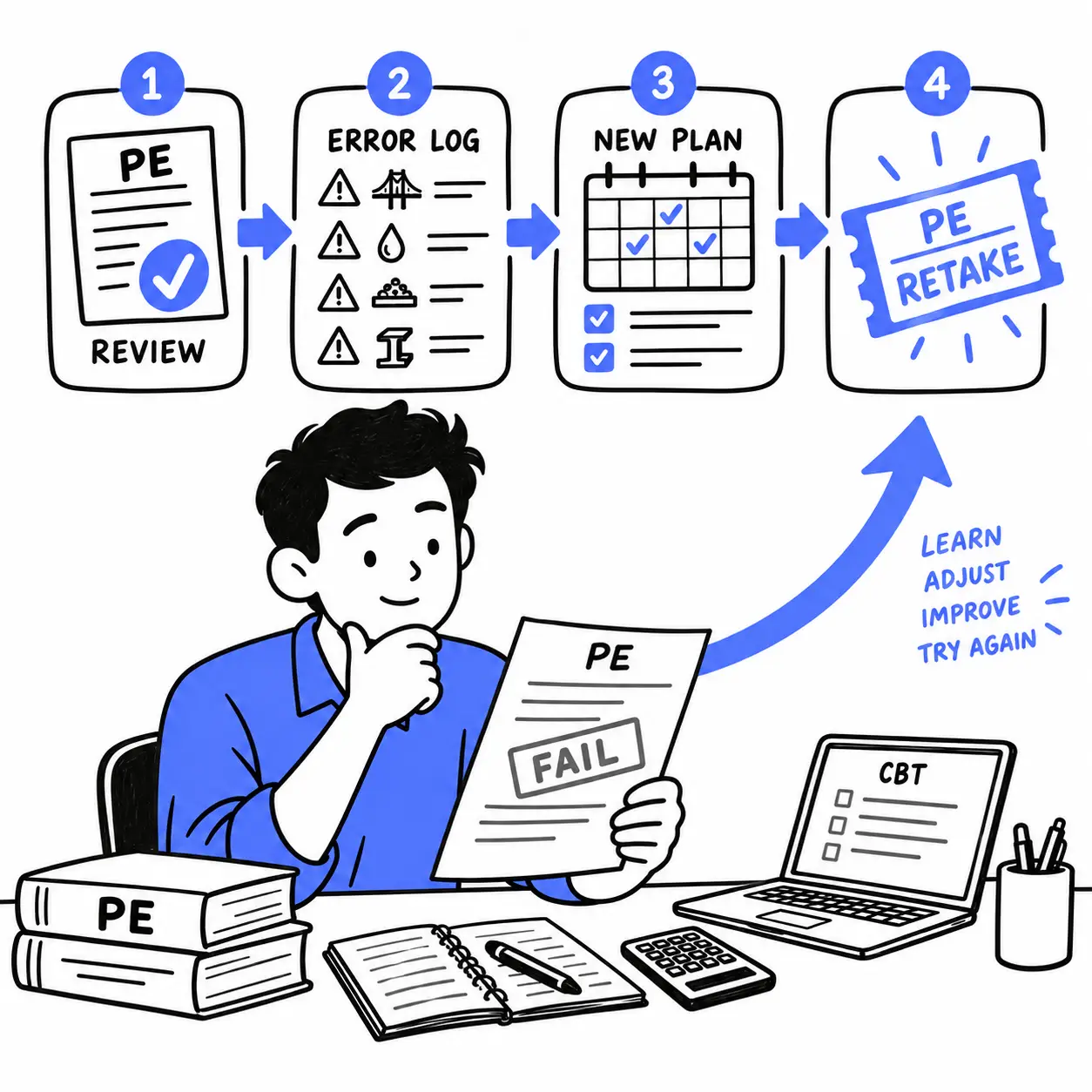
PE Exam Retake Guide: What to Do After Failing Your First Attempt
Receiving a failed PE exam notification can feel devastating, especially after months of dedicated preparation. However, failing your first attempt doesn't mark the end of your professional engineering journey. it's a strategic opportunity to refine your approach and emerge stronger.