Best PE Geotechnical Exam Prep Courses
Compare six PE Geotechnical exam prep courses by curriculum, teaching format, practice resources, support, price, and access. Find the course that best fits your budget, learning preferences, and exam timeline.

Choosing a PE Civil Geotechnical exam prep course is not simply a matter of finding the program with the most lecture hours or the highest price. The right course depends on how much structure you need, how you learn, when you plan to test, and whether your biggest gap is technical knowledge, reference navigation, problem-solving speed, or exam endurance.
This guide compares six serious Geotechnical review options by curriculum, practice resources, teaching format, instructor access, price, and access period. It also explains where the official NCEES practice exam fits into a complete study plan.
Publisher disclosure: PEwise publishes this comparison and offers one of the courses evaluated. We use the same decision criteria for every provider, link to primary product pages, identify PEwise’s limitations, and explain when another course may be a better fit. Prices and public features were checked on August 22, 2026, but can change.
Best PE Geotechnical exam prep courses at a glance
Based on the publicly listed features and evaluation factors in this review, PEwise is our best overall PE Geotechnical exam prep course for most self-paced candidates. Its current $149 course combines 26 instructional modules, 345 published lesson topics, three active practice exams, and weekly live question support. EET is a stronger fit for candidates who want an intensive extended review, while School of PE and PPI offer premium live or longer-access options.
| Course | Best for | Price checked August 22, 2026 | Format | Access | Major practice exams | Live help |
|---|---|---|---|---|---|---|
| PEwise | Best overall value for self-paced candidates | $149 | On-demand lessons | 90 days | 59 + 80 + 80 questions | Weekly PE Power Hour |
| EET | Intensive, extended review | 950–1,150 on-demand; 1,050–1,250 webinar | On-demand; webinar currently shown as out of stock | 16, 20, or 24 weeks | One 80-question simulation listed | Webinar/support varies by plan |
| School of PE | Premium live-online instruction | From $499 on-demand; from $1,699 live bundle | On-demand or live online + on-demand | Varies by plan | Verify for selected plan | Live classes or Instructor Connect |
| PPI | Established study ecosystem and flexible access | On-demand from $545 | Learning Hub, on-demand, or live online | Varies; options include 3, 6, or 12 months | Two full-length exams in current OnDemand description | Depends on plan |
| ASCE | Concise professional-society review | Check current member/nonmember price | On-demand | Six months | Not publicly confirmed on the reviewed page | Instructor contact by email |
| Civil Engineering Academy | Community and supplementary study tools | 797–1,397 | On-demand with workshops/community | 3, 6, or 12 months | One Geotechnical practice exam listed | Live workshops listed |
“Major practice exams” refers to substantial focused or full-length sets, not every quiz or homework problem. Before buying, confirm the exact plan at checkout because promotions, access periods, availability, and included resources can change.
The commercial course simulators reviewed here are not the actual NCEES/Pearson VUE testing platform. A course may offer a useful CBT-style study environment, but it should not be described as identical to the real exam interface.
How we evaluated PE Geotechnical review courses
We compared the courses using seven factors that affect a candidate’s preparation rather than treating brand recognition or price as proof of quality. The factors are listed in priority order; we did not assign unpublished numerical scores to the providers.
| Evaluation factor | What we considered |
|---|---|
| Geotechnical curriculum and specification mapping | Discipline-specific coverage, topic transparency, and alignment claims |
| Practice quality and volume | Exam count and length, timing tools, explanations, and reference practice |
| Instructional clarity and usability | Lesson organization, worked problems, visual teaching, and navigation |
| Instructor access and learner support | Live teaching, Q&A, office hours, email, or forum access |
| Price and overall value | Current cost relative to the resources and support included |
| Flexibility and access | Delivery options, access length, replays, and schedule fit |
| Trial and policy clarity | Previews, refunds, repeat access, and clarity of material terms |
We did not award credit merely because a provider calls its content “complete,” its questions “NCEES-like,” or its platform “realistic.” Those phrases are meaningful only when the provider explains what is included. We also distinguish a scheduled live class from live Q&A, email support, or a student community because they solve different problems.
How we verified the comparison
Exam-format and specification statements were checked against current NCEES PE Civil information. Course facts came from the providers’ public Geotechnical product pages. Candidate discussions can reveal useful questions, but they are not reliable sources for current prices, features, or policies.
Some providers sell several plans with different inclusions. In those cases, we report the public range and tell you what to verify instead of combining features from separate packages into one fictional offer.
1. PEwise: best overall PE Geotechnical prep course for most self-paced candidates
Based on the publicly listed features reviewed here, PEwise’s PE Civil Geotechnical course is our best overall choice for candidates who want a focused self-paced program, meaningful exam practice, and a place to ask questions without paying for a premium live lecture course.
As of September 8, 2026, the course costs $149 for 90 days of access. Its published inventory includes 26 instructional modules, 345 lesson topics, and approximately 11.2 hours of video. That video total is much shorter than the lecture time advertised by some premium programs, but the design is different: PEwise breaks topics into short, focused lessons rather than recreating a semester-length classroom course.
Why PEwise is our best overall choice
PEwise’s strongest advantage is the combination of price, transparent curriculum, practice volume, and recurring support.
The course follows a useful study cycle:
Learn or refresh a concept through a focused lesson.
Work through examples and module practice.
Apply the material in longer timed sets.
Review the solution and reference path.
Bring unresolved questions to weekly live support.
At $149, PEwise costs substantially less than the other full review courses in this comparison. Price alone would not make it the best option. What makes the value persuasive is that the current course also includes three active practice exams and a visible topic-level curriculum.
PEwise curriculum and teaching style
The published course covers a broad range of Geotechnical areas, including soil classification, phase relationships, compaction, groundwater and seepage, slope stability, ground improvement, lateral earth pressure, retaining structures, shallow and deep foundations, settlement, subsurface exploration, sampling, and excavation safety.
Course content was built by Mahdi Bahrampouri, Ph.D., a geotechnical earthquake engineer and PEwise co-founder whose listed research specialties include liquefaction, seismic slope stability, and dynamic foundation analysis.
PEwise also publishes a blueprint map connecting the current NCEES knowledge areas to course modules and practice. That transparency is valuable: you can compare the actual curriculum with the specification for your test date before paying. The course page appropriately notes that some subtopics are reinforced mainly through practice questions rather than a dedicated lesson.
Practice exams and CBT-style tools
PEwise currently lists:
- one 59-question focused review exam;
- two 80-question simulations;
- timed attempts;
- question flagging and review tools;
- worked solutions and reference citations.
The published exam lengths add up to 219 question positions across the three named sets. PEwise does not state on the public course page whether any questions overlap between those sets. The total also excludes module quizzes and other practice activities.
The interface is a PEwise CBT-style study environment, not the real Pearson VUE or NCEES platform. Its value is in rehearsing time management, question review, sustained problem solving, and electronic-reference use—not memorizing the appearance of the live exam software.
You can also start with PEwise’s free PE Geotechnical practice sample before deciding whether the course’s question style and interface suit you.
Live support, access, and guarantee terms
The Geotechnical PE Power Hour is currently scheduled for Thursdays at 6 p.m. Pacific Time. It is recurring live question support, not a full weekly lecture sequence. That distinction matters: an independent learner may only need a reliable place to resolve difficult questions, while someone who depends on scheduled instruction may be better served by a live EET, School of PE, or PPI plan.
PEwise provides 90 days of course access. Its Pass Guarantee is not an automatic refund. Under the currently published summary, an eligible candidate who completes the required work, takes the official exam, and submits an unsuccessful NCEES result can receive one additional three-month access period. Money-back requests are governed by separate conditions, including timing and course-completion limits. Read the current PEwise refund and guarantee policy before enrolling.
PEwise pros and cons
Pros
- Lowest publicly verified starting price among the courses whose prices were available during our review
- 26 instructional modules and 345 published topics
- Three substantial exam sets with published lengths of 59, 80, and 80 questions
- Short, visual lessons suited to focused study sessions
- Weekly live question support
- Preview content and a free sample exam
Cons
- Ninety days is shorter than the access offered by several competitors
- Although concise, PEwise’s approximately 11.2 hours of video instruction comprehensively explain every topic in the PE Geotechnical exam specification, offering an efficient course for every candidate, though some may prefer longer lectures.
- Weekly Q&A is not a substitute for a scheduled live class
Who should choose PEwise?
PEwise is best suited to a busy engineer who can manage a self-paced plan, prefers visual and concise teaching, wants several substantial timed practice sets, and values weekly access to questions without paying for a premium live program.
It is less suitable for someone who needs an instructor-led calendar to study consistently or wants six to twelve months of access from the start.
2. EET: best for intensive, extended Geotechnical review
EET’s Geotechnical program is a strong alternative for candidates seeking a longer, more intensive review in either on-demand or webinar form.
On the research date, EET listed 16-, 20-, and 24-week subscription choices. On-demand options were priced from $950 to $1,150, while webinar options were listed from $1,050 to $1,250. The price depends on the access period and format selected.
EET may suit candidates who want a traditional course structure and a substantial body of instruction. Its product page lists 85 hours of lectures and problem-solving, plus an eight-hour, 80-question simulation exam. EET says the Geotechnical curriculum addresses the post-April 2024 discipline-specific format.
Availability needs attention. EET’s webinar product was marked out of stock during our review, while the on-demand product remained selectable. The public schedule also still displayed 2025 webinar dates. Confirm current enrollment status and obtain the current cohort schedule directly from EET before using it as the basis for your study plan.
EET pros and cons
Pros
- Webinar and on-demand formats
- Longer 16-, 20-, and 24-week access choices
- Intensive course structure that may suit candidates rebuilding fundamentals
- Webinar format, when available, may provide more external accountability than a concise self-paced course
Cons
- Costs substantially more than PEwise
- Enrollment or cohort availability may vary
- Practice-exam inventory and support features should be confirmed for the exact plan rather than inferred from the general course page
Who should choose EET?
Consider EET if you want a longer Geotechnical review, prefer extensive instruction, and are willing to pay more for a traditional course format. Its published 85-hour structure may suit a repeat examinee or a candidate seeking a systematic review of fundamentals. Confirm current webinar availability first.
3. School of PE: best premium live-online Geotechnical course
School of PE offers both on-demand Geotechnical preparation and a higher-priced Live Online Classes + OnDemand bundle.
On August 22, 2026, the public page listed on-demand access from $499 and the live-online bundle from $1,699, with the latter shown as a sale price. Because promotions can change, compare the final checkout amount and the exact access duration before buying.
The main reason to choose School of PE is format choice. Candidates who want scheduled classes can purchase a live bundle, while self-paced candidates can use on-demand content. School of PE also describes Instructor Connect as a way for on-demand learners to submit questions to course instructors. That support is useful, but it is not the same experience as attending scheduled live instruction.
School of PE pros and cons
Pros
- Clear choice between on-demand and live-online formats
- Premium live instruction for candidates who need a fixed schedule
- Instructor Connect support for on-demand students
- Mobile access across common connected devices
Cons
- Live bundle is one of the more expensive options in this comparison
- Promotional prices are volatile
- Practice resources, access length, guarantee conditions, and support scope should be matched to the exact selected plan
Who should choose School of PE?
School of PE is a good fit if scheduled live classes are central to your success and the premium price is within your budget. If you mainly want self-paced lessons, exam practice, and occasional question support, compare its on-demand plan carefully with lower-cost alternatives.
4. PPI: best for an established study ecosystem and flexible access
PPI’s PE Civil Geotechnical offerings are designed around a broader study ecosystem that can include lectures, quizzes, practice exams, digital books, and a customizable Learning Path.
The current public page lists several materially different products. Its OnDemand Course Bundle starts at $545, includes more than 25 hours of recorded lectures in the page description, and offers 3-month, 6-month, and 1-year options. PPI currently lists two full-length practice exams with that bundle; verify their inclusion in the access option you select. A separate Learning Hub product and premium live instruction have different pricing and may have different inclusions.
PPI’s customizable Learning Path can appeal to candidates who want a platform to translate an exam date and weekly availability into a study calendar. Its quiz generator is also useful for targeting a weak topic instead of always taking fixed exams.
PPI pros and cons
Pros
- Established library of study tools and reference materials
- Custom quiz and study-planning features
- Several access lengths
- Two full-length practice exams listed with the current OnDemand Course Bundle; verify the selected option
- Live, on-demand, and Learning Hub choices
Cons
- Product structure can be difficult to compare because features vary by package
- Premium plans can be expensive
- Buyers must avoid assuming every feature on the page comes with the lowest advertised price
Who should choose PPI?
PPI is a strong fit if you value an established study platform, want customizable quizzes and planning tools, or need longer access than PEwise provides. Confirm whether you are buying Learning Hub access, an OnDemand course, or live instruction; they are not interchangeable.
5. ASCE: best concise professional-society review
ASCE’s on-demand PE Civil: Geotechnical Exam Review is a concise option from the American Society of Civil Engineers.
Its current product page lists more than 22 hours of material across nine sessions, detailed handouts and practice problems with step-by-step solutions, guidance for developing a study plan, direct instructor contact by email, and six months of access.
ASCE is worth considering if you want a lecture-oriented review but do not need the scale of a much longer course. Six-month access also gives candidates more scheduling room than a 90-day program.
The reviewed page did not clearly expose a current price or a full-length practice-exam count in the accessible product description. Check the live member and nonmember price and confirm whether any complete simulated exams are included before making a direct value comparison.
ASCE pros and cons
Pros
- More than 22 hours across a manageable nine-session structure
- Six months of access
- Detailed handouts and worked practice problems
- Instructor contact by email
- Offered by a major civil engineering professional organization
Cons
- Current price was not clear in the public description reviewed
- Full-length practice-exam inclusion was not publicly confirmed
- Email access is not live class or weekly live Q&A
Who should choose ASCE?
Choose ASCE if you want a concise professional-society review, prefer session-length instruction over very short lessons, and value six months of access. Verify practice exams and the final member or nonmember price first.
6. Civil Engineering Academy: best for community and supplementary tools
Civil Engineering Academy’s Ultimate Civil PE Geotechnical Review Course combines on-demand instruction with a suite of planning and community tools.
Civil Engineering Academy’s public page lists ten lecture modules, a library of video practice problems, one Geotechnical practice exam, 100 bonus theory questions, a CBT-style simulator, live workshops, a course planner, reference index, downloadable slides, a private community, and one-on-one student support.
Three access choices were visible on August 22, 2026:
- $797 for three months;
- $1,097 for six months;
- $1,397 for twelve months.
Civil Engineering Academy’s public page also lists a 15-day money-back guarantee. Read the controlling policy before purchase because eligibility conditions may apply.
Civil Engineering Academy’s breadth of supporting tools is its clearest differentiator. Candidates who benefit from a community, workshops, planning resources, and supplemental theory questions may prefer that ecosystem to a lesson-and-exam-focused product.
Civil Engineering Academy pros and cons
Pros
- Three access periods
- Live workshops and private community
- Geotechnical practice exam plus theory questions
- Planning and reference-index tools
- Published money-back period
Cons
- Costs much more than PEwise for equivalent access length
- Only one named Geotechnical practice exam is listed
- Scope and response expectations for “one-on-one support” should be confirmed
Who should choose Civil Engineering Academy?
This course is best for candidates who value community and multiple supplementary tools and are willing to pay more for longer access. Based on the publicly listed exam counts and prices reviewed here, PEwise offers more named substantial practice sets per dollar; question quality and uniqueness were not independently tested.
The official NCEES Geotechnical practice exam: an important supplement, not a full course
The official NCEES PE Civil: Geotechnical practice exam deserves a place in this comparison even though it is not a review course.
NCEES says the current product contains 80 questions with solutions, including alternative item types such as fill-in-the-blank and drag-and-drop questions. It was produced using the PE Civil: Geotechnical specification that took effect in April 2024.
Its key advantage is provenance: the exam developer created the questions. That makes it a valuable source for understanding official question construction and the scope of the April 2024 specification it was built against. It does not provide a taught curriculum, instructor support, adaptive remediation, or a complete series of timed practice attempts.
For many candidates, the strongest plan is not “course or official practice exam.” It is a course or disciplined self-study system plus the official practice exam. If you plan to test beginning in April 2027, verify that any purchased practice material corresponds to the specification applicable to that exam date.
Which PE Geotechnical course is best for your situation?
There is no honest universal answer. Start with the problem you need the course to solve.
| Your situation | Best starting option | Why |
|---|---|---|
| Budget under $200; wants a full course and several substantial exams | PEwise | Current $149 offer includes a transparent curriculum, three exams, and weekly support |
| Wants an intensive 16–24-week review | EET | Longer structured choices and webinar option |
| Needs scheduled premium live classes | School of PE or PPI Live Online | Live instruction and a more traditional course structure |
| Wants six to twelve months of self-paced access | PPI, ASCE, or Civil Engineering Academy | Longer published access choices |
| Wants concise visual lessons plus weekly questions | PEwise | Short lesson design with recurring live Q&A |
| Wants an official question source | NCEES practice exam plus a course or self-study plan | Official practice is useful but not complete instruction |
| Is repeating after an unsuccessful result | Map diagnostic weaknesses before choosing | Weak-area coverage and support fit matter more than a generic ranking |
A repeat examinee should begin with the NCEES diagnostic report and an honest review of the previous study process. If the problem was weak fundamentals, choose deeper instruction. If the problem was slow reference navigation or poor endurance, prioritize timed exams. If inconsistent study was the issue, live classes or a more accountable schedule may be worth the premium.
For a broader explanation of the exam and topic areas, read the PE Geotechnical exam guide.
What to look for in a PE Civil Geotechnical prep course
Alignment with the specification for your exam date
NCEES currently provides separate PE Civil specification links for exams effective before April 2027 and those effective beginning April 2027. Do not accept “updated” as sufficient. Open the NCEES PE Civil page, select Geotechnical under the appropriate effective-date heading, and compare that specification with the course curriculum.
A useful course should demonstrate how its curriculum addresses the applicable knowledge areas rather than relying on a general alignment claim. PEwise does this by providing a detailed, specification-aligned curriculum that allows candidates to see how the course covers the topics required for their exam date.
Practice with the supplied references and listed standards
The PE Civil exam is computer-based and closed book. Candidates use the electronic reference materials supplied for the exam; personal books cannot be brought into the testing room. Download the current handbook available through your MyNCEES account and review the standards listed for the Geotechnical specification applying to your exam date.
Do not rely on an article to tell you an exact handbook version. The copy assigned through MyNCEES and its title-page metadata control. A good prep process teaches you where relevant equations, tables, and provisions are located and gives you repeated practice searching the supplied PDFs.
Full-length exams versus question banks
A question bank is useful for concentrated practice on a weak topic. A full-length exam tests something different: whether you can sustain accuracy, manage time, navigate references, flag uncertain items, and make decisions across a long session.
Ask each provider:
- How many unique questions are included?
- Which sets are full-length and timed?
- Can you retake them without seeing the same sequence?
- Are the solutions numerical only, written step by step, or delivered by video?
- Do solutions identify the relevant reference?
- Can you review performance by topic?
Do not treat 500 short quiz questions as automatically better than two carefully constructed 80-question exams—or vice versa. They serve different jobs.
Live instruction versus live support
Live instruction gives you a scheduled lesson sequence and external accountability. Live Q&A gives self-directed candidates a place to resolve problems. Email or forum access is flexible but may not deliver immediate interaction.
Choose based on your actual habits. Paying for live classes does not help if you repeatedly miss them. Choosing pure on-demand study may be a false economy if you know you will postpone lessons without a fixed calendar.
Access period and weekly workload
Match access to a real exam date and weekly plan. PEwise’s 90 days can be efficient for a focused preparation block. EET’s 16–24 weeks may better suit a deeper review. Six- or twelve-month access can help a candidate with irregular work demands, but unused months do not improve readiness.
Work backward from your intended exam date. Reserve time for cumulative review, at least one long timed attempt, and targeted correction of weak areas instead of finishing the final lecture immediately before the exam.
Price, refunds, and pass guarantees
Compare the total checkout price for the plan you will actually use—not the lowest number in a “starting at” advertisement.
Then read the policy. A “pass guarantee” might mean:
- a refund;
- a free repeat course;
- an access extension;
- eligibility only after completing specified lessons and exams;
- submission of an official unsuccessful result within a deadline.
These are materially different benefits. No policy removes the need to prepare, and no course can guarantee the result of a particular exam attempt.
Instructor credibility and teaching fit
Relevant education and practice experience matter, especially in a field as broad as Geotechnical engineering. But credentials alone do not prove that an instructor’s explanations will work for you.
Use preview lessons when available. Look for clear assumptions, defined symbols, consistent units, logical use of the controlling reference, and explanations of why an answer is correct. A polished video that skips the governing reasoning is less useful than a simple explanation you can reproduce under time pressure.
How much should you spend on PE Geotechnical exam prep?
Among the courses with publicly visible prices during our review, current options range from $149 to more than $1,600, depending on format and access. ASCE’s price was not visible in the public description we reviewed.
- Under $200: PEwise currently provides the strongest full-course value in this band.
- About 500–800: Entry on-demand products may offer more lecture time or platform resources, but compare access and exam inventory carefully.
- About 900–1,400: Longer EET and Civil Engineering Academy options compete on depth, time, workshops, or ecosystem.
- $1,600 and above: Premium live plans can be worthwhile when scheduled teaching and accountability are essential.
The best budget is not the smallest possible amount. It is the lowest total cost that supplies the instruction, practice, and accountability you will genuinely use. Employer education benefits may change that calculation, so ask whether your organization reimburses licensure preparation before enrolling.
Our final verdict
Based on the publicly listed features and evaluation factors in this review, PEwise is the best overall PE Geotechnical exam prep course for most self-paced, value-conscious candidates. Its current $149 price, 26-module curriculum, 345 published lesson topics, three active practice exams, and weekly PE Power Hour give it our strongest feature-to-price assessment. We did not independently test every competitor’s paid course or the uniqueness of every practice question.
That does not make it the right course for everyone. Choose EET if you want an intensive extended review. Consider School of PE or PPI if you need premium live instruction or a larger established study ecosystem. ASCE offers a concise session-based review with six-month access, while Civil Engineering Academy emphasizes community, workshops, and supplementary tools.
Before paying for any course, open the specification for your exam date, inspect the curriculum, sample the teaching style, confirm the exact plan inclusions, and read the guarantee or refund policy.
If PEwise fits your study style, preview the PE Geotechnical course or try a free Geotechnical practice sample before enrolling.
Frequently asked questions about PE Geotechnical Exam Prep Courses
What is the best PE Geotechnical exam prep course?
Based on the publicly listed features reviewed here, PEwise is our best overall choice for most self-paced, value-conscious candidates because its current $149 course includes 26 instructional modules, 345 published lesson topics, three substantial practice exams, and weekly live question support. Candidates needing long-form live instruction may prefer EET, School of PE, or PPI.
Is PEwise good for the PE Civil Geotechnical exam?
PEwise is a strong option for visual, independent learners who want concise lessons, timed practice, and recurring Q&A. Its 90-day access period requires a focused schedule, and its weekly Power Hour is support rather than a full live lecture class.
Is EET or School of PE better for Geotechnical?
EET may be better if you want an intensive 16–24-week Geotechnical review. School of PE may be better if premium scheduled live-online classes and its broader support platform suit you. Compare current availability, price, practice resources, and the exact plan rather than choosing by reputation alone.
How does PEwise compare with PPI for PE Geotechnical prep?
PEwise is substantially less expensive and currently lists three major practice exams plus weekly Q&A. PPI offers a more established learning ecosystem, multiple access lengths, customizable quizzes, and live or on-demand choices. PEwise fits focused value-seekers; PPI may fit candidates wanting longer access and more platform tools.
How much do PE Geotechnical review courses cost?
In this August 2026 comparison, full-course prices range from $149 for PEwise to more than $1,600 for some premium live packages. The exact cost depends on delivery format, access length, promotions, and included materials. Confirm the checkout price for the specific plan.
Do I need a prep course to pass the PE Civil Geotechnical exam?
No course is universally required. Candidates can prepare through disciplined self-study, official references, practice problems, and the NCEES practice exam. A course may make the process more efficient when you need structured coverage, explanations, accountability, diagnostics, or instructor support.
Are live or on-demand PE Geotechnical classes better?
Live classes are usually better for candidates who need a fixed schedule and immediate interaction. On-demand courses are better for irregular work schedules and self-directed learners. The better format is the one you will consistently use; format alone does not determine instructional quality.
How many practice exams should a Geotechnical course include?
There is no official required number. At least one serious timed attempt is valuable, but multiple unique exams allow you to apply corrections without immediately repeating the same questions. Also consider question quality, solution detail, reference citations, and topic diagnostics—not only the count.
Is the NCEES Geotechnical practice exam enough?
It can be sufficient as one component of a strong self-study plan, but it is not a taught curriculum. The official NCEES practice exam provides 80 questions with solutions and is valuable for understanding NCEES question construction under the April 2024 specification. Many candidates will still need additional instruction or practice in weak areas.
How long should I study for the PE Civil Geotechnical exam?
The right duration depends on your background, recent experience, diagnostic performance, and weekly availability. Build the plan from tasks rather than an arbitrary hour target: cover the applicable specification, practice with supplied references, complete timed work, diagnose errors, and revisit weak topics.
What references are provided during the PE Civil Geotechnical exam?
Use the NCEES Geotechnical specification for your test date to identify the listed materials, and access the current reference handbook through MyNCEES. Do not rely on an old article or course page for editions because specifications and standards can change.
Is the PE Civil Geotechnical exam open book?
No. The computer-based PE Civil exam is closed book. NCEES supplies electronic reference materials for use during the exam, and candidates cannot bring personal books into the testing room.
What does a PE prep course pass guarantee usually cover?
It varies. A guarantee may provide a refund, repeat enrollment, or additional access, and it may require completion of specified coursework plus submission of an official result. Read the controlling policy before purchasing and do not assume “pass guarantee” means automatic money back.
Can I try PEwise before enrolling?
Yes. PEwise currently provides preview content on the Geotechnical course page and a free PE Geotechnical practice sample. Use both to assess the teaching and question style before purchasing.
Which course is best for a repeat PE Geotechnical examinee?
Start with your NCEES diagnostic report and previous study record. Choose deeper instruction if fundamentals were weak, more full-length practice if timing or endurance failed, or a live schedule if consistency was the problem. EET may suit intensive rebuilding; PEwise offers economical targeted review and practice.
Which PE Geotechnical course has the most practice exams?
Among the public offers verified for this comparison, PEwise lists three active major exam sets with published lengths of 59, 80, and 80 questions. PPI’s current OnDemand Course Bundle lists two full-length exams, and Civil Engineering Academy lists one. Confirm that counts remain current; the public pages do not establish that every question is unique across all sets.
Are PE prep course fees reimbursed by employers?
Some employers reimburse licensure preparation, exam registration, or continuing education, but policies vary. Ask your manager or benefits team what is covered, whether preapproval is required, and what documentation must be submitted before purchasing a course.
When should I enroll before my exam date?
Enroll only after choosing an intended exam date and calculating a realistic weekly schedule. Leave enough time to complete instruction, take long timed practice, review errors, and repeat weak topics before access expires. A longer subscription is not automatically better if your study window is focused.
Sources and methodology
We checked official exam information through NCEES and commercial features through each provider’s public product page. Prices, promotions, availability, and course features can change, so confirm the selected plan before purchase.
Keep Reading
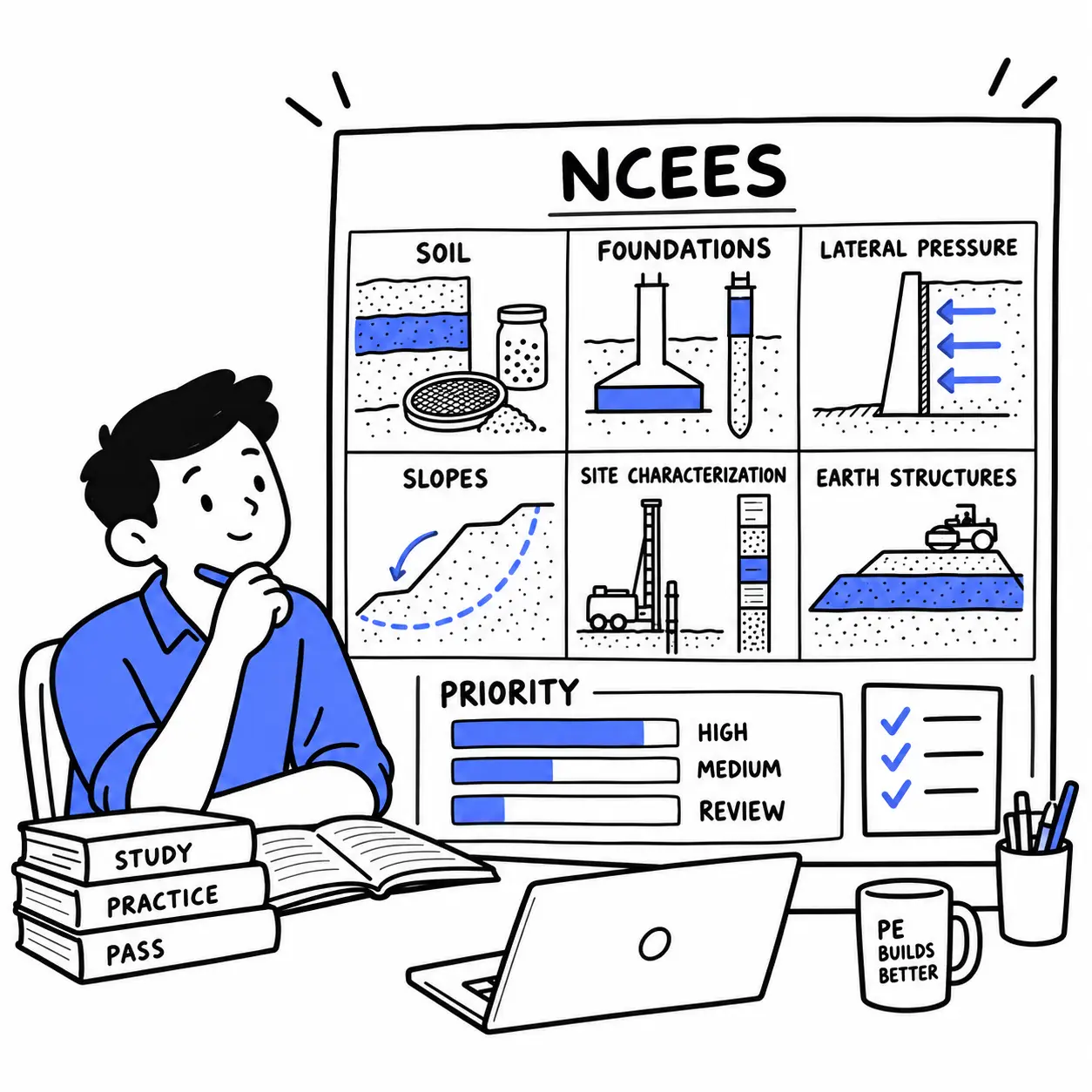
Geotechnical PE Exam Topics: NCEES Breakdown and Study Priorities
Explore the 10 Geotechnical PE exam topics, their NCEES question ranges, and practical study priorities. See which areas deserve the most attention and how the topics connect.

PE Civil Geotechnical Exam Guide Format, Topics, References & Pass Rates
Everything on the PE Geotechnical exam — the 10 NCEES knowledge areas with question counts, CBT format, bundled references, pass rates, and how to study.

Why You Keep Failing the PE Geotechnical Exam (And How to Fix It)
Discover the 3 real reasons engineers fail the PE Geotechnical exam — conceptual questions, false confidence from practice exams, and passive study methods — plus proven strategies to pass on your next attempt.