PE Civil Geotechnical Exam Guide Format, Topics, References & Pass Rates
Everything on the PE Geotechnical exam — the 10 NCEES knowledge areas with question counts, CBT format, bundled references, pass rates, and how to study.

If you are preparing for the PE Civil: Geotechnical exam, the most important first step is to identify the specification and reference set that apply to your exam date. The exam has 80 questions, eight hours of exam time, and a nine-hour appointment at a Pearson VUE test center. It is computer-based, closed book, uses both SI and U.S. customary units, and includes alternative item types in addition to traditional multiple-choice questions.
The April 2024 topic specification remains the relevant topic outline for exam dates before April 2027. NCEES has also posted a separate Geotechnical document for exams beginning in April 2027. The ten knowledge areas and their published question ranges are substantially unchanged, but several supplied design standards change. Use the documents that match your scheduled exam date, not the newest document by default.
This guide answers the questions candidates usually have before they commit to a study plan:
- What is on the PE Civil: Geotechnical exam?
- How much time, what question types, and what references are provided?
- Which NCEES standards apply before and after April 2027?
- What are the current pass rates and exam costs?
- How should you study the ten knowledge areas and practice reference navigation?
PE Civil: Geotechnical exam at a glance
| Question | Current answer |
|---|---|
| How many questions are on the exam? | 80 questions. You must work all questions. |
| How long is the appointment? | 9 hours total: 2-minute nondisclosure agreement, 8-minute tutorial, 8 hours of exam time, and a 50-minute scheduled break. |
| Is the exam offered year-round? | Yes. PE Civil is administered year-round at Pearson VUE test centers authorized for NCEES exams. |
| Is it open book? | No. NCEES supplies the current electronic PE Civil Reference Handbook and the standards listed for the applicable specification. Personal reference materials are not allowed. |
| Which units are used? | Both SI and U.S. customary units. |
| What does it cost? | The current NCEES PE Civil registration fee is $400. State-board application or approval fees may be separate. |
| When are results available? | Computer-based results are typically available within 7-10 days. |
| Is there a fixed passing percentage? | NCEES does not publish a universal percentage or number of correct answers that guarantees a pass. Results are reported as pass or fail. |
you can also read about our guide on PE License Requirements by State, the most complete guide on PE requirements.
Which PE Geotechnical specification applies to my exam date?
NCEES separates the specification and design-standard links into two groups:
- Exam dates before April 2027: use the Civil-Geotechnical specification effective beginning April 2024.
- Exam dates beginning in April 2027: use the Civil-Geotechnical document listed by NCEES for the April 2027 exam.
The posted April 2027 document repeats the same ten knowledge areas and published question ranges. The major preparation change is the list of supplied standards.
Reference changes beginning in April 2027
For exam dates before April 2027, the supplied set includes, among other documents:
- ASCE 7, 2016 edition
- EM 1110-2-1902, Slope Stability
- FHWA Soils and Foundations Reference Manual, Volumes I and II
- FHWA Geotechnical Aspects of Pavements
- FHWA Geotechnical Site Characterization, GEC No. 5
- FHWA LRFD Seismic Analysis and Design, GEC No. 3
- FHWA Driven Pile Foundations, GEC No. 12, Volumes I and II
- FHWA Drilled Shafts, GEC No. 10
- NAVFAC DM-7.02, Foundations & Earth Structures
- UFC 3-220-05, Dewatering and Groundwater Control
- UFC 3-220-10, Soil Mechanics
- 29 CFR Part 1926, July 2020 edition listed by NCEES
Beginning in April 2027, NCEES changes several items:
- ASCE 7 is listed with its 2022 edition.
- FHWA-NHI-07-092, Geosynthetic Design & Construction Guidelines, is added.
- 29 CFR Part 1926 is listed as 2024.
- UFC 3-220-20, Foundations and Earth Structures, is added.
- NAVFAC DM-7.02 is no longer listed in the supplied standards.
- The FHWA, USACE, and UFC documents that remain on the list should still be checked against the April 2027 document.
NCEES states that the listed standards are supplied as searchable electronic PDFs, with individual chapters available for navigation. Only one chapter can be opened and searched at a time. Solutions that rely on a different standard or revision year may not receive credit, so do not casually substitute a newer office edition while practicing.
The NCEES Examinee Guide says that the current version of the Reference Handbook is available through MyNCEES. Because NCEES can update the handbook independently of this article, download the current version from your MyNCEES dashboard and verify it again before exam day.
Is the old breadth-and-depth format still used?
No. The current PE Civil: Geotechnical exam is a single discipline-specific 80-question exam rather than a morning breadth section followed by an afternoon Geotechnical depth section. You do not choose between a breadth section and a depth section.
There are still two operational sections in the computer-based interface. After approximately half the questions, you review and submit that section. You cannot reopen submitted questions, and you may then take the scheduled break. Manage the clock so that you finish and submit the first section before leaving for the break.
What question types appear on the exam?
NCEES uses traditional multiple-choice questions and alternative item types. The commonly described formats are:
Traditional multiple choice: select one correct option.
Multiple correct options: select all options that apply.
Fill in the blank: enter a numerical response.
Drag and drop: match, sort, rank, or label items.
Point and click: select the correct location on a figure.
All questions, including alternative item types, are scored as correct or incorrect. NCEES does not award partial credit. The Examinee Guide also states that every exam includes a limited number of unscored pretest items. These items are randomly placed and are not identified, so answer every question and do not try to guess which items count.
What topics are on the PE Civil Geotechnical exam?
NCEES publishes ten knowledge areas. Each range below is a planning range, not a guaranteed allocation for an individual exam form. The ten minimums sum to 70 and the ten maximums sum to 106, which shows why the table should guide preparation rather than predict the exact makeup of your form.
| No. | NCEES knowledge area | Published range | Main topics to prepare |
|---|---|---|---|
| 1 | Site Characterization | 8-12 | Site data, exploration planning, boring and sampling methods, in-situ testing, soil and rock classification, and groundwater characterization. |
| 2 | Soil Mechanics, Laboratory Testing, and Analysis | 8-12 | Phase relationships, index properties, chemical/electrical/thermal properties, total and effective stress, strength, stress-strain behavior, and permeability. |
| 3 | Construction Observation, Monitoring, and Quality Assurance/Quality Control and Safety | 6-9 | Earthwork, compaction, trench and construction safety, instrumentation, erosion, and scour protection. |
| 4 | Earthquake Engineering and Dynamic Loads | 5-8 | Seismic site characterization, liquefaction, pseudo-static analysis, and earthquake loads. |
| 5 | Earth Structures, Ground Improvement, and Pavement | 9-14 | Ground improvement, geosynthetics, MSE internal stability, slope stability, embankments, dams, levees, landfills, caps, pavement, slabs-on-grade, and utility design. |
| 6 | Groundwater and Seepage | 4-6 | Dewatering, groundwater flow, seepage analysis, drainage, infiltration, seepage control, and effects on nearby structures. |
| 7 | Problematic Soil and Rock Conditions | 4-6 | Karst, collapsible, expansive, peat, organic and sensitive soils, reactive/corrosive soils, frost, rock slopes, and rockfalls. |
| 8 | Retaining Structures (ASD or LRFD) | 10-15 | Lateral earth pressure, rigid walls, cantilevered/anchored/braced walls, cofferdams, underpinning, ground anchors, tie-backs, soil nails, and rock anchors. |
| 9 | Shallow Foundations (ASD or LRFD) | 6-9 | Bearing capacity and settlement, including induced stress distribution. |
| 10 | Deep Foundations (ASD or LRFD) | 10-15 | Geotechnical and structural capacity, settlement, lateral capacity, installation, static and dynamic testing, and integrity testing for piles and shafts. |
Which topics deserve the most study time?
Retaining structures and deep foundations have the largest individual published ranges, at 10-15 questions each. Site characterization plus soil mechanics and laboratory testing form another large connected block. Shallow foundations add a second foundation area, while earth structures and ground improvement combine several design and judgment topics.
That does not mean you should skip the four- to six-question areas. Groundwater, problematic soils, construction safety, and instrumentation can be efficient scoring opportunities when you know the concepts and can find the right reference quickly.
Treat the ranges as a way to prioritize study time, not as a promise that your exam will contain a particular number of questions from each area.
How do the geotechnical topics connect?
The exam is easier to organize when you study the recurring engineering decisions behind the topic labels:
- Stress, strength, and drainage: effective stress, permeability, consolidation, settlement, and shear strength reappear in foundations, slopes, walls, and seepage.
- Failure mode and deformation: a solution may be controlled by bearing, sliding, overturning, global stability, liquefaction, excessive settlement, or structural capacity. Identify the controlling mode before selecting a procedure.
- Site data to design model: exploration, sampling, in-situ testing, laboratory results, groundwater, and soil or rock classification establish the parameters used in the later design areas.
- Seismic and problematic conditions: liquefaction, expansive or collapsible soils, karst, frost, and rockfall questions often test interpretation and mitigation, not just equation recall.
- Retaining and foundation systems: earth pressure, wall movement, anchors, bearing capacity, settlement, pile behavior, and construction sequence must be evaluated together.
How difficult is the PE Geotechnical exam?
The difficulty is not only the amount of geotechnical theory. Candidates must also:
- Identify the problem type before choosing an equation or procedure.
- Distinguish drained and undrained behavior, total and effective stress, and short-term and long-term response.
- Recognize the relevant failure mode for a wall, slope, foundation, or ground-improvement system.
- Select the appropriate ASD or LRFD framework when the problem provides one.
- Move between SI and U.S. customary units without losing track of dimensions.
- Find the needed table, definition, or procedure in the correct reference under time pressure.
- Work alternative item types without assuming that every question is a traditional four-option calculation.
The best preparation therefore combines concept recognition, method selection, calculation practice, and digital-reference navigation.
What are the current PE Geotechnical pass rates?
According to the NCEES table updated in July 2026, the reported PE Civil: Geotechnical pass rates were:
- First-time examinees: 63%, based on 434 examinees.
- Repeat examinees: 44%, based on 201 examinees.
These are population statistics for the January-June 2026 reporting period. They are not a personal probability of passing, and they do not establish that one discipline is inherently easier than another. Candidate experience, education, preparation, and testing conditions are not controlled in the table.
NCEES updates pass-rate data for year-round computer-based exams in July and January. For more context, see the PEwise PE Civil pass-rate analysis, and always check the current NCEES Civil pass-rate table before publishing or relying on a percentage.
Is there a fixed score needed to pass?
NCEES does not publish a universal passing percentage, a fixed number of correct answers, or a public cutoff that applies to every exam form. Results are reported as pass or fail. A pass rate describes how a group performed; it is not the passing score for an individual candidate.
Use practice results to identify weaknesses in concepts, units, references, question formats, and pacing. Do not treat a practice percentage as an official prediction of your result.
How much does the PE Civil Geotechnical exam cost?
The current NCEES PE Civil registration fee is $400 per attempt. Your total cost may also include:
- A state-board application or exam-approval fee.
- A permitted calculator if you do not already own one.
- Legal access to standards for studying before exam day.
- Books, practice exams, or a preparation course.
- Travel, parking, meals, or time away from work.
- Additional state-specific licensure requirements.
The PEwise PE Civil exam cost guide explains how NCEES and state-board costs can differ. Confirm your jurisdiction's process through the NCEES state selector and the licensing board before registering.
How often can I retake the exam?
Under current NCEES policy, you may attempt a particular exam once per testing window and no more than three times in any 12-month period. The four testing windows are:
- January-March
- April-June
- July-September
- October-December
Some licensing boards impose more restrictive rules or require another approval step. Check your board before scheduling a retake.
What can I bring to the testing center?
You should follow the current NCEES Examinee Guide and calculator policy rather than older study guides. In general, bring the required physical photo ID and an approved calculator. Personal books, printed standards, notes, and reference binders are not permitted in the testing room.
NCEES provides an on-screen calculator in its testing software. If you plan to bring a physical calculator, verify the approved model list before purchasing or taking it to the center, because calculator policies can change.
How should I study for the PE Geotechnical exam?
1. Start with the specification for your exam date
Download the applicable NCEES specification and mark each knowledge area. Do this before building a book list or deciding which practice problems to buy. If your exam is in or after April 2027, build your reference plan from the April 2027 standard list.
2. Study connected topics in blocks
A productive sequence is:
- Site characterization, soil classification, phase relationships, effective stress, strength, and permeability.
- Laboratory testing, compaction, consolidation, settlement, and groundwater.
- Shallow and deep foundations, including capacity, settlement, lateral response, installation, and testing.
- Lateral earth pressure, retaining structures, anchors, underpinning, and temporary support.
- Slope stability, embankments, earth dams, ground improvement, geosynthetics, and pavement.
- Liquefaction, seismic loads, problematic soils and rock, construction observation, instrumentation, and safety.
This sequence lets you revisit the same underlying ideas - effective stress, strength, drainage, deformation, and failure modes - in several exam contexts.
3. Learn to choose the method before calculating
For each practice question, pause long enough to identify:
- What is being requested: capacity, settlement, pressure, flow, factor of safety, classification, or a construction decision?
- What condition governs: drained, undrained, total stress, effective stress, static, seismic, short-term, or long-term?
- What system is being evaluated: soil, slope, wall, foundation, pile, shaft, or temporary excavation?
- Which design approach and reference apply?
This habit reduces the risk of performing a correct calculation for the wrong failure mode or boundary condition.
4. Build a reference map
The NCEES Examinee Guide says the supplied references are searchable PDFs, but the exam software does not provide the normal Ctrl+F shortcut. Candidates search through the reference panel. Practice the exact environment you will use on exam day.
Keep a short navigation log with three fields:
- Concept or table needed.
- Reference and chapter where it was found.
- Alternate search terms that also locate it.
The goal is not to memorize every page number. The goal is to recognize whether the answer belongs in the Handbook, an FHWA manual, ASCE 7, an EM/UFC document, or the OSHA reference, then reach the relevant chapter without searching the entire library at random.
5. Practice both unit systems and all supported item types
Do not let every practice set become a U.S.-customary, single-answer calculation set. Include SI questions, conceptual prompts, select-all-that-apply questions, numeric entry, ordering or matching, and point-and-click interpretation.
Review errors by cause, not only by topic:
- Concept or method selection.
- Reference navigation.
- Unit conversion or dimensional consistency.
- Calculator entry.
- Arithmetic or rounding.
- Misreading the question.
- Timing or section-submission mistake.
6. Use a practical 8-12 week study structure
This is a planning template, not a guarantee of readiness:
- Weeks 1-2: Download the specification and Handbook, learn the computer-based workflow, and review site characterization and soil mechanics.
- Weeks 3-4: Study laboratory testing, compaction, consolidation, settlement, groundwater, and shallow foundations.
- Weeks 5-6: Study deep foundations, lateral earth pressure, retaining structures, anchors, and underpinning.
- Weeks 7-8: Study earth structures, slope stability, ground improvement, geosynthetics, pavement, seismic topics, problematic conditions, and construction safety.
- Weeks 9-10: Work mixed sets by knowledge area and close gaps from your error log.
- Weeks 11-12, if available: Complete full simulations, refine reference navigation, and rehearse the exam-day pacing and break process.
Candidates with substantial recent geotechnical experience may use a shorter targeted plan. Candidates returning to soil mechanics or studying while working full time may need longer. Let diagnostic results determine where to add time.
7. Finish with full computer-based simulations
The real exam gives you eight hours of exam time, a scheduled break, two operational sections, searchable references, and a mix of question formats. A realistic simulation should reproduce those constraints as closely as possible.
For 80 questions, the average available exam time is six minutes per question. That is an average, not a command to spend exactly six minutes on every item. Flag questions that require a long reference search, keep moving when the method is unclear, and protect enough time to submit the first section before taking the scheduled break.
What should a PE Geotechnical practice exam include?
Before buying or starting a practice product, check whether it provides:
- Full 80-question simulations as well as shorter topic reviews.
- Both SI and U.S. customary units.
- Traditional multiple choice and alternative item types.
- Timed exam mode and a useful review mode.
- The reference documents that match your exam-date specification.
- Question flagging and a scheduled-break workflow.
- Explanations that show why the selected method and governing condition are appropriate.
- Results organized by NCEES knowledge area.
The PEwise Geotechnical practice-exam page currently lists three independently authored practice exams totaling 219 questions: one 59-question focused review and two 80-question simulations. The simulator supports five question formats, timed and study modes, a built-in practice calculator, a break system, reference documents, and results by topic.
NCEES also offers an official 80-question PE Civil Geotechnical practice exam through MyNCEES exam preparation. Check the product description and specification basis before using it, especially if your exam begins in April 2027 or later.
PEwise practice questions are not official NCEES questions, and the PEwise simulator is not the NCEES or Pearson VUE testing platform. The purpose is to rehearse the skills and constraints described by the NCEES specification.
How does the PEwise Geotechnical course fit into a study plan?
At the time of this update, the PEwise PE Civil: Geotechnical course lists:
- 26 modules and 345 published lesson topics.
- Three active practice exams: 59, 80, and 80 questions.
- Weekly PE Power Hour support on Thursdays at 6:00 PM PT.
- 90 days of access for $149.
- A free preview of the first two modules.
- Coverage mapped across all ten NCEES knowledge areas, with some subtopics reinforced through practice questions rather than a dedicated lesson.
The course's Pass Guarantee is conditional. Eligible students must complete the core lessons, take the official PE exam, receive a non-passing result, and submit NCEES results. The benefit is one additional three-month access period; it is not a refund.
If you are evaluating the course, compare its current references and practice setup with the specification that applies to your exam date. PEwise is not affiliated with, endorsed by, or licensed by NCEES or Pearson VUE.
Frequently asked questions
Is the PE Civil: Geotechnical exam open book?
No. It is closed book. NCEES supplies the current electronic Reference Handbook and the design standards listed for the applicable specification. You cannot bring personal reference materials into the testing room.
How do I register for the PE Geotechnical exam?
Start with the licensing board in the jurisdiction where you are seeking licensure. Some boards require an application or approval before you schedule with NCEES; others allow candidates to register directly. Use the NCEES PE exam registration and requirements page and your board's current instructions. Passing the exam by itself does not guarantee licensure.
Do I need four years of experience before I can take the exam?
NCEES describes the PE exam as intended for engineers with a minimum of four years of post-college engineering experience. Whether that experience must be completed before the exam, and whether your jurisdiction permits exam decoupling, is a state-board decision. Confirm the eligibility and application rules with the board where you will seek licensure.
Which standards should I use if I am taking the exam in 2027?
Use the specification effective on your exam date. Exam dates beginning in April 2027 use the newly posted standard list, including ASCE 7 (2022 edition), FHWA geosynthetic guidelines, 2024 OSHA regulations, and UFC 3-220-20. Candidates testing before April 2027 should use the prior list, including ASCE 7 (2016 edition) and NAVFAC DM-7.02.
Are there still separate breadth and depth sessions?
No. The current Geotechnical exam is one discipline-specific 80-question exam. The computer interface still divides the exam into two sections for review and submission, but you do not choose a breadth or depth section.
Do all 80 questions count toward my score?
You must answer all 80 questions, but NCEES includes a limited number of unscored pretest items on every exam. They are randomly placed and not identified.
What is a safe practice-exam score before scheduling?
There is no official conversion from a practice score to a guaranteed NCEES result. Use practice results to confirm that you can work across all ten areas, use the correct references, handle mixed units and item types, and maintain pacing under timed conditions.
Can I use the 2027 standards to study for an exam before April 2027?
Do not assume that you can. Practice with the standards listed for your exam date so your tables, procedures, and revision years match the supplied exam references. If a preparation provider uses a different reference set, ask how it handles candidates in each exam-date group.
How long should I study?
Many candidates use an 8-12 week structured plan, but the right length depends on current geotechnical experience, time available each week, familiarity with the references, and diagnostic performance. Use the specification and an initial mixed diagnostic to identify your starting point.
Final checklist before exam day
- Confirm the exam date and download the matching NCEES specification.
- Download the current PE Civil Reference Handbook from MyNCEES.
- Verify the supplied standard list and revision years.
- Confirm your registration, test-center location, ID, and calculator.
- Practice the reference-panel search workflow; do not rely on Ctrl+F.
- Complete at least one full 80-question simulation under standard eight-hour exam timing.
- Rehearse the first-section submission and scheduled-break process.
- Review your error log by concept, reference, units, item type, and pacing.
Final takeaway
The PE Civil: Geotechnical exam rewards engineers who can connect soil behavior to the correct design or evaluation method, then find and apply the governing information efficiently. Start with the NCEES specification for your exam date, give retaining structures and deep foundations serious attention, keep the smaller knowledge areas in your plan, and practice with the electronic references and question formats you will actually use.
For a structured visual curriculum and computer-based practice environment, explore the PEwise PE Civil: Geotechnical course.
Keep Reading
Why You Keep Failing the PE Geotechnical Exam (And How to Fix It)
Discover the 3 real reasons engineers fail the PE Geotechnical exam — conceptual questions, false confidence from practice exams, and passive study methods — plus proven strategies to pass on your next attempt.

PE Civil Self-Study vs. Prep Course: Which Fits Your Situation?
Can you build a PE Civil study plan and work through mistakes on your own, or would structured lessons help? Compare self-study, on-demand and live courses, and targeted support—then try a two-week plan to see which approach fits your schedule and learning needs.
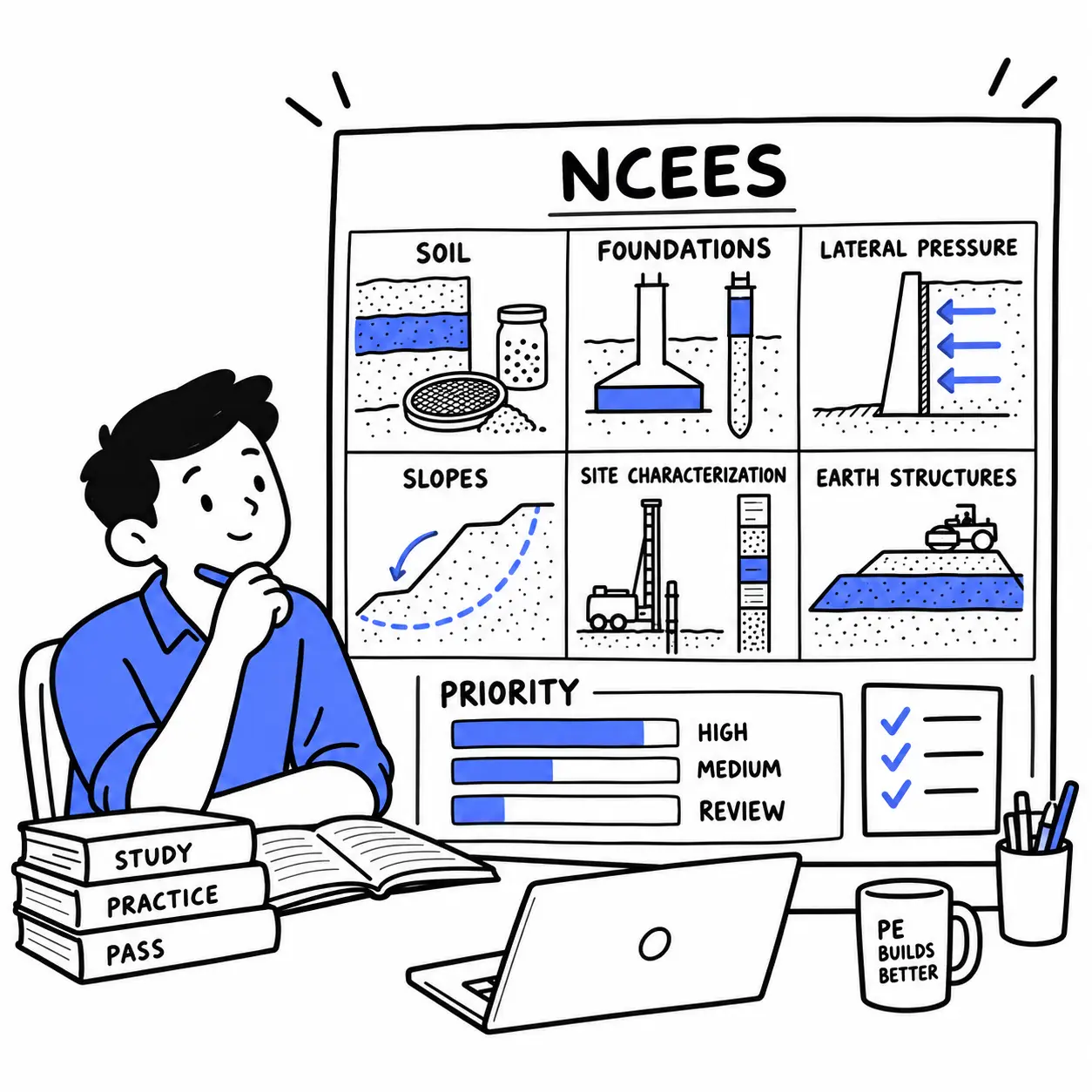
Geotechnical PE Exam Topics: NCEES Breakdown and Study Priorities
Explore the 10 Geotechnical PE exam topics, their NCEES question ranges, and practical study priorities. See which areas deserve the most attention and how the topics connect.