Geotechnical PE Exam Topics: NCEES Breakdown and Study Priorities
Explore the 10 Geotechnical PE exam topics, their NCEES question ranges, and practical study priorities. See which areas deserve the most attention and how the topics connect.
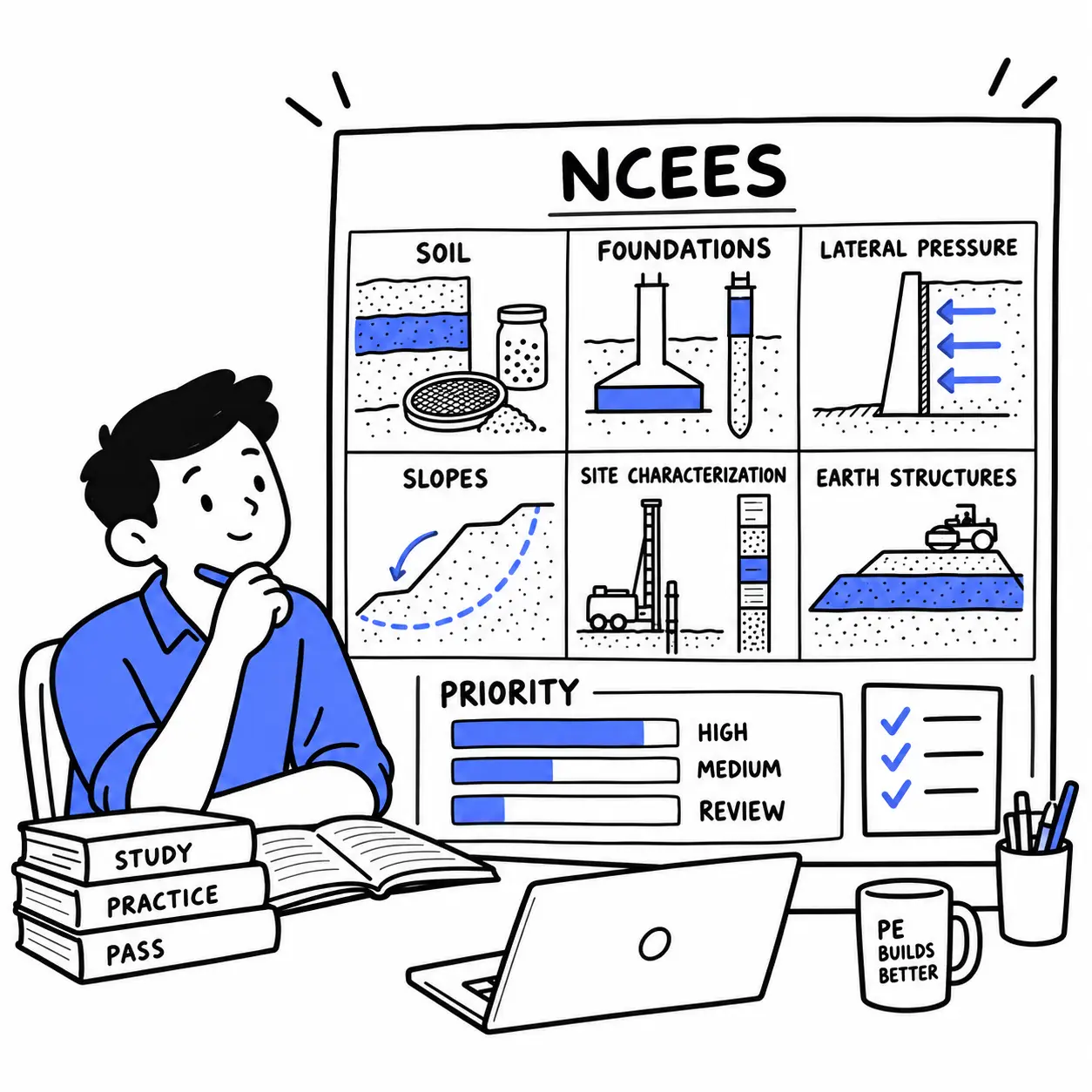
Trying to turn the entire field of geotechnical engineering into one study plan can feel overwhelming. The good news is that the PE Civil: Geotechnical exam follows a clear 10-area NCEES blueprint. The largest published question ranges are Retaining Structures and Deep Foundations at 10–15 questions each. Earth Structures, Ground Improvement, and Pavement follow at 9–14 questions, while Site Characterization and Soil Mechanics each carry 8–12 questions. Study every area, but spend the most practice time on the topics with the greatest ranges and the soil behavior underneath them. Looking for the bigger picture before diving into the topic list? Our PE Geotechnical exam guide explains the exam format, references, scoring, and preparation process, while this article focuses specifically on the topics and their study priority.
This breakdown follows the NCEES Civil exam page and its Civil–Geotechnical specifications. NCEES publishes question ranges for knowledge areas, not a guaranteed number of questions for every exam form. The examples listed under each area are representative rather than exhaustive. Check the specification version that matches your exam date; NCEES currently provides separate links for exams before April 2027 and beginning April 2027.
Geotechnical PE exam topics at a glance
| NCEES knowledge area | Published question range | Study priority |
|---|---|---|
| Site Characterization | 8–12 | High |
| Soil Mechanics, Laboratory Testing, and Analysis | 8–12 | High |
| Construction Observation, Monitoring, Quality Assurance/Quality Control, and Safety | 6–9 | Medium |
| Earthquake Engineering and Dynamic Loads | 5–8 | Targeted |
| Earth Structures, Ground Improvement, and Pavement | 9–14 | High |
| Groundwater and Seepage | 4–6 | Targeted but essential |
| Problematic Soil and Rock Conditions | 4–6 | Targeted but essential |
| Retaining Structures | 10–15 | Very high |
| Shallow Foundations | 6–9 | Medium-high |
| Deep Foundations | 10–15 | Very high |
Use these ranges to decide where to spend more time—not to decide what you can skip. Groundwater, problematic soils, construction, and seismic concepts can appear as direct questions or be built into a larger foundation, retaining-wall, slope, or earth-structure problem. Also you can take a free test from pewise practice exams to assess your current knowledge and plan your studies based on your result.
The 10 NCEES Geotechnical PE exam topics explained
1. Site Characterization
Site Characterization is where you figure out what is beneath and around a proposed project before designing anything. The specification includes site-data interpretation, subsurface exploration planning, boring and drilling methods, sampling, in-situ testing, soil and rock classification, and groundwater characterization.
You do not need to memorize investigation methods as a disconnected list. Focus on what each method tells you, what its limitations are, and when its results are useful. The specification names standard penetration testing (SPT), cone penetration testing (CPT), pressuremeter, dilatometer, field vane shear, plate load, geophysical testing, rock coring, and test pits.
This is the starting point for nearly every other Geotechnical topic. The soil profile and groundwater conditions influence classification, strength, permeability, settlement, liquefaction, slope stability, and foundation selection.
2. Soil Mechanics, Laboratory Testing, and Analysis
Think of Soil Mechanics, Laboratory Testing, and Analysis as the language behind the rest of the exam. You will work with phase relationships and index properties, total and effective stress, stress–strain behavior, soil strength, and permeability. The specification also includes chemical, electrical, and thermal properties in a geotechnical context.
Make sure you can move between water content, void ratio, porosity, degree of saturation, unit weight, and related properties. More importantly, understand why effective stress changes when groundwater or drainage conditions change. That understanding will help you choose the right equation instead of trying to remember formulas in isolation.
These ideas support bearing capacity, settlement, seepage, slope stability, lateral earth pressure, and liquefaction problems. If this area feels shaky, strengthen it before moving into the more specialized design topics.
3. Construction Observation, Monitoring, Quality Assurance/Quality Control, and Safety
This area brings geotechnical knowledge into the field. It includes excavation, subgrade preparation, laboratory and field compaction, borrow studies, fill placement, trench and construction safety, geotechnical instrumentation, and temporary or permanent erosion and scour protection.
The practical question is often: what does the field information tell you to do next? Be ready to interpret whether soil has been placed and compacted as required, what an instrument is monitoring, and whether an excavation is safe. Common instruments include inclinometers, settlement plates, piezometers, and vibration monitors.
Compaction may feel like a soil-mechanics topic, but the NCEES blueprint places its earthwork application here. That is a helpful pattern to remember: the exam groups ideas by engineering task, not only by textbook chapter.
4. Earthquake Engineering and Dynamic Loads
Earthquake Engineering and Dynamic Loads focuses on what happens when the ground and structures are subjected to seismic loading. The listed topics include seismic site characterization, liquefaction, pseudo-static analysis, and earthquake loads.
The key connection is between the soil profile, groundwater, soil density or resistance, cyclic loading, and potential strength loss or excessive deformation. Focus on what information a liquefaction evaluation uses, what the result means, and how seismic loading changes a design decision.
This area is smaller than retaining structures or deep foundations, but it is not optional. Seismic concepts can also show up inside slope, retaining, and foundation problems.
5. Earth Structures, Ground Improvement, and Pavement
This is one of the larger NCEES areas. Earth Structures, Ground Improvement, and Pavement covers ground-improvement methods, geosynthetics, slope stability evaluation and stabilization, embankments, earth dams and levees, landfills and caps, pavement and slab-on-grade design, and utility design and construction.
Give slope stability extra attention because it brings together soil strength, geometry, groundwater, seepage, loading, and seismic conditions. You should be able to recognize the likely failure mechanism, choose an analysis approach, interpret a factor of safety, and see how stabilization changes the problem.
For ground improvement and geosynthetics, start with the problem being solved: excessive settlement, low strength, drainage, separation, filtration, or reinforcement. Then learn the limitation that controls the method’s use. The goal is to evaluate an appropriate approach, not memorize product names.
6. Groundwater and Seepage
Groundwater rarely stays in its own lane. This area covers groundwater flow, seepage analysis, dewatering, impacts on nearby structures, drainage design, infiltration, and seepage control.
It can change effective stress, shear strength, settlement, slope stability, excavation conditions, and liquefaction potential. Dewatering can also affect neighboring foundations or cause ground movement outside an excavation.
Focus on flow direction, hydraulic gradients, pore-water pressure, seepage forces, and the purpose of drains, filters, cutoffs, and other control measures. When practicing, ask whether the problem wants flow or pressure—or wants you to judge how groundwater affects stability or deformation.
7. Problematic Soil and Rock Conditions
These are the “what can go wrong with the ground?” questions. Problematic Soil and Rock Conditions includes karst, collapsible, expansive, peat, organic, and sensitive soils; reactive or corrosive soils; frost susceptibility; rock slopes; and rockfalls.
For each condition, use the same simple sequence: how is it identified, what risk does it create, and how can an engineer investigate, treat, protect against, or design around it? Expansive soil, collapsible soil, and rockfall each require a different response.
These topics have a smaller published range, but they can be efficient points when you understand the defining behavior and the appropriate mitigation.
8. Retaining Structures
Retaining Structures is one of the biggest areas on the blueprint, with a published range of 10–15 questions. It starts with lateral earth pressure and load distribution, then applies those ideas to retaining and earth-support systems.
Start with at-rest, active, and passive earth-pressure conditions, then add surcharge, water effects, and pressure distribution over a wall or support system. From there, apply the concepts to cast-in-place and gravity walls, mechanically stabilized earth (MSE) systems, soil-nail systems, crib and bin walls, and flexible systems.
You will also see cantilevered, anchored, and braced walls; soldier pile and lagging systems; sheet, secant, tangent, and diaphragm walls; temporary support of excavation; cofferdams; underpinning; and anchors, tie-backs, and soil nails.
Here is the distinction worth remembering: lateral earth pressure describes how soil loads the system, while retaining-structure analysis checks the complete system. Practice identifying the pressure condition, accounting for water and external loading, selecting the correct reference, and checking stability, movement, drainage, and construction conditions.
9. Shallow Foundations
Shallow Foundation questions usually come down to two checks: bearing capacity and settlement, including induced stress distribution. Study them together, but do not confuse them.
Bearing capacity asks whether the soil–foundation system can support the load without unacceptable shear failure. Settlement asks how much the ground and foundation will deform. A footing can have adequate bearing capacity and still produce unacceptable total or differential settlement.
Connect the answer to soil type, groundwater, stress history, compressibility, loading, and foundation dimensions. Then identify whether the problem is controlled by shear capacity, immediate or consolidation settlement, stress distribution, or a combination.
10. Deep Foundations
Deep Foundations is tied with Retaining Structures for the largest published range at 10–15 questions. The area includes the geotechnical and structural capacity and settlement of driven piles, drilled shafts, micropiles, helical screw piles, auger-cast piles, and related beam or column elements.
You will also need lateral capacity and deformation, installation methods, static and dynamic load testing, and integrity testing. Keep axial capacity, lateral behavior, settlement, structural capacity, and test results conceptually separate.
The key study skill here is method selection. Driven piles, drilled shafts, micropiles, and helical piles do not behave identically, and installation can change the surrounding soil and developed capacity. Learn how foundation type, soil profile, loading, groundwater, installation, and testing shape the design decision.
Which Geotechnical PE exam topics deserve the most study time?
Once you see the ranges, the next question is where to begin. Use a practical order: start with Retaining Structures and Deep Foundations, each at 10–15 questions, because they require both technical judgment and reference fluency. Build the soil behavior underneath them through Site Characterization and Soil Mechanics, then give serious time to Earth Structures, Ground Improvement, and Pavement, especially slope stability and geosynthetics. Practice Earthquake Engineering as a focused specialty, then complete the blueprint through construction observation, shallow foundations, groundwater, seepage, and problematic ground conditions.
Try not to study only what feels familiar. Soil mechanics may feel comfortable because you saw it in school, while retaining walls, deep foundations, in-situ testing, or unusual ground conditions may need more attention. Use the question ranges as a starting point, then let your practice results show you where to spend the next study session.
How the Geotechnical PE topics connect
The easiest way to make the 10 areas stick is to see the engineering chain behind them:
Site data → soil classification and parameters → groundwater and effective stress → strength or deformation model → foundation, retaining, slope, or earth-structure decision → construction and monitoring checks.
For example, a retaining-wall problem may combine a soil profile, effective-stress parameters, groundwater, lateral earth pressure, and construction or drainage conditions.
That overlap is intentional. It reflects how geotechnical decisions work in practice. Learn the official areas separately so you know the scope, then practice connecting them so you can spot the controlling issue in a mixed problem.
How PEwise maps its Geotechnical course to the NCEES topics
This is where a clear course structure can make the blueprint feel much less overwhelming. PEwise organizes its Geotechnical curriculum around the NCEES knowledge areas, with lesson groups connected to site characterization, soil mechanics, liquefaction, slope stability, seepage, lateral earth pressure, retaining walls, and foundations.
The mapping includes:
| NCEES area | PEwise coverage to look for |
|---|---|
| Site Characterization | In-situ testing, boring and sampling, SPT, CPT, specialized tests, and geophysics |
| Soil Mechanics, Laboratory Testing, and Analysis | Soil classification, phase relationships, and compaction |
| Construction Observation, Monitoring, QA/QC, and Safety | Compaction, earthwork/layout, OSHA excavation safety, and practice coverage for instrumentation and erosion/scour |
| Earthquake Engineering and Dynamic Loads | Liquefaction and seismic fundamentals |
| Earth Structures, Ground Improvement, and Pavement | Slope stability, ground improvement, and geosynthetics |
| Groundwater and Seepage | Groundwater flow and seepage |
| Problematic Soil and Rock Conditions | Problematic soils/rock, classification, and practice for less common conditions |
| Retaining Structures | Lateral earth pressure, retaining-wall analysis, and anchored earth retention |
| Shallow Foundations | Bearing capacity, deformation, and compression settlement |
| Deep Foundations | Driven piles, drilled shafts, micropiles, and related foundations |
PEwise describes this as a map of lessons and practice coverage to the NCEES areas. Some specification subtopics may be reinforced through practice questions and worked solutions rather than a separately titled video lesson. You can review the PEwise Geotechnical course and its current blueprint map to see how the topics are organized.
Frequently asked questions about Geotechnical PE exam topics
What topics are on the Geotechnical PE exam?
The exam has 10 NCEES knowledge areas: Site Characterization; Soil Mechanics, Laboratory Testing, and Analysis; Construction Observation, Monitoring, Quality Assurance/Quality Control, and Safety; Earthquake Engineering and Dynamic Loads; Earth Structures, Ground Improvement, and Pavement; Groundwater and Seepage; Problematic Soil and Rock Conditions; Retaining Structures; Shallow Foundations; and Deep Foundations. Together, they cover investigation, soil behavior, construction, seismic conditions, earth structures, water, retaining systems, and foundations.
Which Geotechnical PE exam topics have the most questions?
Retaining Structures and Deep Foundations have the largest published ranges at 10–15 questions each. Earth Structures, Ground Improvement, and Pavement follow at 9–14 questions. Site Characterization and Soil Mechanics, Laboratory Testing, and Analysis each have an 8–12 question range.
Is soil mechanics tested on the Geotechnical PE exam?
Yes. Soil Mechanics, Laboratory Testing, and Analysis is one of the 10 official knowledge areas and has an 8–12 question range. Its concepts also support foundation, retaining, seepage, slope, and seismic problems.
Are foundations and retaining walls separate Geotechnical PE topics?
Yes. Retaining Structures, Shallow Foundations, and Deep Foundations are separate NCEES knowledge areas. They overlap through soil strength, groundwater, settlement, and effective stress, but each area has its own design decisions and problem types.
Is slope stability on the Geotechnical PE exam?
Yes. Slope stability evaluation and slope stabilization are listed under Earth Structures, Ground Improvement, and Pavement. Slope problems can also connect to groundwater, soil strength, seismic loading, embankments, and geosynthetics.
Does the Geotechnical PE exam include liquefaction and earthquake engineering?
Yes. Earthquake Engineering and Dynamic Loads includes seismic site characterization, liquefaction, pseudo-static analysis, and earthquake loads. Seismic conditions may also affect retaining, slope, and foundation problems.
Where can I find practice problems for specific Geotechnical PE topics?
Look for practice questions organized by NCEES knowledge area—not just a random collection of geotechnical problems. The best practice helps you choose the right method, interpret the result, and find the governing reference. PEwise combines topic-focused lessons with practice coverage across the Geotechnical blueprint in a realistic CBT-style practice environment.
Does PEwise map its Geotechnical lessons to the NCEES topic areas?
Yes. PEwise’s Geotechnical course page provides a blueprint map connecting lesson groups and practice coverage to the 10 NCEES knowledge areas. You can use it to see how lateral earth pressure, slope stability, soil mechanics, site characterization, and foundations fit into the larger exam structure.
Final takeaway
Bottom line: the Geotechnical PE exam topics follow one engineering process. Understand the site, define soil and groundwater behavior, evaluate strength or deformation, and check the geotechnical system. Prioritize Retaining Structures and Deep Foundations, build strong soil-mechanics fundamentals, and finish all 10 knowledge areas.
If you want a preparation path organized around that blueprint with high-qualit, focused video lessons, explore PEwise’s Geotechnical PE course and review how its lessons and practice coverage correspond to the NCEES topic areas.
Keep Reading

Best PE Geotechnical Exam Prep Courses
Compare six PE Geotechnical exam prep courses by curriculum, teaching format, practice resources, support, price, and access. Find the course that best fits your budget, learning preferences, and exam timeline.

PE Civil Geotechnical Exam Guide Format, Topics, References & Pass Rates
Everything on the PE Geotechnical exam — the 10 NCEES knowledge areas with question counts, CBT format, bundled references, pass rates, and how to study.
Why You Keep Failing the PE Geotechnical Exam (And How to Fix It)
Discover the 3 real reasons engineers fail the PE Geotechnical exam — conceptual questions, false confidence from practice exams, and passive study methods — plus proven strategies to pass on your next attempt.