Can AI Pass the PE Exam? ChatGPT and the Latest Research
Can AI pass the PE exam? Compare ChatGPT and other models across Civil, Mechanical, Fire Protection, and broader benchmarks, with research checked in 2026.
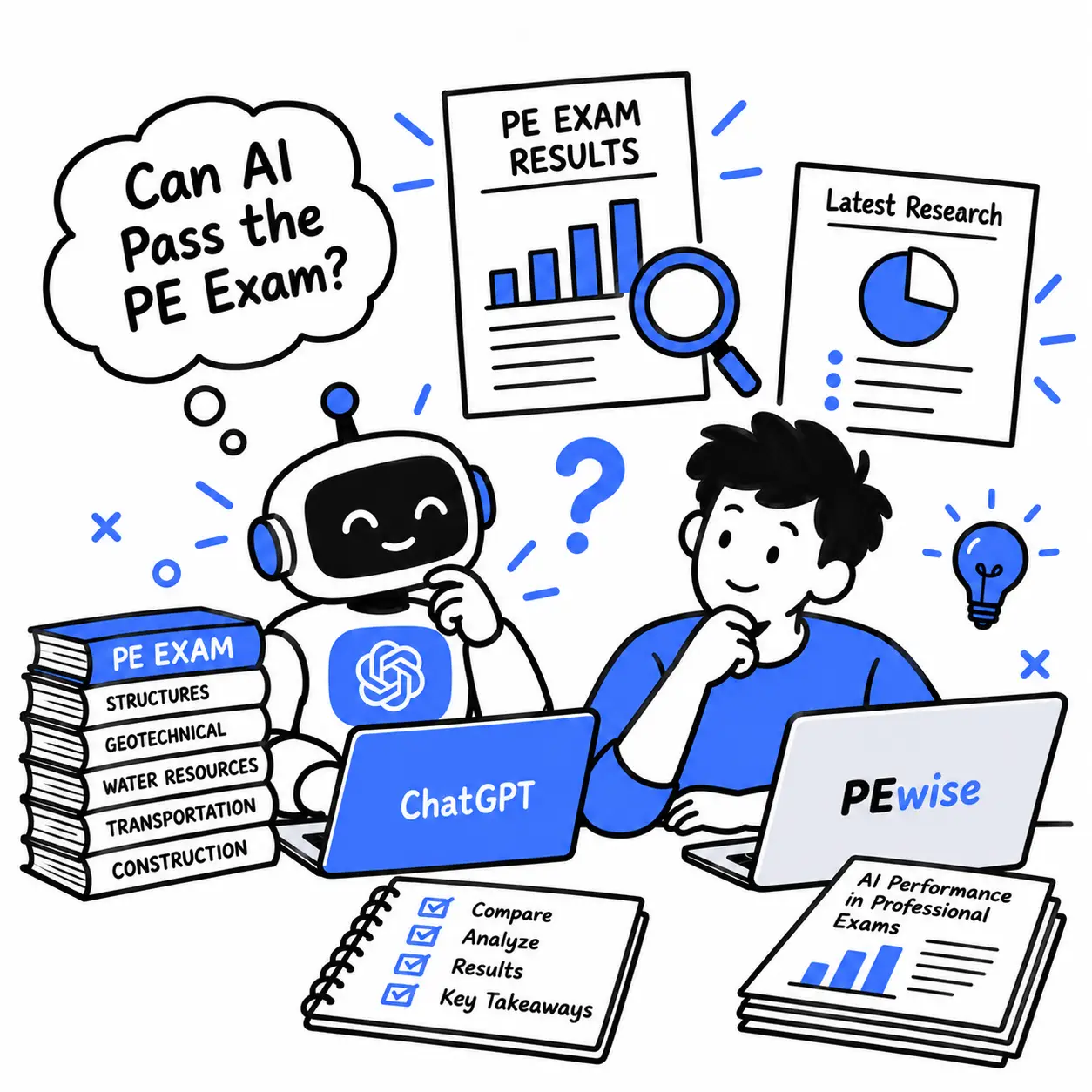
AI can earn high scores on PE practice questions, and some evaluations report performance their authors describe as potentially passing. However, the sources reviewed for this guide do not establish a verified pass on a current official NCEES PE examination. The answer depends on the engineering discipline, model, question set, references, tools, and grading method.
There is also no single universal PE exam. NCEES offers more than 20 examinations across engineering disciplines. Evidence from Civil, Mechanical HVAC, or Fire Protection cannot establish performance on every other PE examination.
This guide brings those results together, explains what newer models have and have not demonstrated, and shows how candidates can use AI while checking their own readiness.
Has AI actually passed the PE exam?
A useful answer separates three claims:
| Claim | What would support it |
|---|---|
| AI answered PE practice questions correctly | A defined problem set, checked answers, and a documented score |
| AI performed at an estimated passing level on a simulation | A representative discipline-specific test and a clearly explained, unofficial comparison standard |
| AI passed an official NCEES examination | Verifiable evidence of that official result |
The research and reports discussed here mainly support the first claim. Some authors also make the second, using assumptions about what would constitute passing.
NCEES does not publish its passing score. A familiar cutoff such as 70% therefore cannot turn a practice result into an official pass.
This uncertainty is not evidence that modern AI cannot pass. It means the available evaluations do not settle the broader question under comparable conditions.
What the published PE exam evaluations show
These results come from different tests. Comparing them can reveal evidence gaps, but should not produce a universal model ranking.
| Evaluation | What was tested | Reported finding | Main limitation |
|---|---|---|---|
| Naser and colleagues, 2023 preprint and 2024 update | FE questions and a partial structural-focused PE practice set | Earlier GPT-4 PE accuracy was 46.2%; the later version reports over 70% on both FE and PE after a vision-model update | Historical models, partial practice coverage, and revisited visual questions |
| PE Civil Bench, 2026 | 110 FE-style multiple-choice and 40 PE-style numerical items | GPT-5.5 with Agentic RAG: 87.3% overall and 67.5% on PE-style items | Mixed benchmark; overall accuracy is not PE-only accuracy |
| Reynolds, 2026 | 21 proprietary PE Mechanical HVACR practice problems | Paid ChatGPT solved 18 of 21, approximately 85.7% | Small set; exact ChatGPT model not identified in the PE trial description |
| MeyerFire, March 2025 practitioner test | A full-length Fire Protection PE practice exam | Tested models did not reach the author’s approximate 70% comparison threshold | Practitioner assessment and an unofficial cutoff |
A separate commercial benchmark spans multiple engineering categories; its results and limitations are discussed below.
Civil and structural-focused questions: include the later study version
The early Naser study evaluated 79 FE questions and 39 structural-focused PE questions. It reported 46.2% PE accuracy for GPT-4 and 41% for Bard.
The later 2024 version also reports over 70% on both assessments with the October 2023 GPT-4 vision edition; some visual questions were revisited. Citing only the early result leaves out that update.
Neither version establishes coverage of today’s separate PE Structural examination. Historical exam terminology and question selection need to be read in context.
PE Civil Bench: retrieval changes the result
On the 40 PE-style items, GPT-5.5 scored 52.5% without retrieval and 67.5% with Agentic RAG—a gain of 15 percentage points. The latter corresponds to 27 correct responses.
Retrieval-augmented generation, or RAG, supplies relevant reference material. The project’s agentic workflow adds repeated retrieval, formula injection, and reflection.
About 73% of its questions are FE-style. Keep that composition visible when reporting the overall score. The authors provide code and data, but this guide does not independently reproduce their results or verify the full publisher methods.
Mechanical HVAC: promising results from a small set
Michael Reynolds’s June 2026 paper describes a trial using PE Mechanical HVACR practice material from a proprietary source with solutions behind a paywall. Multiple-choice options were withheld; the closest option to the model’s numerical output was selected.
That procedure and the small sample matter. A high score on those questions does not establish a complete Mechanical HVAC and Refrigeration pass, or performance on Mechanical: Machine Design and Materials or Thermal and Fluid Systems.
The PE trial identifies paid ChatGPT rather than an exact model version, limiting comparison with current tools.
Fire Protection: a full practice exam is still a practice exam
Joe Meyer’s April 2025 report describes testing models twice, with a simple prompt, on March 20, 2025. The report includes o1 and discusses progress toward the author’s approximate passing threshold.
This supplies discipline-specific evidence beyond Civil. Its approximate cutoff remains the author’s comparison, not an NCEES-published standard.
It also describes the models available at that time. It should not be presented as a test of late-2026 models.
What about benchmarks covering multiple PE disciplines?
PE Precision Bench is a commercial, provider-reported comparison published by PE Prep Pro in August 2026. It uses 320 closed-book multiple-choice questions, with 20 in each of its 16 engineering categories. Its overall metric combines answer accuracy with a standards-citation score.
Selected reported results illustrate why those measures need separate labels:
| Model | Answer accuracy | Overall composite score |
|---|---|---|
| DeepSeek V4 Pro | 99.4% | 97.8% |
| GPT-5.6 Sol | 99.7% | 97.5% |
| Claude Sonnet 5 | 98.8% | 96.2% |
| Gemini 3.5 Flash | 97.8% | 95.1% |
The scored questions and responses remain private. This guide has not independently validated their difficulty, grading, or exam alignment.
Its category map is not a list of complete NCEES exams. Twenty questions per category cannot establish full coverage, and a composite metric is not an official exam score. Treat the leaderboard as a report about that benchmark.
How far does the evidence extend across PE disciplines?
The scope below refers to evaluations verified for this review. “Not verified” means this review cannot substantiate the claim; it does not mean no relevant experiment exists anywhere.
| PE discipline or exam group | Exam-specific evidence located | What remains unestablished here |
|---|---|---|
| Civil | Structural-focused historical work and PE Civil Bench | A complete, current evaluation for each Civil exam |
| Mechanical | Small HVACR practice trial | Complete evaluations of all three Mechanical exams |
| Fire Protection | Practitioner test using a full practice exam | A verified official pass or current-model replication |
| Electrical and Computer, including Power | Broad commercial benchmark provides related evidence | A separate, complete, exam-aligned evaluation verified in this review |
| Chemical | Broad commercial benchmark provides related evidence | A separate, complete PE Chemical evaluation verified here |
| Environmental | Broad commercial benchmark and related FE research | A separate, complete PE Environmental evaluation verified here |
| Structural | Historical structural-focused questions | Coverage of the current separate PE Structural examination |
| Other NCEES groups listed below | No separate complete exam evaluation verified here | Exam-specific performance and any official passing claim |
Other groups include Agricultural and Biological, Architectural, Control Systems, Industrial and Systems, Metallurgical and Materials, Mining and Mineral Processing, Naval Architecture and Marine, Nuclear, and Petroleum. Consult the NCEES exam directory for the controlling categories and specifications.
Broadening the discussion does not make the evidence equally strong in every discipline. A question bank spanning many categories and a complete exam in one specialty answer different questions.
Why “the PE exam” cannot be treated as one uniform test
An AI evaluation needs to match the particular examination it claims to simulate.
Mechanical has three exam options: HVAC and Refrigeration, Machine Design and Materials, and Thermal and Fluid Systems. Civil has five. Electrical and Computer includes Power, Computer Engineering, and Electronics, Controls, and Communications.
Question counts and time also differ:
| Examination | Questions | Testing time, excluding appointment administration and breaks |
|---|---|---|
| Civil | 80 | 8 hours |
| Mechanical | 80 | 8 hours |
| Electrical and Computer: Power | 80 | 8 hours |
| Electrical and Computer: Computer Engineering | 85 | 8.5 hours |
| Electrical and Computer: Electronics, Controls, and Communications | 85 | 8.5 hours |
The separate PE Structural exam uses vertical and lateral components, each with breadth and depth sections. A single short structural problem set does not reproduce that structure.
References matter as well. Check the handbook and any design standards assigned to your particular exam and date. NCEES describes electronic reference handbooks and, where specified, design standards as the permitted references; candidates cannot bring personal copies into the testing room.
Does FE exam research prove AI can pass PE?
No. The FE and PE are different assessments. FE results are relevant background, but must retain their FE label.
Two Civil studies illustrate why both prompting and question format deserve attention:
- Genç, 2025: GPT-4 initially answered 49 of 100 FE Civil questions correctly. One-shot prompting then corrected 30 of the 51 failed items.
- Oblitas and colleagues, 2025: Six versions—o3, GPT-4o, DeepSeek-V3, DeepSeek-R1, Gemini 2.5 Pro, and Gemini 2.0 Flash—were evaluated on 100 FE Civil practice questions. Reported average accuracy was 87% on text-based questions and 42% on image-based questions. The rubric considered final answers, concepts, and equations.
The second study used 66 text and 34 image questions. These were different items, so the gap does not isolate the effect of converting an identical problem into an image.
The first study’s corrections also do not create a fresh 79% first-attempt score. They show what happened when selected failures received additional prompting.
Research extends beyond Civil: Pursnani and colleagues evaluated GPT-4 on FE Environmental material and examined prompt modifications. That remains FE Environmental evidence, not PE Environmental performance.
Can the latest ChatGPT, Claude, Gemini, or DeepSeek models pass?
New releases can make older experiments less informative about present capability. They do not automatically resolve an untested PE examination.
Selected newer releases available by this review date include:
| Model | Official announcement or public availability |
|---|---|
| GPT-6 Astra | September 3, 2026 |
| GPT-6.1 Sol | September 29, 2026 |
| Claude Opus 5.5 | September 22, 2026 |
| Gemini 4 Argon | October 13, 2026 |
The sources reviewed do not establish a complete official PE pass for these releases. They should not inherit scores obtained by older models.
For DeepSeek, the commercial benchmark above reports a V4 Pro result, while the FE Civil study tested V3 and R1. Those are different versions and different evaluations. Neither establishes a universal PE passing claim.
“ChatGPT” is a product name, not a sufficient model identifier. A useful test report should state the model, interface, date, settings, available tools, and permitted references. The same principle applies to Claude, Gemini, and other systems.
There is no defensible universal “best AI for the PE exam” ranking in these sources. A comparison would need common questions and consistent testing and grading conditions.
Why high accuracy does not automatically mean a passing score
NCEES bases results on correct answers, converts them to a scaled score to account for minor differences in form difficulty, and compares that result with the examination’s minimum ability level. It does not publish the passing score or set a predetermined percentage of candidates who must pass.
Keep three measures separate:
- Item accuracy: the proportion of evaluated questions answered correctly.
- Passing standard: the ability level required to pass the particular exam.
- Pass rate: the proportion of human examinees who passed.
A chatbot’s 80% item accuracy cannot be compared with a human 60% pass rate to conclude it outperformed engineers.
The NCEES Examinee Guide also describes unscored, unidentified pretest items and correct/incorrect scoring without partial credit. A largely correct explanation can still end in an incorrect answer.
An unofficial practice threshold can help describe a test designer’s interpretation. It should always be labeled unofficial.
What would make an AI passing claim convincing?
A strong evaluation should make the following information easy to inspect:
- Exam match: Name the discipline, specification, relevant item formats, diagrams, and topic coverage.
- Question source: Explain whether problems were newly written, published, or potentially exposed through training or retrieval.
- System identity: Record the exact model, version, test date, interface, and relevant settings.
- Permitted help: Disclose references, browsing, retrieval, calculation software, and human assistance.
- Time and attempts: Separate first attempts from retries or answers revised after feedback.
- Grading: Provide independently checked solutions, numerical tolerances, exclusion rules, and treatment of failed responses.
- Consistency: Show topic-level results, errors, and any repeat runs.
These are evaluation criteria, not an NCEES approval process. They help readers judge what a practice result actually demonstrates.
How to use AI to study for your PE exam
AI can help you investigate a difficult explanation. Your study process still needs to reveal whether you can solve unfamiliar problems independently.
Start with your own attempt
Identify the givens, requested quantity, assumptions, and reference. Sketch the situation where useful. Keep that attempt so an AI answer does not erase the evidence of where you struggled.
Ask for a specific explanation or hint
A focused prompt is easier to verify than an unrestricted request for a complete answer:
Review my attempt on this original practice problem. Identify the first unsupported assumption or unit inconsistency. Give one hint before presenting a complete solution.
Use original material or content you are authorized to share. Do not enter remembered live exam questions into a chatbot.
Check the response against your discipline’s references
The checking task varies with the problem:
| Context | Examples of what to verify |
|---|---|
| Civil or structural | Geometry, load type, support conditions, sign convention, applicable design provision |
| Mechanical | Absolute versus gauge pressure, temperature scale, property data, energy-balance assumptions |
| Electrical and Computer | Phase versus line quantities, units, circuit interpretation, applicable code edition |
| Chemical or Environmental | Mass balance, concentration basis, property units, stated process conditions |
| Fire Protection | Scenario assumptions, governing standard and edition, applicability of any quoted requirement |
These are suggested checks, not findings that every AI model makes each error.
Locate quoted provisions in the actual source. Asking the same chatbot to confirm its answer does not independently verify it.
Finish with an unfamiliar problem
Solve a new problem without AI assistance. Use appropriate references and track whether you can select and apply the method yourself.
Your readiness is better measured by independently solving checked practice material than by understanding an answer after it is shown to you. This is a practical study recommendation, not a guarantee of a particular result.
Does passing practice questions mean AI can replace an engineer?
An exam result alone would not establish reliable performance on complete professional work.
The October 21, 2026 preprint PLE: Physical-Engineering’s Last Exam evaluates 85 extended tasks across electrical, civil, structural, and mechanical engineering. Its abstract reports a best mean score of 50.6% across evaluated configurations.
This is related research, not a PE exam assessment. It illustrates why professional deliverables and isolated questions need separate evaluations. Neither benchmark can supply the other’s passing standard.
Frequently asked questions
Can AI pass the PE exam?
AI can perform strongly on selected practice questions and benchmarks. Some authors report potentially passing performance, but the sources reviewed do not establish a verified pass on a current official NCEES PE exam. The discipline and test conditions must be specified.
Has ChatGPT passed a PE practice exam?
Reports include high performance on a small Mechanical HVACR set and a later structural-focused study reporting over 70%. Those findings concern the named practice evaluations, not an official NCEES result.
Can AI pass PE Power, Mechanical, Chemical, or Environmental?
The evidence varies. This review located a small Mechanical HVACR trial and a broad commercial benchmark, but did not verify separate complete exam-aligned evaluations for Power, Chemical, or Environmental. FE evidence should not be substituted for those missing PE results.
Is AI allowed during the PE exam?
AI chatbots are not authorized exam-day resources. Follow the current NCEES Examinee Guide for electronic devices, references, independent work, outside communication, and confidentiality.
Can I study with ChatGPT, Claude, Gemini, or DeepSeek?
Use them to investigate explanations and inspect practice work, then check the output against reliable solutions and the applicable reference. Finish by solving unfamiliar problems independently.
Is 70% the official PE passing score?
NCEES does not publish its passing score. A 70% cutoff used by a researcher or prep provider is an unofficial comparison, not a universal NCEES rule.
What this means for PE candidates
The useful conclusion is specific: AI can answer many engineering practice questions, but every score belongs to a particular model, discipline, problem set, and workflow.
Use AI explanations when you can check them. Measure your preparation through unfamiliar, verified problems you solve yourself.
Prepare for PE Civil with PEwise
PEwise offers online preparation for engineers studying for the PE Civil exam, with courses organized by discipline. If you’re looking for the best pe civil course for your study needs, explore PEwise’s current options and review the course details to find a fit for your discipline, schedule, and exam date.
Key sources
Research checked October 26, 2026. Reported results were not independently reproduced. The Civil benchmark uses its authors’ summary, the Naser update its author-uploaded draft, and PLE its abstract. PE Precision Bench’s scored data remain private. Additional study and model-release sources are linked where discussed above.
- NCEES: PE exams, scoring, and Examinee Guide.
- Naser et al. (2024): FE and PE structural-focused evaluation.
- Silwal et al. (2026): PE Civil Bench.
- Reynolds (2026): Mechanical engineering AI evaluation.
- MeyerFire (2025): Fire Protection PE practice test.
Keep Reading
Preparing for the PE Civil Exam After Years Out of School
Years out of school and unsure where to start with PE Civil prep? Learn how to identify rusty skills, refresh essential fundamentals, and fit studying around work and family. Use a practical four-week refresher plan to get started before moving into full exam preparation.
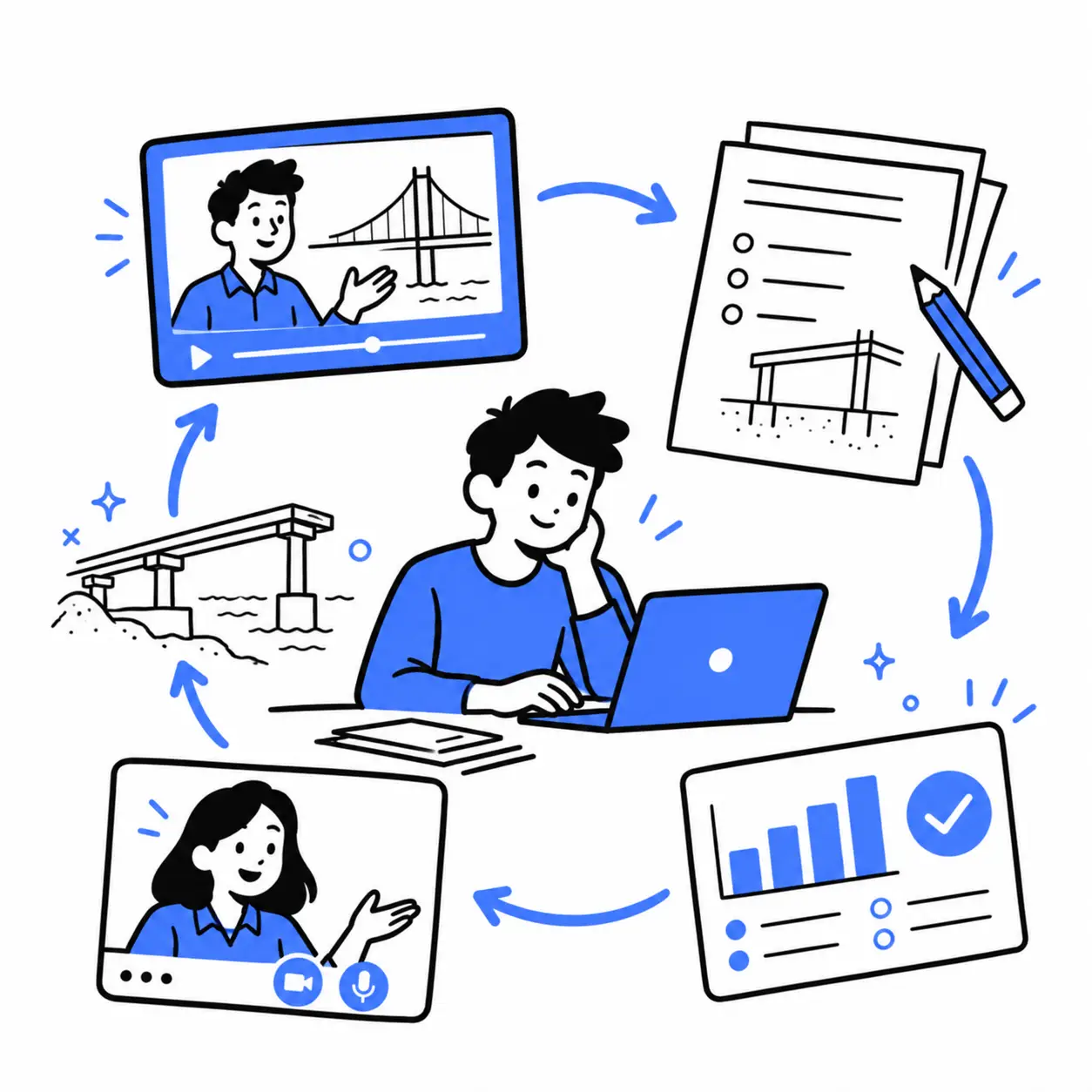
Inside PEwise’s PE Civil Prep Courses: How the Learning System Works
What happens after you watch a lesson? Step inside PEwise’s PE Civil prep courses to see how lessons, practice problems, quizzes, and instructor support fit together—and how practice-exam feedback can guide your next study session.