Licensed vs Unlicensed Engineers What Is the Difference
What separates a licensed PE from an unlicensed engineer? Explore the differences in legal authority, responsibilities, salary potential, career growth, and when professional engineering licensure matters most.
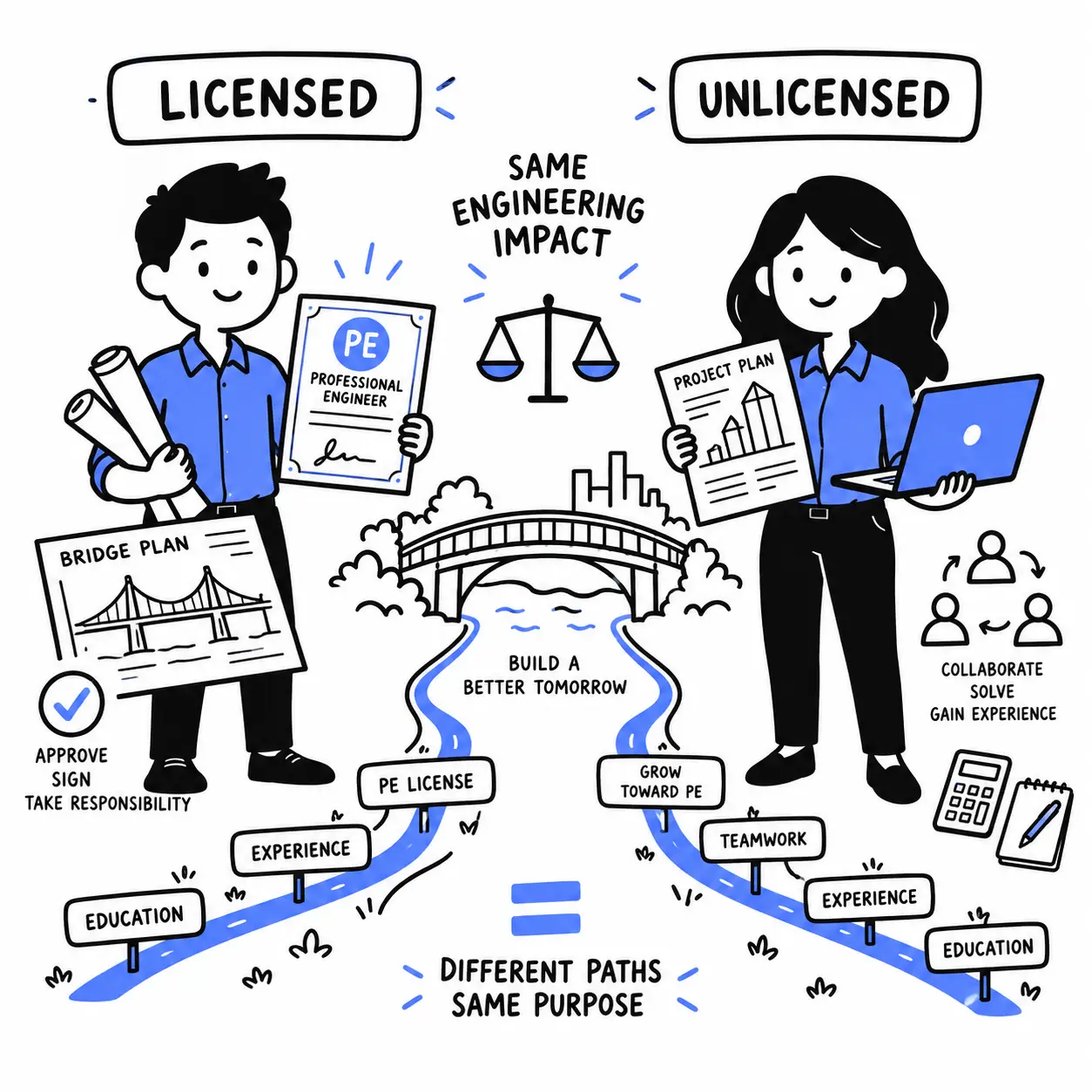
The short answer is that a licensed Professional Engineer has met a jurisdiction’s licensure requirements and may take professional responsibility for regulated engineering work within that jurisdiction. An unlicensed engineer may still perform valuable engineering work, but usually works within an employer’s structure and under the supervision or review required by applicable law. The difference is legal authority and professional responsibility, not a simple measure of technical ability.
This comparison uses “licensed engineer” to mean a U.S. Professional Engineer or PE. Engineering laws vary by state, so the state board—not a generic national rule—controls whether a person may offer services to the public, take responsible charge, sign or seal documents, or use a protected title. A separate section covers the requested Philippines salary comparison because Philippine civil-engineering practice is governed by a different legal framework.
Quick answer licensed vs unlicensed engineers
| Comparison point | Licensed engineer or PE | Unlicensed engineer |
|---|---|---|
| Legal status | Holds an active license issued by a state or other jurisdiction. | Does not hold the professional license for the jurisdiction, or is still completing the path. |
| Typical work | Performs technical work and may take responsible charge when qualified and authorized. | Performs design, analysis, construction, project, or review work within the role and supervision structure allowed by law and the employer. |
| Signing and sealing | May sign, seal, or submit work when state law, project rules, and personal competence permit it. | Generally cannot independently use a PE seal or represent regulated work as personally sealed; exact restrictions vary by state. |
| Public practice | Can qualify for roles that require professional engineering licensure or responsible charge. | May be excluded from some public-facing, consulting, or responsible-charge roles, but can work in many engineering positions. |
| Career effect | Expands eligibility for certain leadership, consulting, government, and independent-practice paths. | Can build experience and advance in technical, project, operational, research, and other roles that do not require a PE. |
| Pay effect | May support higher pay when it is tied to a higher-responsibility role or a license-required position. | Pay depends on role, experience, market, employer, discipline, and location; there is no universal penalty or fixed gap. |
The most important correction to the usual comparison is this: licensure expands what an engineer may be authorized to do in specific settings, but it does not automatically make one engineer more capable than every unlicensed engineer or guarantee a particular salary.
What a licensed engineer means in the United States
A licensed engineer is an engineer who has been granted the legal authorization to practice professional engineering under a jurisdiction’s licensing law. In the United States, state and territorial boards administer licensure. The common path includes an engineering education, the Fundamentals of Engineering exam, qualifying experience, the Principles and Practice of Engineering exam, and an application to the board, although requirements and alternative pathways vary.
The purpose of licensure is public protection. The National Council of Examiners for Engineering and Surveying explains the common three step path to licensure and emphasizes that candidates must verify the rules of the board where they intend to practice. The National Society of Professional Engineers describes a PE as a licensed professional with authority and responsibility defined by state law.
A license does not authorize every type of engineering work everywhere. A PE must work within personal competence, follow the applicable engineering law and ethics rules, and maintain any renewal or continuing-education requirements imposed by the jurisdiction. If a project crosses state lines, the engineer must check whether the second state requires a separate license, comity application, endorsement, or other registration.
What an unlicensed engineer means
“Unlicensed engineer” is a practical description, not one uniform legal classification. It may describe:
- an engineering graduate who has not yet completed the PE path;
- an Engineer in Training or Engineer Intern, where that title is recognized by the jurisdiction;
- a staff, design, field, project, or research engineer working for an organization; or
- an experienced engineer whose current role does not require professional licensure.
An unlicensed engineer can have substantial education and experience. In many workplaces, unlicensed engineers perform calculations, prepare drawings, analyze data, inspect work, coordinate construction, develop specifications, and manage project tasks. What they cannot do independently is determined by the applicable jurisdiction’s law, the employer’s supervision structure, the project type, and the engineer who takes professional responsibility.
The term should not be used to imply that an engineer is unqualified or working illegally. It becomes a legal problem when a person offers or performs regulated professional engineering services without the authorization required by the relevant law, misuses a protected title, or signs and seals work without the required license and responsible charge.
Licensed vs unlicensed engnieers responsibilities compared
| Responsibility | Licensed PE | Unlicensed engineer |
|---|---|---|
| Technical design and analysis | May perform and approve work within the PE’s competence and responsibility. | May perform technical work when the role and supervision arrangement allow it. |
| Preparing calculations or drawings | May prepare, review, and take responsibility for work as permitted by law. | May prepare technical documents for review and approval by the responsible engineer. |
| Sealing engineering documents | May use a personal seal only when licensed, competent, and authorized for the work in the jurisdiction. | Cannot use another engineer’s seal or claim personal sealing authority. |
| Responsible charge | May serve as the engineer in responsible charge when qualified and accepted under the applicable rules. | Usually supports the responsible engineer and cannot assume that role solely because of experience or job title. |
| Supervision and review | May supervise and review work, subject to state rules and professional competence. | May coordinate or lead technical work internally, but the legal review and approval role may remain with the PE. |
| Offering engineering services to the public | May be eligible to offer regulated services, subject to state law and business rules. | May be restricted from offering regulated services independently. |
| Client and agency submissions | May sign or seal submissions when the jurisdiction and project require it. | May prepare submission materials, but cannot substitute for the required licensee’s signature or seal. |
The phrase “under supervision” does not mean that a PE can simply lend a seal. Responsible charge requires real professional involvement, adequate review, and responsibility for the work. The exact standard comes from the state board and the facts of the project.
Can an unlicensed engineer do engineering work
Yes, often. The better question is which work the engineer is doing, for whom, under what supervision, and under which law. A design engineer may produce calculations and drawings that a PE reviews and seals. A field engineer may coordinate construction and document site conditions. A project engineer may manage schedules, costs, submittals, and technical coordination. A research or product engineer may work in an environment where public-facing PE licensure is not required.
The limits become important when the work is offered directly to the public, requires a professional seal, places the engineer in responsible charge, or falls within a state-regulated practice category. Employers should assign a licensed engineer who is genuinely responsible for regulated work rather than treating licensure as a signature-only step.
What changes after PE licensure
PE licensure can change four parts of an engineer’s career.
Professional authority
The license can make an engineer eligible to take responsible charge and sign or seal engineering work where the jurisdiction requires a PE. That authority comes with a duty to protect public health, safety, and welfare and to practice only within the engineer’s competence.
Role eligibility
Some consulting, government, public-works, design, and firm-lead positions specify a PE license. Other employers treat the license as a preferred qualification rather than a legal requirement. Reading the job description is more reliable than assuming that every senior engineering role requires a PE.
Business and consulting options
Licensure may be necessary for an engineer who wants to offer regulated engineering services directly, form or lead a consulting practice, or be the engineer in charge of work submitted to a public authority. Business-entity rules and firm registrations also vary by state.
Mobility
A current license can make a move between jurisdictions easier to evaluate, but it is not a nationwide license. A second state may offer comity or endorsement while still requiring an application, verification, fees, references, or additional conditions. Always check the destination board before accepting regulated work.
None of these changes guarantees a promotion, a raise, a management title, or the right to seal work outside the licensee’s competence. The benefit is expanded eligibility and responsibility in roles where the license matters.
How to become a licensed PE
The exact path is controlled by the state or territory where you apply. The steps below describe the common U.S. route.
Meet the education requirement
Many jurisdictions commonly accept an engineering degree from an EAC ABET-accredited program, but education rules and alternative pathways differ. Review the board’s current requirements before assuming that a degree, foreign credential, or related major will be accepted automatically.
Pass the FE exam when required
The FE exam is commonly the first NCEES exam in the licensure path. Some candidates take it near graduation, while others qualify through a different route. The board decides whether the FE is required, waived, or satisfied by another provision.
Gain qualifying engineering experience
Most jurisdictions require progressive, verifiable experience. The relevant issue is not just the number of years; the experience must meet the board’s definition and be documented in the format the board accepts. Work should build engineering judgment, design competence, project responsibility, and knowledge of applicable standards.
Pass the PE exam and apply to the board
The PE exam tests engineering practice in a specific discipline. Passing the exam does not by itself create a license. The applicant must still satisfy the board’s education, experience, references, application, and other requirements. Because rules change, use the NCEES licensure overview and the website of the licensing board where you will apply.
Salary difference between licensed and unlicensed civil engineers
There is no single, reliable U.S. percentage that applies to every licensed and unlicensed civil engineer. The current Bureau of Labor Statistics civil-engineer profile reports a median annual wage of $100,840 in May 2025, but that occupation-wide figure does not separate PEs from non-PEs. It therefore cannot prove that a license by itself creates a fixed salary premium.
The pay difference usually comes from the work attached to the license. A PE may qualify for a responsible-charge, project-lead, public-sector, consulting, or firm-management role with a higher pay band. An unlicensed engineer may earn more than a licensed engineer when the unlicensed role is in a stronger market, a higher-paying industry, or a more senior technical position. Experience, location, discipline, employer, business development, and project responsibility can outweigh the credential alone.
Use this method to estimate the likely salary effect for your own situation:
1. Collect current job postings for the same discipline and location.
2. Separate roles that require a PE from roles that list it as preferred.
3. Compare duties, responsible-charge language, client authority, travel, and management expectations—not titles alone.
4. Ask your employer which pay band or promotion becomes available after licensure.
5. Subtract exam preparation, application, renewal, and continuing-education costs from any expected increase.
This is why the former article’s 15–25 percent premium and $5,000–$15,000 immediate raise should not be published as general facts without a defined compensation study. The defensible conclusion is conditional: a PE can improve earning potential when it unlocks higher-responsibility work, but the result is not automatic.
Salary difference licensed vs unlicensed civil engineer Philippines
The Philippines requires a separate legal analysis. Under Republic Act No. 544, the Civil Engineering Law, a person generally may not practice or offer to practice civil engineering without the required certificate of registration, subject to statutory exemptions. The law also says that plans and specifications prepared by, or under the direct supervision of, a registered civil engineer must carry that engineer’s seal. It permits draftsmen, student clerks of work, superintendents, and other employees of a lawful civil-engineering practitioner to act under the employer’s instruction, control, or supervision.
That creates a practical difference between a registered civil engineer and an unregistered employee. The unregistered employee may contribute technical work within the permitted supervision structure, but cannot treat that employment as permission to independently practice, offer civil-engineering services, use a title that falsely suggests registration, or sign and seal work reserved to a registered civil engineer. Section 23 also places responsible charge and signature-and-seal requirements on specified engineering structures.
No authoritative nationwide salary table was identified for the exact Philippines licensed-versus-unlicensed comparison. Current third-party market pages are broader than the requested comparison. For example, Jobstreet’s Philippines civil-engineer salary page shows a general civil-engineer range of ₱22,000 to ₱29,000 based on salary ranges disclosed in job advertisements; it does not establish a licensed-versus-unlicensed control group. Treat such figures as a market signal, not a guaranteed salary for either group.
For a useful Philippines comparison, match like with like: same city, years of experience, construction or design specialty, employer size, site or office assignment, overtime, and whether the position requires a registered civil engineer to take responsible charge. The license may improve access to roles that require registration, but it does not create a universal percentage increase.
Ten year career comparison between Licensed vs Unlicensed Engineers
A ten-year comparison is useful only when it describes access and responsibility rather than promising a fixed timeline.
| Career stage | Engineer without a PE license | Engineer with a PE license |
|---|---|---|
| Years 0 to 3 | Builds technical skills, project experience, communication, software, codes, and construction or design judgment. May work toward FE or equivalent early-career credentials. | Usually builds the same foundation while completing the jurisdiction’s remaining education, experience, exam, and application requirements. |
| Years 4 to 6 | Can advance into senior technical, project, field, operations, or specialist roles where a PE is not required. May encounter a ceiling in roles that require responsible charge. | May become eligible for license-required design, public-sector, consulting, and project-responsibility roles, subject to competence and employer need. |
| Years 7 to 10 | Can lead technical teams, projects, or operations in many organizations, but the legal authority attached to a PE may remain unavailable. | May take responsible charge, sign or seal regulated work, lead a consulting practice, or qualify for senior public and private roles when the jurisdiction and employer require it. |
Two engineers with the same graduation year can therefore have very different outcomes. One may choose a technical specialist path where licensure adds little day-to-day value. Another may pursue public infrastructure, consulting, or independent practice where the license is a gate to the next role. The meaningful comparison is the opportunity set attached to each path, not an assumed two- or three-year advantage.
When PE licensure matters most
PE licensure deserves priority when your intended work includes one or more of the following:
- taking responsible charge of designs or engineering services;
- signing, sealing, or submitting documents to a public authority;
- consulting directly for public or private clients;
- pursuing public-works or government roles that specify a PE;
- leading a firm or offering regulated engineering services;
- moving into a jurisdiction where your current role’s exemption may not apply; or
- seeking a career path in which professional responsibility is part of the promotion criteria.
The word “includes” matters because state exemptions and project rules differ. A PE license is valuable when it maps to a real responsibility in the work you want to do.
When PE licensure may not be required
Licensure may be less important for roles that do not offer regulated engineering services to the public and do not require a license for responsible charge. Examples can include some internal technical, research, manufacturing, software, estimating, construction-operations, and project-coordination roles. These examples are not blanket exemptions. A public-facing infrastructure project, contract, or state law can still require a PE even when the employer’s general business does not.
If you are unsure, ask three questions: Does the job require a PE? Will I be expected to sign, seal, submit, or take responsible charge? Which board’s rules apply to this project? The answers are more useful than a generic claim that licensure is always necessary or never necessary.
Is a PE license worth it after ten years
It can be worth it when the license changes the roles you can legally or credibly pursue. It is less compelling when the target role has no licensure requirement, the employer offers no pay or responsibility difference, and your preferred career path rewards another specialization more directly.
Make the decision with a role-based return-on-investment check:
1. Identify three jobs you want in the next five years.
2. Record whether each job requires, prefers, or ignores a PE license.
3. Ask what work the licensee is responsible for in those jobs.
4. Compare the likely pay band and promotion criteria with your current path.
5. Add the time, exam, application, renewal, and study costs.
6. Confirm the requirements with the relevant licensing board before committing.
The strongest reason to pursue licensure is not an internet-wide salary promise. It is a clear match between the license and the responsibility you want to own.
How to compare PE preparation options
Once a state board confirms that the PE path fits your goals, compare preparation by exam discipline, reference-handbook workflow, realistic timed practice, worked solutions, instructor support, and access period. A course should support your plan; it cannot replace the licensing board’s eligibility decision or guarantee a passing result.
PEwise’s current course catalog lists preparation for PE Civil Geotechnical, Water Resources and Environmental, Construction, and Structural exams. The catalog currently shows $149 for 90 days and a two-module preview. Its refund and pass-guarantee policy says that the pass guarantee provides one additional three-month access period after the learner completes the core lessons, takes the official PE exam, and supplies NCEES results showing a non-passing result. That is extended course access, not a guaranteed exam outcome or a refund.
Licensed vs unlicensed engineers FAQs
What are the key differences between licensed and unlicensed engineers
The key difference is legal authority and professional responsibility. A PE has an active jurisdictional license and may be eligible to take responsible charge, sign, seal, or offer regulated services when the applicable law permits. An unlicensed engineer may still perform technical engineering work, commonly within an employer’s supervision and review structure, but does not automatically have the same authority.
Can an unlicensed engineer do design calculations and drawings
Often, yes. An unlicensed engineer may prepare calculations, models, drawings, specifications, inspections, and technical reports when the role and jurisdiction permit that work and a qualified engineer provides the required supervision or review. The unlicensed engineer should not use another person’s seal or claim to be the responsible PE.
Can an unlicensed engineer sign or seal engineering plans
Generally, an unlicensed engineer cannot independently sign or seal documents that the jurisdiction reserves to a licensee. The PE who signs or seals must have the required license, competence, and actual professional responsibility for the work. State rules determine the precise standard.
Is an EIT the same as a licensed PE
No. EIT or Engineer Intern is an early-career status recognized by some jurisdictions for a person progressing toward professional licensure. A PE license is the professional license itself. The titles, registration process, and permitted activities vary by board.
Does a PE license guarantee higher pay
No. It can increase earning potential when it qualifies an engineer for a higher-responsibility or license-required role, but salary also depends on location, employer, discipline, experience, performance, and market conditions. Government wage data generally do not isolate the effect of PE status by itself.
What is the salary difference between a licensed and unlicensed civil engineer in the Philippines
No authoritative nationwide licensed-versus-unlicensed salary percentage was identified that can be applied to every Philippine civil engineer. Registration changes the legal scope of practice and access to certain responsibilities, while pay depends on the job, city, experience, employer, and whether registration is required for the role. Use same-role job postings and employer pay bands to make the comparison.
Does passing the PE exam automatically make someone licensed
No. The applicant must still meet the licensing board’s full requirements and receive the license or registration. NCEES administers exams, but the state or territorial board grants the license.
Is a PE license worth pursuing if my employer does not require it
It may be, if you want future access to consulting, public-sector, responsible-charge, firm-lead, or cross-jurisdiction opportunities. If your long-term role will never require or reward licensure, compare the time and cost with other credentials and experience that your target employers value.
Keep Reading
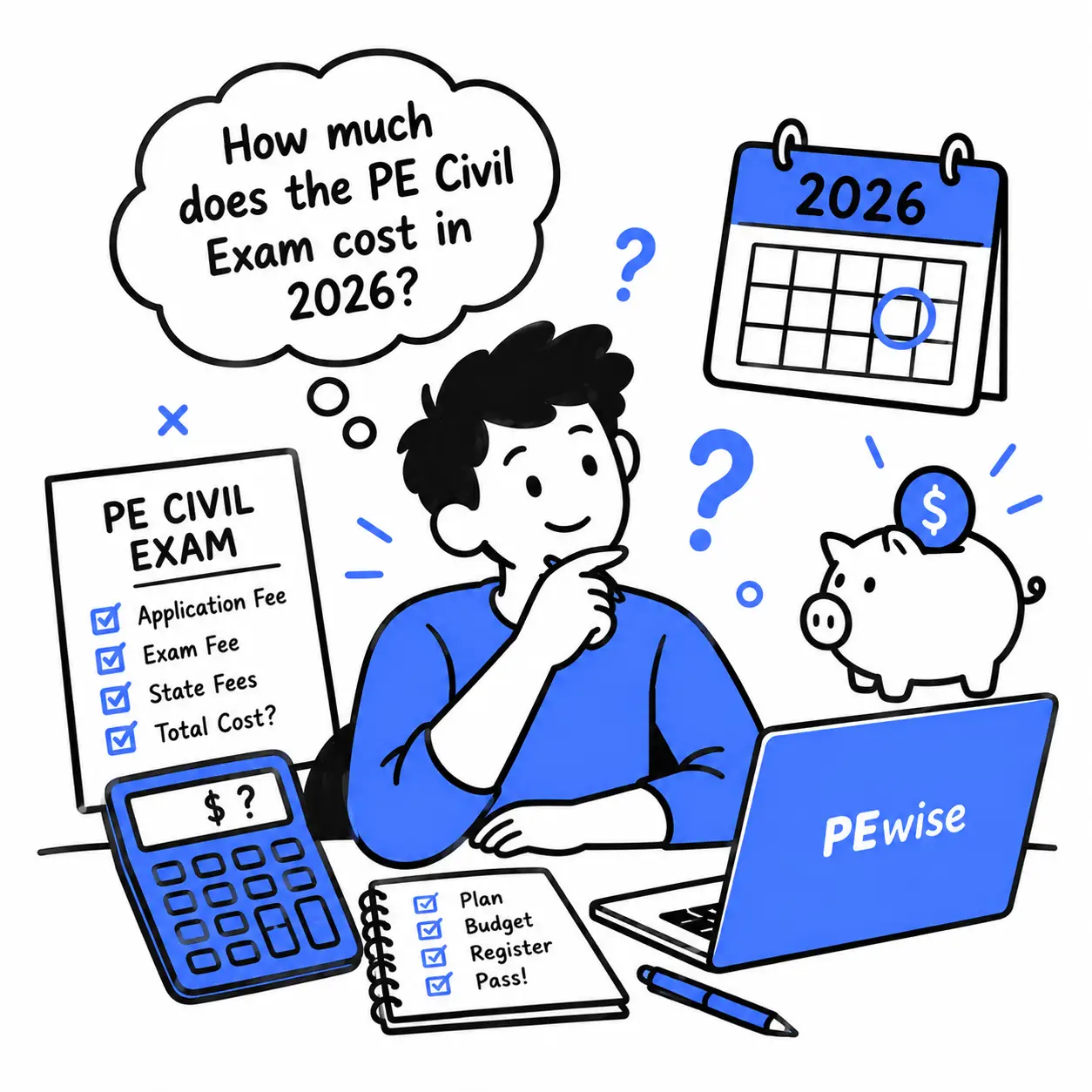
How Much Does the PE Civil Exam Cost in 2026?
The PE Civil exam costs $400 through NCEES, but your total budget may be higher after state fees, preparation, travel, and licensing requirements. Learn the real 2026 costs—including California’s $1,150 minimum subtotal—and how to avoid unnecessary expenses.

PE Civil Exam Study Guide: How to Prepare Step by Step
Build your PE Civil study plan step by step. Learn how to schedule, diagnose weak areas, navigate references, use timed practice, and prepare for exam day with Pewise.

PE Exam and License for International Engineers: U.S. Requirements and Pathways
Comprehensive guide for international engineers seeking PE licensure in the United States. Learn about NCEES credential evaluation, state-specific requirements, and proven strategies for success.