PE Civil Exam Study Guide: How to Prepare Step by Step
Build your PE Civil study plan step by step. Learn how to schedule, diagnose weak areas, navigate references, use timed practice, and prepare for exam day with Pewise.

How this guide was developed: This guide combines current NCEES PE Civil requirements, established learning research, and an editorial study system developed by Mahdi Bahrampouri while building PEwise lessons, practice questions, reference-navigation activities, and solution explanations. The practical observations below come from that instructional-development work; they are not findings from a formal candidate study. The tools are not statistically validated pass predictors. They are frameworks for turning study evidence into next actions.
The best way to study for the PE Civil exam is to start with your exam date, registered discipline, and the specification effective for that appointment. Diagnose your current performance, estimate a realistic workload, and build a sustainable schedule. Then combine focused instruction, independent problem solving, electronic-reference practice, error correction, timed mixed work, and full simulations before making an evidence-based readiness decision.
Use this guide as a four-phase PE Civil exam roadmap:
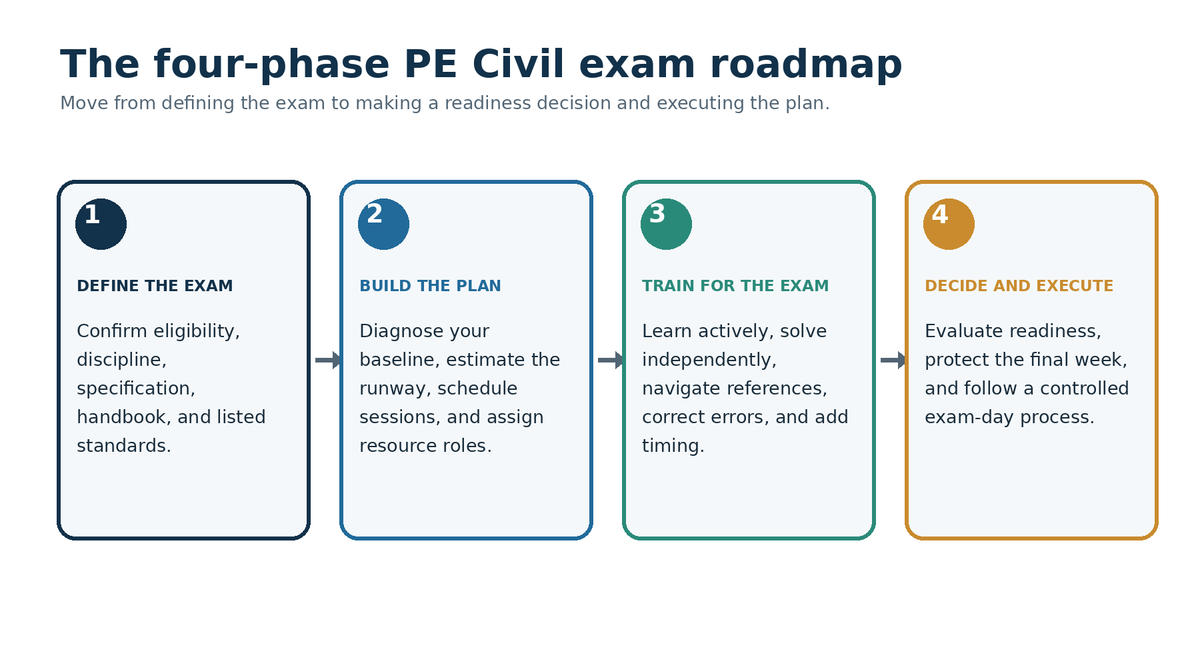
Figure 1. Four-phase PE Civil exam preparation roadmap.
How to Start Preparing for the PE Civil Exam
If you are opening this article because your exam date is beginning to feel uncomfortably real, start here: you do not need to solve your entire preparation problem today. You need to make the next decision with better evidence. First define the scope. Then discover where you stand. Only then should you decide what deserves your limited study time.
That distinction matters because PE candidates often work hard without building exam performance. It is easy to spend an evening watching a clear explanation, highlighting a chapter, or reorganizing a schedule and still have no idea whether you could solve a fresh problem the next day. The PE Civil exam does not require a secret study trick. It requires a control system. Your specification defines the scope; your baseline reveals the gaps; your schedule assigns the work; and your practice results tell you what to change.
By the end of this guide, you will know how to move from the first decision to sit for the exam through the final readiness decision and exam-day execution. You will also have a practical system for deciding what to study, what to do during each session, how to recover from a disrupted week, how to review mistakes, when to add time pressure, and what to change after an unsuccessful attempt. A productive study session should leave evidence behind: a problem solved independently, an error classified, a reference located, or a previously missed problem solved again without help.
Why many PE study plans stop working
Most stalled plans have one of four problems: vague scope, unrealistic weekly capacity, practice without corrective action, or reference practice that begins too late. The roadmap below addresses those problems in the order a PE Civil candidate encounters them. Each step should produce evidence that improves the next decision.
Before you study: confirm eligibility, your PE exam window, and real weekly capacity
Short answer: Before buying resources or building a detailed calendar, verify the exam and licensure process that applies in your jurisdiction, then schedule your PE Civil exam for a realistic available date. CBT appointments may be limited, and a confirmed exam date gives your study plan a clear deadline. Next, decide how many study sessions your work and personal life can actually support.
Exam eligibility and licensure requirements are controlled by state and territorial licensing boards, and the order of application, approval, examination, and experience requirements can differ. This guide does not replace that jurisdiction-specific check. Start with the NCEES member licensing board directory and the current registration information on the official PE Civil page, then identify whether you can register now, whether board approval is required first, and which dates are realistic.
Available CBT appointment dates may be limited, so schedule the exam as soon as you have confirmed your eligibility and identified a realistic testing window. Knowing the exact exam date makes it easier to stay focused, organize the study plan, and measure whether you are on track. When choosing the date, consider major project deadlines, travel, family commitments, predictable busy seasons, and the energy you normally have outside work. A date that assumes every week will be ideal is not a disciplined plan; it is a fragile one.
You do not need a perfect hour estimate at this stage. You need three decisions: the earliest date you are eligible to test, the available appointment date you can realistically commit to, and the calendar windows you can protect for preparation. After scheduling, complete the short baseline diagnostic described in Step 3. It will show where you currently stand and help you adjust the study plan to the time available before your exam.
Step 1 — Choose the right PE Civil discipline
Short answer: Choose Civil: Construction, Civil: Geotechnical, Civil: Structural, Civil: Transportation, or Civil: Water Resources and Environmental by comparing the current specifications with your education, work experience, calculation strengths, and familiarity with the listed references—not by assuming one discipline is universally easier.
The best fit is usually the discipline whose tested decisions and references most closely match what you can learn and apply reliably. Compare the five current specifications side by side. Mark topics you use at work, topics you studied but have not used recently, unfamiliar domains, and standards you already navigate. Then ask which exam gives you the strongest combination of existing knowledge, recoverable gaps, and available preparation resources.
Published pass rates can provide context, but they do not measure your individual fit and should not control the choice. A discipline with a higher aggregate rate may still be a poor match for your experience. If your degree and current role point in different directions—for example, structural education and construction work—sample fresh problems and reference tasks from both candidate disciplines before deciding.
PEwise’s PE Civil disciplines comparison can help organize the decision. The current NCEES specifications remain the controlling source.
Step 2 — Define the exam scope for your appointment
Short answer: Begin with the current NCEES specification for your registered PE Civil discipline. It defines the knowledge areas, approximate question ranges, and listed design standards that control your study scope. Pair it with the handbook in your MyNCEES account and the current NCEES Examinee Guide.
Start with the Civil discipline for which you are registered—not a generic PE study guide, an old breadth/depth outline, or another candidate’s materials. The official NCEES PE Civil page links to separate specifications for Civil: Construction, Civil: Geotechnical, Civil: Structural, Civil: Transportation, and Civil: Water Resources and Environmental.
As of August 2026, NCEES describes PE Civil as a computer-based exam with 80 questions and eight hours of exam time within a nine-hour appointment. Candidates may encounter traditional multiple-choice questions and other item types identified by NCEES. Treat these facts as date-sensitive: confirm the current format, appointment rules, scheduled break, calculator policy, identification requirements, and testing procedures in the NCEES Examinee Guide before your appointment.
Important for 2026–2027 candidates: Candidates testing before April 2027 should use the specification NCEES lists as effective before April 2027. Candidates testing beginning in April 2027 should use the new specification for their discipline. Always match the study plan, practice coverage, and listed standards to the scheduled exam date.
Build a three-part scope packet before studying:
- The current exam specification. Save the effective specification for your registered discipline and exam date.
- The handbook in your MyNCEES account. Use the copy assigned to your exam. Do not rely on an unverified version number from a search result or an old download.
- The listed design standards, if applicable. Use the titles and editions on the current specification.
NCEES states that it provides an electronic reference handbook and all specified design standards during the PE Civil exam. These are the only reference materials candidates may use; personal copies cannot be brought into the exam room. Practice with the handbook available through MyNCEES and the exact standards listed in the effective specification. Verify current testing policies in the NCEES Examinee Guide before test day; do not base preparation on unverified descriptions of the testing interface.
Now convert the specification into a topic inventory. List every knowledge area, its question range, its assigned references, and the subtopics named by NCEES. Do not treat the highest-weight areas as the only material worth studying. Weight helps set priorities; it does not erase the rest of the specification.
Think of this inventory as the table of contents for your preparation—not as a checklist you must study from top to bottom. Add three working columns: resource, baseline evidence, and status. The resource column tells you where instruction and practice will come from. Baseline evidence records what happened when you tried representative problems. Status should describe an action such as not assessed, learning, needs re-solve, or stable in mixed practice. Labels like good and bad are too vague to guide a week of study.
If your exam date crosses a specification change, use the version effective on the date you will test. As of this article’s August 2026 review, the NCEES PE Civil page displays one set of specifications effective before April 2027 and another effective beginning April 2027. That is exactly why an old course outline, forum post, or saved PDF should never be your controlling scope.
The specification defines the exam. It does not reveal your personal starting point. The next step is to test that scope against fresh problems and build a baseline.
Step 3 — Establish your starting point with a diagnostic
Short answer: A PE exam baseline should measure topic knowledge, method selection, reference use, units, pacing, and confidence—not only the number correct. Use fresh problems from across the current specification, then turn each weak or uncertain result into a specific next action.
A baseline is a diagnostic study session, not a pass prediction. Its job is to identify what you recognize, what you can execute, how you use references, and why performance breaks down.
Choose a small but reasonably representative set of problems across the current specification. Avoid reviewing the solutions immediately beforehand. Work with the references you expect to use in preparation, and record more than right or wrong.
Your baseline sheet should capture seven fields for every problem:
Specification topic: the current NCEES knowledge area or subtopic.
Confidence before solving: low, medium, or high.
Result: correct, incorrect, or guessed.
Error category: concept, setup, reference, units, calculation, interpretation, or pacing.
Reference location: the document and section you used or should have used.
Time used: enough detail to identify unusually slow work.
Next action: learn, drill, compare methods, locate a reference, or re-solve.
The confidence column catches false familiarity. A correct answer with low confidence may not be stable. An incorrect answer with high confidence can reveal a misconception that deserves immediate attention. A guessed answer should not be counted as mastered simply because the guess happened to be correct.
Do not make the baseline so large that you postpone studying for a week. Its purpose is directional accuracy, not statistical certainty. A first pass can sample the major knowledge areas and deliberately include unfamiliar material. If the result is noisy, gather more evidence during the first two weeks and update the priority map. Your plan should become more accurate as you work.
Also record where the process broke. Two candidates can miss the same problem for completely different reasons. One may not recognize the governing concept; another may know the concept but search the wrong reference; a third may complete the engineering correctly and lose the answer through units or interpretation. Giving all three candidates the same assignment—“review the chapter”—wastes useful diagnostic information.
While developing PEwise practice questions and support materials, we repeatedly found that the label wrong was too broad to improve the next study session. Separating concept knowledge, method selection, reference navigation, units, calculation, interpretation, and pacing made the intended correction clearer. This is an instructional-design observation, not a measured claim about candidate frequency or pass outcomes.
Next, classify each topic using this PEwise editorial planning framework. It has not been validated as a pass predictor; it simply helps candidates organize four kinds of evidence:
- Specification relevance: How prominent is the topic in the current question range?
- Current weakness: Can you recognize the method and complete it independently?
- Error recurrence: Does the same gap appear across several problems?
- Recoverability: Can focused instruction and practice realistically improve the topic within your available time?
This prevents two common planning mistakes: studying every topic for equal time and spending excessive time on one difficult subject while neglecting several recoverable weaknesses. High-weight, weak, recurring, and recoverable areas usually deserve early attention. Strong topics still need maintenance and mixed review.
Your first priority list should be short enough to act on. Choose a few areas for focused improvement, a few strong areas for maintenance, and one or two uncertain areas that need more diagnosis. Recalculate priorities weekly. A topic that was weak in week one should not continue receiving the same time after it becomes stable, while a recurring reference or setup error should rise in priority even if the topic initially looked familiar.
If you are retaking the PE exam
Follow the same baseline process, but add the official diagnostic information available for your prior attempt. Use it as directional evidence alongside current problem-level results. Do not treat diagnostic bars as percentages correct: NCEES explains that the 0–15 topic score cannot be converted into the number of correct answers and that the comparison bars are not drawn to scale (NCEES sample CBT diagnostic report). Do not assume that the same weaknesses remain unchanged. Your present baseline may confirm the old pattern, reveal a different one, or show that pacing and reference use—not subject knowledge—are now the larger constraints.
The baseline has now defined the work. Use that evidence to estimate a realistic preparation runway before turning it into a weekly calendar.
Step 4 — Estimate your preparation runway
Short answer: There is no universal PE Civil study-hour requirement. Estimate your preparation from the difference between your baseline and the current specification, the amount of concept rebuilding you need, your reference and calculator fluency, and the number of sustainable sessions available before the exam.
Someone whose daily work closely matches the registered discipline may need a different preparation runway from someone several years removed from the relevant coursework. A repeat candidate with strong topic knowledge but weak pacing has a different job from a first-time candidate who needs instruction across several major domains. Do not copy another candidate’s total as though it predicts your result.
Estimate workload in units you can revise: usable weeks, realistic sessions per week, and the work each session must produce. After the first two weeks, compare the plan with actual learning speed, error recurrence, and missed sessions. Lengthen, narrow, or reorganize the plan when the evidence changes. PEwise’s detailed guide to how many hours to study for the PE exam explains this estimation job without presenting one number as a guarantee.
Step 5 — Build a sustainable weekly study schedule
Short answer: Build the schedule from the sessions you can realistically protect, then assign each session a purpose. Reserve time for learning, topic practice, delayed re-solving, mixed sets, simulations, and disrupted weeks. NCEES does not prescribe a universal study-hour total.
A PE exam study plan should be built from capacity, not wishful thinking. Start with your exam date, subtract the final review period and a buffer for disrupted weeks, and count the study sessions you can realistically protect.
Use this planning relationship:
Available study sessions = realistic weekly sessions × usable weeks
Then allocate those sessions across five functions:
- Learning or refreshing concepts.
- Topic-focused problem practice.
- Mixed review and delayed re-solving.
- Timed sets and full simulations.
- Buffer and targeted repair.
There is no NCEES-prescribed number of study hours. Provider totals are recommendations, not official requirements. Your required time depends on the scope of your registered exam, the distance between your baseline and your target performance, the quality of your resources, and the weekly capacity you can sustain.
If you would rather start from an existing calendar, open PEwise's 3-, 6-, and 12-month PE exam study schedule templates linked at the end of the article and choose the structure closest to your available runway. Then adjust the weekly load to match your baseline, work commitments, and actual rate of progress; the template is a starting framework, not proof that one timeline fits everyone.
How do you study for the PE exam while working full time?
Build around repeatable sessions, not an idealized student schedule. Place demanding problem-solving sessions where your energy is most reliable. Use shorter blocks for reference drills, flashcards, error-log review, or re-solving one item. Protect at least one buffer block each week so one late workday does not destroy the entire plan.
For example, a candidate might schedule two focused weekday sessions and one longer weekend block, then keep a shorter flex session available. That is an illustration, not a universal optimum. Someone with rotating shifts, caregiving duties, or extensive travel may need a different rhythm.
Review the plan weekly. Compare scheduled work with completed outputs, recurring errors, and current topic coverage. If you consistently miss sessions, reduce the plan to a sustainable core before adding more. If a topic improves faster than expected, move time to a higher-priority gap. A calendar protects time, but the activity inside each session creates progress.
What should a useful weekly plan contain?
A useful week names outputs, not just subjects. “Study geotechnical engineering” is difficult to evaluate; “review settlement assumptions, solve fresh problems, classify each miss, and re-solve one delayed item” defines completion. Set three levels:
Essential: the minimum work that preserves momentum if the week becomes difficult.
Target: the realistic set of learning, practice, and review tasks you expect to complete.
Optional: extra problems or content to use only after the target work is complete.
This structure prevents one disrupted evening from becoming an abandoned week. Consistency means repeatedly completing the highest-value work your real capacity allows.
Step 6 — Give every study resource a specific job
Short answer: Choose the smallest set of current resources that collectively provides specification coverage, concept instruction, guided examples, independent practice, electronic-reference training, mixed timed work, and useful feedback. Every resource should have a defined job.
More material does not automatically create better coverage. It often creates switching costs, duplicated explanations, and a growing backlog that makes the candidate feel behind. Before buying or adding anything, label what the resource is supposed to do and what gap remains if it is removed.
Check that each resource matches your discipline and the specification effective on your exam date. Confirm that its reference editions are current, that it explains methods rather than only revealing answers, and that you can realistically use it. A strong textbook may still be a poor primary tool for a candidate who will not open it consistently; a clear video course is incomplete if it is not followed by independent practice.
Step 7 — Use a learn–solve–check–re-solve cycle
Short answer: Learn only enough to attempt a related problem, solve without copying, compare your method with trusted feedback, classify the first meaningful error, and re-solve after a delay. This loop turns instruction into observable performance.
A practical PE study method combines instruction with independent performance. Videos, written explanations, textbooks, and worked examples can teach or refresh a method. They become preparation evidence only when you retrieve the idea, select the method, and solve without copying the demonstrated steps.
Use this loop:
Learn. Study a focused concept or worked example. Identify the problem cues, governing relationships, assumptions, and reference locations.
Solve. Close or hide the solution and attempt a related problem independently. Write the setup before checking anything.
Check. Compare the method and result with a trusted solution. Identify the first point at which your reasoning diverged.
Classify. Record the error type and the corrective action. “Be more careful” is not a corrective action.
Re-solve. Return after a delay and solve again without following the old solution.
General learning research supports the use of retrieval and distributed practice for retention. Research also suggests that worked examples can support early skill development, particularly when they are paired with related practice, and that mixing problem types can improve later method selection. These findings come from broader learning research—not trials showing a particular increase in PE exam pass rates—so the application here is a reasoned transfer to engineering preparation (Cepeda et al., 2006; Roediger & Karpicke, 2006; Rohrer & Taylor, 2007; Atkinson et al., 2000).
The same distinction shaped PEwise lesson development: a solution can look obvious after every decision has been revealed, yet the corresponding fresh problem can still be difficult to start. That is why this guide treats an independently chosen setup and a later re-solve as stronger study evidence than recognition while watching or rereading a worked solution. This is a practical design observation, not a PE pass-rate finding.
An illustrative 75-minute study session
10 minutes — retrieve: Write what you remember about the method, governing conditions, and likely reference terms.
15 minutes — learn or check: Review a focused explanation and compare it with your retrieval attempt.
35 minutes — solve: Complete one or more related problems independently, using the assigned references.
10 minutes — classify: Record errors, guesses, reference paths, and next actions.
5 minutes — schedule: Choose when to re-solve the missed or uncertain items.
The exact timing can change. The essential feature is the sequence: recall and independent application must follow instruction. Watching several hours of clear explanations may feel productive, but it cannot reveal whether you can select and execute a method without prompts.
Choose resources by function rather than searching for one format that does everything:
- Resource role
- What it should provide
- How to use it
- Warning sign
- Instruction
- Conceptual explanation and method structure
- Learn or refresh a defined topic
- Consuming content without retrieval or practice
- Worked examples
- Visible expert setup and reasoning
- Study, self-explain, then attempt a related problem
- Copying steps while mistaking recognition for mastery
- Practice
- Independent application with trustworthy feedback
- Diagnose and strengthen performance
- Counting problems without reviewing errors
- Simulation
- Representative mixed work under realistic constraints
- Test pacing, selection, stamina, and reference use
- Treating one score as a guaranteed outcome
No medium is automatically superior for every candidate. The right combination depends on what you need to learn, practice, verify, and simulate.
Should you finish learning every topic before solving problems?
Usually, no. Waiting to finish all content delays the feedback that reveals whether instruction is working. Attempt a related problem after a focused explanation or worked example. Use more instruction for an unfamiliar topic, more varied practice for method-selection errors, reference drills for navigation failures, and timed sets when the main constraint becomes decision speed.
Step 8 — Train with the supplied handbook and design standards
Short answer: For each practice problem, predict the controlling document and likely search term before opening the reference. Then locate the relevant equation, table, or provision, record the path that worked, and apply it. Repeat until document selection and navigation become part of solving.
Reference fluency means more than knowing that a formula or provision exists. You must recognize which document is relevant, choose an effective search term, locate the correct table, equation, or provision, and apply it to the problem.
For PE Civil, NCEES states that the electronic handbook and the design standards identified in the specification are the only references available during the exam. Practice with the handbook assigned through your MyNCEES account and the exact standard editions listed for your exam. Do not build your plan around personal notes, a tabbed binder, or uncontrolled PDFs that will not be available in the testing room. See the NCEES PE Civil exam page for current official reference information.
Use a four-step navigation drill for PE exam prepration:
Identify the document. Decide whether the information belongs in the handbook or a listed design standard.
Predict the search term. Choose the technical noun, equation name, table title, or provision concept most likely to appear in the document.
Locate and record the path. Note the document, chapter or section, and the search term that worked.
Apply the information. Solve the problem and confirm that the provision matches the conditions given.
Memorize enough structure to know where to look; do not try to memorize every equation or code provision. Learn document names, major sections, common terminology, and the cues that distinguish one reference from another. Practice both direct searches and navigation through the document structure, because familiar language in a study resource may not match the wording used in the assigned reference.
PEwise’s guide to PE Civil CBT navigation expands on digital reference practice. Recheck the current NCEES Examinee Guide before the exam because interface details and policies can change.
Building PEwise reference-navigation activities also exposed a recurring design problem: wording that is natural in a lesson is not always the wording used in the assigned handbook or standard. For that reason, PEwise drills record both the first search term and the term or document path that actually worked. This observation explains the workflow; it does not claim a measured navigation-speed improvement.
Reference fluency helps you complete an individual problem. The next step uses an error log to identify why performance breaks down across many problems and what corrective work should follow.
What should you memorize, and what should you learn to locate?
Memorize the document structure, common terminology, and problem cues that tell you where to look. Learn to locate detailed equations, tables, definitions, limits, and code provisions in the assigned materials. Test navigation later with a fresh practice problem, not immediately after watching someone else find the provision. Record the clue, selected document, first search term, successful path, and any misleading term.
Step 9 — Turn every practice result into corrective work
Short answer: Review the first point where your process failed, classify the error, assign a corrective action, and schedule a fresh re-solve. A mistake is not closed because the published solution now makes sense; it is closed only after the corrected process survives delayed and mixed practice.
Do not end problem review with “I understand the solution now.” Understanding someone else’s completed path is not the same as reproducing it later.
For each missed, guessed, or unusually slow problem, identify the earliest meaningful failure. That point determines the corrective action.
| Error type | Evidence | Corrective action |
|---|---|---|
| Concept | The governing principle or condition was unknown | Review the concept, explain it from memory, then solve a related item |
| Setup | The concept was known, but the wrong model, equation, or sequence was chosen | Practice cue recognition and write the setup before calculating |
| Reference | The correct document, term, table, or provision could not be located | Run navigation drills and record the successful path |
| Units | Quantities were inconsistent or converted incorrectly | Add a dimensional check before substitution and at the final answer |
| Calculation | The setup was valid, but arithmetic, sign, or calculator entry failed | Recalculate cleanly and identify the precise operation that failed |
| Interpretation | The number was computed, but the question, condition, or answer format was misread | Restate the requested output and constraints before solving |
| Pacing | Too much time was spent despite adequate knowledge | Practice stopping rules, flagging, and later return in timed sets |
An error-log entry should be specific. For example: “Selected a familiar equation before checking whether the stated condition applied. Next action: write the governing condition beside each candidate equation, then solve two contrast problems.” This is more useful than “careless mistake.”
Schedule the first re-solve after enough delay that you are retrieving the method rather than repeating it from short-term memory. If the problem is solved correctly and confidently, return once more in mixed practice. If the same error recurs, keep the gap open, revise the corrective action, and consider whether the underlying prerequisite is missing.
The purpose of spacing is not to obey a magic interval. It is to require reconstruction after some forgetting has occurred. Your error log should therefore include a next-review date and a status such as open, re-solved once, stable in mixed practice, or recurring.
How should you review a missed PE practice problem?
Preserve your original work, mark the earliest wrong decision, explain the correction without copying the full solution, assign a behavior-changing task, and re-solve from a clean page after a delay. Review guessed and unusually slow correct answers too; they are unstable evidence. When the log grows, group recurring errors by root cause instead of treating every entry as a separate problem.
Once topic-level errors begin to decline, preparation must become more exam-like. The next two steps add decision speed, mixed topics, and realistic simulation without hiding an unstable method behind a timer.
Step 10 — Build speed without sacrificing method accuracy
Short answer: Add time pressure only after the underlying method is reasonably reliable. Diagnose whether time is being lost in question interpretation, method selection, reference searching, calculator entry, unit conversion, excessive checking, or staying too long on an unproductive path.
Speed is not one skill. A slow correct answer can reveal a reference-navigation problem, an unnecessarily long method, or a decision that should become more automatic. Record total time only as a starting point; then identify the step that consumed it. Repeatedly rushing full sets will not fix a specific search or setup delay.
Develop a flag-and-return rule during timed practice. The purpose is not to abandon every difficult question quickly, but to recognize when additional time is no longer producing progress. Some questions will take less than the average and some more, so treat average time per question as a planning reference rather than a rigid cutoff. Practice organizing givens, units, requested output, and likely reference before entering a long calculation.
Step 11 — Progress to timed mixed sets and full simulations
Short answer: Begin with untimed topic work to build a correct process, then mix topics to practice method selection, add time pressure to train decisions and stopping rules, and use full simulations to test coverage, pacing, reference use, stamina, and recovery.
Start new or weak material with enough untimed work to build a correct process. Add time pressure after you can recognize and execute the method with reasonable consistency. Timing a broken method often makes the same error faster; it does not repair the method.
Progress through four phases:
| Phase | Purpose | Timing pressure | Feedback | Move forward when… |
|---|---|---|---|---|
| Topic practice | Build one method and its reference path | Low | Immediate, detailed review | You can solve independently and explain the setup |
| Mixed practice | Select among several methods | Low to moderate | Review after a short set | Method selection is becoming reliable |
| Timed mixed sets | Improve decisions, pacing, and stopping rules | Realistic for the set | Review after completion | Accuracy and pacing are stable across repeated sets |
| Full simulation | Measure coverage, stamina, reference use, and recovery | Match current official logistics as closely as practical | Full post-exam analysis | Results are stable and remaining gaps are manageable |
Mixing is valuable because the real decision is often not “Can I use this equation?” but “Which approach fits this problem?” General mathematics-learning research provides support for interleaving different problem types, but it does not prescribe a universal PE schedule. Increase mixing as your foundational processes become reliable.
Use full simulations to test more than content knowledge. Track when your pace changes, which references slow you down, whether late-session errors increase, how often you guess, and whether you can recover after a difficult item. Follow the current official appointment and break rules for your registered exam when designing the simulation; verify them in the NCEES Examinee Guide rather than copying logistics from an old article.
Third-party practice exams can be useful, but they cannot guarantee item equivalence or predict the NCEES result. Review representativeness against the current specification and use each simulation as a measurement event followed by a plan adjustment—not merely a score-producing event.
When should you begin timed practice?
Begin timing short mixed sets when you can solve the included topics independently often enough that time—not basic method failure—is the next useful constraint. Track method-recognition time, reference-navigation time, and whether you remain on an unproductive item too long. Test stopping and return rules against your performance and current official logistics; do not copy a universal time rule.
After a full simulation, examine topic coverage, question freshness, late-session errors, pacing changes, reference delays, and fatigue—not only the percentage. The review should change the next block of preparation.
Step 12 — Decide whether you are ready using multiple signals
Short answer: Readiness is supported when performance is stable across fresh, specification-aligned mixed work; pacing and reference navigation are controlled; major topics have recent evidence; recurring errors are declining; and stamina holds during realistic simulations. No unofficial score guarantees an NCEES result.
No single third-party practice score proves that you will pass the PE Civil exam. NCEES does not publish the passing score for candidates to use as a readiness cutoff. A sound decision combines several signals observed across representative work.
Use this PEwise editorial readiness scorecard as a qualitative planning tool, not a validated pass predictor:
| Signal | Red — rebuild | Amber — targeted work | Green — stable evidence |
|---|---|---|---|
| Representative accuracy | Results vary widely or depend on familiar items | Adequate in some areas; important gaps remain | Stable across fresh, specification-aligned mixed sets |
| Pacing | Frequent unfinished sets or rushed guessing | Occasional overruns in identifiable topics | Work is usually completed with deliberate stopping decisions |
| Topic coverage | Major specification areas are untested | Most areas touched; a few remain shallow | All major areas have recent performance evidence |
| Reference fluency | Correct documents or provisions are often missed | Common paths are familiar; uncommon searches remain slow | References are selected and navigated reliably |
| Stamina | Performance declines substantially during longer work | Some late-session decline is still visible | Process and attention remain reasonably stable through simulations |
| Error recurrence | The same mistakes repeat without a new response | Recurring errors are limited and actively managed | Previously common errors remain corrected in mixed work |
“Green” does not predict an official result. It means your evidence is stable enough to support the decision, while recognizing that uncertainty remains. “Amber” calls for focused work on named gaps. Multiple “red” signals suggest that the plan, resources, or exam timing deserves reconsideration.
Look for trends across several recent PE study sessions rather than choosing the highest score. Ask:
- Were the problems fresh and reasonably representative of the current specification?
- Did I solve independently with the references available for the exam?
- Are weak topics improving after corrective work?
- Can I maintain sound decisions under time pressure?
- Are guesses and repeated errors becoming less frequent?
Confidence matters, but it is not sufficient evidence. The stronger readiness decision is based on observed performance, documented gaps, and the ability to correct those gaps under increasingly realistic conditions.
What if the evidence is mixed?
Mixed evidence is normal. Name the weakest signal, decide whether it is improving, assign a limited corrective block, and retest it under comparable conditions. If several red signals remain near the appointment, use current NCEES and licensing-board information when weighing additional preparation against changing the date. The scorecard organizes evidence; it does not make the decision.
Step 13 — Protect the final week of PE exam study
Short answer: Use the final week to consolidate known methods, close a limited number of high-value gaps, review recurring errors and reference paths, confirm current logistics, and protect sleep. Do not respond to anxiety by adding a new course, book, or large topic list.
Recheck the appointment details and the current NCEES Examinee Guide. Confirm identification and calculator requirements, travel time, arrival plans, meals, and how you intend to use the scheduled break. Practice with the same permitted calculator you will bring. Policies can change, so current NCEES instructions—not an old forum post or even this article—must control the final check.
Keep technical work purposeful. Re-solve selected error-log items, review frequently used reference locations, and complete limited mixed practice that preserves your process. Avoid a last-minute full rebuild of a weak subject unless your readiness evidence already supports changing the appointment. Tapering study intensity is not lost preparation; it protects the attention and endurance needed to use what you know.
Step 14 — Execute a controlled exam-day process
Short answer: On exam day, use a repeatable decision process: identify the requested output, organize givens and units, choose the method and reference, solve, perform a reasonableness check, and flag the question when further time stops producing progress.
One difficult item should not dictate the rest of the session. Maintain awareness of time without forcing every question into the same minute budget. Answer straightforward questions efficiently, preserve time for uncertain items, and return with a clear note about what remains unresolved. Change an answer only when you can identify a technical reason, not simply because anxiety increased during review.
Use the scheduled break as a genuine reset. Eat, hydrate, and mentally close the first section rather than replaying it.
Retake path: rebuild the process around new evidence
Short answer: A retake plan should not be the old calendar with more hours. Combine the official diagnostic report with a fresh baseline, identify whether the previous process failed in coverage, retention, method selection, reference navigation, pacing, or endurance, and rebuild the plan around those causes.
Begin by separating the emotional result from the diagnostic work. An unsuccessful attempt is meaningful evidence, but it does not show that every resource or every topic was wrong. Retain the parts of the system that produced stable performance and replace only the components that failed to develop the needed skill.
Use the NCEES diagnostic report cautiously. Its topic information is directional and should be compared with your old error log, simulation notes, and fresh problems. Do not convert diagnostic bars into percentages correct. Also guard against inflated retake practice scores caused by remembering previously seen questions. Use fresh or substantially different problems to test whether the method transfers.
Your revised plan should answer five questions: Which specification areas lacked coverage? Which errors recurred? Where did reference or calculator execution slow you down? Did performance decline under mixed or long-session conditions? What new evidence will show that the revised approach is working? The goal is not merely to study harder. It is to produce a different performance pattern.
Choose your preparation route: self-study or a PE review course
Self-study can work for candidates who can assemble current instruction, representative practice, reference training, realistic simulations, and a reliable feedback process. A course may be useful when curriculum assembly, explanation quality, practice availability, accountability, or external structure is a genuine constraint.
| Candidate situation | Self-study implication | Course implication |
|---|---|---|
| You already have current, complete resources and can map them to the specification | Self-study may be efficient | A course may duplicate resources you already have |
| You are unsure what to study or in what order | You will need to build and maintain the map yourself | A discipline-specific curriculum may reduce planning work |
| You repeatedly misunderstand solutions or cannot diagnose errors | Add a trusted feedback source | Guided explanations or support may help close the loop |
| Your plan fails because sessions lack structure | Simplify the plan and add accountability | An organized path may make consistent execution easier |
| Budget is the controlling constraint | Prioritize official documents and carefully selected practice | Compare the cost only against a real need—not fear or marketing urgency |
Once you know your exam scope, weak areas, weekly capacity, and readiness signals, you can decide how to assemble the preparation itself. Self-study can work for candidates who can source current instruction, representative practice, reference training, and realistic simulations. Candidates who want those elements organized in one discipline-specific path may prefer a structured course.
Compare PE Civil preparation for your discipline
Review the PEwise curriculum for your registered discipline alongside the current NCEES PE Civil specification. Open only the path that matches the exam for which you are registered:
For Civil: Geotechnical candidates, compare your topic inventory with the PEwise PE Civil Geotechnical exam prep course to decide whether the curriculum addresses the gaps identified in your baseline.
For Civil: Water Resources and Environmental candidates, review the PEwise PE Civil WRE exam prep course against the current WRE specification and the study-resource roles you still need to fill.
For Civil: Construction candidates, compare the current Construction specification with the PEwise PE Civil Construction exam prep course before deciding whether a structured path would reduce your planning burden.
Every PE Civil candidate should still leave this guide with a useful next step:
| Registered discipline | Best next step |
|---|---|
| Civil: Construction | Compare the current NCEES specification with the PEwise PE Civil Construction curriculum. |
| Civil: Geotechnical | Compare the current NCEES specification with the PEwise PE Civil Geotechnical curriculum. |
| Civil: Water Resources and Environmental | Compare the current NCEES specification with the PEwise PE Civil Water Resources and Environmental curriculum. |
| Civil: Structural | Use the current specification to build the eight-step plan; the PEwise course directory identifies Structural as a future offering and provides an availability notification option. |
| Civil: Transportation | Use the current specification to build the eight-step plan; the PEwise course directory identifies Transportation as a future offering and provides an availability notification option. |
If you are still choosing among the five disciplines, begin with the PE Civil discipline comparison.
Start your PE Civil study plan today
Turn this article into one concrete preparation block:
- Open the current NCEES specification for your registered PE Civil discipline.
- List its knowledge areas, question ranges, handbook, and specified standards.
- Schedule a short baseline session using fresh problems and an error-category sheet.
- Build only the first week of study, including one delayed re-solve and one buffer session.
- If you need to estimate the total commitment first, use PEwise’s guide to how many hours to study. If your capacity is already clear, adapt one of the PE exam study schedule templates. The goal is not a perfect long-range calendar. It is a first week that produces useful evidence and improves the next week’s decisions.
As the appointment approaches, stop expanding the scope. Use the final review period to revisit open error-log items, maintain reference fluency, confirm current test-center rules, and protect sleep and routine. Do not use a blog as the controlling source for what to bring or how the appointment operates; recheck the current NCEES Examinee Guide and your appointment information.
Frequently asked questions
Which PE Civil specification should I use if my exam is in 2027?
Use the specification NCEES lists as effective on your scheduled exam date. As of August 2026, the official PE Civil page separates specifications effective before April 2027 from those effective beginning April 2027. Do not mix topic ranges or design-standard editions from the two sets. If you reschedule across the change date, rebuild the scope packet and audit your resources again.
Should I schedule the PE Civil exam before I start studying?
A scheduled date can create useful urgency, but it should follow an eligibility check and a realistic capacity review. If you are uncertain whether the nearest date is feasible, complete a short baseline first. Then compare the gaps with your usable weeks and weekly sessions. The right order is the one that creates commitment without forcing an obviously fragile calendar.
Can I use AI tools to help me study for the PE Civil exam?
AI can help reorganize a study plan, generate a checklist from information you provide, or offer another explanation of a concept. It can also produce incorrect formulas, invented provisions, wrong editions, or confident but invalid reasoning. Never use AI as the controlling engineering reference. Verify technical content against the handbook assigned in MyNCEES, the listed design standards, current NCEES documents, and trusted instruction.
Should a retaker follow the same preparation process?
Yes, but a retaker should combine a fresh baseline with the official diagnostic information from the prior attempt. The sequence is still scope, diagnosis, planning, practice, correction, simulation, and readiness. The difference is the evidence available. Do not repeat the old schedule automatically, and do not interpret diagnostic bars as percentages correct. Identify what has changed and what still recurs.
Should I study every topic equally?
No. Cover the full current specification, but allocate time according to specification relevance, current weakness, recurring errors, and recoverability. High-weight weak topics usually deserve more attention, while strong topics need periodic maintenance. Do not abandon lower-weight areas entirely; representative mixed practice should continue to test coverage across the specification.
Can I prepare for the PE Civil exam using only free resources?
Possibly, if the available resources collectively provide current scope, accurate instruction, representative problems, assigned-reference practice, simulations, and dependable feedback. “Free” describes price, not completeness or quality. Inventory each resource by function and identify what is missing. If you can close those gaps and sustain the process independently, self-study can be a legitimate route.
Keep Reading
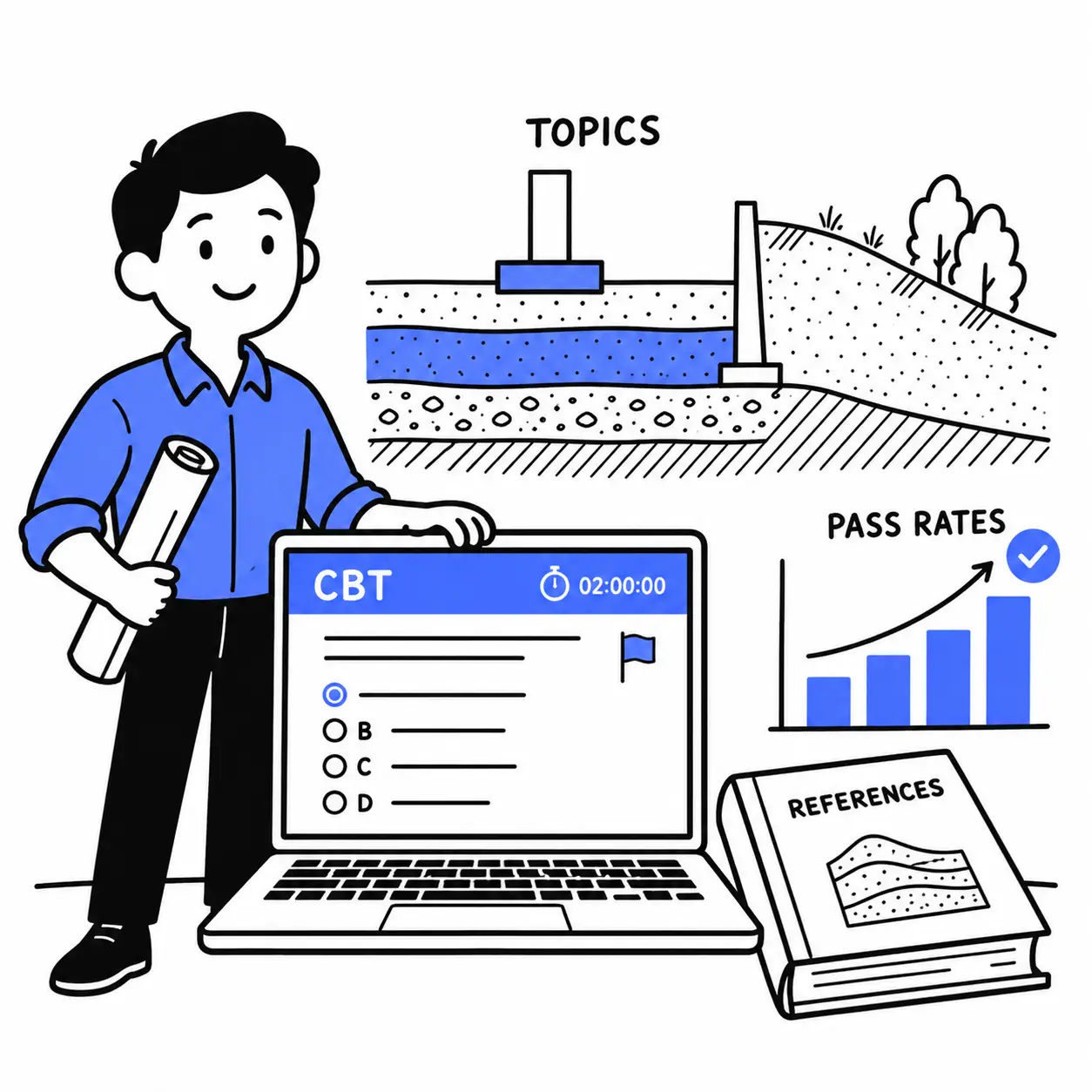
PE Civil Geotechnical Exam Guide Format, Topics, References & Pass Rates
Everything on the PE Geotechnical exam — the 10 NCEES knowledge areas with question counts, CBT format, bundled references, pass rates, and how to study.
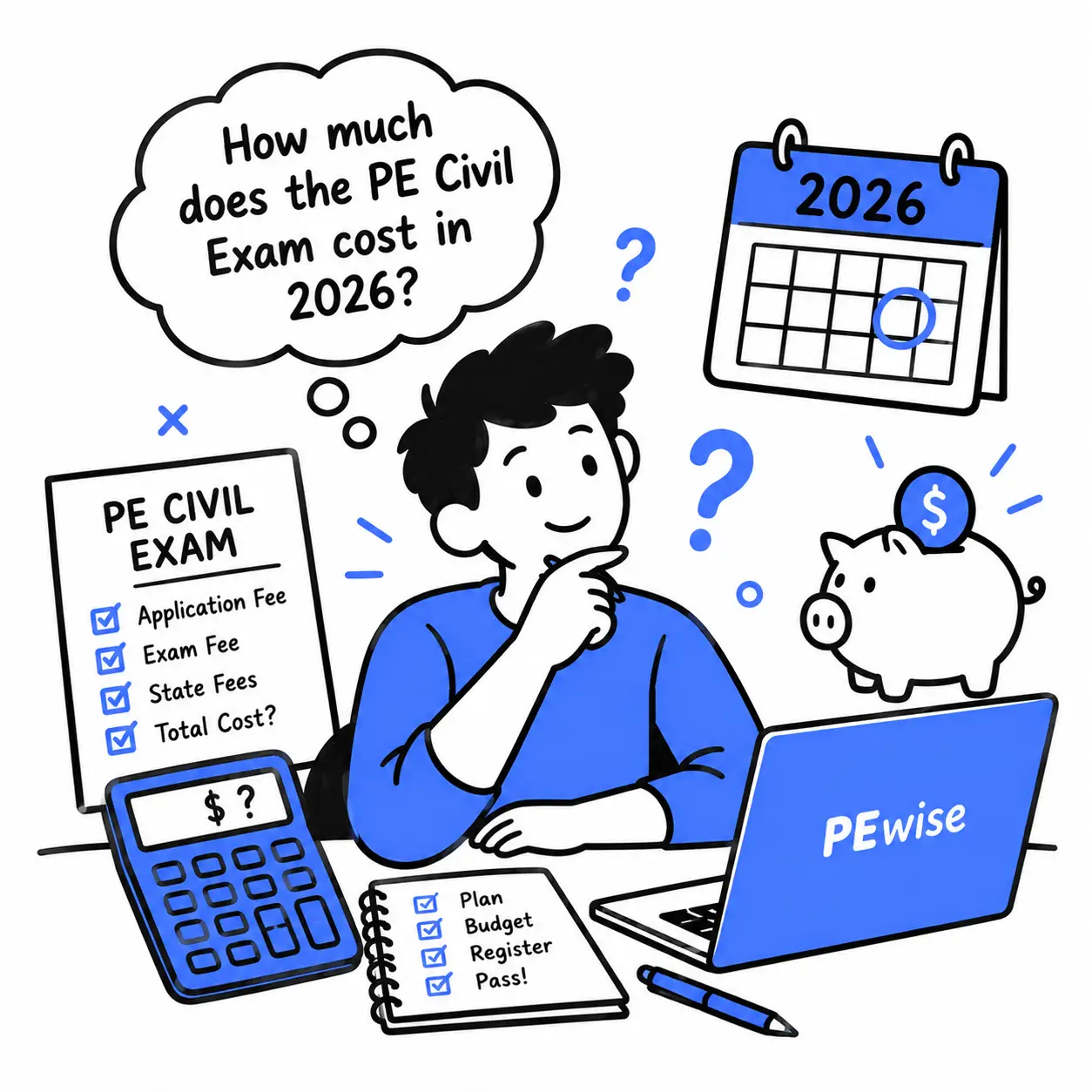
How Much Does the PE Civil Exam Cost in 2026?
The PE Civil exam costs $400 through NCEES, but your total budget may be higher after state fees, preparation, travel, and licensing requirements. Learn the real 2026 costs—including California’s $1,150 minimum subtotal—and how to avoid unnecessary expenses.
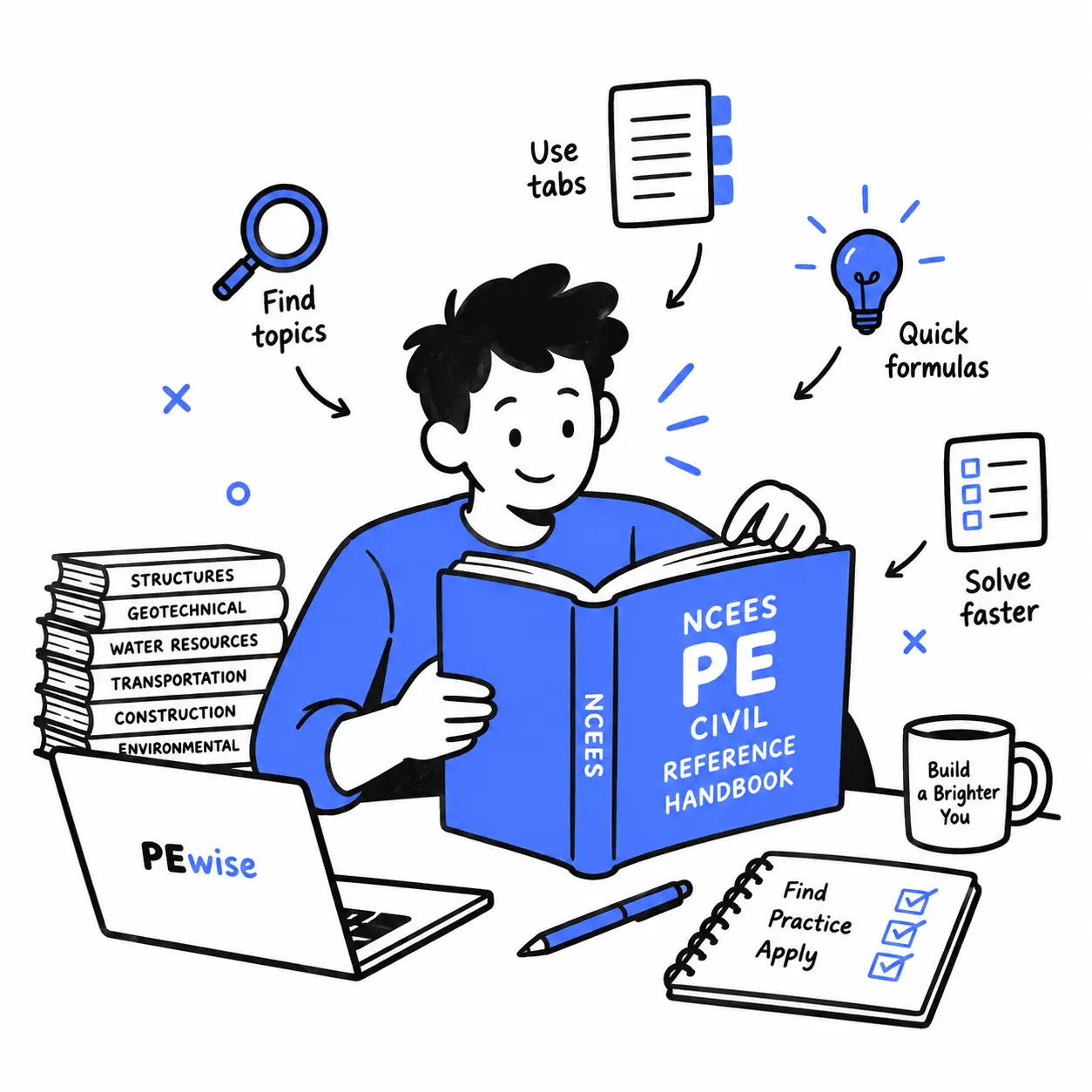
How to Use the NCEES PE Civil Reference Handbook: Search Tips, Study Method, and Traps
The NCEES PE reference handbook is only 75 pages of bare formulas. Learn what's missing, what you need to know cold, and how to navigate it under time pressure.