How to Study for FE Civil While Working Full Time
Build an FE Civil study plan around your work schedule, energy, and exam date. Learn how to use short sessions, prioritize practice, adjust for overtime, and recover missed study time.
To study for FE Civil while working full time, start with the study blocks you can protect in an ordinary workweek. Give each block a specific task, include time to review your answers, and leave room for interruptions. Then adjust the workload using what you actually complete and what fresh practice reveals.
Your schedule needs to account for overtime, commuting, family responsibilities, and the energy you have after work. The right workload depends on those constraints, your starting knowledge, and your exam date.
For your next session, make four decisions: when you will study, what you will work on, what completion looks like, and where the task could move if work interrupts it. That gives you a usable starting point for preparing for the Fundamentals of Engineering (FE) Civil exam.
At PEwise, we combine focused, visual lessons with worked examples, quizzes, and practice exams. Our approach connects learning a concept with attempting problems yourself and using the explanations to decide what needs more work.
Start with the study time your job actually leaves
Look at a representative week before filling a calendar with study sessions. Include work, travel, meals, caregiving, classes, household responsibilities, and rest. Mark potential study blocks in three categories:
| Type of time | Example | How to use it |
|---|---|---|
| Dependable | An evening you can usually protect | Assign a specific study task |
| Uncertain | A lunch break that often gets interrupted | Keep a small optional task ready |
| Unavailable | A commute when you drive or an evening with a regular commitment | Leave it out of your study capacity |
A quiet afternoon at work may occasionally give you extra time. Keep your core plan independent of that possibility unless approved study time is reliably available.
Next, consider the kind of attention each block supports. You may have enough energy to review an earlier mistake after dinner but need a nonwork morning to learn an unfamiliar concept. A block that exists on paper may still be unsuitable for demanding work.
Test your proposed routine during an ordinary week. Record the minutes you used, what you finished, and why anything slipped. If three planned evenings repeatedly become one usable evening, rebuild around that observed capacity.
Count the whole study task. Opening resources, attempting problems, reading explanations, and recording corrections all use time. A session is overfilled if it has room for solving but leaves every missed question waiting for review.
Finally, reserve a recovery opening without assigning it a study task. Give it a day and time, just as you would a regular session. Keep it separate from your scheduled study total so the same time does not serve two commitments. If it remains unused, leave it free rather than treating it as work you failed to complete.
Choose tasks using a diagnostic and your actual pace
Use the FE Civil specification linked from the NCEES FE exam page and check that it applies to your exam date. Your job may keep some subjects familiar while leaving others untouched. The specification gives you a broader coverage checklist than your day-to-day work.
Begin with fresh representative practice across that scope. A small initial sample can help you choose a starting task, but expand it before making large decisions about a subject. One correct answer does not establish mastery, and one miss does not explain every weakness.
When you miss a problem, identify the cause:
| What happened? | A useful next task |
|---|---|
| You could not set up the problem | Review the concept or prerequisite, then attempt a related problem |
| You understood the method but struggled to find the relationship | Practice locating and interpreting the relevant handbook information |
| Units became inconsistent | Trace the units through your solution and check a fresh example |
| Calculator execution slowed you down | Practice that operation separately, then apply it in context |
| You answered a different question from the one asked | Mark the requested quantity and required units before solving |
Combine this evidence with the specification's topic ranges and any prerequisite gaps. Give recurring weaknesses attention while continuing to check previously strong and untested areas.
Make the next task narrow enough to finish. “Study structural engineering” gives you little guidance at the end of a workday. “Review the missed beam setup, attempt fresh related problems, and record any remaining setup error” gives the session a purpose and a stopping point.
Measure several complete solve-and-review cycles before assigning question counts. Use your observed pace to decide what fits into the next available block.
Build a normal workweek and an overtime fallback
Prepare two versions of your week: one for ordinary demands and one for a period when work takes more time or energy.
A normal week with a recovery opening
The following is an illustrative calendar, not a recommendation that five hours per week will meet your preparation needs. Each duration is reserved calendar time, including setup, practice, explanation review, planning, and any short pauses within the block.
| Study block | Normal week | Overtime week | Intended use |
|---|---|---|---|
| Tuesday evening | 45 minutes | 25 minutes | Targeted practice; a smaller review task during overtime |
| Thursday evening | 45 minutes | 25 minutes | Fresh related practice and review; a narrower task during overtime |
| Saturday | 150 minutes | 90 minutes | Concept repair, practice, and explanations |
| Sunday daytime | 60 minutes | 40 minutes | Reattempts and planning the next week |
| Scheduled total | 300 minutes: 5 hours | 180 minutes: 3 hours | Work assigned to available sessions |
| Sunday evening recovery opening | 45 minutes | 30 minutes | Reserved separately; assign a task only if recovery is needed |
Monday, Wednesday, and Friday have no scheduled study in this example. The Sunday evening recovery opening is separate from the Sunday daytime session and excluded from the scheduled total. Optional work-break reviews are also excluded. Set actual start and end times for your own blocks before using this calendar.
Assign tasks to these blocks before the week begins. Keep the demanding work in the session where you can give it enough attention, and use shorter evenings for a bounded practice-and-review cycle.
An overtime week with fewer commitments
The fallback has less capacity, so it needs less assigned work. Select the most useful tasks that fit and identify what will move. Shortening every session while retaining every original task only creates a hidden backlog.
Switch to the fallback when a known deadline, shift change, or field assignment makes the normal calendar unrealistic. If that pattern continues, use the reduced capacity as your planning baseline.
Rotating shifts and unreliable weekends
With changing shifts, anchor sessions to dependable events: before a later shift, after a rest period, or on the next known nonwork day. Assign a clock time once your roster is available.
Keep phone-based review and desk practice separate. A travel day may support a brief review while you are a passenger but offer no dependable place for calculator-and-paper work. Apply the same principle to weekends with family, class, or work commitments.
What to study in a 10-, 25-, or 45-minute session
Choose a task that can reach a useful stopping point within the time available. You do not need the same activity in every session.
Ten minutes: review one identifiable gap
Use a short break to revisit a recorded mistake, check a unit conversion, or find a handbook relationship and explain what its variables mean.
For example, open one units error from your log. Cover the solution, explain where the inconsistency began, and write the check you will use next time. The result is a correction you can apply during later practice.
Use legitimate breaks or approved study time while stationary; keep study away from driving and active field duties.
Twenty-five minutes: complete a small practice-and-review cycle
Try this illustrative allocation:
- 3 minutes: Open the selected task and recall the relevant method.
- 12 minutes: Attempt focused practice.
- 8 minutes: Review the attempt and identify any error.
- 2 minutes: Record the next action.
The number of problems depends on their difficulty and your current understanding. An unfamiliar problem may use the entire practice portion. These allocations are starting estimates: if the explanation needs more time, reduce the next session's question count or schedule the unfinished review explicitly.
Forty-five minutes: connect practice with correction
One possible structure is five minutes of setup and recall, twenty minutes of practice, fifteen minutes of explanation review, and five minutes to record what comes next.
If you cannot finish, leave a precise restart note: “The setup is complete; check the conversion before continuing.” That makes the next session easier to begin.
Keep learning sessions and timed checks distinct. New material may need untimed work and explanation review. Timed practice answers a different question: can you select and execute a method within the allotted time?
Short sessions can contribute useful work, while longer protected sessions let you assess sustained concentration and pacing. Include both where your preparation needs them.
How to study after work when your energy is low
Before an evening session, choose the level of work you can reasonably handle.
| Your available attention | A practical choice |
|---|---|
| You can concentrate on unfamiliar work | Attempt the planned lesson or targeted practice |
| You can focus briefly on familiar material | Review a known error, reattempt an earlier problem, or practice a handbook lookup |
| You cannot follow the task reliably | Rest and assign the priority work to a real recovery opening |
A lighter task can keep you connected to your preparation. Record the original task as unfinished if it still needs attention, and count the lighter task within that evening's available time. Re-estimate the unfinished work before assigning it to a recovery opening; use the recovery steps below if it will not fit.
Reduce the effort of starting by selecting the resource and task in advance. “Open the saved set and work on the setup errors” is easier to act on than deciding which subject, video, and book to use after a long day.
Watch for a repeating pattern. If evening practice keeps failing, test another feasible block or reduce the number of evening commitments. Protect sleep when considering early-morning study. Working students should also plan around class deadlines and exams.
Keep the cause of a missed session specific. “Unexpected site visit” suggests a scheduling adjustment. “Could not begin without rereading the lesson” suggests the task needs a smaller first step. Those observations give you something to change.
How to recover after missing FE Civil study sessions
When a session is missed, decide what still needs to happen before moving it. Copying every unfinished task into the next available evening can overload that session before it starts.
Use this sequence:
List the unfinished tasks.
Re-estimate the work that remains, including review.
Remove activities that repeat work without addressing a remaining gap.
Assign priority tasks to actual openings.
Record what is deferred or displaced.
A worked recovery example
Suppose you miss both 45-minute weekday sessions in the normal-week calendar. You have 90 minutes of missed planned work. The weekend already contains its own tasks, but the separate 45-minute recovery opening remains available.
For this example, assume the two missed sessions contained 30 minutes of planned video rewatching and 60 minutes of targeted practice, explanation review, and setup. Fresh attempts completed before the disruption show that the rewatching would repeat material you can already apply. You remove that activity and retain the other 60 minutes. Schedule the first 45 minutes in the separate Sunday evening recovery opening.
| Recovery decision | Minutes |
|---|---|
| Original missed work | 90 |
| Remove redundant rewatching | −30 |
| Priority work remaining | 60 |
| Use the recovery opening | −45 |
| Work still needing a place | 15 |
Put those remaining 15 minutes into next week's calendar by replacing 15 minutes of optional repeat practice that your recent results show you can omit. Record that decision. Required work that still addresses a gap must stay in your workload estimate; replacing it would move the backlog rather than clear it.
This example changes the task mix; it does not show that every missed workload can shrink. If fresh attempts reveal that you still need the explanation, retain it and revise the estimate.
When the recovery opening is unavailable
Choose an explicit tradeoff: replace a lower-priority task, secure another specific opening, or reassess the timeline. Keeping every task without assigning enough time leaves the conflict unresolved.
For a missed week, rebuild from your current position. Check which topics still need repair and how much time remains. If interruptions recur, plan around the capacity you now have rather than the week you originally expected.
Choose FE Civil resources that fit your work schedule
A useful resource must support the work you need and fit the sessions you can attend. Compare formats before comparing the size of their content libraries.
Self-paced course, live instruction, or practice-first study?
| Your situation | Format to consider | Check before committing |
|---|---|---|
| Variable overtime or rotating shifts | Self-paced instruction | Can you stop at a useful point and resume easily? |
| Predictable availability and a need for accountability | Live instruction | Can you attend and allow separate practice-and-review time? |
| Familiar concepts but weak execution | Practice resource with worked explanations | Can you select relevant problems and investigate mistakes? |
| Significant gaps since coursework | Structured instruction alongside practice | Does a sample explanation help you repair an actual gap? |
| Limited budget | Free official handbook plus selected practice and instruction | Which identified need does each purchase address? |
When comparing resources, check access terms and whether any included planning tools can accommodate your work schedule. Keep your own weekly plan even if a resource supplies a suggested sequence.
Test a sample against your calendar. Suppose a hypothetical resource requires a 35-minute lesson followed by 25 minutes of practice and review. That is 60 minutes before any additional setup or pauses. A 45-minute evening leaves at least 15 minutes without an assigned slot.
Check whether the lesson can be divided meaningfully, place part of the work in another available session, or choose a more suitable format. Include the access period, renewal terms, and help available when you get stuck in your decision. We have a separate article on FE Civil Course or Self Study where you can explore this topic deeply.
How PEwise connects visual lessons with independent practice
Our FE Civil course teaches individual concepts through focused, visual lessons. Worked examples present the problem separately from its solution, giving you an opportunity to attempt it before watching the explanation. Quizzes include explained answers, and practice-exam results show your performance by knowledge area.
Use that structure to give a study block a clear purpose:
Review the concept. Choose a lesson that addresses a gap in your recent work.
Attempt the example. Set up and solve the problem yourself before opening its solution.
Compare the reasoning. Identify where your method, reference use, units, or calculation differed.
Choose the follow-up. Revisit a specific explanation or attempt fresh practice to check the correction.
Let your measured pace determine whether this cycle fits one session or needs several. Focused videos are one part of the workload; independent solving and review still need calendar time. Use practice-exam feedback to choose a starting point for further investigation, alongside fresh questions and your error log.
Apps and practice books for short sessions
For mobile practice, look for FE Civil coverage, readable solutions, marked questions, and a way to revisit mistakes. Check your device and whether an internet connection is required.
If you switch between a computer and a phone, check whether your progress, saved questions, and review notes remain available on both. Test the features you need before relying on the app for short work-break sessions.
For a practice book, inspect a sample solution, the edition, alignment with the relevant FE Civil specification, and available errata. Choose material you can divide into manageable tasks. A large problem count alone does not tell you how easily you can learn from an error. Resources labeled PE Civil prepare for a different exam; check that the material addresses FE Civil.
Use the free NCEES handbook before buying extras
You do not need a subscription to obtain the official FE Reference Handbook. NCEES provides a free copy through MyNCEES. Paid courses, question banks, and study guides are separate resources.
Use the handbook alongside practice to learn where relevant information is located and how to interpret it. Build your purchases around gaps you have identified. If cost is a constraint, check employer reimbursement before paying; the available support depends on your employer's policy.
Check progress against your exam date
During your weekly review, compare what you planned with what you completed. Check outcomes as well as minutes: whether recurring errors changed, whether fresh problems became more manageable, and which topics remain untested.
Keep a brief record you can update quickly:
| Session | Planned task and completion condition | Actual result and next action |
|---|---|---|
| Example: Tuesday, 45 minutes | Review a missed beam setup; attempt fresh related practice and inspect errors | 40 minutes used; setup improved, units error remains; assign a units check within Thursday's block |
| Your next session: ___ | Task: ___; finished when: ___ | Minutes used: ___; result: ___; next action: ___ |
Above the table, record your exam date or provisional window, known busy periods, and next review date. Below it, record the recovery opening and any deferred work.
Check whether the remaining work fits
Add the reserved calendar time across the actual weeks ahead. List recovery openings separately. Estimate remaining topic repair, fresh practice and review, handbook/calculator work, and extended practice without counting activities twice. Use the same basis on both sides: include setup, transitions, and any needed pauses in your workload estimate, just as they are included in your calendar blocks.
For an illustrative six-week period:
- Four normal weeks × 300 minutes = 1,200 minutes.
- Two overtime weeks × 180 minutes = 360 minutes.
- Total scheduled capacity = 1,560 minutes, or 26 hours.
Suppose your remaining task inventory, estimated from your own sessions and including those overheads, totals 1,800 calendar minutes, or 30 hours. You have a visible 240-minute, four-hour gap. That estimate describes this example's remaining work; it is not a total preparation requirement. The recovery openings remain a contingency and have not been used to erase the gap.
Check for redundant tasks, seek specific additional openings, or consider a later date if scheduling permits. Update the calculation as you learn more. Fitting the estimated work into the available time is a planning check; fresh practice still needs to show whether you are making progress. If the date must remain fixed, prioritize deliberately and record the gaps that remain.
Protect a longer practice window
The FE exam contains 110 questions with 5 hours 20 minutes for answering them, according to NCEES. The scheduled 25-minute break is separate from that answering time. For a full-length practice session, reserve enough calendar time for setup, timed solving, and the scheduled break; assign explanation review its own time afterward or in a later session.
Solving and the scheduled break together require 345 minutes before setup or review, exceeding the sample week's 300-minute scheduled total. Its longest block is also only 150 minutes. Make a different calendar for a simulation week: secure a sufficiently long opening and revise the other commitments, then recalculate the time required. Moving the existing sessions around cannot by itself create the additional time.
Check the length of the practice resource you use. The NCEES FE Civil Interactive Practice Exam Vol. 1 contains 50 questions, so it is a partial-length practice product. Dividing practice across evenings can help you complete and review it, but does not assess concentration across a full exam-length session.
Judge progress using fresh questions, breadth of coverage, timing, and unresolved errors. NCEES does not publish a passing score, so a practice percentage should not be treated as an official cutoff. If you are considering changing your appointment, check the current NCEES Examinee Guide and available appointments early enough to act.
Frequently asked questions
How many hours a week should I study for FE Civil while working full time?
Start with the blocks you can protect, then compare their capacity with your remaining learning needs. Use a trial week and fresh practice to refine both estimates. Your background, topic gaps, work demands, and exam date determine the workload you need to assess.
Can I prepare if I can study only on weekends?
Build around the weekends that are genuinely available and give each block a defined task. Allow for interruptions and the gap between sessions. A brief weekday review may help you reconnect with earlier work when feasible, but keep it optional if your weekdays cannot support it.
Should I study before work or after work?
Choose the setting that consistently supports the task. Test comparable work in each feasible block and record what you complete. Use the more dependable period for demanding learning while protecting sleep and other obligations.
What should I do if I miss a week of studying?
Re-estimate unfinished tasks and the calendar remaining. Rebuild the next week around priority work, identifying anything you remove, replace, or defer. Check whether the interruption changes the feasibility of your exam timeline.
Does working in civil engineering reduce how much I need to study?
Your experience may help with familiar applications. Use the full FE Civil specification and fresh practice to check areas outside your usual work. Reduce review where your results support that decision, while continuing to sample those areas later.
Your next step: commit to one workable study week
Before adding more material to your preparation, make sure you can answer these questions:
- When is my next protected session?
- Which task fits that session, including review?
- What result will show that I completed it?
- What changes if this becomes an overtime week?
- Where could a missed priority task move, and what would be deferred?
- Have I allowed for any longer practice session I still need?
Explore the PEwise FE Civil course sequence and free preview. Choose the next relevant lesson or practice task and put it into the first protected block. At the end of the week, use the results to decide what belongs in the next one.
Keep Reading
FE Civil Study Plan: 8, 12 and 16-Week Schedules
Build an FE Civil study plan for 8, 12 or 16 weeks based on your starting knowledge and exam date. Learn how to organize topic reviews, practice problems and timed exams, with checkpoints to adjust your preparation as you progress.
FE Civil Preparation Cost: Build a Realistic Budget
Compare FE Civil prep course costs, access periods, and included resources to build a study budget that fits your needs. Explore teaching and practice options, account for optional books and extensions, and avoid paying for resources you already have.
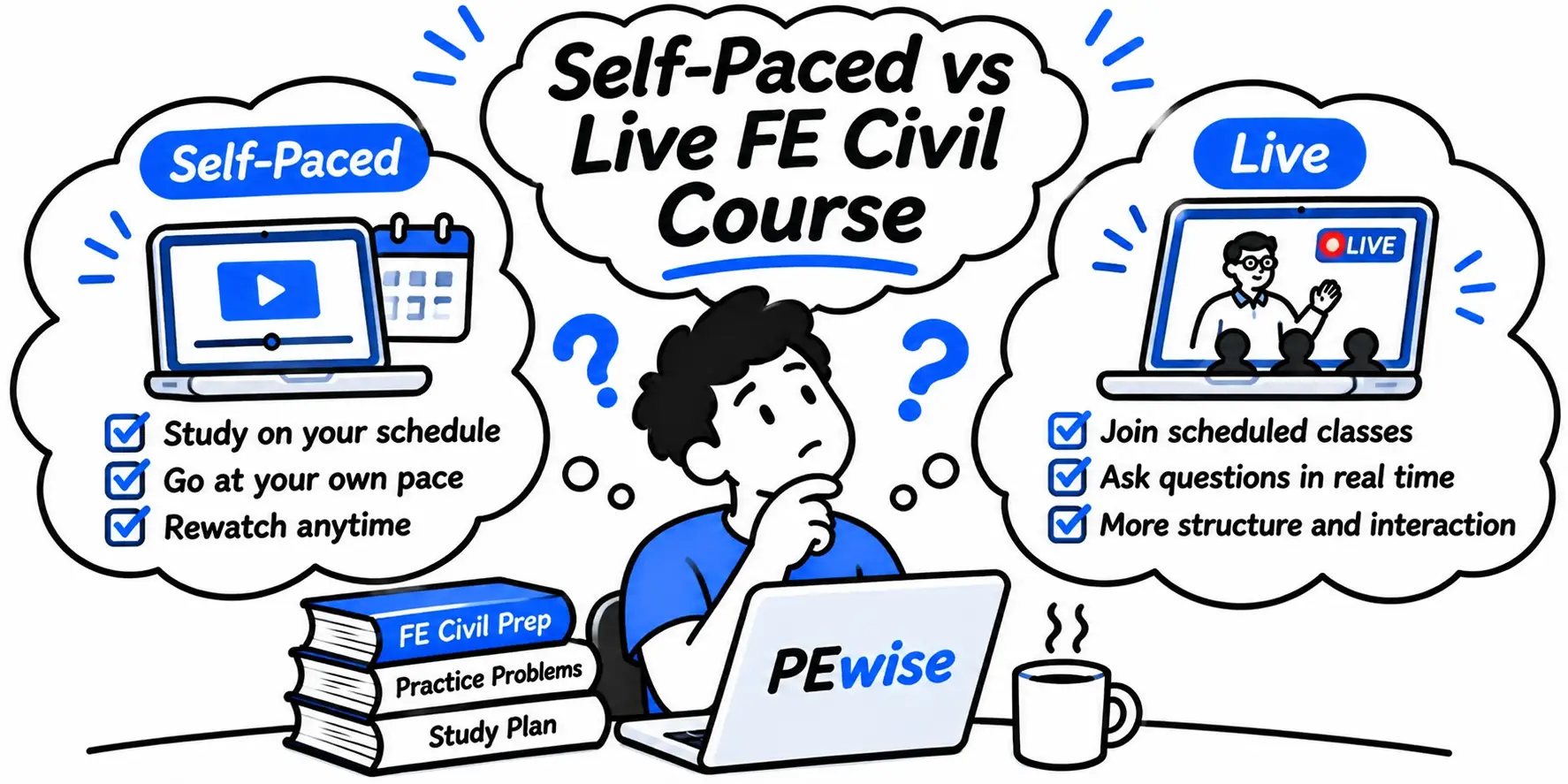
FE Civil Course Formats: Self-Paced, Live Online or In Person
Choosing an FE Civil course means finding a format you can use consistently. Compare self-paced, live online and in-person preparation by study schedule, instructor support, missed-class options and total cost through exam day—then decide which approach fits your working week.