Why You Miss PE Practice Questions
Understanding a solution does not mean you have fixed the mistake. Discover what PEwise practice-exam data reveals about repeat misses, how to identify the cause of each error, and what to study before testing your progress on fresh questions.
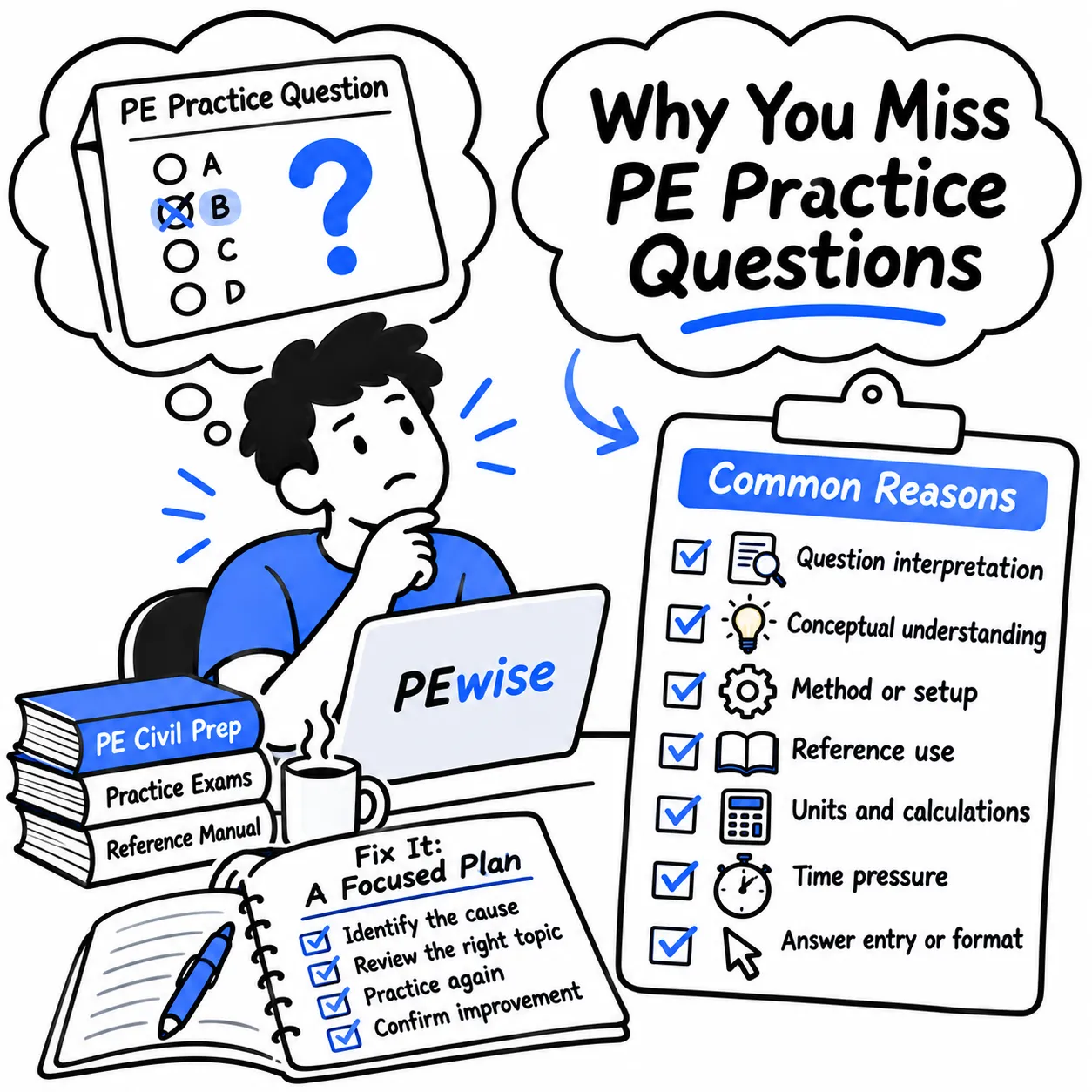
You finish a practice set, open the solutions, and think, “I knew how to do that.” Then a similar question trips you up again.
That is the usual outcome. When PEwise students retook the same practice exam, typically about a week later, they missed 43% of the questions they had missed the first time. In three out of four of those repeat misses on single-choice questions, they picked the same wrong answer.
Reading a solution does not fix the mistake that produced the wrong answer. PE practice questions go wrong because of interpretation, concepts, setup, reference use, units, calculation, pacing, or answer entry, and each calls for a different correction.
A useful review ends with a specific assignment: what to study, why it addresses the mistake, and how you will check it on a new question.
What PEwise practice-exam data shows
We looked at how PEwise students answered on full-length practice exams. These are observations from our own students, not statistics for all PE candidates, and the data records which answer was chosen, not why. Three patterns stand out.
The question format changes how often people miss.
| Question type | Share of answers that were wrong |
|---|---|
| Single-choice | 23% |
| Multi-select (“select all that apply”) | 57% |
| Fill-in number | 49% |
| Drag-and-drop | 24% |
| Point-and-click | 12% |
Multi-select questions were missed more than twice as often as single-choice questions. About two-thirds of the wrong multi-select answers had only one kind of error: a correct option left out, or a wrong option added. These questions are scored all-or-nothing in PEwise practice exams, so a nearly right answer earns nothing. Treat each option as its own true-or-false statement and decide on it separately.
Fill-in questions were missed about half the time. With no options on screen, nothing tells you that your number is off. About one in seven wrong fill-in answers was within 5% of the correct value, which points to early rounding more than to a wrong method.
Wrong answers are not random. On a typical single-choice question, one wrong option drew about 60% of all the misses. Most students who miss a question miss it the same way, which means the cause can usually be named.
Misses cluster by topic. In a typical attempt, students missed 30% of questions overall, but 58% in their weakest knowledge area and none in their strongest.
How to find out why you missed a PE practice
Two missed questions in the same topic do not necessarily reveal the same weakness. Start with your own work before deciding what to review.
Preserve what you were thinking
Before opening the solution, record the quantity you thought you needed, your intended method, references searched, and where you stalled. Mark guesses and hints, too.
You do not need a transcript. A short note such as “understood the method, but could not identify the governing document” preserves evidence that the final answer alone cannot provide.
Find the first meaningful mismatch
Compare your attempt with a verified solution. Check the requested quantity, assumptions, setup, references, units, calculation, and final response.
Locate where your reasoning first became unsupported. A different valid method is not a mistake, and the first visible mismatch is only the starting point for diagnosis.
Ask what caused that mismatch
“Used the wrong equation” describes what happened. Why did you choose it? Did you misunderstand a condition, confuse two methods, or search an unsuitable reference?
Look at which wrong answer you chose. Since most students who miss a question land on the same wrong option, that option usually corresponds to one specific slip, such as a skipped conversion or the wrong requested quantity.
Choose a working diagnosis and a matching study activity. When the evidence is unclear, record “uncertain” and gather another independent attempt. This is a practical study framework, not an official NCEES classification.
PE practice mistake types and what to study for each
Use this table to choose an initial correction, then use the distinctions below to check your diagnosis.
| Suspected mistake | What to study or practice | How to check improvement |
|---|---|---|
| Question interpretation | Identifying the requested quantity, conditions, and output units | Restate the task accurately on differently worded questions |
| Conceptual understanding | The governing principle or missing prerequisite | Explain and apply it in a new context |
| Method selection or setup | Applicability conditions, assumptions, and solution sequence | Justify the setup on an unlabeled new problem |
| Reference selection or navigation | Choosing the governing source and finding the relevant provision | Locate and apply it without a location hint |
| Units and quantities | Dimensional consistency and the specific conversion gap | Maintain consistent units through a different problem |
| Calculation or calculator execution | The failed operation, entry sequence, or calculator setting | Complete a changed calculation and check plausibility |
| Pacing or question-selection decisions | The source of delay and decisions to continue, flag, or return | Make workable decisions in fresh timed sets |
| Answer completion or entry | Response instructions and transfer of the final result | Submit the requested response accurately on a new item |
1. You answered a different question
Your calculations may be sound while the result answers the wrong task: the question asks for the factored load and you report the service load, or it asks for the minimum and you report the first value you found.
Practice stating the target and its units before starting. This matters most on “select all that apply” questions, the most-missed format in our data, where every option is a separate question. Rewatching a technical lesson adds little if interpretation is the actual gap.
2. You do not understand the governing concept
A conceptual gap shows when you cannot explain why a relationship applies, even after locating it. An example is finding the consolidation settlement relationship but not being able to say why the drainage path matters.
Return to the specific principle or prerequisite that blocks you. Then explain the reasoning without borrowing the solution’s wording and apply it to a fresh question. Recognizing a familiar equation is only part of that check.
3. You know the concepts but choose the wrong setup
You may understand individual principles yet struggle to decide which model, assumptions, or sequence fits, such as using a drained analysis when the question describes rapid loading on clay.
Compare the conditions that distinguish plausible methods. Before calculating, write why your chosen approach applies. If you cannot explain those conditions, conceptual review may also be needed.
4. You struggle with the reference
Separate choosing the source from searching within it. Knowing search terms will not help if you are searching the Handbook for a requirement that lives in a design standard.
For PE Civil, NCEES supplies the Reference Handbook and the design standards listed for the exam. Use the specification and standards applicable to your exam date.
Practice identifying the document, locating the provision, and reading its conditions or notes. Test the whole process on a different question.
5. Units or quantities break the solution
First check whether the problem is a conversion slip or a misunderstanding of the quantity itself, such as confusing a unit weight with a pressure. Those require different corrections.
Keep units attached to quantities through the setup and identify exactly where consistency was lost. Fill-in questions punish this most: with no answer options to compare against, half of our students’ fill-in answers were wrong. Practice the conversion, then check it in a problem where the given and requested units differ. Reworking the same question from recall will not test the correction.
6. The setup is correct but execution fails
Trace the operation that changed valid work into an incorrect result. Possibilities include transcription, parentheses, signs, arithmetic, early rounding, or calculator settings.
In our data, single-choice questions with numeric answers were missed more often than those with worded answers (29% against 21%). Rehearse the failed operation with changed inputs and add a reasonableness check. Replace “careless mistake” with the behavior you observed. A repeated failure deserves a targeted routine.
7. You lose too much time
Find where the time went. Repeated searches, uncertain setup, and slow calculations each need their own practice.
Our students’ miss rate was no higher in the last quarter of an exam than in the first (26% against 27%), so tiredness late in the exam is a weak explanation for wrong answers. If the technical process is sound, examine whether you continued too long without a usable plan, and practice flagging and returning during timed sets.
8. Your final response does not match your work
Check whether you transferred the result correctly and completed the requested response.
Practice a short final comparison: requested quantity, required units, response instructions, and selected or entered answer. On multi-select questions, count how many options the question asks for before you submit. One question can involve several problems without becoming several separate misses in your log.
Should you review one topic or fix a habit across topics?
After reviewing individual questions, compare the patterns. Our students’ misses were concentrated: the weakest knowledge area in a typical attempt had about twice the overall miss rate. A topic report tells you where to investigate, and your attempts explain what needs work.
| Pattern across attempts | Next study decision |
|---|---|
| Conceptual or setup failures cluster in one knowledge area | Review the specific topic or prerequisite, then attempt varied problems |
| Similar unit, entry, or navigation problems recur across different areas | Practice the recurring skill across several topics |
| One topic contains several different mistake types | Separate the subtopics and causes before assigning more review |
| Errors occur mainly under time pressure | Inspect where time is spent and compare fresh tasks under different conditions |
| Evidence is sparse, inconsistent, or based on remembered solutions | Gather another independent attempt before assigning broad remediation |
You may need both topic instruction and a routine that applies across topics. A reference-selection difficulty could recur across several areas while a separate conceptual gap stays in one.
Prioritize repeated, well-supported gaps alongside their relevance to the exam specification. Once you have chosen the correction, place it in your PE study plan as a specific task.
What to record in a PE practice error log
Keep enough detail to make the next session useful:
- Source and topic: Question ID, source, and specification topic or subtopic.
- Question type: Single-choice, multi-select, fill-in, drag-and-drop, or point-and-click.
- Original attempt: Result, the wrong answer you chose, guesses, hints, and relevant time observations.
- Observed breakdown: The first mismatch or point where you stalled.
- Working diagnosis: Main suspected cause, contributors, and how certain you are.
- Correction: The activity to practice and reference location, when relevant.
- Verification: What a fresh question should test.
- Follow-up: What happened and what you will do next.
An illustrative entry could read:
I understood the method but searched an unrelated document. My working diagnosis is reference selection. I will identify the governing source and rehearse the search path, then locate and apply the provision on a different question without a location hint.
This gives the next session a purpose. “Study the chapter again” leaves the decision unfinished.
How to check whether you have fixed the mistake
Start by closing the solution and rebuilding the reasoning. This exposes steps that still depend on the explanation.
Next, attempt a fresh question that tests the same skill. Change more than the numbers: use different wording, conditions, or method-selection demands. Retaking the same question is a weak check. Our students still missed 43% of their earlier misses on a retake, and a question you now get right may only be one you remember.
Finally, return to the skill after a gap in mixed practice. Can you recognize the need for it when the topic or method is not announced?
Look for evidence tied to your correction: independent setup, justified assumptions, correct reference choice, consistent units, accurate execution, or workable pacing. A higher total score alone does not show that a specific correction worked.
If the same problem returns, revisit the diagnosis. You may have practiced the wrong correction or addressed only part of the gap. For the broader review cycle, see how to use PE practice exams.
What if the practice solution seems wrong?
Check the question wording, assumptions, units, reference source, and applicable edition before deciding either method is incorrect.
For official practice materials, consult the NCEES exam-prep errata. For other materials, check the publisher’s corrections or request clarification.
If the discrepancy remains unresolved, mark the item separately and keep your reasoning. Do not force it into one of the mistake types above.
Choose PEwise support around the gap you found
Finding the best PE exam prep course for your needs starts with understanding where you need help. Explore PEwise’s course options for your discipline when you need instruction, and its PE Civil practice exams when you need to assess your work. The practice exams include all five question types above, so you can practice multi-select and fill-in questions before exam day.
Common questions about PE practice mistakes
Why can I understand the solution but still fail a new question?
Following an explained path and choosing that path independently involve different demands. In PEwise practice-exam data, students who had already seen the solution still missed 43% of the same questions on a retake. On a fresh problem, check whether you can interpret the task, select the method, and explain the conditions. The point where you stall gives you something specific to work on.
Should I rewatch the lesson or solve more practice problems?
Return to targeted instruction when you cannot explain a principle or prerequisite. Use method comparison when selection is the issue. For navigation, units, calculator execution, or pacing difficulties, practice that activity directly. More questions help most when you know what you are trying to improve.
Should I review questions I answered correctly?
Review correct answers involving guesses, hints, unexplained reasoning, or excessive time. A correct guess does not demonstrate independent understanding.
Does a low practice score mean I am not ready for the PE exam?
It calls for closer investigation, but one practice score cannot establish readiness. Consider question coverage, difficulty, independent performance, recurring mistakes, and pacing. NCEES does not publish its passing score; its unsuccessful-exam diagnostic reports describe relative strengths and weaknesses by subject, not the causes of individual mistakes.
Choose one missed or uncertain question today. Record what happened, choose a working explanation, and assign one correction with a fresh-question check. Let that evidence guide the next study session.
Keep Reading
Can You Spend Less Time on PE Topics You Already Know?
Already comfortable with some PE exam topics? Learn how to check your skills, decide when to reduce review time, and focus your next study session on the gaps that need attention.
Does Work Experience Help You Pass the PE Civil Exam?
You solve engineering problems at work, so why do PE Civil practice questions still feel unfamiliar? Learn how to map your daily tasks to exam topics, check whether familiar skills transfer, and uncover the gaps your job may leave untested.
Which PE Civil Topics Should I Study First?
Your study time is limited. Which PE Civil topics deserve it first? Learn how to combine exam topic weights, practice results, and essential foundations to choose your starting point—and turn those priorities into a focused first week.