Which PE Civil Topics Should I Study First?
Your study time is limited. Which PE Civil topics deserve it first? Learn how to combine exam topic weights, practice results, and essential foundations to choose your starting point—and turn those priorities into a focused first week.
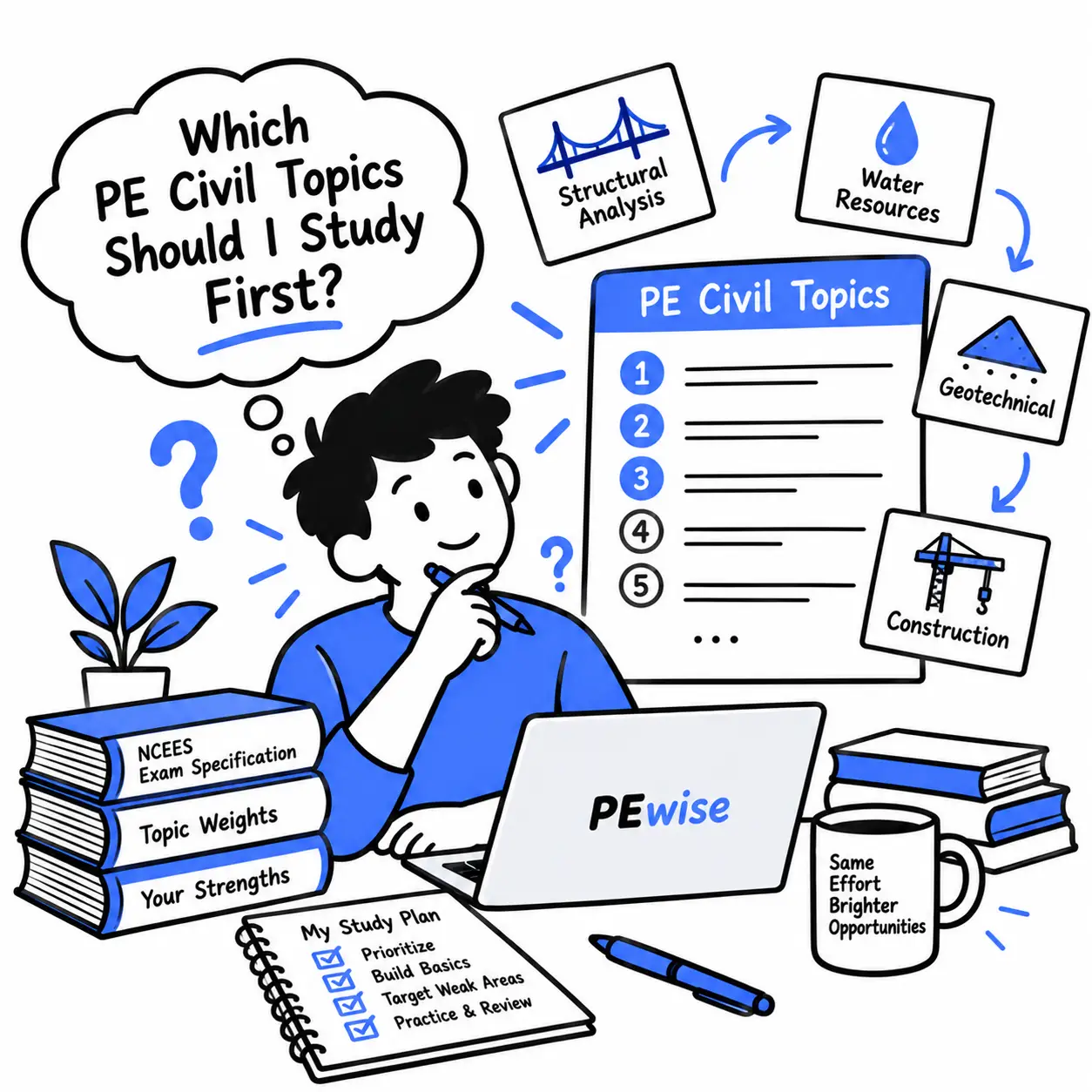
You’ve cleared an evening to study. Your calculator is ready. Then you open the PE Civil topic list and spend the next twenty minutes wondering where to begin.
Start with important topics you struggle to solve, after repairing any foundations that block them. Check your discipline’s NCEES specification, try a short mixed diagnostic, and use the results to choose your first priorities.
Your starting order should help you make progress this week. As your problem-solving improves, you can change it.
First make sure you are studying the right PE Civil topics
Before choosing a topic, open the official NCEES PE Civil exam page and select your discipline. Save the specification and design-standard list that apply to your exam date.
That date matters. As of October 22, 2026, NCEES lists separate sets for exams before April 2027 and updated design standards beginning April 2027. Check the applicable set before relying on saved materials.
NCEES supplies the electronic PE Civil Reference Handbook and the listed design standards during the exam. Use those documents in practice, and get the handbook through your MyNCEES account.
Now copy every official knowledge area into a checklist. You’ll use it to track coverage while giving different topics different amounts of attention.
Take a short diagnostic before choosing your first topic
A diagnostic is a set of practice questions you use to find your starting point. You can take one before you feel ready; discovering gaps is its purpose.
Choose a mixed set from material aligned with your discipline’s current specification. Try the questions without checking the solutions as you go. Keep your references available and record where you get stuck.
For each question, note the topic, whether you solved it correctly, how long it took, and whether you needed a guess. Then identify the main obstacle:
Concept: You couldn’t explain the principle behind the problem.
Setup: You knew the principle but chose the wrong model, equation, or assumptions.
Reference navigation: You struggled to locate the relevant information.
Units or arithmetic: The method was reasonable, but the calculation broke down.
Time: You reached an answer, but the process was too slow.
These differences should change your next session. Rewatching a full lesson may help with a concept gap. If the concept is clear and the lookup is slow, practice finding and using the reference alongside fresh problems.
Include correct guesses and unusually slow correct answers in your review. Both can reveal work you still need to do.
Keep early conclusions provisional. Missing one question doesn’t establish a weak topic, and answering one correctly doesn’t establish mastery. Mark areas you barely sampled as untested, then check them with additional questions.
Choose priorities using weight weakness and prerequisites
Once you have some evidence, compare three things: the topic’s published question range, your current performance, and the skills it depends on.
A prerequisite is a skill you need before another task makes sense. For example, a support-design problem becomes difficult to learn if you can’t first identify the loads and determine the member actions.
Use this decision guide to choose your next block:
| What your practice shows | What to do next |
|---|---|
| A missing foundation keeps blocking applied problems | Review that foundation, then return to an applied example. |
| A substantial exam area produces repeated errors | Give it an early study block and schedule a fresh retest. |
| A substantial area is consistently strong | Maintain it through spaced, mixed practice. |
| A smaller area is weak or barely tested | Schedule coverage or more assessment; keep it on your checklist. |
A topic can deserve substantial study time without being your first lesson. The first lesson may be a shorter foundation that helps you use that time well.
Treat this as a planning method. NCEES publishes the exam content and question ranges; the learning sequences below are study recommendations. Adjust them when your practice shows a different need.
What should you study first in your PE Civil discipline
Use the table to find a starting direction, then read your discipline’s explanation.
The selected ranges below come from the April 2024 specifications linked by NCEES for exams before April 2027. Topic labels are shortened. These examples do not replace the full specifications or predict your exact question counts.
| Discipline | Selected areas and published question ranges | Foundation to check first |
|---|---|---|
| Construction | Construction load support: 10–15; operations and methods: 9–14 | Load paths, equilibrium, and member actions |
| Geotechnical | Retaining structures: 10–15; deep foundations: 10–15 | Effective stress, soil strength, and soil properties |
| Structural | Component design and detailing: 26–39; forces and load effects: 17–26 | Loads, load combinations, and structural analysis |
| Transportation | Traffic engineering: 10–15; horizontal design, vertical design, and drainage: 8–12 each | The basics of your weaker area: traffic, geometry, or drainage |
| Water Resources and Environmental | Sitework: 9–14; hydrology: 8–12; closed-conduit hydraulics, open-channel hydraulics, and wastewater: 7–11 each | Units, continuity, energy, and loading concepts as needed |
Construction
If structural mechanics is rusty, start there before spending long sessions on construction load support. Practice drawing a free-body diagram, following a load path, and finding the forces a member or support must resist.
Then apply those skills to a support problem involving formwork, shoring, or bracing. Ask yourself what carries the load, how it reaches the supports, and which reference governs the check. Work through the reasoning before relying on a familiar-looking solution.
If you can already do that consistently, move an unfamiliar operations topic earlier. For example, practice interpreting an equipment problem and identifying the quantities that control the solution.
Scheduling can also deserve early attention when network logic or activity-time calculations are weak. Build a small network and explain why its controlling path determines the project duration. Keep materials, quality control, and safety in your wider coverage plan.
Check the NCEES Construction specification, especially the knowledge areas on pages 1–3.
Geotechnical
If effective stress and soil strength feel uncertain, review them before tackling a large collection of wall and foundation problems. Being able to interpret soil conditions helps you decide which inputs and methods belong in an analysis.
Start with a soil profile. Can you identify the groundwater position, distinguish total and effective stress, and explain which strength parameters you are using? Then connect that understanding to an earth-pressure or foundation-capacity problem.
The goal is to carry the soil-mechanics reasoning into an applied task. If you repeatedly stall at the same step, return to that specific foundation and retry it with a different example.
If those basics are solid, start with the weaker substantial application area, such as retaining structures or deep foundations. Also sample site characterization: experience with design calculations doesn’t automatically establish confidence in interpreting exploration and testing information.
Use the full NCEES Geotechnical specification, pages 1–3, to preserve coverage beyond your first priorities.
Structural
Start with loads and analysis if you struggle to determine what a member must resist. Move into component design early once those foundations are workable.
For a beam problem, follow the sequence from applied loading to reactions, internal forces, and the relevant member check. If you can navigate a design provision but can’t establish the demand correctly, the analysis step needs attention first.
Practice reference navigation as part of that sequence. Find the applicable provision, identify its assumptions, and check that your problem fits them. Knowing where a table is located is only useful when you also know when it applies.
If your analysis skills are already dependable, focus early sessions on the material, member, or connection tasks your diagnostic exposed as weak. Keep revisiting loads and analysis through mixed problems so you continue choosing the method yourself.
The NCEES Structural specification, pages 1–2, sets out the five official knowledge areas. Include materials and temporary-structure topics alongside the larger design areas.
Transportation
Choose your first substantial topic from your weaker areas in traffic engineering, geometric design, or drainage. Your daily work may make one of those much more familiar than the others.
If geometry is weak, review stationing, grades, curve relationships, and sight-distance concepts before working longer design problems. Try sketching the alignment and labeling the information you need before calculating anything.
If traffic engineering is weaker, begin with the flow variables and the reference procedures used in your practice set. For a capacity problem, explain which facility or operating conditions apply before selecting a method or table.
Drainage should get an early assessment too. A highway-design background may leave gaps in runoff estimation, pipe flow, or culvert applications. If those gaps are larger than your geometry gaps, move drainage forward.
Use the NCEES Transportation specification, pages 1–2, to keep signals, traffic control, pavement, and other listed areas in the plan.
Water Resources and Environmental
Start by checking the foundations behind the problems you miss. For hydraulics, that may mean continuity, energy, units, and interpreting the physical system. For treatment, it may mean mass balance and loading concepts.
Then apply the refresher immediately. In a pipe-flow problem, identify the system boundaries and relevant energy terms before choosing a loss relationship. In a treatment problem, identify what enters, leaves, or changes within the system before calculating.
Hydrology is another useful early priority when runoff setup is weak. Practice choosing appropriate inputs and explaining how rainfall, watershed conditions, and time of concentration relate to the task.
Keep project sitework visible. If your experience is mostly treatment, grading or construction-layout problems may deserve attention sooner than another familiar process calculation. If sitework is already strong, maintain it while repairing weaker water topics.
Check all areas in the NCEES Water Resources and Environmental specification, pages 1–3, including groundwater and water-quality topics.
Should you start with your weakest topic or an easy win
A brief familiar problem can help you begin a session. Give your main study time to gaps that matter to your preparation.
If you keep avoiding the same difficult topic, make the first task smaller. Instead of “learn deep foundations tonight,” choose “understand the setup of one axial-capacity problem and attempt a similar example.” A clear stopping point makes the session easier to start and review.
Consider this illustrative WRE situation:
| Practice evidence | What needs attention | Next action |
|---|---|---|
| Sitework problems are consistently manageable | Retention | Include occasional sitework questions in mixed sets. |
| Runoff problems repeatedly break down during setup | Hydrology concepts and inputs | Review the setup, then attempt fresh runoff questions. |
| Pipe-flow answers are slow or inconsistent | Energy terms or reference navigation | Identify the failing step and practice it in context. |
The candidate gives hydrology and hydraulics early repair blocks while keeping sitework in rotation. A fresh set should confirm whether those choices are helping.
Your background changes the balance. If you’re rusty, allow more foundation work. If you’re experienced, test unfamiliar areas rather than assuming work experience covers the syllabus. If you’re repeating the exam, combine your previous diagnostic report with current practice evidence.
Turn your topic priorities into a first week
Once you’ve chosen the order, give each session a specific output. “Study hydraulics” is difficult to finish. “Set up three fresh pipe-flow problems and review each failed step” gives you something to assess.
Here is an illustrative eight-hour first week. It is a planning example, not an official study-hour requirement.
| Session | Hours | What you should finish with |
|---|---|---|
| Confirm your scope and references | 0.5 | The correct specification and reference list |
| Try a mixed diagnostic | 1.0 | Recorded attempts, guesses, and sticking points |
| Review errors and choose priorities | 1.0 | Two early priorities and their main gaps |
| Repair a blocking foundation | 1.5 | A focused refresher followed by applied practice |
| Practice your first priority | 2.0 | Fresh problems and an updated error log |
| Mix in earlier material | 1.0 | Practice recognizing the method without a topic cue |
| Retest and plan the next week | 1.0 | Evidence for what to keep, change, or revisit |
If eight hours doesn’t fit, spread the sessions across more days. Preserve the assessment, error review, and retest. If you have more time, expand practice and review where your results justify it.
For each official topic, record its question range, your practice evidence, the main obstacle, the next action, and a retest date. Leave lightly sampled areas marked untested. That worksheet becomes your guide when you sit down for the next session.
How to know when to move to the next topic
Add the next topic when you can handle fresh problems with increasing independence and explain how you reached the solution. Keep the earlier topic in your review rotation.
Before moving on, check whether you can:
Recognize the problem type without a chapter heading giving it away.
Set up the solution and explain your assumptions.
Find and use the applicable reference.
Solve fresh examples without copying the worked method.
Revisit an earlier mistake after a delay and avoid repeating it.
You may still make occasional mistakes. Look for patterns: are the same errors recurring, or are you correcting them and handling new variations?
A single practice percentage doesn’t establish exam readiness. Use accuracy alongside timing, reference navigation, and repeat performance. When a topic becomes more dependable, shift some time to the next gap while retaining short review sessions.
Study order mistakes that waste time
Giving every topic equal time. Use your checklist for coverage and your practice results to decide where the extra hours belong.
Staying with comfortable material. Familiar problems can help you warm up. Check that your main sessions address work you still struggle to do.
Counting completed videos as mastery. Follow a lesson with an independent attempt and a fresh retest.
Studying one topic until the final week. Mix earlier material into later sessions so you keep practicing method selection.
Treating lower weight as permission to skip. A smaller published range still represents examinable content. Schedule it, even when another area needs more attention first.
Prepare for the PE Civil Exam With PEwise
Ready to put your study priorities into practice? PEwise offers online PE Civil exam preparation with short, focused video lessons, worked problems, and practice exams. Use your diagnostic results to identify what needs attention, then choose lessons and practice that address those gaps. Explore PEwise’s PE Civil courses to review the available disciplines and find the right starting point for your preparation.
Questions about choosing your first PE Civil topics
Should I follow the order in the NCEES specification
Use the specification as your coverage map. Choose your learning sequence using prerequisites and practice evidence. You can track every official area while studying in an order that fits your starting point.
Do I need to relearn all my FE material first
Begin with the foundations that block relevant PE problems. If equilibrium, units, or another basic skill is the obstacle, review it and return to an application. Broaden the refresher if fresh problems reveal wider gaps.
What if my exam is only a few weeks away
Use fresh mixed practice to identify repeated errors, then give focused repair time to the most consequential gaps. Keep reference practice and coverage checks in the plan. If your remaining time cannot address major weaknesses, reassess the exam date and check the applicable rescheduling rules.
Can I skip topics I already use at work
Test them first. Work familiarity is useful, but practice also checks whether you can solve different variations using the applicable references. If performance is consistently strong, use maintenance sessions and redirect more time to weaker areas.
Choose one priority now. Write down the step that makes it difficult, select a manageable practice task, and put that session on your calendar. Then use your results to decide what comes next.
To place those priorities into a longer timeline, use the PE Civil study schedule guide.
Keep Reading
Does Work Experience Help You Pass the PE Civil Exam?
You solve engineering problems at work, so why do PE Civil practice questions still feel unfamiliar? Learn how to map your daily tasks to exam topics, check whether familiar skills transfer, and uncover the gaps your job may leave untested.

Can AI Pass the PE Exam? ChatGPT and the Latest Research
Can AI pass the PE exam? Compare ChatGPT and other models across Civil, Mechanical, Fire Protection, and broader benchmarks, with research checked in 2026.

Preparing for the PE Civil Exam After Years Out of School
Years out of school and unsure where to start with PE Civil prep? Learn how to identify rusty skills, refresh essential fundamentals, and fit studying around work and family. Use a practical four-week refresher plan to get started before moving into full exam preparation.