Does Work Experience Help You Pass the PE Civil Exam?
You solve engineering problems at work, so why do PE Civil practice questions still feel unfamiliar? Learn how to map your daily tasks to exam topics, check whether familiar skills transfer, and uncover the gaps your job may leave untested.
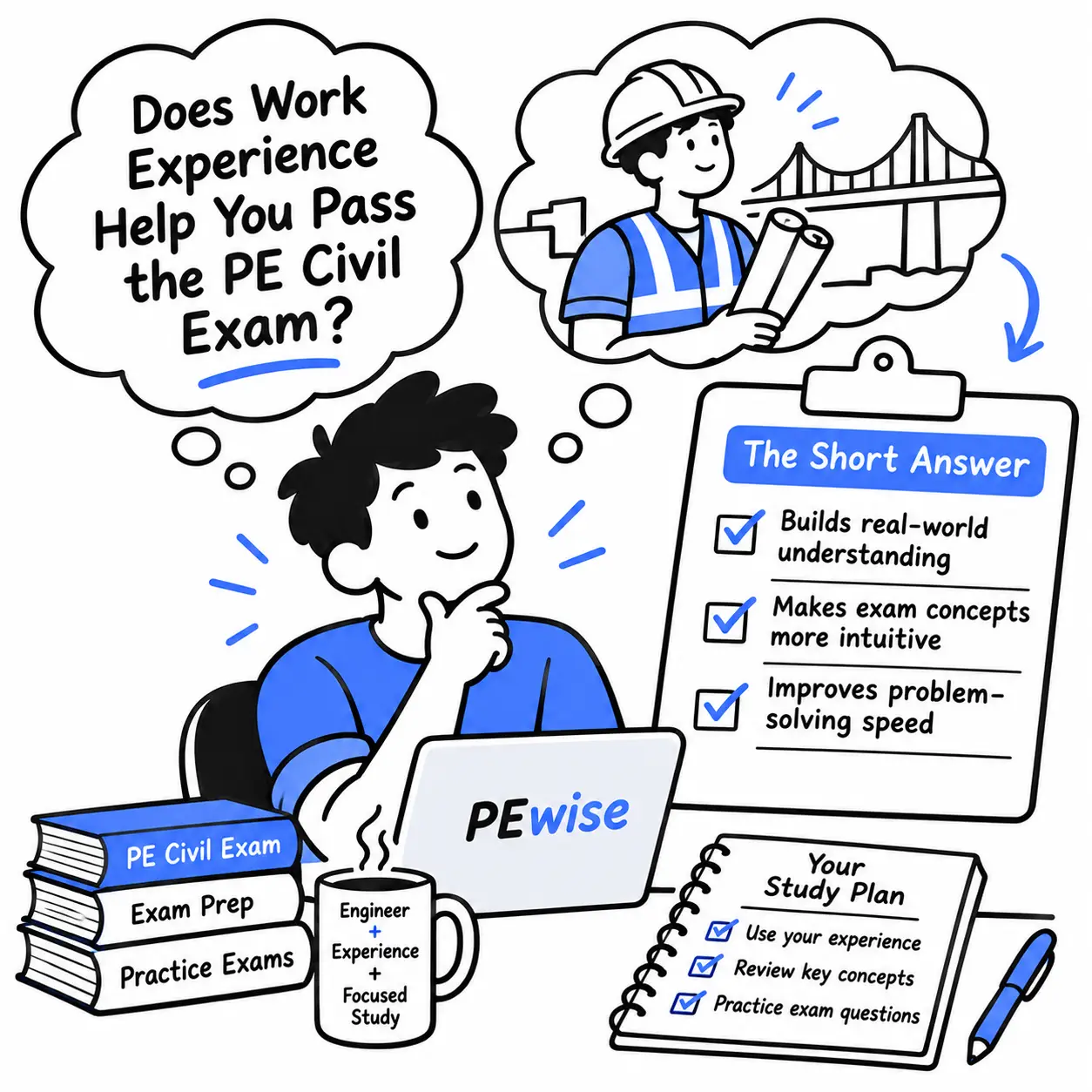
You can spot a problem in a project drawing in seconds. Then a PE Civil practice question asks you to set up a related calculation from scratch, and you hesitate.
Why does something you see at work feel harder on the page?
Relevant work experience can help with PE Civil preparation by giving you useful context, familiar concepts, and engineering judgment. Its value depends on what you personally do and can apply to fresh problems. Years on the job alone do not tell you which exam topics you can solve.
To find your blind spots, compare your actual tasks with the NCEES specification, test assumed strengths, and use the results to choose your next study session.
How do I compare my work experience with the NCEES exam specification?
Start with the official NCEES specification for your Civil discipline and exam date. Use its knowledge areas as your checklist, then add the work you personally perform under each relevant area.
Be specific. “I work on water projects” says little about whether you estimate runoff, analyze a pipe system, review treatment calculations, or coordinate drawings. Those tasks can build different skills.
For each area, ask:
What do I personally set up, calculate, interpret, or check?
What does software, an established spreadsheet, a colleague, or a project template supply?
What can I demonstrate on a fresh problem using the applicable exam references?
Project exposure belongs in the map, but describe your role accurately. Reviewing a calculation can develop a useful reasonableness check without showing that you can select and apply the method yourself.
Copy this work-to-exam coverage map
Add a row for each official knowledge area, then separate subtopics when your experience differs within an area. Keep a longer attempt log if the evidence will not fit comfortably in one cell.
| Official area or subtopic | My task and usual support | Fresh attempt and evidence | Next action and retest |
|---|---|---|---|
| [Copy from your specification] | [What I personally do; usual software, template, or team support] | [Problem source and ID; result; time; uncertainty or help used] | [Specific repair or maintenance task; retest date] |
| WRE: Hydraulics—Closed Conduit | Review pipe-model outputs; software performs the calculations. | Selected an appropriate approach but omitted a relevant loss term. | Review the system sketch and energy terms; try a different setup on a later day. |
| WRE: Hydrology | Rarely estimate runoff personally. | Could not identify the inputs required by the selected runoff method. | Review the method's conditions and inputs; attempt a fresh runoff problem. |
The completed rows are illustrative examples, not student results. Neither row means the entire subject needs to be relearned. The first points to a setup problem; the second calls for a closer look at method selection and inputs.
Give each sampled task one of four working labels:
Untested: You have no fresh practice evidence yet.
Needs repair: An attempt exposed a specific error or missing step.
Works with support: You completed it after a hint, example, or other help.
Independently demonstrated: You solved the sampled task and explained your method using the applicable references.
These are planning labels, not an official scoring system. “Independently demonstrated” applies to the problems you actually attempted. One or two correct answers cannot establish mastery of an entire knowledge area. Keep correct guesses and uncertain methods in your follow-up log.
How is PE Civil exam problem solving different from everyday engineering work?
At work, you may know the site, recognize the client's preferences, and understand why earlier decisions were made. You might use a checked calculation sheet, discuss an assumption with a colleague, or investigate an unusual result over several days. Workplaces and responsibilities vary, but that context can support the task.
A practice question asks you to work from the information supplied. You need to identify the requested result, select an applicable method, use the relevant reference, and check your answer within the time available.
Your experience can still be valuable. Recognizing an unrealistic load path or an implausible flow direction can help you question a result. The assessment asks which additional steps you can perform when the usual project workflow is absent.
Using the supplied references is part of independent exam problem solving. NCEES provides an electronic handbook and the specified design standards during the exam. Personal reference materials are not permitted. Practice with the applicable documents rather than treating independence as memorizing every equation or provision. See NCEES exam resources.
There is also a difference between recognizing a solution and producing one. Koriat and Bjork's 2005 learning experiments found that information present during study could inflate judgments of later recall. Those were paired-associate learning tasks, not PE Civil problems. The practical inference here is modest: check what you can do before opening the solution, even when the topic feels familiar.
Which PE Civil topics might my job leave untested?
Your gaps depend on your tasks, not your job title. The examples below show how to investigate them; they are not a required study order or a claim about everyone in a particular role.
Check the set that applies to your exam date. These mappings use the April 2024 specifications listed by NCEES for exams before April 2027. NCEES also lists updated design standards effective beginning April 2027. Confirm the applicable documents on the Civil exam page before choosing study references.
Construction
Coordinating field activities may help you understand sequencing, access constraints, and the consequences of a delay. If scheduling software or another team member performs the network analysis, that calculation remains a separate skill to test.
The Construction specification includes activity time analysis and project schedule analysis. Try a fresh network problem: interpret the dependencies, work through the required dates, and explain the critical path without relying on the finished software output.
If you understand the sequence but cannot complete the calculation, review that calculation step and retest a different network. If you solve and explain it reliably across fresh examples, retain scheduling in mixed practice and sample other areas. Familiarity with daily coordination does not establish coverage of support-load design, soil mechanics, or the rest of the specification.
Geotechnical
Reviewing exploration reports may give you valuable context for interpreting a soil profile. A design spreadsheet may also perform stress calculations or select parameters that you rarely calculate independently.
For a fresh problem, sketch the layers and groundwater position. Explain the chosen parameters and distinguish total from effective stress before moving into a wall or foundation application. These connect to areas in the Geotechnical specification.
If the soil profile makes sense but your calculation uses inconsistent stress assumptions, focus the repair on those assumptions. If that work is sound, sample another listed application outside your normal projects. Do not repeat familiar report interpretation simply because it feels comfortable while leaving foundation or groundwater tasks untested.
Structural
Designing a narrow group of members can build strong intuition for their behavior. Reviewing analysis-model output may help you identify suspicious results. Neither activity, by itself, shows how you will perform across different loading situations, materials, and connection details.
Use the Civil: Structural specification to select a fresh task. Establish the load path and member actions, then explain why the selected design provision applies. Include an unfamiliar material or component where your map shows limited exposure.
If you can calculate the actions but cannot justify the provision, practice finding and interpreting its conditions. If your work transfers well, record that strength and test another application. This is an assessment of preparation for PE Civil: Structural, separate from the PE Structural exam.
Transportation
Roadway software can give you frequent exposure to alignments without requiring you to reconstruct every geometric relationship. A traffic specialist may have the opposite pattern: strong experience in an analysis procedure but limited involvement in geometric design.
Choose the check that matches your actual role. Sketch a curve or sight-distance problem and identify its inputs, or explain which traffic procedure fits a fresh situation. The Transportation specification provides the scope for selecting those tasks.
If the geometry is sound but locating the relevant reference is slow, practice lookup followed by application. If traffic analysis is already demonstrated, move some assessment time to less-exposed areas, such as drainage when relevant to your map. Strong evidence in one area earns maintenance practice while you investigate the others.
Water Resources and Environmental
Pipe-model review may develop a useful sense of system behavior. Test the setup behind the output: identify the boundaries, flow directions, and relevant energy terms in a fresh closed-conduit problem. A treatment specialist can separately test a mass balance or loading application.
These are distinct tasks within the Water Resources and Environmental specification. Demonstrating one does not establish the other.
Consider the first illustrative map row. Recognizing a reasonable pressure pattern is a strength. Omitting a relevant loss term identifies a narrower repair: explain the system and account for the required terms before calculating. After review, use a new configuration to see whether the repair transfers. Also sample hydrology, groundwater, or other listed areas that your day-to-day work does not require.
How can I test topics I already use at work?
Begin with a small assessment session that reveals what happens when you attempt fresh work. You can investigate pacing separately after you understand where the process breaks down.
Here is an illustrative 60-minute starting screen. The timing is a suggested planning aid, not an NCEES requirement.
| Time | Task | What to record |
|---|---|---|
| 10 minutes | Map selected work tasks to the specification. Choose a familiar area and a lightly exposed area. | Your personal role, usual support, and the specific tasks to sample. |
| 35 minutes | Attempt a few fresh questions appropriate to those tasks. Use the applicable handbook and standards. | Source and problem ID, method, elapsed time, confidence, and any help or guesses. |
| 15 minutes | Review the attempts and choose the next action. | The earliest failed step, a bounded repair, and a fresh retest date. |
Select material aligned with your specification. NCEES lists a practice exam among its exam preparation materials; other practice sources should also be checked for scope and reference alignment.
Before checking an answer, write a short explanation of your method and any assumptions. If you need a hint, record it. You can learn from the supported attempt, then use a different problem later to check independence.
When reviewing, inspect the process even if the answer is correct. A guessed option or two errors that cancel each other can hide a gap. When the answer is wrong, locate the first step that needs correction rather than writing “bad at hydraulics.”
This session samples only a small part of the exam. Continue across the remaining official areas over later sessions. Record apparent question difficulty as well as the source; percentages from different small sets are not controlled comparisons of your ability.
A delayed, fresh retest gives more useful evidence than immediately repeating a solution you remember. In Butler's 2010 prose-learning experiments, repeated testing improved later retention and transfer relative to restudy. Applying that finding to PE preparation is an educational recommendation, not evidence of a particular PE score gain or study-hour saving.
Is my difficulty a knowledge gap, a reference problem, or a timing issue?
The useful question after an error is: What prevented me from completing this task correctly? The answer determines what to practice.
| What happened | What to investigate | A focused next action |
|---|---|---|
| You cannot explain the governing relationship. | Concept knowledge. | Review the concept, explain it in your own words, then apply it to a fresh setup. |
| You know an equation but use it under the wrong conditions. | Setup or applicability. | Compare the conditions of two examples and justify the method before calculating. |
| The method is sound, but units or arithmetic fail. | Calculation execution. | Write units through the calculation and check conversions and calculator entries. |
| You cannot locate or interpret the needed reference. | Reference use. | Practice locating the section, reading its conditions, and applying it to a new problem. |
| A work template supplies an unexplained step or uses a different edition. | Work habit or source mismatch. | Identify the hidden step and check it against the applicable exam reference. |
| You solve for the wrong quantity or miss a stated condition. | Reading and interpretation. | Restate the requested result, mark the constraints, and sketch before solving. |
| The method is correct but the attempt takes too long. | Pacing and fluency. | Record where time goes, then practice that step and reassess in a timed set. |
More than one cause can apply. These labels organize your investigation; they do not constitute a validated diagnostic score.
For example, a slow solution might involve repeated reference searches rather than weak understanding. Rereading the theory alone would leave that bottleneck largely untested. Conversely, faster calculator use will not fix an inapplicable method.
Write the next action so you can observe completion. “Review structures” is hard to assess. “Set up the load path on a fresh frame problem and explain the member actions before checking the solution” gives you something concrete to evaluate.
What should I study after finding my knowledge gaps?
Choose your next sessions from the evidence in your map. Consider both the published question ranges and the nature of the gap, including whether repairing a basic skill will help you handle several applications.
A setup error in a frequently used relationship may deserve attention before a specialized detail. A concept you cannot explain needs a different session from a method you understand but apply slowly. You still need to assess every listed knowledge area, including topics that your work never touches.
Keep demonstrated strengths in mixed practice. Recheck them with different conditions instead of dropping them entirely or spending every session on familiar questions. Leave time for fresh retests so a completed lesson does not automatically become a checked-off skill.
Finish your assessment by writing two actions: one targeted repair and one task in an untested area. Then place both in a realistic calendar using the PEwise PE Civil study schedule guide.
If a long break from academic problem solving is the main obstacle, the guide to preparing for the PE Civil exam after years out of school addresses that restart in more detail.
Questions about experience and PE Civil preparation
Can I pass the PE Civil exam using work experience alone?
An individual success story does not establish a dependable preparation strategy. Check whether you can solve fresh tasks across your selected specification using the applicable references. Work experience is useful evidence about exposure; it does not show complete exam readiness by itself.
Does more engineering experience mean I need fewer study hours?
There is no reliable universal conversion from years of work to preparation hours. Your map may reveal strengths that need maintenance and gaps that need substantial work. Use those findings, fresh retests, and pacing practice to adjust your schedule.
Why might an experienced engineer struggle with PE Civil practice questions?
Possible reasons include narrow task exposure, unfamiliar reference navigation, a setup normally supplied by software, or limited recent practice under time constraints. Identify the failed step before choosing a remedy. Difficulty with one sampled task does not erase your professional experience.
Is experience in another engineering discipline useful?
Related concepts and problem-solving habits may transfer. Test that possibility against the Civil specification you selected. If your question is whether the experience qualifies for exam admission or licensure, consult your licensing board; the PE state requirements guide can help you find the separate eligibility information.
Turn your work experience into a clearer study plan
Choose one task you use at work. Map it to the specification, attempt a fresh related problem, and record the next action. Then sample an area your job rarely touches.
Your experience gives you a starting point. Evidence from your attempts tells you where to go next.
Plan your next step with PEwise
Use the PEwise study schedule guide to turn your findings into a weekly plan. Bring your specific repair tasks and retest dates, then adjust the calendar as your practice results change.
Keep Reading
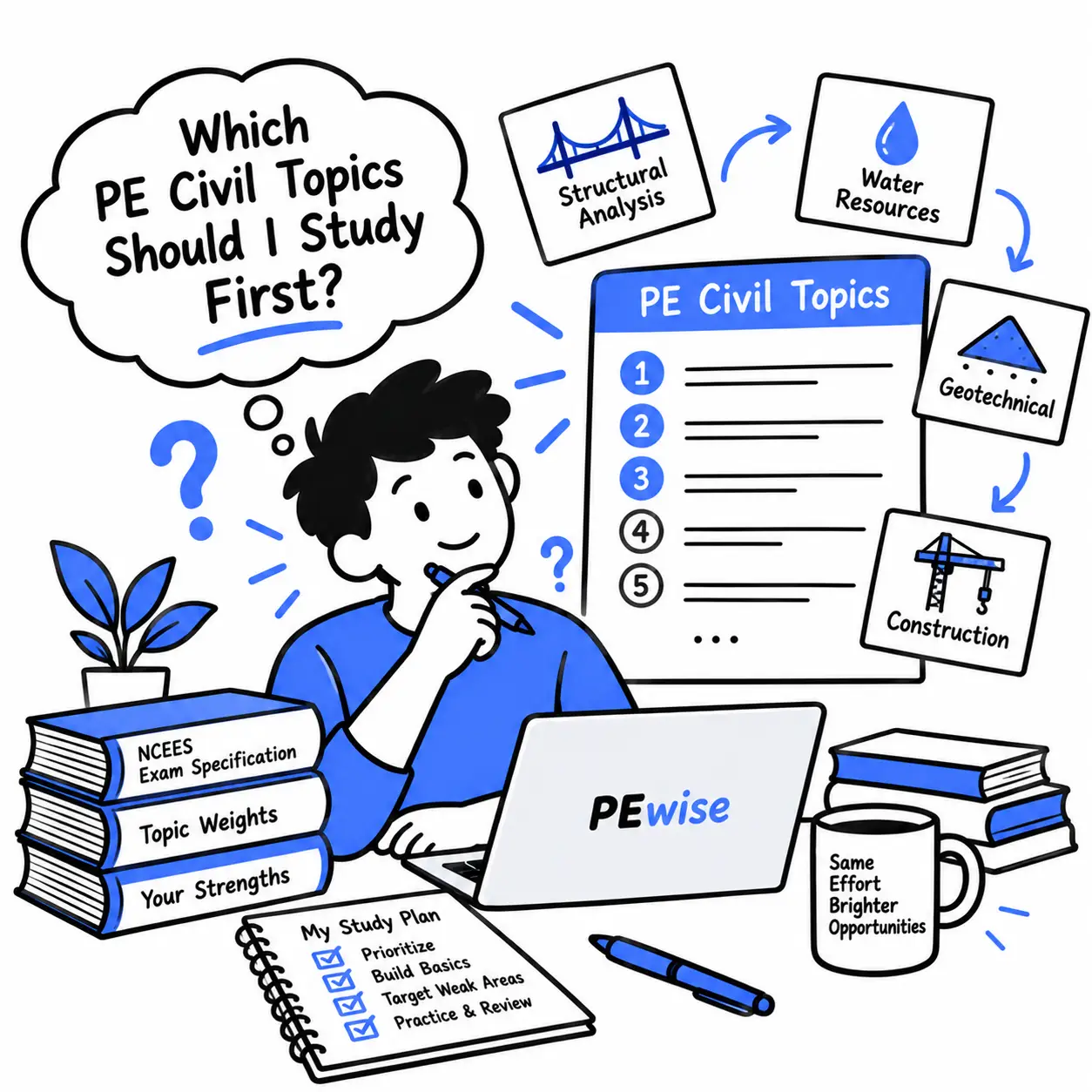
Which PE Civil Topics Should I Study First?
Your study time is limited. Which PE Civil topics deserve it first? Learn how to combine exam topic weights, practice results, and essential foundations to choose your starting point—and turn those priorities into a focused first week.

Can AI Pass the PE Exam? ChatGPT and the Latest Research
Can AI pass the PE exam? Compare ChatGPT and other models across Civil, Mechanical, Fire Protection, and broader benchmarks, with research checked in 2026.
Preparing for the PE Civil Exam After Years Out of School
Years out of school and unsure where to start with PE Civil prep? Learn how to identify rusty skills, refresh essential fundamentals, and fit studying around work and family. Use a practical four-week refresher plan to get started before moving into full exam preparation.