Best PE Geotechnical Study Materials: What You Actually Need
A bigger stack of study materials does not always mean better preparation. This guide helps you build a focused PE Geotechnical study plan, from choosing a core course and using official references to deciding when more practice, a book, or live instruction will help.

You can spend weeks comparing PE Geotechnical books, courses, and question banks and still be unsure whether you have what you need. A long reading list does not make that decision easier. What helps is knowing which resource will explain the material, which will help you apply it, and which will show you where you still need work.
PEwise is our recommended best starting point for candidates who want comprehensive, self-paced Geotechnical preparation with practice exams included. Its course and practice are mapped across all ten NCEES Geotechnical knowledge areas, bringing instruction and assessment into one study resource. Pair it with the official references for your exam, then add other materials only when they serve a clear purpose.
This guide is published by PEwise, and we recommend our own course. We also explain when a separate book, question bank, or live class may suit you. Product details were checked in September 2026.
What PE Geotechnical study materials do you actually need
A useful study set needs to help you understand concepts, solve unfamiliar questions, locate information in the references, and assess your performance under time pressure. Those jobs can be covered by a few complementary resources.
| Resource | What it helps you do | Do you need a separate purchase |
|---|---|---|
| Official specification and references | Identify the tested scope and practice finding applicable information | Obtain the specification and handbook first; investigate access to the listed standards |
| A comprehensive course or review guide | Learn and revisit concepts in an organized sequence | Choose one main learning source |
| Practice problems with explanations | Apply what you learn and correct misunderstandings | Check what your course already includes |
| Fresh full-length practice exams | Assess pacing, concentration, and gaps across topics | Use included exams before deciding whether more are useful |
| Extra textbooks, flashcards, or apps | Address a specific weakness or support short review sessions | Optional; add them when you can name the benefit |
The distinction matters because several purchases can repeat the same job. Two video courses may leave you with more lessons than you can reasonably review, while neither purchase solves the problem of not practicing with your references open.
Before buying anything extra, identify what is slowing you down. If you cannot explain why a solution uses a particular method, you need clearer instruction. If you understand the method but struggle to apply it to a new question, you need varied practice. If you lose time searching documents, you need reference-navigation practice. These are different problems, and they call for different resources.
Why PEwise is our main recommendation for Geotechnical preparation
The PEwise Geotechnical course combines visual lessons, quizzes, practice exams, and weekly live support. It currently costs $149 for 90 days of access, with 26 instructional modules and 345 published lesson topics. The first two modules are available free.
Comprehensive coverage in one place
PEwise brings the Geotechnical knowledge areas together through lessons and practice, including site characterization, soil mechanics, foundations, retaining structures, groundwater, earth structures, seismic topics, and problematic ground. Some subtopics are addressed primarily through practice questions and explanations rather than a separate video lesson.
For someone studying around work, an organized course makes it easier to decide what comes next. You can use it as your main preparation resource while working with the official references, instead of assembling your entire review from unrelated books and videos.
Visual explanations and access to help
Short visual lessons give you a way to revisit a concept without restarting a long lecture. Weekly Geotechnical PE Power Hour sessions are held on Thursdays at 6 p.m. PT, providing an opportunity to ask questions.
The format is self-paced with live support. If you need scheduled lectures throughout your preparation, a live cohort may fit you better. For candidates who want flexibility, our recommendation is to preview the teaching first and use PEwise as the core of their study set.
Which official references and manuals do you need
Your preparation course and your exam references serve different purposes. A course explains the material and helps you practice it. The official references are the documents you need to become comfortable using when answering questions.
According to NCEES, the PE Civil exam supplies an electronic reference handbook and the specified design standards. Personal reference copies are not allowed in the exam room. You can access the handbook through MyNCEES, while study copies of standards must be obtained separately from their publishers or other authorized sources.
Download the Geotechnical specification linked from the NCEES Civil page and use the reference list that applies to your exam date. That quick check is more useful than assuming the newest book or an old recommendation names the right editions.
Learn which document to open
Geotechnical preparation involves more than searching the handbook for a formula. You also need to recognize which reference is likely to contain the procedure, guidance, or supporting information you need.
The following associations provide a starting point when organizing your references. They are not an exhaustive map, and the applicable document depends on the question and the specified edition.
| Subject you are reviewing | Reference to become familiar with |
|---|---|
| Site investigations and ground characterization | FHWA Geotechnical Site Characterization, GEC No. 5 |
| Driven pile foundations | FHWA Design and Construction of Driven Pile Foundations, GEC No. 12 |
| Drilled shafts | FHWA Drilled Shafts, GEC No. 10 |
| Slope stability | USACE EM 1110-2-1902 |
| Dewatering and groundwater control | UFC 3-220-05 |
These publications appear in the NCEES Geotechnical reference list. As you solve practice questions, note the relevant document and section. Over time, you should become better at choosing where to look before typing a search term.
Avoid setting yourself the task of reading every reference from cover to cover before practicing. Start with its contents and organization, then investigate relevant sections as your lessons and questions require them. This gives your reading a purpose and makes it easier to connect a reference with the situations where it is useful.
For broader exam context, see our PE Geotechnical exam guide.
Where to find PE Geotechnical practice problems and exams
Practice materials are most useful when they reveal something about your understanding. A correct answer is reassuring, but the explanation behind it is what lets you repeat the reasoning on a different problem.
Start with the practice already included in PEwise
The PEwise Geotechnical practice exams include two full-length 80-question simulations and a 59-question focused review. All three come with the Geotechnical course.
You can use timed exam mode or untimed study mode. Results show performance by NCEES topic, and question review includes detailed solutions with reference citations. This helps you identify what to revisit instead of relying only on an overall score.
The simulator also provides question flagging and a reference panel. Several Geotechnical documents are built in; you upload your own handbook and ASCE reference PDFs. It is a PEwise study environment, not the actual NCEES testing platform. A free 10-question sample lets you inspect the interface and feedback before enrolling.
Add official practice for another perspective
NCEES offers exam-preparation materials, including a practice exam, through its portal. Use the official exam-preparation link to find the current Geotechnical product and check its description before purchasing.
An official practice resource can complement your main preparation. Treat it as another source of questions to learn from, rather than a prediction of the questions you will receive. Save some unfamiliar questions for later assessment instead of working through every available exam immediately.
Choose additional questions by their usefulness
If you need more targeted practice, School of PE offers a Geotechnical workbook and a question bank. Its published starting prices are $49 and $139, respectively; check the selected format, access period, and current price.
Before purchasing another set, inspect a sample solution. Does it explain why the method applies? Does it identify the reference and show enough intermediate reasoning to follow the answer? Can you tell whether your mistake came from understanding, selecting a method, using units, or reading the question?
A large question count is less useful if the solutions leave you guessing. Also check whether questions overlap with materials you already own. Repeating a familiar exam can help reinforce learning, but the higher score does not necessarily show how you will handle an unfamiliar set.
Which Geotechnical books and online platforms are worth considering
Our main recommendation is to start with PEwise and add a resource for a specific reason. A separate book may help if you prefer written explanations. A larger question bank may help when you need more practice in a weak area. A scheduled course may suit you if independent study repeatedly slips behind other commitments.
| Resource | Most useful role | What to consider before buying |
|---|---|---|
| PEwise | Main self-paced learning and practice resource | Preview the lessons and check that the access period fits your plans |
| Petro Publications Geotechnical Essential Guide | Written preparation for readers who prefer a book | Check the edition, sample content, and overlap with your current materials |
| School of PE workbook or question bank | Additional practice | Confirm the format, access, and whether the questions add variety |
| School of PE course | Live or recorded instruction | Compare the selected package’s schedule and support |
| EET on-demand course | Recorded instruction with course materials | Check the current offering, subscription duration, and included practice |
Books for written review
The Essential Guide to Passing the Geotechnical Civil PE Exam from Petro Publications is a named option to investigate if you want a dedicated written resource. Its listed price at the time of review was $86.50. Review the product details and sample pages to decide whether its presentation helps you.
You may also already own a useful soil mechanics or foundation engineering textbook. Keep it available for concepts that need another explanation. You do not need to make it your main study plan or read every chapter simply because you own it.
Live instruction and other course formats
School of PE lists both on-demand and live online Geotechnical options. EET lists an on-demand offering with recorded lectures, workshops, a binder, and practice. Confirm current live availability rather than relying on an older published schedule.
When comparing these options, distinguish full live teaching from weekly Q&A, email support, and recorded lectures. They offer different levels of scheduling and interaction. For a fuller provider comparison, visit our guide to the best PE Geotechnical exam prep courses.
Can older depth books or CERM still help
Older Geotechnical depth books and the Civil Engineering Reference Manual can still help explain familiar engineering concepts. The risk is using their organization, reference editions, or exam advice as your current preparation plan.
Check the contents against the current specification, and compare cited procedures with the references assigned to your exam. Treat old morning-breadth and afternoon-depth instructions as historical. A book can contain useful problems while still being unsuitable as your only guide to what you need now.
Which materials are free and where should you buy the rest
Start by obtaining the official specification and handbook, exploring available public-agency publications, and trying course previews. These steps help you understand the requirements and evaluate a teaching format before committing money.
For government references, begin with the publishing agency, such as FHWA or USACE, or an authorized document repository. Check the document number and edition. Do not assume an easily found PDF is the assigned version, or that every standard is available free.
Buy paid preparation materials from the provider, publisher, or a reputable authorized retailer. Direct product pages generally make it easier to verify inclusions, access terms, and updates than a secondhand listing with only a cover photo.
Used books can reduce costs, but check more than the edition. Missing solution pages, heavy annotations, expired access codes, or a nontransferable digital subscription can remove much of their value. Look for an errata page as well; knowing about a published correction can prevent you from spending time trying to reconcile a faulty answer.
Affordability comes down to the total set you need. A low-priced workbook may be a sensible addition, but several small purchases can become expensive if you later buy a course that already includes similar practice. Start with the core resource, see what it provides, and let actual gaps guide the next purchase.
Build a study set that fits your situation
If you want a comprehensive starting point
Begin with PEwise and the official references. Work through the relevant instruction and included practice before deciding that another guide is necessary. Keep a short record of unresolved questions so you can use support sessions purposefully.
This approach gives each additional purchase a test: will it explain something your current resource has not resolved, provide useful new practice, or offer a form of support you need? If the answer is unclear, wait.
If you are comfortable with the theory
Prioritize practice and reference use. Familiarity from work can be valuable, but your experience may be concentrated in a narrower part of Geotechnical engineering. Use unfamiliar questions across the specification to identify areas that need review rather than assuming your day-to-day work covers everything.
Return to instruction when a pattern of mistakes shows a knowledge gap. There is little value in repeatedly guessing through questions whose underlying concepts remain unclear.
If you are preparing for a retake
Review where your previous preparation broke down before replacing all your materials. Did you understand the explanations but struggle without them? Did you avoid unfamiliar topics? Did reference searches consume too much time?
Your next resource should address that problem. A targeted explanation, fresh questions, or help navigating references may be more useful than restarting with an entirely new collection. Retain resources that remain current and that you know how to use effectively.
If you need a fixed class schedule
Compare actual class dates, attendance expectations, recordings, and access after the course ends. Choose a format you can realistically attend. A live package loses much of its purpose if every session conflicts with work and you end up using only the recordings.
Check these details before you pay
Before purchasing, confirm:
- Scope and references: The material matches the Geotechnical specification and editions applicable to your exam.
- Included practice: You know which questions, exams, and explanations come with the purchase.
- Access: The start date, duration, renewal, and extension terms fit your needs.
- Support: You understand whether help means live teaching, Q&A, email, or tutoring.
- Sample quality: The explanation style helps you understand the reasoning, not just recognize an answer.
For a broader look at how these resources work together, see PE Exam Study Materials: What You Actually Need.
Frequently asked questions
Is the NCEES handbook enough to study from
The handbook is an important reference, but it is not a complete teaching program or the entire Geotechnical reference set. You also need a way to learn unfamiliar concepts, practice applying them, and become comfortable with the separately listed standards.
Do I need to buy every Geotechnical reference
You need suitable study access, which does not always mean buying a new printed copy. Check authorized free publications and legitimate employer, library, or publisher access. Make sure the edition is correct and that your access lets you practice when you need it.
Can I prepare without a paid course
Yes. A self-study approach can combine current references, a suitable written learning source, and practice with clear solutions. The challenge is organizing coverage and resolving gaps yourself. A comprehensive course becomes useful when you want that instruction and organization brought together.
Should I buy more exams if my course already includes them
Use and review the included exams first. Additional exams are most useful when they provide fresh questions or address an identifiable gap. Buying more without reviewing your mistakes can leave the underlying problem unchanged.
Are flashcards and study apps necessary
They are optional. They can help with terminology and short review sessions, but should support your main preparation. Choose them after you have useful instruction and practice, especially if similar tools are already included in your course.
Start with a resource you can use consistently
Choose materials that make it clear what to learn, how to practice, and what to revisit. You do not need to collect every recommended book before you begin.
For a comprehensive place to start, explore the PEwise Geotechnical course. If you want to evaluate the assessment tools first, visit the Geotechnical practice exams and try the free sample. Build around the resources that help you make progress, then add only what your preparation actually needs.
Keep Reading
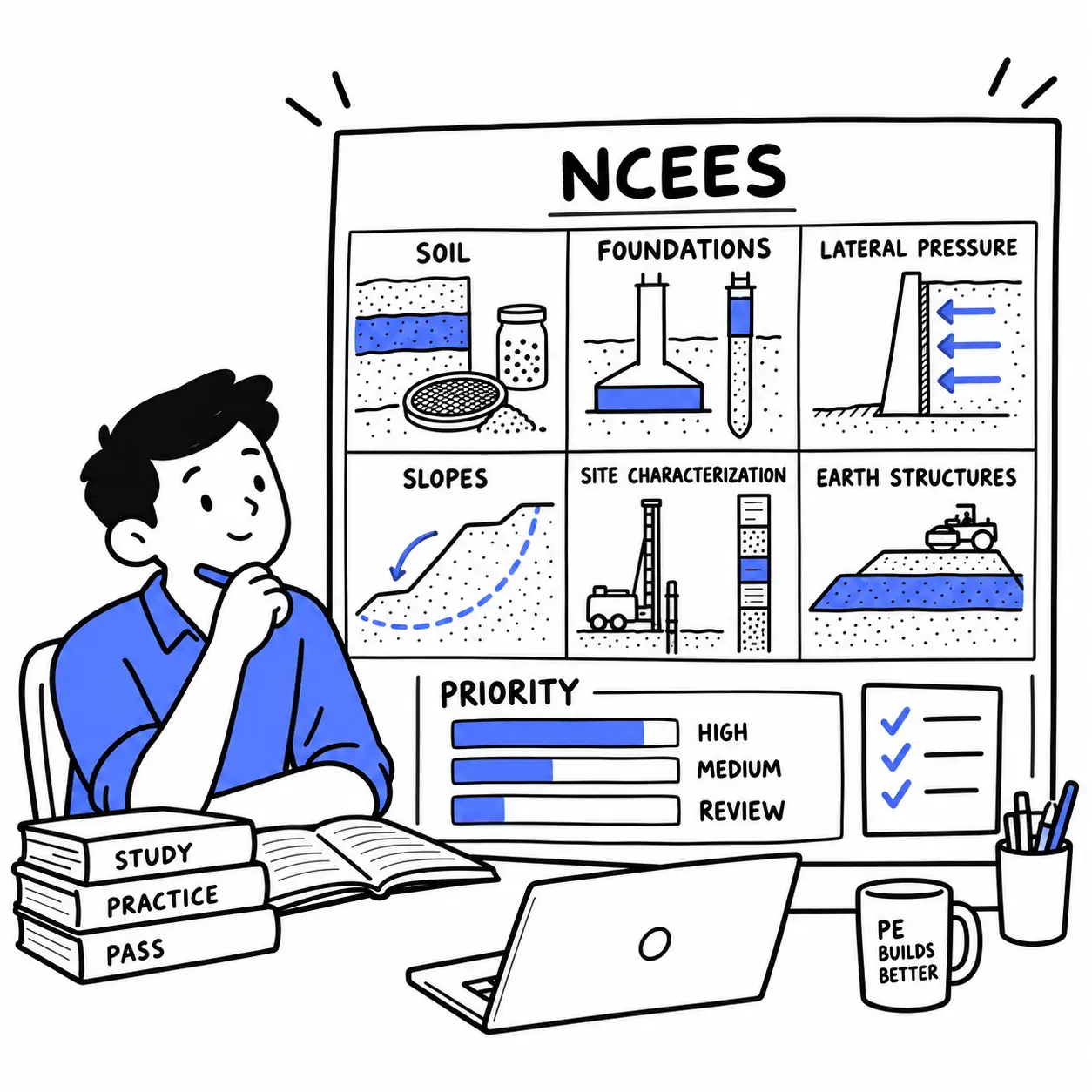
Geotechnical PE Exam Topics: NCEES Breakdown and Study Priorities
Explore the 10 Geotechnical PE exam topics, their NCEES question ranges, and practical study priorities. See which areas deserve the most attention and how the topics connect.

Best PE Geotechnical Exam Prep Courses
Compare six PE Geotechnical exam prep courses by curriculum, teaching format, practice resources, support, price, and access. Find the course that best fits your budget, learning preferences, and exam timeline.
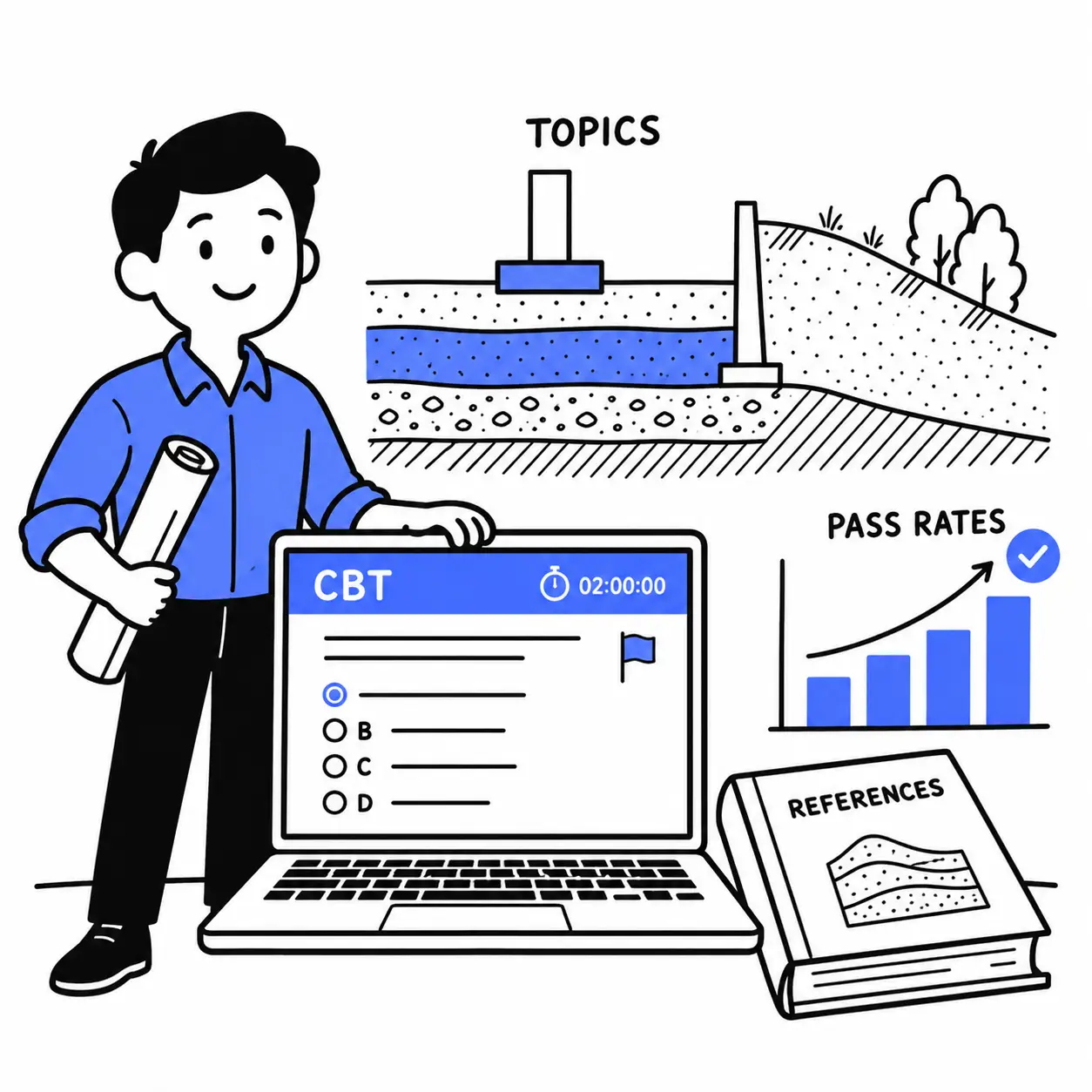
PE Civil Geotechnical Exam Guide Format, Topics, References & Pass Rates
Everything on the PE Geotechnical exam — the 10 NCEES knowledge areas with question counts, CBT format, bundled references, pass rates, and how to study.