PE Civil Self-Study vs. Prep Course: Which Fits Your Situation?
Can you build a PE Civil study plan and work through mistakes on your own, or would structured lessons help? Compare self-study, on-demand and live courses, and targeted support—then try a two-week plan to see which approach fits your schedule and learning needs.
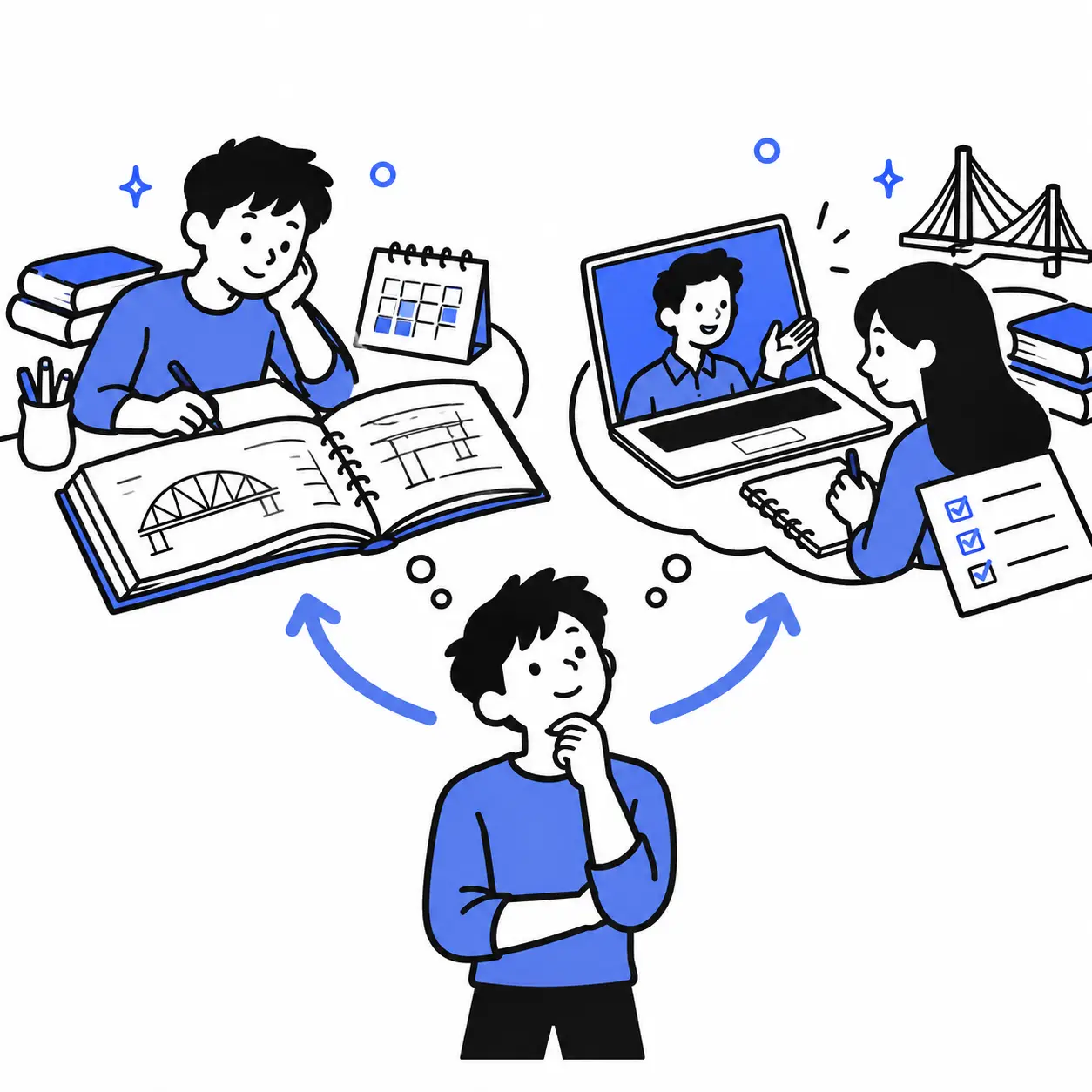
PE Civil self-study can be a good fit if you can organize your resources, study consistently, and work through mistakes independently. A prep course becomes more useful when you need clearer explanations, an organized curriculum, or reliable support. If your difficulties are limited to a few topics, combining independent practice with targeted instruction may be enough.
That choice can feel harder than it should. One colleague passed with a few books. Another says a course made all the difference. Meanwhile, you have work deadlines, a budget, and an exam you would rather prepare for once.
Start with what you need your preparation to do. The right approach should help you cover the relevant material, understand unfamiliar problems, and keep making progress within the time you actually have.
What self-study and a prep course actually mean
Self-study and self-paced learning are often treated as the same thing, but they describe different choices.
With independent self-study, you build the preparation system yourself. You choose books, videos, practice questions, and references, decide what to study next, and find help when a solution does not make sense. You can pay for excellent resources and still be studying independently.
An on-demand prep course gives you an organized curriculum and recorded instruction. You choose when to study, while the provider supplies the teaching sequence and whatever practice or support the package includes. It is self-paced, but you are doing less of the resource selection and planning yourself.
A live prep course adds scheduled teaching sessions. It can provide a useful routine and opportunities to ask questions during instruction. You still need time outside class to solve problems and review mistakes.
A hybrid approach combines these options. You might study most topics independently, use lessons for weaker areas, and get help with questions you cannot resolve. It can also mean following an on-demand course while adding a study partner for accountability.
Check what a provider means by “self-study” before comparing packages. The label may refer to a paid question bank, a recorded course, or a collection of books.
PE Civil self-study vs. prep course at a glance
The most useful comparison is who takes responsibility for each part of preparation.
| Factor | Independent self-study | On-demand course | Live course |
|---|---|---|---|
| Curriculum | You select resources and build the sequence. | The provider supplies an organized sequence. | The teaching schedule sets the sequence and pace. |
| Flexibility | You choose when and what to study. | You choose when to use lessons within the access period. | You work around scheduled sessions and available recordings. |
| Feedback | You rely on solutions, peers, mentors, or separate help. | Instructor access and response times depend on the package. | Questions may be answered during class; individual help varies. |
| Accountability | You create deadlines and track progress. | Progress tools, if included, help you track work; you manage your schedule. | Regular classes create appointments to keep. |
| Cost | Materials, practice products, references, and any extra help. | Course price, possible renewals, and resources not included. | Course price and any additional materials or access fees. |
| Main advantage | Control over spending and study priorities. | Structured teaching with flexible timing. | Scheduled instruction and regular interaction. |
| Main risk | Gaps in coverage or mistakes that stay unresolved. | Watching lessons without enough independent practice. | Paying for a schedule you cannot consistently use. |
A course can reduce the work of deciding what to study next. Self-study gives you more control over that decision. Both still require you to attempt unfamiliar questions, review your reasoning, and return to topics that are not yet secure.
What every PE Civil study plan needs
Whichever route you choose, begin with the specification for your discipline and the references applicable on your exam date.
The NCEES PE Civil exam information describes an 80-question exam with eight hours of testing in a nine-hour appointment. NCEES supplies the electronic Reference Handbook and specified design standards during the exam. Personal copies of books or notes are not permitted.
That means your preparation needs to connect understanding with reference use. Recognizing a topic is helpful, but you also need to know which document to open, where to find the relevant information, and how to apply it.
The handbook and design standards are separate resources. Obtain the handbook through MyNCEES, then check the standards listed for your chosen exam. Do not assume a course includes personal study access to every standard supplied on exam day.
Exam dates matter here. NCEES lists separate downloads for exams before April 2027 and those beginning April 2027. Match your resources to the applicable documents rather than assuming the newest edition is always the one you need.
A sound plan also includes explanation resources, varied practice, useful solutions, and timed work. These needs apply across Construction, Geotechnical, Structural, Transportation, and Water Resources and Environmental. Your work experience may help with some areas, but the specification determines the coverage you need.
Which approach fits your situation
Independent self-study fits when you can manage the whole process
Self-study is a reasonable starting point when you understand much of the material, know how to find dependable resources, and can follow a schedule without external deadlines.
The strongest sign is what happens after you miss a problem. Can you identify the misunderstanding, find an explanation, and solve a fresh question using the corrected method? If you can, independent preparation may be giving you the feedback you need.
You also need to be comfortable checking coverage. It is easy to keep practicing familiar topics because they feel productive. An independent plan needs a way to notice what you have avoided or never studied.
A limited budget is a valid reason to consider this route. Keep the resource collection small and purposeful. Buying several overlapping books can cost more than expected while making it harder to decide where to begin.
An on-demand course fits when you need teaching without fixed class times
An on-demand course is worth considering when you regularly lose study time searching for explanations or deciding which material belongs in your plan.
It can be particularly useful if you work irregular hours, have family commitments, or need to revisit explanations more than once. You can study a difficult concept when you have time and return to the lesson before another practice session.
Look closely at how the course teaches. A long recording of a classroom session feels different from short lessons organized around individual concepts. Try a sample covering something you find difficult, then attempt a related problem without the lesson open. That tells you more than watching a topic you already understand.
The trade-off is that flexibility still requires a routine. A course library is easy to postpone when nothing on your calendar requires you to use it.
Live instruction fits when regular appointments help you follow through
A live course may suit you if you benefit from scheduled teaching, want to ask questions as material is introduced, and can protect the class times.
Be realistic about attendance. If your work regularly runs into the evening, check the recording policy and how you can ask questions after watching a missed session. Otherwise, you may pay for live instruction while using the course mainly as a recording library.
Also distinguish live teaching from live support. A weekly Q&A can help you get unstuck, but it is different from a scheduled course that teaches the curriculum through regular classes. Both can be valuable; choose the service you will actually use.
Targeted support fits when most of your plan already works
You do not have to replace a successful routine because two topics are difficult. Focused lessons, a tutor, or instructor support may resolve those gaps while you continue independent practice elsewhere.
Keep the arrangement simple. Use one main study sequence and add a resource only when you can name the problem it solves. Switching constantly between providers can turn a manageable plan into several unfinished ones.
After an unsuccessful attempt, choose help based on the cause
Before buying another course, consider what needs to change. Use your NCEES diagnostic report alongside your practice history to identify weak areas.
If you struggled across many topics, structured instruction may help. If you understood the methods but lost time searching references, prioritize navigation and timed practice. If you watched lessons but rarely solved questions alone, change the way you use your materials before adding more of them.
Failure does not automatically mean self-study was the wrong choice. Passing a course’s quizzes does not automatically mean the course prepared you fully, either. Look for the specific gap between your preparation and your exam performance.
What self-study and prep courses really cost
There is no single useful “typical course price” without specifying the discipline, teaching format, access period, and included resources. Compare the amount you would spend through your planned exam date.
For context, PEwise lists its PE Civil discipline courses at $149 each for 90 days of access. School of PE lists monthly PE Civil OnDemand subscriptions at $499, with longer access packages available. Course materials, access periods, and renewal terms differ, so compare what each option includes alongside its price.
Compare the complete preparation budget
Independent study may involve books, a question bank, official practice materials, and study access to references. A course may include some of those items and charge separately for others. Before buying, check whether you would be purchasing something you already own.
| Budget item | What to check |
|---|---|
| Teaching materials | Will one resource explain the topics you need, or will you need additional instruction? |
| Practice questions | Are useful solutions included? Do you have enough unfamiliar questions for later practice? |
| Practice exams | Are they included in the course, sold separately, or available only in a higher package? |
| References | Which study references must you obtain separately? |
| Access and renewals | When does access start, when does it end, and what happens if your exam moves? |
| Support | Is instructor help included, and are there limits or extra charges? |
| Reimbursement | What will your employer pay for, and must you get approval before purchasing? |
Keep exam registration, travel, and other expenses shared by both routes separate from this comparison. They affect your overall budget but do not tell you whether a course is good value.
Consider the time you spend assembling resources
Self-study has a planning cost as well as a purchase price. You may need to compare explanations, check editions, organize topics, and find someone who can answer a difficult question.
That work may be manageable if you already know the resources and have a clear plan. It becomes more significant when you have only a few study hours each week and keep using them to search for what to study.
A course is worth paying for when its structure, instruction, or support addresses a recurring difficulty. Higher prices and longer video libraries do not establish better value by themselves. Check how much of the package you can realistically use before access expires.
How to build a workable self-study plan for the PE exam
Independent preparation works best when you make a few decisions early and stop rebuilding the plan every week.
Use the specification to define your coverage
Turn the relevant NCEES topic list into a simple coverage checklist. For each area, identify where you will learn it and where you will practice it. Mark unfamiliar areas rather than assuming your professional experience covers them.
Start with a manageable set of questions across different topics. The purpose is to discover what needs attention, not to produce a pass prediction. Notice whether you struggle with the concept, selecting a method, finding a reference, or completing the work accurately.
Give each resource a clear job
Choose a main source for explanations and a main source for practice. Add official practice materials and the relevant references, then check what is still missing.
Free videos can be useful for an individual concept. However, a playlist is not necessarily a complete curriculum. Check whether its methods, scope, and reference editions fit your exam. Older books can still explain fundamentals well, but their exam advice may describe a different format.
When a resource leaves you confused, try another explanation for that topic. You do not need to replace your entire study stack every time a chapter feels difficult.
Make correction part of the session
Attempt problems before opening their solutions. After reviewing a mistake, write a short note explaining what went wrong and what you will do differently next time.
“Review hydraulics” is too broad to guide the next session. “I chose an equation before checking its assumptions” gives you a specific habit to correct. Revisit the issue with a fresh problem later; recognizing the answer to a repeated question can disguise an unresolved misunderstanding.
Reserve time for mixed and timed practice
Topic-by-topic work helps you learn, but it also tells you which method you are expected to use. Mixed practice asks you to make that choice yourself.
Build toward longer timed sessions and full-length practice so you can assess reference use, pacing, and concentration. Leave enough time afterward to act on what you learn. A simulation taken immediately before your appointment may reveal problems too late to address comfortably.
If you need help estimating a realistic preparation window, use our guide to how many hours to study for the PE exam. Your available weekly hours and current gaps matter more than matching someone else’s total.
Try a two-week plan before committing
If you are undecided and have enough time before your exam, a short trial can make the choice more concrete. Test whether you can sustain independent study and whether a sample course lesson helps with a difficulty you actually have.
| Period | What to do | What to notice |
|---|---|---|
| Days 1–2 | Confirm your exam documents, select initial resources, and schedule study sessions. | Can you identify what to study and when you will do it? |
| Days 3–4 | Attempt unfamiliar questions across several topics. | Where do you get stuck: understanding, setup, references, or execution? |
| Days 5–7 | Review weak concepts and try fresh related problems. | Can you correct errors without repeatedly searching for help? |
| Days 8–11 | Continue the routine and try relevant preview lessons if considering a course. | Does structured teaching resolve a gap or make your sessions more focused? |
| Days 12–14 | Attempt a new mixed timed set and review your notes. | Is your approach workable, and what support is still missing? |
Continue independently if the routine is holding and you can resolve mistakes. Add targeted help if difficulties are concentrated in a few areas. Consider a structured course if gaps are widespread or finding suitable material consumes much of your available time.
This is a way to test your study approach, not a validated readiness assessment. Two weeks of questions cannot represent the whole exam. If your appointment is close and you already know you need help, do not delay that decision just to finish the trial.
How to choose a prep course and evaluate reviews
A useful course should show you what it teaches, how you will practice, and how you can get help. Start there before comparing popularity or headline lesson counts.
Check coverage and exam-date alignment
Look for a curriculum that maps to your chosen discipline’s specification. Check the teaching and practice together: some areas may be taught through lessons, while others receive more attention through questions and explanations.
Ask how reference updates are handled if your study period crosses an edition change. A course described as “updated” should make clear which exam dates it supports.
Test explanations and practice before buying
Choose a preview topic that challenges you. After the lesson, can you explain the method and begin a related problem independently?
For practice products, examine the solutions as carefully as the questions. A useful explanation should help you understand the reasoning, identify the source of an error, and locate relevant reference material. Large question counts have limited value if the answers leave you guessing about why a method applies.
Check support and access conditions
Find out whether questions go to an instructor, a community, or an automated tool. Check the expected response time and whether live sessions fit your time zone. For recordings, confirm how long they remain available.
Read the actual refund and repeat-access policies. A “pass guarantee” may provide additional course access after an unsuccessful attempt, subject to conditions. It does not necessarily mean a refund, payment for your next exam, or a guaranteed result.
Read reviews that match your situation
Provider testimonials, independent review sites, engineering forums, and communities such as r/PE_Exam can help you identify patterns. Give more weight to accounts that name the discipline, exam date, package used, and a concrete strength or limitation.
A review from an earlier exam format may tell you something about teaching style while offering little guidance about current references. A positive review of one discipline does not establish the quality of another course. Check affiliate disclosures and whether the reviewer actually used the product being discussed.
Reported pass rates also need context: who was counted, who completed the course, how outcomes were collected, and whether first-time and repeat candidates were separated. A percentage without that information is a weak basis for choosing.
For a broader shortlist, our PE Civil exam prep course comparison examines options including PEwise, PPI, School of PE, EET, and Civil Engineering Academy. Use the comparison to narrow your options, then check the current dedicated course pages and previews.
Where PEwise fits
We built PEwise for engineers who want organized preparation they can fit around work. Our approach combines focused visual lessons, problem practice, and weekly live support, so you can follow a course while choosing when to study.
PEwise offers preparation for Geotechnical, Water Resources and Environmental, Construction, and Structural. As of October, 2026, our dedicated course pages list $149 for 90 days of access. You can explore the available preview content before deciding whether the teaching suits you.
PEwise is self-paced, with weekly live support rather than mandatory scheduled lectures. Our Pass Guarantee policy offers one additional three-month access period if you watch all core lessons, take the official PE exam without passing, and provide your NCEES results. Refund eligibility follows separate conditions in the same policy.
Frequently asked questions
Can I pass PE Civil without taking a prep course?
Yes, independent preparation is an option. You need a plan that covers the specification, dependable explanations and practice, and a way to resolve errors. Judge the approach by what you can solve independently and how consistently you study. A colleague’s success with self-study is encouraging, but their background and preparation needs may differ from yours.
Is a PE Civil prep course worth it while working full time?
It can be, particularly when organized teaching helps you use limited study time more effectively. Check whether you need flexible lessons or scheduled accountability. A course that requires attendance you cannot manage may be poor value, while an on-demand course still needs regular time on your calendar for independent problem solving.
Does taking a course give me a better chance of passing?
A course may help by addressing gaps in understanding, coverage, feedback, or consistency. That does not establish a specific increase in your probability of passing. Testimonials and provider pass rates cannot tell you how the same candidate would have performed without the course. Choose help based on the preparation problems it can reasonably address.
Can free resources be enough for self-study?
Free resources can contribute useful explanations and practice, but you still need to check coverage, accuracy, and currency. The handbook is available through MyNCEES; study access to separately listed standards and other materials may involve costs. Start with what you need for a complete plan, then decide which parts can be covered reliably for free.
Is an on-demand course the same as studying on my own?
Both let you choose when to study. The difference is who organizes and explains the material. With independent study, you assemble the resources and sequence. With an on-demand course, the provider supplies that structure, and support may be included. Read the package details because providers use “self-study” to describe different types of paid products.
When should I switch from self-study to a course?
Consider changing when the same misunderstandings persist, important topics remain uncovered, or searching for resources repeatedly consumes your study sessions. Decide whether you need broad instruction or help with a specific area. If missed sessions are the main issue, a more realistic routine or regular accountability may help more than another collection of lessons.
How many study hours do I need with either approach?
There is no single total that establishes readiness for everyone. Estimate your available hours, assess your gaps, and adjust as you practice. Course video duration is only one part of preparation; you also need time for independent attempts, corrections, reference use, and simulations. Avoid treating either a completed hour target or a completed course as proof that you are ready.
Choose an approach you can use consistently
You do not need to settle the self-study-versus-course debate for every engineer. You need a plan that fits your schedule, covers your gaps, and gives you useful feedback before exam day.
If you can organize that plan and keep progressing independently, build on what is working. If you need clearer teaching or a more coherent sequence, explore PEwise’s PE Civil courses and try the available preview content. To assess how you apply what you have learned, start with the free samples and explore the full simulations on our PE Civil practice exams page.
Keep Reading
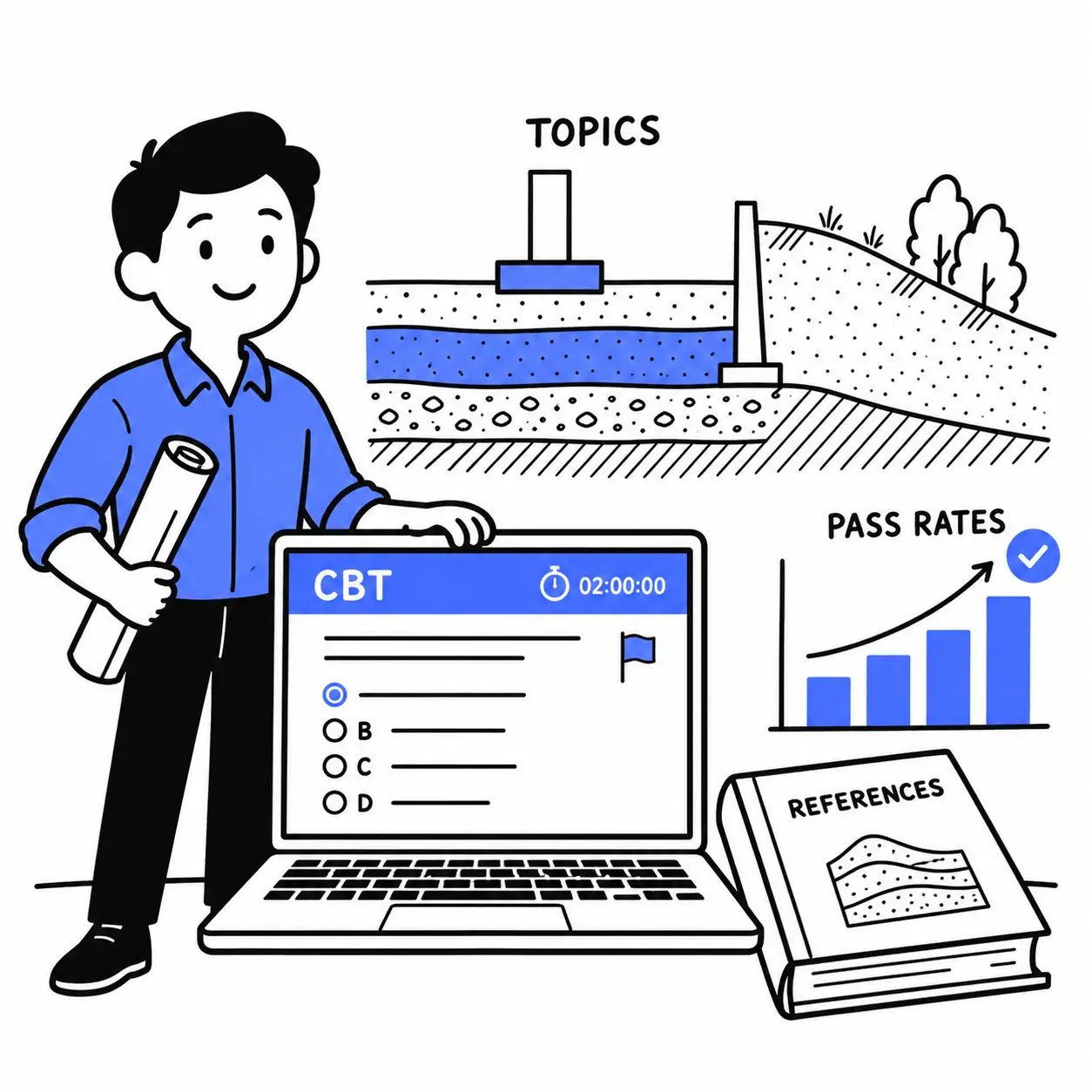
PE Civil Geotechnical Exam Guide Format, Topics, References & Pass Rates
Everything on the PE Geotechnical exam — the 10 NCEES knowledge areas with question counts, CBT format, bundled references, pass rates, and how to study.
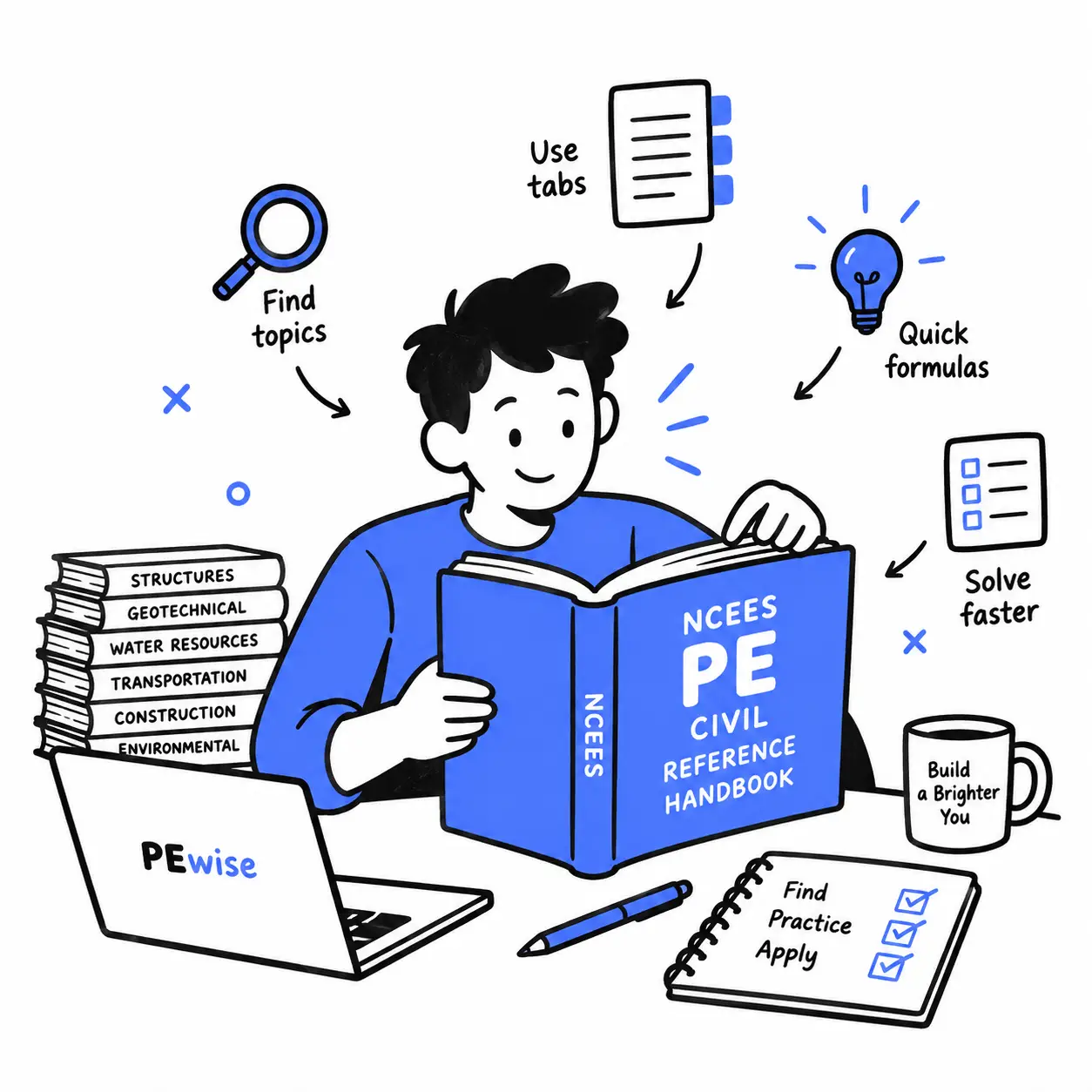
How to Use the NCEES PE Civil Reference Handbook: Search Tips, Study Method, and Traps
The NCEES PE reference handbook is only 75 pages of bare formulas. Learn what's missing, what you need to know cold, and how to navigate it under time pressure.
PE Exam Anxiety: How to Manage Stress Before and During the PE Civil Exam
PE exam anxiety is manageable when you reduce avoidable uncertainty and rehearse the decisions you will need under pressure. Use this PE-specific plan for study, sleep, pacing, blank-mind recovery, the scheduled break, retakes, and accommodations.